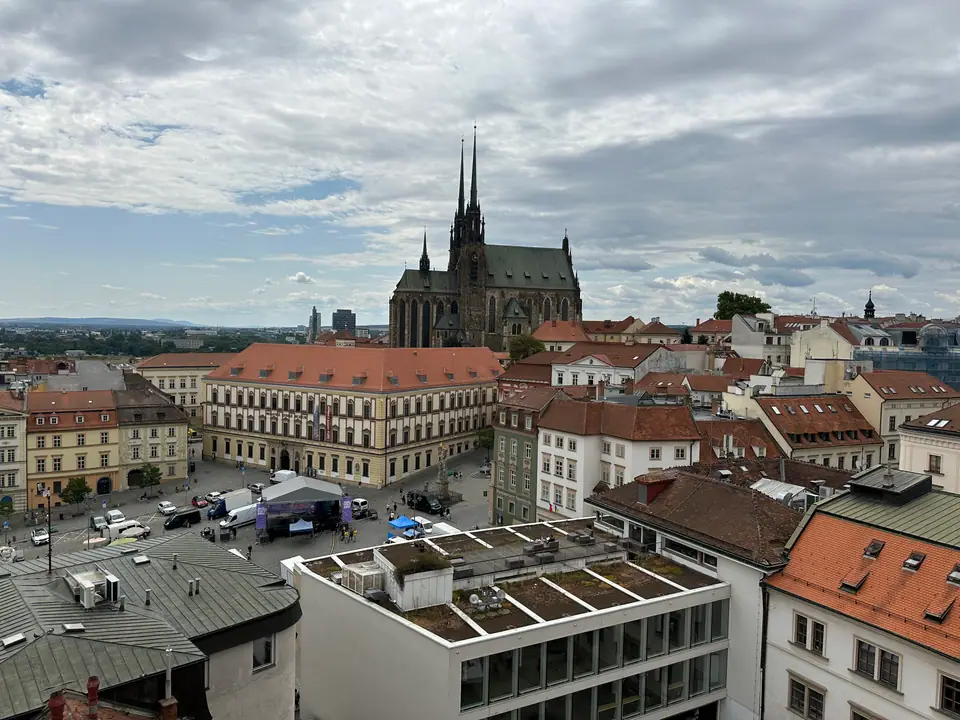
Photo: Punteador · CC BY-SA 4.0
From Špilberk Bastions to Subterranean Brick Vaults
How to sequence Brno’s walkable old core, the newly opened Žlutý kopec water tanks, First Republic villas, Reservoir boats, and Brnopas rules.
Brno rewards curiosity downward and outward as much as uphill. Within a single kilometre of pedestrian lanes sit twin hilltop landmarks, silent underground bone vaults, monumental brick water cathedrals, and interwar glass pavilions. Spacing visits into morning hillside climbs and afternoon cellar or tram hops prevents museum fatigue across two or three days.
The Walkable Oval Between Petrov and Freedom Square
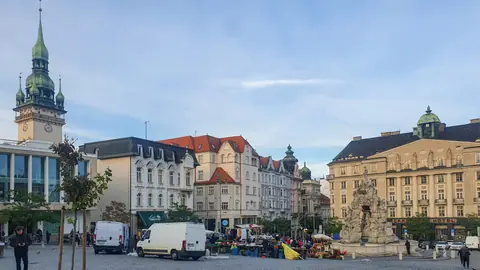
Begin inside the former bastion ring where medieval streets keep distances short and mostly level. Mornings start naturally around triangular Náměstí Svobody and Stará radnice. Watch the black granite timepiece drop its marble at 11 in the morning, then walk south to inspect Anton Pilgram’s crooked Gothic portal and the hanging Brno Dragon. Drop downward onto terraced Zelný trh (Cabbage Market) to watch growers stack produce around the 1690s Parnas Fountain before climbing stone steps onto Denisovy sady.
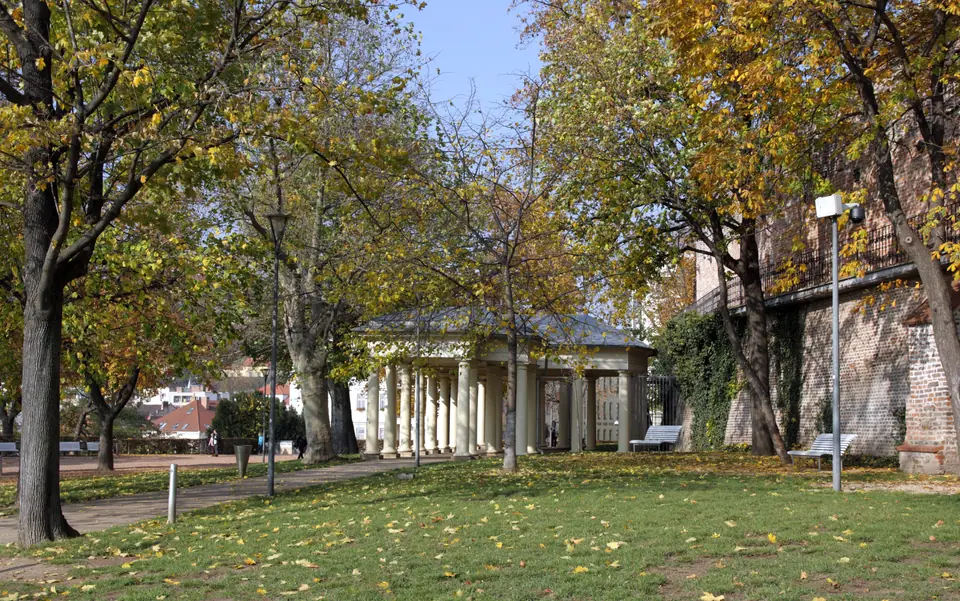
From those shaded rampart colonnades, paved paths climb gently into Petrov Cathedral and Špilberk Castle across the valley notch. Morning light shows off red-tiled roofs across Staré Brno cleanly before midday visitors arrive. When clouds roll across Moravia, duck indoors around Jakubské náměstí and Kapucínské náměstí for St James’s Ossuary and the Capuchin Crypt. Both solemn underground memorials stay sheltered from summer glare and autumn showers alike.
Subterranean Brick Cathedrals on Žlutý Kopec
Brno’s standout recent opening hides quietly under grassy parkland just west of the centre on Žlutý kopec (Yellow Hill). Opened permanently in March 2024 after meticulous restoration, the Vodojemy Žlutý kopec (Yellow Hill Water Reservoirs) reveal three cavernous subterranean water tanks built in 1874, 1894, and 1917. Walking down timber stairs into the 1874 brick basin feels closer to entering a Roman cistern than a nineteenth-century municipal utility. That chamber spans 45 by 45 metres beneath 6.5-metre barrel vaults.
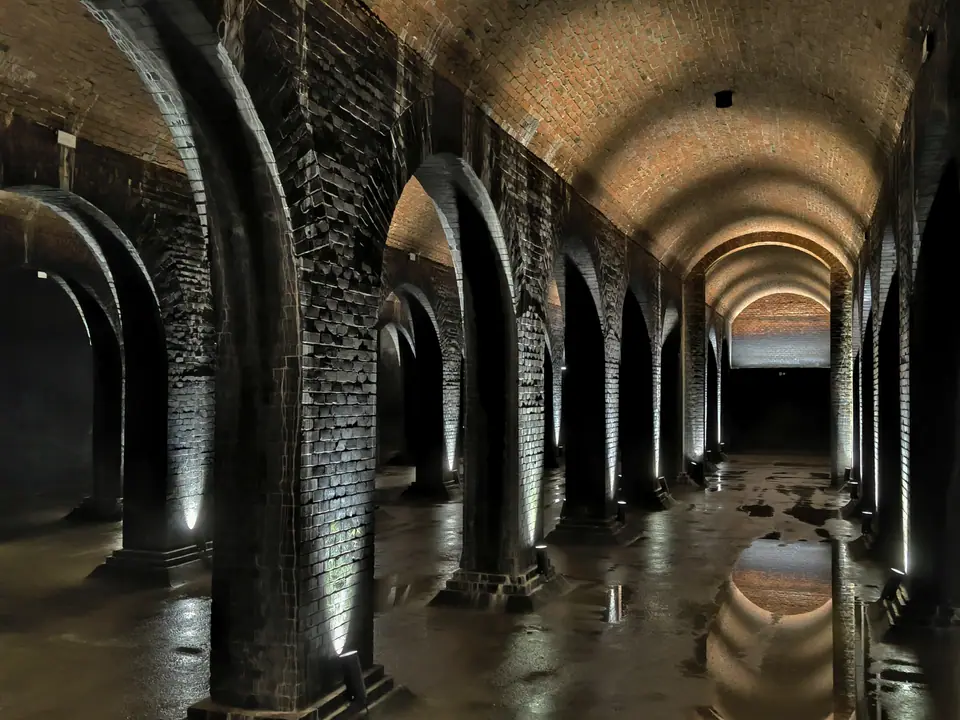
Each tank showcases a distinct engineering phase without cramped crawlspaces or damp darkness. Warm floor spotlights illuminate sweeping rows of raw brick arches across the 1874 and 1894 halls. Next door stand the twin monolithic concrete chambers of 1917, held aloft by a silent forest of 87 slender columns. Acoustic echoes carry clearly beneath those vaults, turning an industrial waterworks into a haunting architectural walk. No hard hats or muddy boots are needed, though grippy flat soles help on slightly damp stone floors.
Modernist Villas Beyond Villa Tugendhat
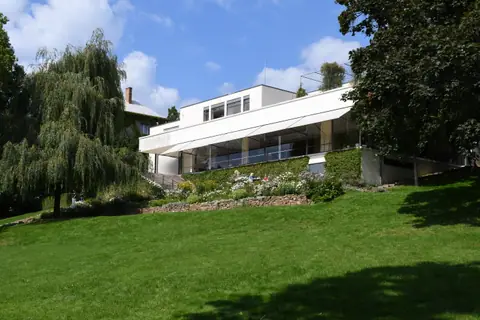
Architecture enthusiasts who miss reservations inside Villa Tugendhat still find rich First Republic heritage across residential ridges. Step downhill through a shared garden gate into Art Nouveau Villa Löw-Beer on Drobného street, built in 1904 for Greta Tugendhat’s parents. Calm museum rooms inside trace Brno’s interwar textile families and design shifts. Nearby in Černá Pole sits restored Café Era by Josef Kranz, where visitors drink espresso inside primary-coloured Bauhaus geometry without waitlists.
West in Pisárky, tram lines reach Ernst Wiesner’s luminous 1927 to 1929 Villa Stiassni, set inside quiet lawns where visiting state guests once stayed. Downtown, Bohuslav Fuchs’s 1926 Zemanova kavárna pavilion stands reconstructed amid Koliště park trees. Meanwhile, the Moravian Gallery’s Pražák Palace and Museum of Applied Arts curate fine Czech modernism indoors, offering an easy rainy-day swap within walking range of central hotels.
Cruising Brno Reservoir Out to Veveří Castle
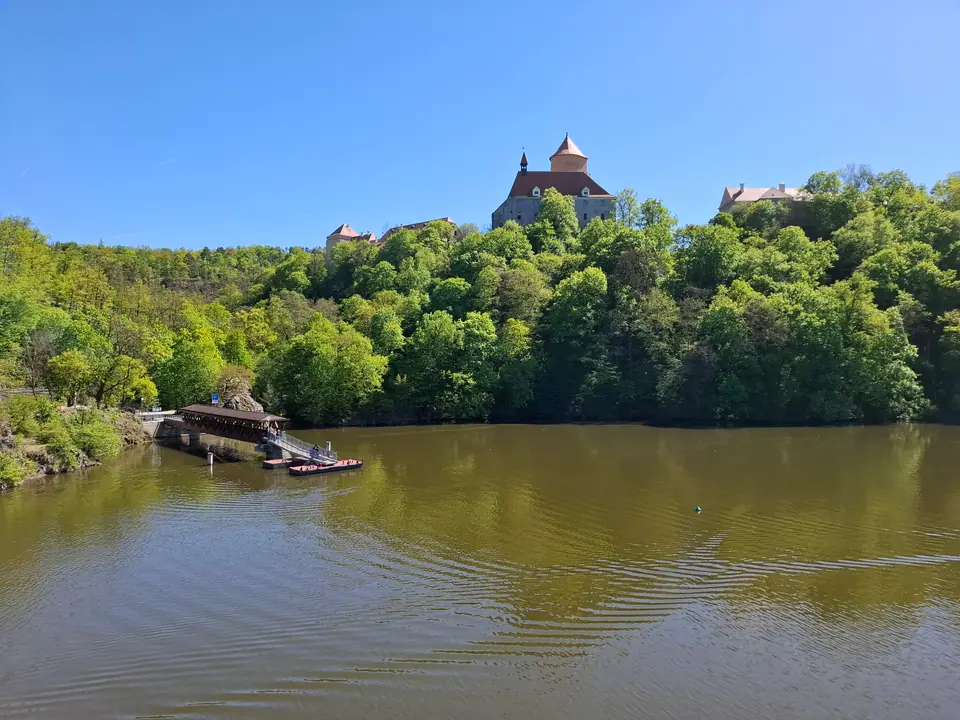
When sunny afternoons invite fresh air outside stone streets, board Tram 1 or 3 northwest to Bystrc pier at Brněnská přehrada (Brno Reservoir). Electric excursion steamboats operate seasonally from April through October along forested valley slopes where locals swim, paddle, and hike pine trails. Quiet bay inlets shelter rowers and lakeside pubs away from urban tram bells. Staying aboard to the upper dock lands walkers beneath the stone walls of medieval Veveří Castle, perched dramatically on a rocky spur above the Svratka valley. Combined hill trails connect back toward Bystrc stops on foot for energetic walkers.
Concert Halls of a UNESCO Creative City of Music
UNESCO inscribed Brno as a Creative City of Music in 2017 in recognition of Leoš Janáček’s creative decades here. Evening performances fill the sweeping modernist travertine hall of the Janáček Theatre on Koliště ring park. Two blocks south stands the Neo-Baroque Mahen Theatre (opened in 1882), celebrated as one of Europe’s earliest public theatres wired completely for Thomas Edison’s electric bulbs. Off Zelný trh sits Reduta Theatre, where 11-year-old Wolfgang Amadeus Mozart played in December 1767 after fleeing Vienna. Summer evenings extend chamber music outdoors onto Špilberk’s courtyard stages. Checking concert calendars ahead pays off because student crowds fill hall balconies rapidly.
Brnopas Tiers and Practical Sightseeing Traps
Administered by TIC Brno, the 1-day, 2-day, or 3-day Brnopas card simplifies multi-sight itineraries when used thoughtfully. Before purchasing, match your actual museum wishlist against individual ticket costs so the card pays back cleanly. Travellers skipping Špilberk exhibitions or Brno Zoo often spend less paying at each door. Weigh your sightseeing plans carefully against the card rules below:
- Standard Brnopas and Brnopas+: Standard cards cover single entries to Stará radnice tower, St James’s Ossuary, Špilberk Castle circuits, Petrov towers, and Brno Zoo. Upgraded Brnopas+ tiers unlock Žlutý kopec Water Reservoirs or Villa Tugendhat access.
- Transit Exclusion Trap: Brnopas does not cover daily DPMB city trams or buses, so tap contactless Beep & Go bank cards on board instead.
- Three-Day Reservoir Bonus: Only the three-day Brnopas includes a seasonal return steamboat trip on Brno Reservoir between Bystrc and Veveří Castle from April through October.
- Monday and Advance Closures: Municipal galleries such as the Moravian Gallery and Špilberk exhibitions frequently shut on Mondays. Villa Tugendhat interiors demand booking months ahead via tugendhat.eu.
- Cold War Shelter 10-Z: Visitors seeking 1950s atomic-bunker corridors beneath Špilberk can add 10-Z independently, packing a light layer for cool subterranean rooms.
Where it is
- 1Brno
- Vienna International Airport (VIE) · about 121 km from Brno in a straight line
- Directions in Google Maps
Stations and taxi ranks: OpenStreetMap. Airports: OurAirports. Distances are in a straight line.
Traveller tips
Real advice from people who have been to Brno. Every tip is read by our team before it goes live.
No tips yet. Been here? Yours could be the first.
Thank you! Your tip will appear here after a quick review.
More in Brno
Continue exploring Brno with related neighbourhood, food, and planning guides