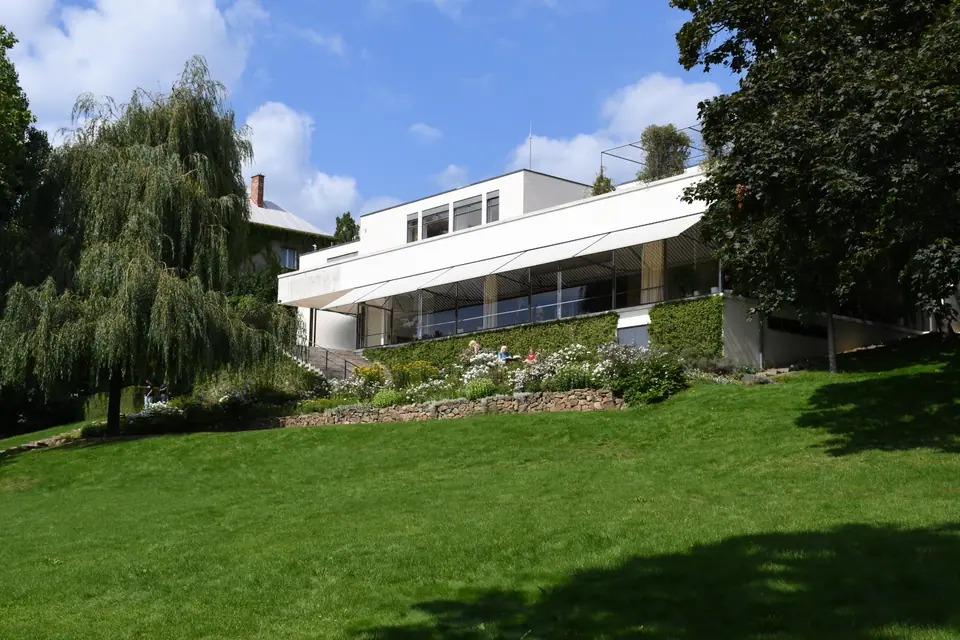
Photo: Ben Skála · CC BY-SA 4.0
Villa Tugendhat: Glass, Honey Onyx and Booking Strategy
Inside Mies van der Rohe and Lilly Reich’s 1930 UNESCO villa in Černá Pole, why tours sell out months ahead, and what to do if interiors are full.
Rising unobtrusively off a quiet villa street in Černá Pole (CHER-nah POH-leh), Villa Tugendhat redefined twentieth-century residential architecture without grand stone columns or gilded cornices. Designed between 1928 and 1930 by German architect Ludwig Mies van der Rohe with interior partner Lilly Reich for textile industrialists Fritz and Greta Tugendhat, this steel-framed hillside house replaced closed rooms with continuous space. In August 1992, Czech Prime Minister Václav Klaus and Slovak Prime Minister Vladimír Mečiar met here to sign the political agreement dividing Czechoslovakia in January 1993. UNESCO inscribed the villa in 2001 (Ref 1052), and every preservation rule since protects fragile 1930 surfaces over casual walk-in volume.
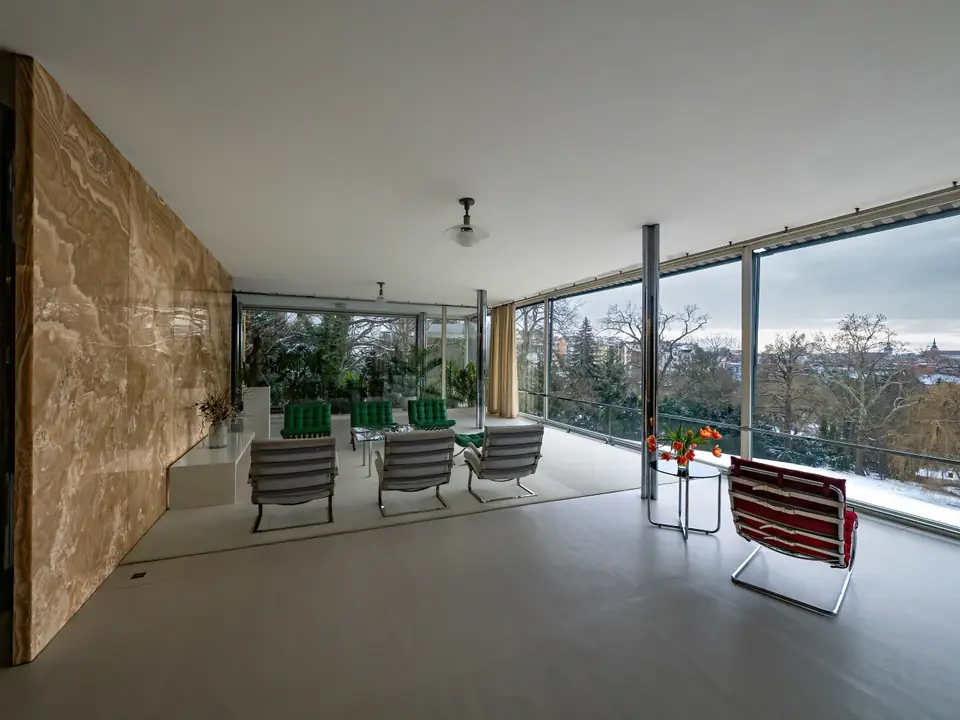
Steel Frame, Retractable Glass and the Moroccan Onyx Wall
From the quiet pavement of Černopolní 45, visitors initially see a restrained single-storey white entrance pavilion hiding two full storeys dropping south down the slope. Once inside, chrome-plated cruciform steel columns carry the structural load instead of solid brick walls. That skeletal grid liberates a vast 230-square-metre living floor flowing effortlessly between study, dining alcove, winter garden, and terrace.
Rather than relying on painted plaster ornament, Mies van der Rohe and Lilly Reich elevated rare natural textures to spatial art. Floor slabs of Italian travertine meet custom white linoleum floors and tubular steel Brno and Tugendhat chairs upholstered in pale and emerald leather. Around the dining table curves a semicircular partition crafted from striped Makassar ebony wood. Across the sitting area stands the house’s famous focal divider: a monolithic slab of translucent honey-gold onyx quarried in Morocco. Late-afternoon sunlight strikes the stone obliquely and makes the whole partition glow warm amber from within. Beside the living room sits a bright planted conservatory terrace buffering winter chill behind dual glass walls. Facing south, giant steel-framed plate-glass windows frame Brno’s spires below. Two monumental panes even sink smoothly down into basement pockets via electric winches, uniting salon and garden cleanly.
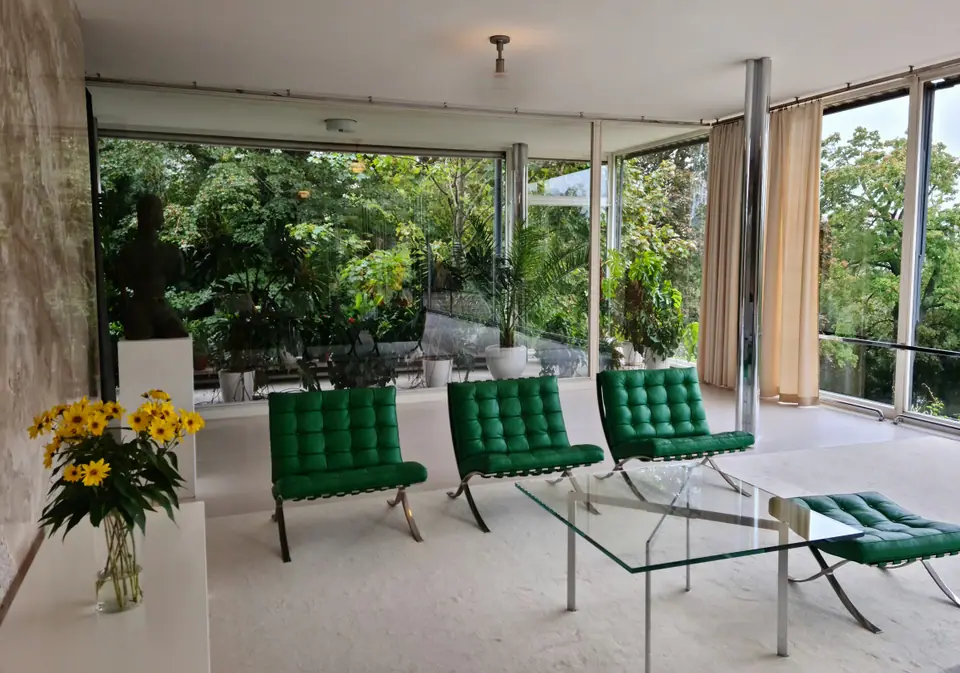
By transferring weight onto slender chrome steel pillars, Mies van der Rohe freed the living room into an unbroken horizon of travertine, onyx, and glass.
After surviving wartime seizure and decades as a children’s physiotherapy clinic, the villa became a Brno City Museum monument in 1994. It reopened in March 2012 following an exhaustive two-year restoration from 2010 to 2012. Restorers painstakingly matched original lime renders, walnut doors, and custom metal fittings to 1930 specifications. Curators divide entry strictly into three guided formats. The 60-minute Basic Tour covers the main second-floor living room, third-floor family bedrooms, kitchen wing, and terrace garden. Architectural specialists strongly favour the 90-minute Extended Tour, which adds the technical basement floor revealing original air washers, boiler halls, mothproof fur storage, and the electric window-lowering winches. A shorter 40-minute exterior circuit ("The Villa from the Outside") interprets structural siting across the garden without entering interior rooms.
Booking Months Ahead and What Happens When Slots Sell Out
Strict conservation caps tiny guided groups to prevent humidity, scuffing, and congestion across original linoleum and wood veneers. Consequently, interior Basic and Extended Tour tickets on the official portal (tugendhat.eu, routed via Brno iD) routinely sell out weeks or several months ahead. Summer dates between May and September vanish fastest across the calendar. Never turn up at the gate expecting walk-in interior admission. Aim for weekday morning bookings if planning winter or spring visits, when group demand eases slightly.
Several legitimate back-up routes help when primary dates look empty. Check the official Ticket Resale section inside Brno iD ("My Museum Products"), where travellers who cancel release verified slots right up to the day before. Alternatively, an upgraded BRNOPAS+ tier with Villa Tugendhat included occasionally unlocks reserved inventory via TIC Brno, though timing still demands early coordination. If interior rooms stay completely full, buy a garden-only admission ticket directly. You can walk along the cantilevered terrace, sloping lawns, and winter garden glazing from outside without entering the main hall. Inside all guided tours, non-commercial handheld photography without flash, tripods, or selfie sticks is permitted once you follow guide rules. Backpacks stay in entrance lockers and protective shoe covers shield floors. Commercial filming requires advance director sign-off.
Getting to Černopolní 45 and Neighbouring Functionalist Houses
Public transit climbs smoothly uphill from Brno hlavní nádraží without taxi hassle. Ride DPMB Tram 7 or Tram 9 north to the Tomanova stop, then walk roughly 400 metres downhill along Tomanova street straight to the entrance gate. Alternatively, board Bus 67 to Schodová and follow the 500-metre hillside approach climbing roughly 100 metres of steps through residential gardens. Plan an early departure from central Brno-střed hotels so you pass ticket checks and reach lockers comfortably before your guided group locks its door. Guided groups leave promptly on schedule, and late arrivals forfeit entry without refunds.
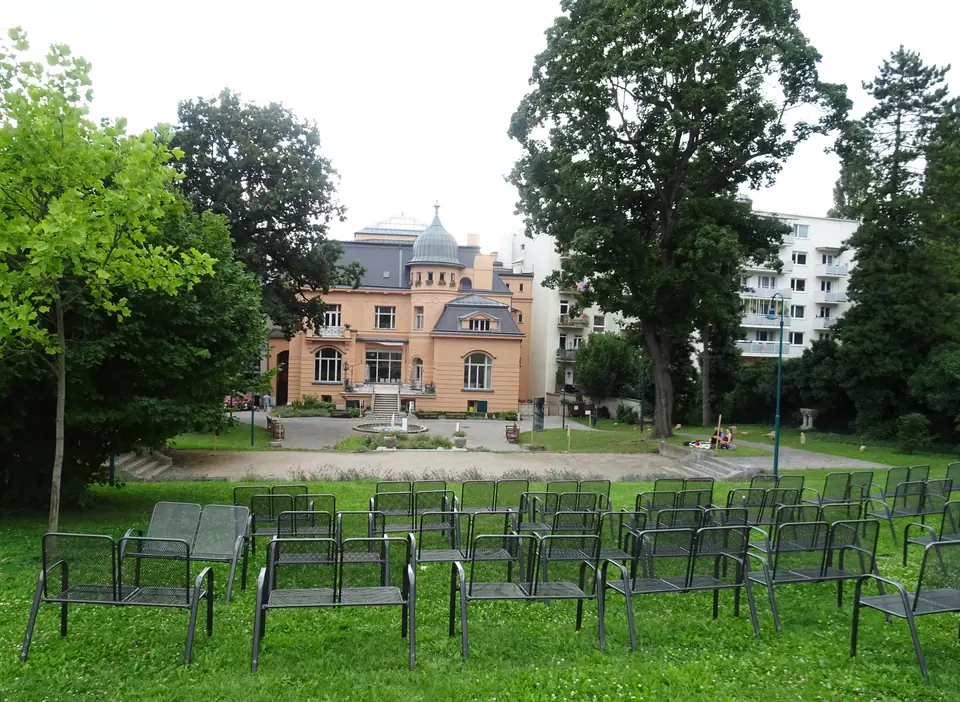
Leave room in your afternoon schedule once the tour finishes. A five-minute path drops straight from Villa Tugendhat’s lower lawn into Villa Löw-Beer on Drobného 22. Greta Tugendhat spent her childhood inside that ornate 1903 to 1904 Art Nouveau villa before her father gifted the upper orchard plot for her modern home. Stepping between those two houses inside minutes dramatizes Brno’s leap from imperial stucco to radical glass clarity. Timber staircases and decorative garden halls inside Villa Löw-Beer frame the Tugendhat family story clearly. Pair both visits with coffee inside Josef Kranz’s functionalist Café Era on Zemědělská street nearby. Architecture buffs can also ride west toward Pisárky for Ernst Wiesner’s 1929 Villa Stiassni before returning downtown toward Špilberk and Petrov.
Where it is
- 1Villa Tugendhat
- Vienna International Airport (VIE) · about 122 km from here in a straight line
- Directions in Google Maps
Stations and taxi ranks: OpenStreetMap. Airports: OurAirports. Distances are in a straight line.
Traveller tips
Real advice from people who have been to Brno. Every tip is read by our team before it goes live.
No tips yet. Been here? Yours could be the first.
Thank you! Your tip will appear here after a quick review.
More in Brno
Continue exploring Brno with related neighbourhood, food, and planning guides