Photo: CEphoto, Uwe Aranas · CC BY-SA 3.0
Rubble, Archaeological Reconstruction and the Frauenkirche
From George Bähr’s daring stone bell of 1743 to its collapse in February 1945 and 2005 reconsecration, the Frauenkirche embodies Dresden’s destruction and archaeological rebirth.
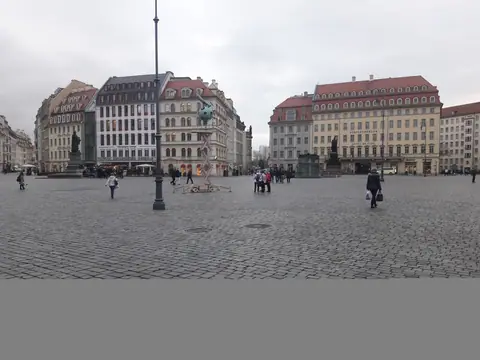
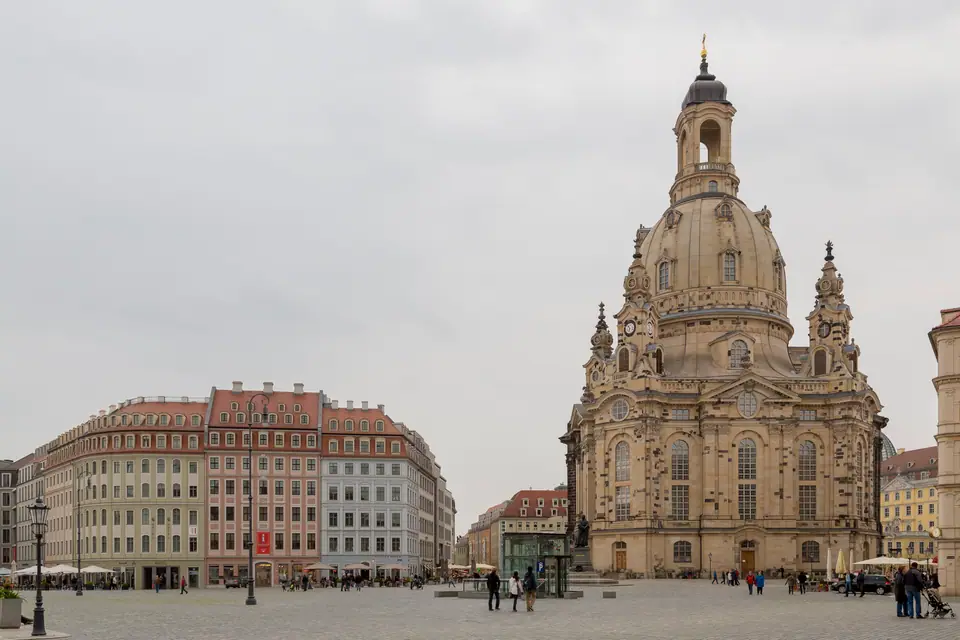
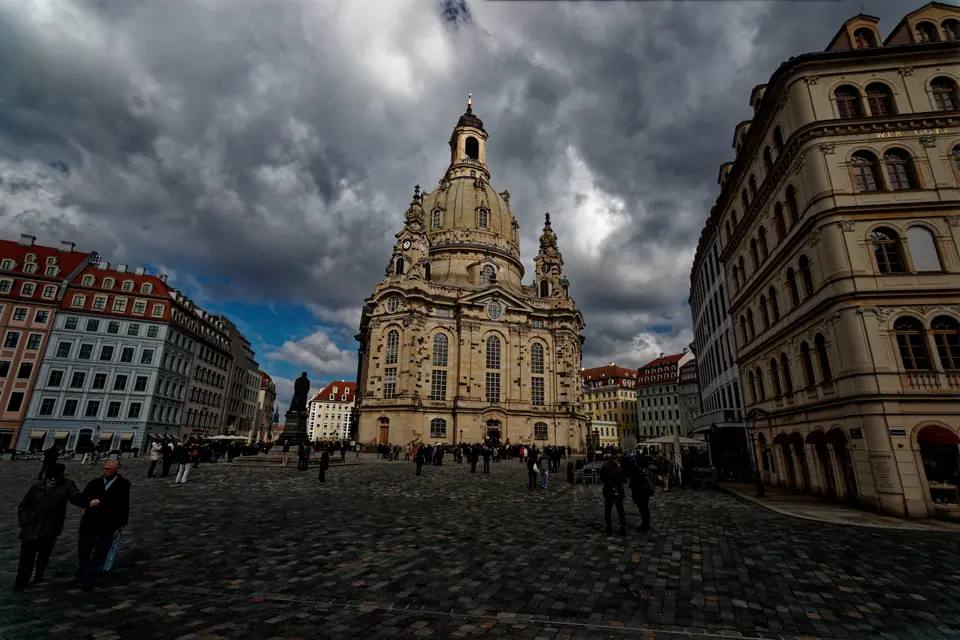
Walk onto Neumarkt square and your eye jumps straight to the mottled patchwork climbing the Frauenkirche facade. Charcoal-blackened 18th-century stone blocks sit wedged beside pale cream sandstone quarried in the 1990s. Every dark block reads like an exposed scar inside a sanctuary built twice from Pirna stone and once erased. Few European landmarks gather baroque engineering daring, wartime trauma, Cold War stillness, and patient civic archaeology under one dome. Reading those contrasting stones turns a quick square crossing into the emotional anchor of visiting Dresden.
George Bähr's Stone Bell Over the Neumarkt
George Bähr designed an audacious Lutheran preaching hall here. When councillors hired the master carpenter in 1726 to replace an ageing parish church, Protestant worship called for open balconies and crisp acoustics. Working until his death prior to consecration in 1743, Bähr raised a soaring central octagon topped by a self-supporting masonry dome dubbed the Stone Bell (Steinerne Glocke). Towering 91.23 metres to the cross across a 50.02-metre by 41.95-metre plan, the church holds roughly 60,000 tonnes of stone. Around 13,000 tonnes of cupola and lantern rest squarely upon eight slender inner stone piers rather than thick outer walls.
Silbermann's Organ and Bach's Recital
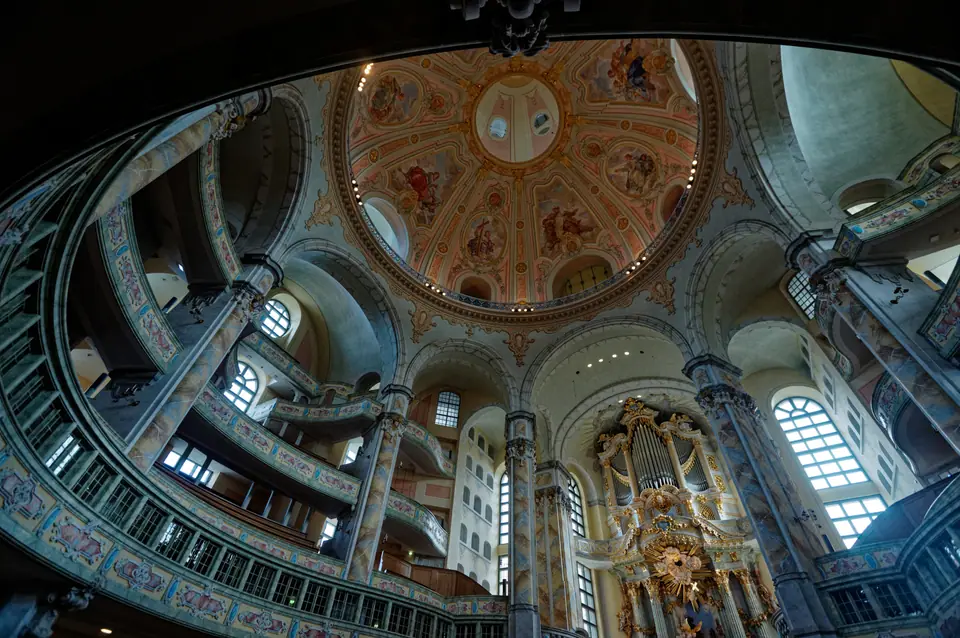
Inside, curved timber galleries swept skyward toward bright ceiling murals in soft baroque blues and golds. Gently sloped stone spiral ramps (Treppentürme) inside the outer corners emptied crowded tiers straight onto Neumarkt without tight stairwell queues. Organ builder Gottfried Silbermann completed a celebrated 43-stop pipe organ here in 1736. Johann Sebastian Bach played an acclaimed afternoon recital on that console on 1 December the same year. For two centuries that proud stone dome anchored Bernardo Bellotto's painted river views beside Augustus the Strong's Residenzschloss.
Three Raids in February 1945 and the Pier Collapse
Everything fractured across roughly 48 hours between 13 and 15 February 1945. Late in the Second World War, Allied bombers targeted rail corridors, troop barracks, and urban infrastructure behind retreating German forces. Across two night waves on 13 to 14 February, 773 RAF Lancasters dropped roughly 2,659 tonnes of high-explosive and incendiary ordnance. Daylight American B-17 raids followed with 316 aircraft on 14 February and 211 bombers on 15 February. Firestorms burned over 6.5 square kilometres of central Dresden and destroyed roughly 78,000 dwellings. In 2010, Dresden's independent Historians' Commission documented between 22,700 and 25,000 deaths across the raids, replacing inflated propaganda figures.
How Fire Brought the Dome Down
Bähr's stone cupola actually withstood the direct air blasts, sheltering roughly 300 civilians inside the vaulted crypt beneath. Fierce fires nonetheless roared through wooden gallery tiers inside the nave like a blast furnace. Heat pushed the eight load-bearing sandstone piers well past tolerance. Shortly past mid-morning on 15 February 1945, after survivors had evacuated the crypt, those piers failed cleanly. The entire Stone Bell crashed straight down into a thirteen-metre mound of shattered ashlar.
Four Decades as a Candlelit Anti-War Rubble Mound
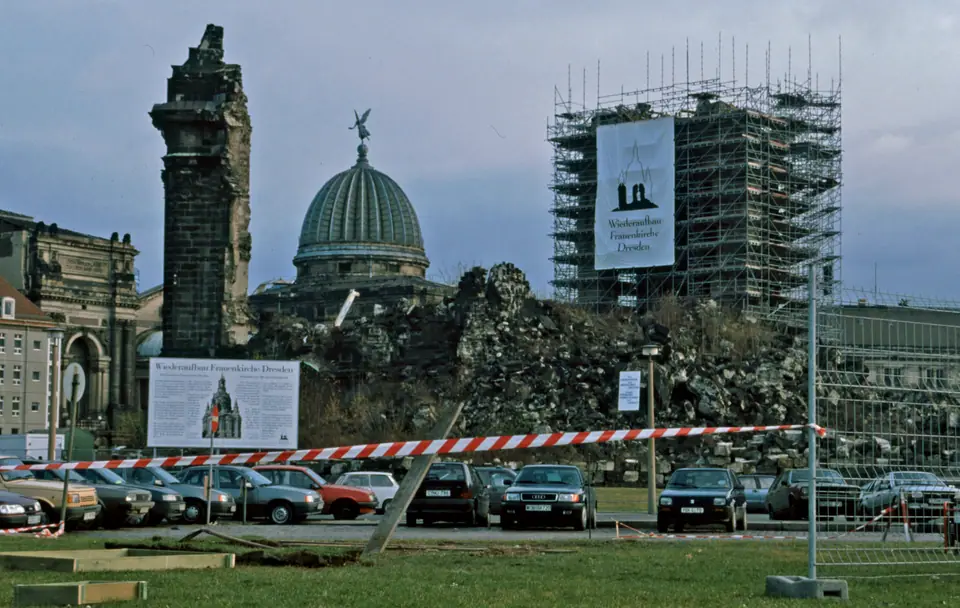
East German crews cleared surrounding Neumarkt streets flat while leaving the Frauenkirche mound untouched. Across more than four decades of socialist rule, wild roses and weeds grew across the tangled stones. State officials designated the jagged altar wall remnant and stone pile an anti-war peace memorial (Mahnmal gegen den Krieg) in 1966. Starting on 13 February 1982, young citizens and churchgoers gathered quietly every winter beside the ruins holding lit candles during peace vigils. Crushed sandstone became civic protest long before the Berlin Wall opened.
Ruf aus Dresden and Archaeological Sorting by Computer
Urgent civic appeals launched reconstruction soon after the border fell. As peaceful reunification gained pace, city voices broadcast the Ruf aus Dresden ("Call from Dresden") on 12 to 13 February 1990. Their message appealed worldwide for funds and skill to raise Bähr's sanctuary faithfully from its ruins. City councillors approved rebuilding in February 1992. Workers began archaeologically sorting the thirteen-metre rubble mound stone by stone in January 1993. Engineers laser-measured every salvaged fragment, catalogued chisel marks, and checked computer models against 1930s architectural photogrammetry.
Donor Certificates and Global Reconciliation
After a fresh foundation stone went down in 1994 and the crypt reopened in 1996, masons laid pure load-bearing stonework without hidden steel frames. Carefully engineered bronze and steel tie rods reinforced historic stone paths discreetly where load geometry demanded stability. Donor-certificate appeals and worldwide gifts backed public funding, including generous backing from Britain's Dresden Trust and House of Windsor. In June 2004, cranes lifted a gilded dome orb and cross forged by London silversmith Alan Smith, whose father had flown in the 1945 raids. Reconsecration followed on 30 October 2005.
Dark Weathered Blocks Fitted Into Fresh Quarry Stone
Roughly 45 percent of today's rebuilt church consists of surviving historic fabric. Conservators documented and matched 8,425 salvaged sandstone blocks back into exact structural coordinates. Across exterior elevations, 7,110 soot-blackened 18th-century blocks appear visibly fitted into fresh golden sandstone quarried near Pirna. That deliberate colour contrast forms the walls' unmistakable speckled mosaic. Inside, roughly 80 percent of the baroque high altar weaves together 1,642 carved fragments recovered from the 1945 rubble.
Inside the Reconsecrated Sanctuary and Lantern Climb
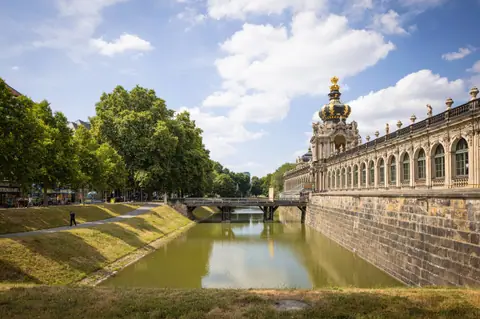
Stepping inside today rewards unhurried quiet. The bright octagonal nave reveals warm ivory stucco, pastel ceiling scenes, and a 4,873-pipe organ built by Daniel Kern in 2005. Sit briefly in pale pews gazing straight upward toward bright dome openings above the gilded altar. Notice glass showcases beneath lower arcades holding melted bronze bells and twisted iron anchors before stepping outside onto spiral ramps inside the outer wall. Reaching the 67.06-metre observation deck inside the lantern opens clear vistas across Brühl's Terrace, Zwinger's lawns, and distant Saxon Switzerland peaks. Check parish schedules beforehand, since active worship pauses tourist entry.
Where it is
- 1Rubble, Archaeological Reconstruction and the Frauenkirche
- Dresden Airport (DRS) · about 9 km from here in a straight line
- Berlin Brandenburg Airport (BER) · about 147 km from here in a straight line
- Directions in Google Maps
Stations and taxi ranks: OpenStreetMap. Airports: OurAirports. Distances are in a straight line.
Traveller tips
Real advice from people who have been to Dresden. Every tip is read by our team before it goes live.
No tips yet. Been here? Yours could be the first.
Thank you! Your tip will appear here after a quick review.
More in Dresden
Continue exploring Dresden with related neighbourhood, food, and planning guides