Photo: Txllxt TxllxT · CC BY-SA 4.0
Dresden Across the Elbe: Sandstone, Ruin and Rebirth
Dresden divides cleanly across the River Elbe between the rebuilt royal sandstone core of Innere Altstadt and the surviving Gründerzeit streets of Neustadt.
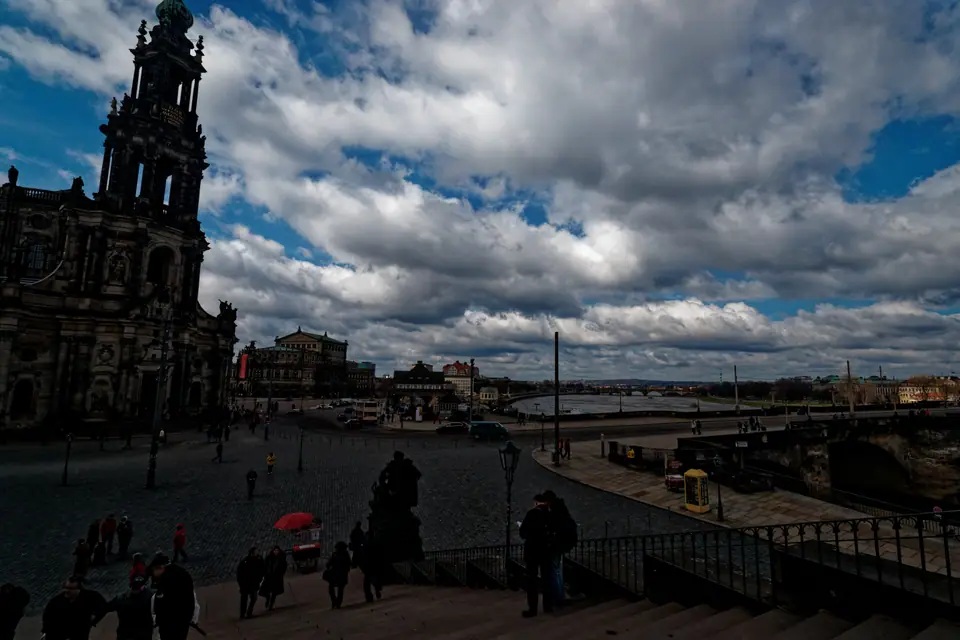
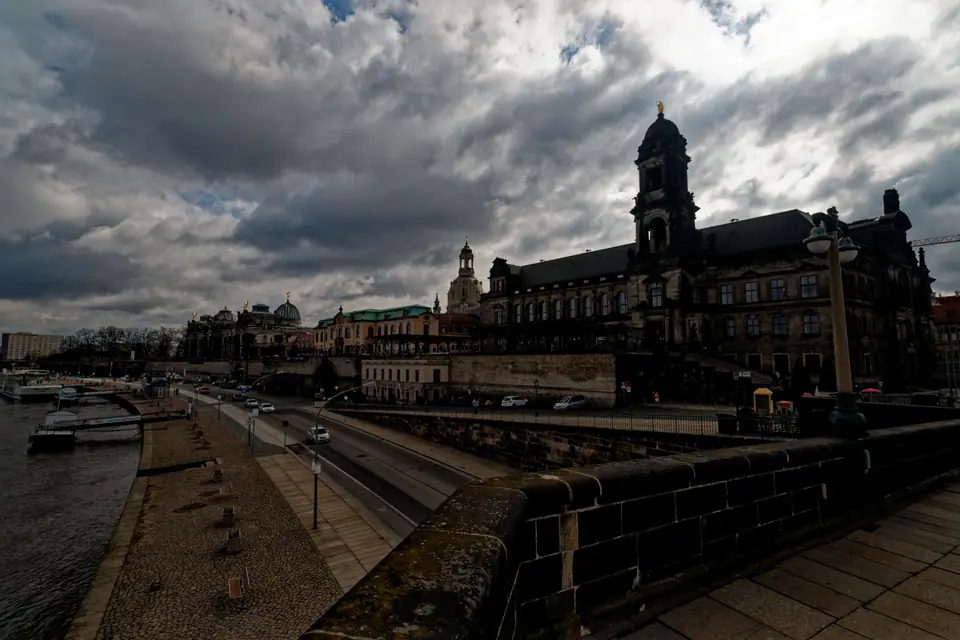
Stand on the grassy right bank of the River Elbe opposite the court church spires. Dresden splits cleanly into two contrasting cities built face to face. On the southern left bank, the pale and blackened sandstone domes of Innere Altstadt echo the 18th-century paintings of Bernardo Bellotto. Venetian-born Bellotto worked as court painter here and earned the local nickname Canaletto. Turn around on the northern right bank and the urban fabric shifts abruptly. Neoclassical avenues give way to dense late-19th-century tenement blocks packed with record shops, small bakeries, and late beer gardens. Most visitors walk across Augustusbrücke once and assume they know Dresden. Understanding the city takes crossing repeatedly between ceremonial reconstruction and lived-in survival.
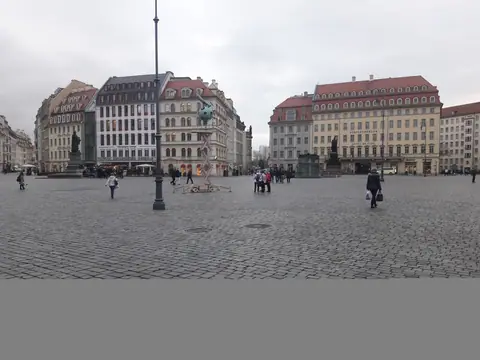
Documented since 1206 and anchored by a stone river crossing by 1220, the Saxon capital sits 113 metres above sea level. Municipal boundaries cover roughly 328 square kilometres. That broad footprint makes Dresden Germany's fourth-largest city by land area, housing around 571,510 inhabitants. Under Augustus II the Strong, Elector of Saxony from 1694 and King of Poland from 1697, court architects turned this Elbe bend into a showcase of sandstone palaces and porcelain rooms. Allied air raids from 13 to 15 February 1945 shattered that inner core. Following East German district rule from 1952 to 1990 and German reunification in 1990, Dresden regained its status as capital of Saxony. Civic rebuilding around Neumarkt accelerated after 2000, while everyday neighbourhood life stayed rooted north of the water. Crossing between bankscapes takes less than ten minutes on foot over Augustusbrücke or one swift tram hop across Albertbrücke.
Left Bank Ceremonial Core Versus Right Bank Streets
South of the river, Innere Altstadt packs royal landmarks onto flat cobbles. Within postcode 01067, major monuments sit less than ten minutes apart on level paving. Begin along Brühl's Terrace, a 500-metre elevated bastion above Terrassenufer nicknamed the Balcony of Europe. Steps inland rise the Frauenkirche, the Residenzschloss royal complex, the Semperoper opera house, and the Zwinger courtyards. South of Neumarkt opens medieval Altmarkt, while post-war Prager Straße forms the main shopping spine toward Hauptbahnhof. Even on crisp winter afternoons, sunlit sandstone across Terrassenufer glows warmly over moored Elbe steamers. Because old alleys burned in 1945 and returned largely as museums, upscale flats, and hotels after 2000, Altstadt empties quickly once tour coaches leave before dinner. Give yourself slow mornings to wander both riverbanks cleanly.
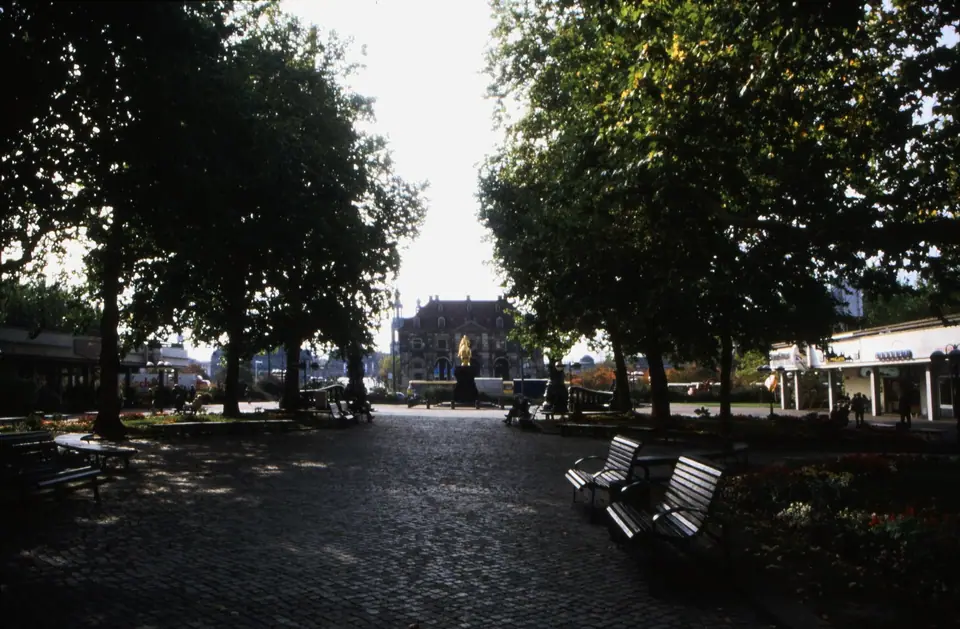
Cross Augustusbrücke into Innere Neustadt (postcode 01097) and street energy slows before climbing further north. Directly past the bridge gleams the gilded 1736 Golden Rider statue of Augustus the Strong, pointing up tree-lined Hauptstraße toward Dreikönigskirche. Quiet baroque townhouses along nearby Königstraße escaped severe wartime bombing, preserving original 18th-century stonework rare south of the river. Keep walking north past Albertplatz tram hub into Äußere Neustadt (postcode 01099). Gridded blocks along Alaunstraße, Louisenstraße, and Görlitzer Straße survived February 1945 standing intact. Ground-floor craft studios, Spätkauf corner grocers, and painted passages stay lively with students, families, and musicians well past nightfall. Further east upriver, the blue steel Blaues Wunder truss links villa quarters between Blasewitz and Loschwitz hills.
That river split guides most planning on a three-day or four-day break. Sightseers wanting quiet dawn walks under floodlit domes choose Innere Altstadt hotels, accepting busier daytime tour groups and formal restaurant menus. Travellers preferring independent coffee roasters, Saxon craft-beer rooms, and late kitchens book Neustadt quarters and ride trams across the water in minutes. Neither bank captures Dresden on its own. Together they show a city that rebuilt its formal front parlour while keeping everyday life alive north of the bridge.
Bridges, Flood Memory and Crossing the Valley
River engineering remains a live debate in Dresden rather than settled history. Listed by UNESCO in 2004, the Dresden Elbe Valley was delisted in 2009 after work proceeded on the Waldschlösschen Bridge east of town. Dresden became the second World Heritage site ever removed from the register worldwide. Seasonal high water shapes riverbanks just as visibly. Severe floods pushed the Elbe to a record 9.40 metres in August 2002 and climbed again to 8.76 metres in June 2013 behind reinforced floodwalls. Broad grassy Elbwiesen meadows remain unbuilt right through town to carry seasonal floods safely downstream.
Crossing central Dresden changed after Deck C of the Carolabrücke collapsed into the Elbe on 11 September 2024. Engineers finished demolishing Decks A and B in September 2025, and city councillors picked replacement design CAROLA 3.0 in September 2026 toward construction from 2028 to 2031. Cross-river trams stay routed across Augustusbrücke and Albertbrücke, so trust live DVB departure screens rather than older hotel paper maps.
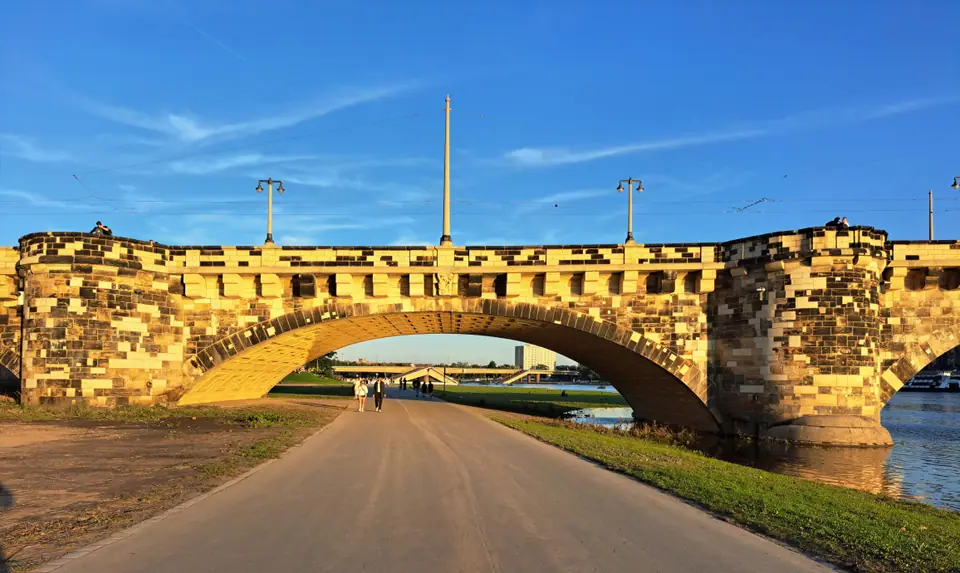
Even with one bridge gap below Pirnaischer Platz, riverfront paths and Elbe boat excursions operate reliably. Below Brühl's Terrace at Terrassenufer, Sächsische Dampfschifffahrt (founded in 1836) docks nine historic paddle steamers built between 1879 and 1929. Together they form the oldest and largest paddle-steamer fleet in the world. Steamboats cruise upriver past Loschwitz villas toward Pillnitz and Kurort Rathen, or downriver past Radebeul vineyards toward Meissen. Check landing notices during dry mid-summer weeks when shallow water occasionally trims upstream runs.
Pack tap-enabled bank cards and small euro notes for corner bakeries, tram kiosks, and pub counters across Saxony. Remember Germany's Sunday closing rule, Sonntagsruhe, which closes nearly all supermarkets except rail-station branches inside Hauptbahnhof and Dresden-Neustadt. Non-EU visitors should verify Schengen passport rules (issued under ten years prior and valid three months beyond departure) plus biometric Entry/Exit System checks. From either station, fast rail links connect easily north to Berlin or south through the rocky Elbe canyon to Prague.
Where it is
- 1Dresden
- Dresden Airport (DRS) · about 10 km from Dresden in a straight line
- Berlin Brandenburg Airport (BER) · about 147 km from Dresden in a straight line
- Directions in Google Maps
Stations and taxi ranks: OpenStreetMap. Airports: OurAirports. Distances are in a straight line.
Traveller tips
Real advice from people who have been to Dresden. Every tip is read by our team before it goes live.
No tips yet. Been here? Yours could be the first.
Thank you! Your tip will appear here after a quick review.
More in Dresden
Continue exploring Dresden with related neighbourhood, food, and planning guides