Photo: Albrecht Voß · CC BY-SA 4.0
Meissen Porcelain, Courtyard Pavilions and the Old Masters
Following the 2025 reopening of its restored Baroque courtyard lawns, the Dresden Zwinger pairs Pöppelmann’s sandstone pavilions with Raphael, Vermeer, and the world’s largest porcelain collection.
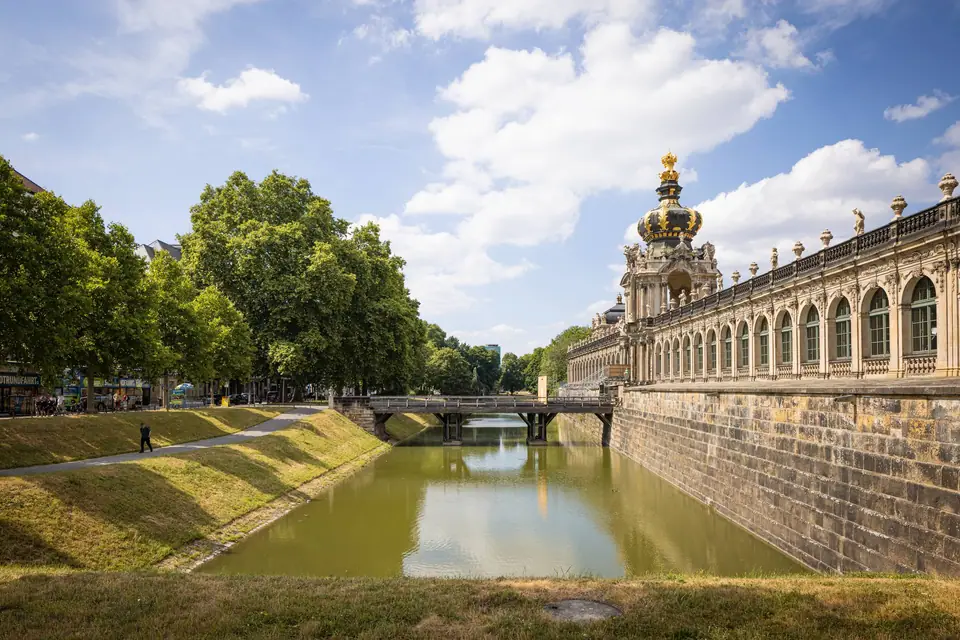
Walk beneath the gilded onion cupola of the Crown Gate (Kronentor) into the Dresden Zwinger. You step directly inside Augustus II the Strong's theatrical pleasure courtyard. Originally built as an orangery, tournament arena, and palace forecourt, curving sandstone pavilions shelter three remarkable state museums today. For years between 2021 and late 2025, archaeological digs and construction fences cut across the open square. Crisp grass parterres, balanced fountains, and carved arcades now stand freshly restored from gate to pavilion. Keep one clear scheduling rule handy before leaving your Neustadt or Altstadt room: all Zwinger museums close on Mondays.
Augustus II's Orange Courtyard and the Reopened Parterres
Royal showmanship turns every sandstone balustrade into carved outdoor stagecraft.
Pöppelmann's Pavilions and 1719 Wedding Pageantry
Pöppelmann shaped an open-air baroque theatre around potted citrus trees. Together with sculptor Balthasar Permoser, he built curving galleries between 1709 and 1728 across an outer castle bastion ("Zwinger" meaning the space between fortress walls). Tall arched windows warmed tender winter orange shrubs while sculpted nymphs, garlands, and roof balustrades wrapped the sandy arena. Glazed arcades inaugurated in 1719 for the marriage of Augustus's son to Archduchess Maria Josepha hosted glittering torchlit carousels. Expansion paused after Augustus II died in 1733, leaving the Elbe flank open for over a century. Heavily damaged during February 1945 bombing raids, conservators opened early halls by 1951 and finished core structural repairs in 1963.
October 2025 Courtyard Reopening
Autumn 2025 ended four and a half years of courtyard fences. Work started back in 2021 beneath the central lawns. Garden historians painstakingly restored historic water basins, symmetrical pale gravel paths, neatly trimmed boxwood borders, and four emerald grass parterres across the open square, reopening completely on 14 October 2025. Crossing the courtyard stays free from dawn until dark, linking Theaterplatz cleanly to Ostra-Allee gates. Shaded stone alcoves flank every wing. Pauses on wooden courtyard chairs break up long gallery visits cleanly before morning tour buses line Theaterplatz.
Inside Gottfried Semper's Gallery and the Old Masters
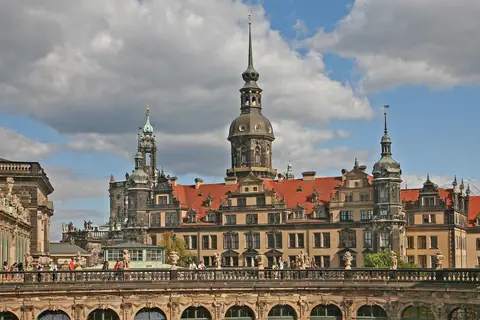
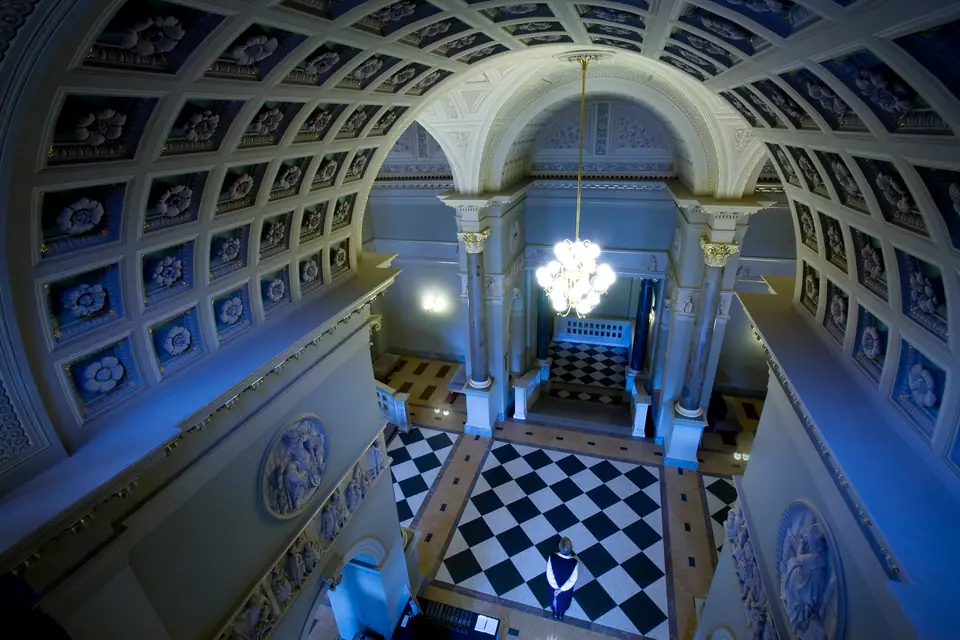
Semper closed the Elbe side with luminous Neo-Renaissance galleries. Built between 1847 and 1855 to house Saxony's royal paintings, the monumental wing balances the baroque pavilions cleanly. Following a seven-year architectural overhaul, the Semperbau reopened completely on 29 February 2020. Wide stone stairs and frescoed halls separate rich crimson Italian picture rooms cleanly from cooler Dutch landscape wings, preventing gallery fatigue. Today sky-lit rooms unite the Old Masters Picture Gallery (Gemäldegalerie Alte Meister) with the Sculpture Collection up to 1800, showing roughly 750 paintings (around 40 percent of holdings) near classical casts. Wartime Soviet evacuation returned most works in 1955 before a 1960 reopening. Even with 206 paintings lost and around 450 to 500 unaccounted for, the surviving collection ranks among Germany's finest.
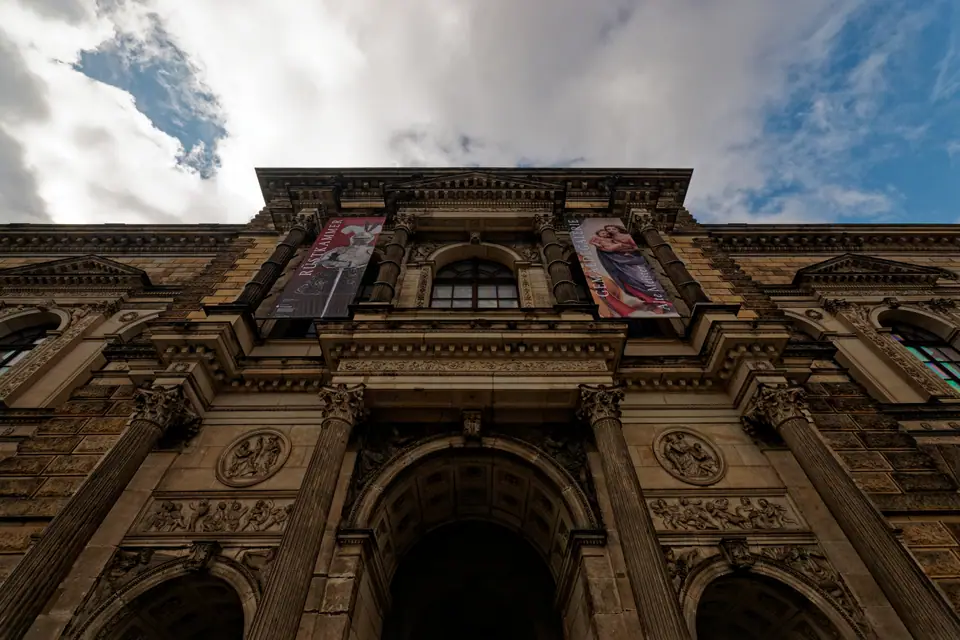
- Raphael's Sistine Madonna (1512 to 1513): Bought by Elector Augustus III in 1754, anchoring deep-red Italian rooms with the serene Virgin and Pope Sixtus. Two famous resting cherubs frame the lower sill.
- Johannes Vermeer's Restored Canvases: Recent conservation on Girl Reading a Letter at an Open Window revealed a previously hidden Cupid painted behind the window reader. It hangs near Vermeer's luminous early scene The Procuress.
- Venetian High Renaissance Masters: Warm glowing oil glazes unite Giorgione's Sleeping Venus with celebrated canvases by Titian, Correggio, and Tintoretto.
- Northern European Panels: Rembrandt's joyful Self-Portrait with Saskia and The Abduction of Ganymede hang beside Rubens, Van Eyck, and crisp Lucas Cranach portraits.
- Bernardo Bellotto's Vedute of Dresden: Exact 1740s and 1750s city views guided engineers rebuilding the Frauenkirche and Neumarkt facades.
Dragoon Vases and Meissen Whiteness in the Porcelain Wing
Royal porcelain mania fills the curving southern Zwinger pavilions cleanly. Founded in 1715 and ranked as the largest porcelain collection in the world, the Porzellansammlung stores roughly 20,000 pieces in total. Around 2,000 ceramics appear on view inside halls occupied since 1962 and enlarged by an East Asian wing in 2006. Pause before towering blue-and-white Chinese "Dragoon Vases" (Dragonervasen), famously traded from King Frederick William I of Prussia in 1717 for 600 Saxon cavalry dragoons. Nearby cases display crisp Ming and Qing bowls plus Japanese Arita and Imari jars against deep muted gallery walls. Across neighbouring rooms shines Europe's earliest hard-paste Meissen porcelain, fired after Johann Friedrich Böttger solved the white kaolin formula in 1708 to 1709, including life-size ceramic animals and comical court figurines. Glass cases stay evenly illuminated throughout grey winter afternoons. Crisp cobalt brushstrokes glow cleanly across delicate tea bowls and tall ceremonial vessels.
Telescopes, Crown Gate Terraces and the Nymph Bath
Astronomical brass and stone waterworks reward stepping beyond the picture halls.
Mathematical-Physical Salon and Water Grotto
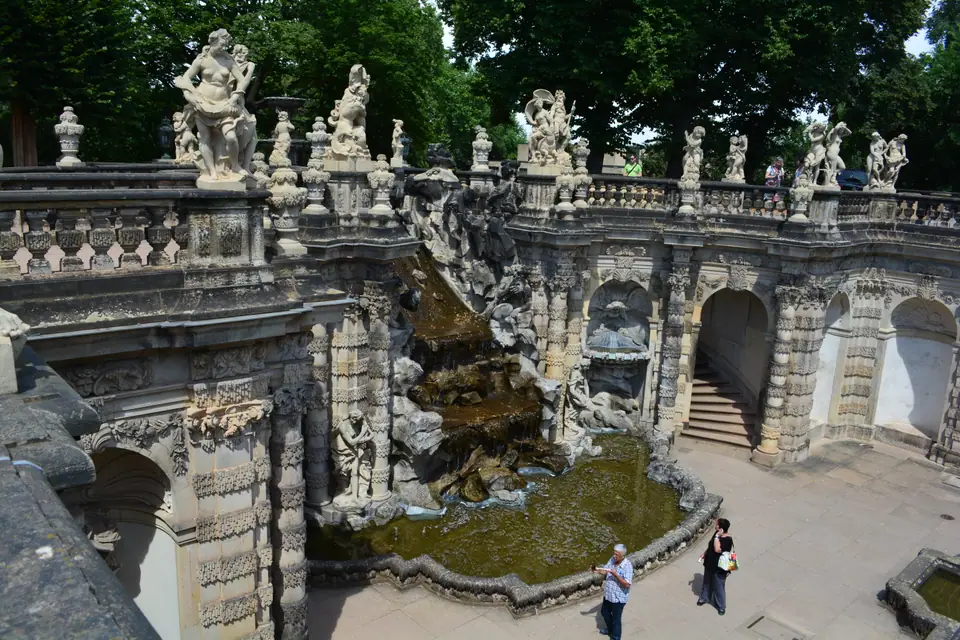
Rare precision clocks and hidden fountains complete any Zwinger afternoon. Step inside the western pavilion to examine 16th-century to 19th-century celestial globes, burning mirrors, optical telescopes, and early calculating instruments made for Saxon electors. Outside behind the French Pavilion on the north-west corner, quiet stone stairs descend into the Nymphenbad (Nymph Bath). Sculpted tritons, cascading stone shells, and splashing jets cool an intimate baroque water grotto tucked inside old fortress walls. Walk upper rampart stairs flanking the Crown Gate for close angles on gilded Saxon-Polish eagles above the dry western moat before crossing toward the Residenzschloss or Brühl's Terrace. Watch late shadows shift across ornate stonework before descending main stairs onto Theaterplatz. Pause unhurriedly inside here to study carved brass sundials, folding calculators, and painted celestial globes.
Where it is
- 1Meissen Porcelain, Courtyard Pavilions and the Old Masters
- Dresden Airport (DRS) · about 9 km from here in a straight line
- Berlin Brandenburg Airport (BER) · about 146 km from here in a straight line
- Directions in Google Maps
Stations and taxi ranks: OpenStreetMap. Airports: OurAirports. Distances are in a straight line.
Traveller tips
Real advice from people who have been to Dresden. Every tip is read by our team before it goes live.
No tips yet. Been here? Yours could be the first.
Thank you! Your tip will appear here after a quick review.
More in Dresden
Continue exploring Dresden with related neighbourhood, food, and planning guides