Photo: Stephan van Helden · CC BY-SA 4.0
Riding the 1907 Wooden Mountain Railway up the Königstuhl
Engineering split between the 1890 modern lower Bergbahn and 1907 wooden upper railway, Molkenkur bottlenecks, and summit walks.
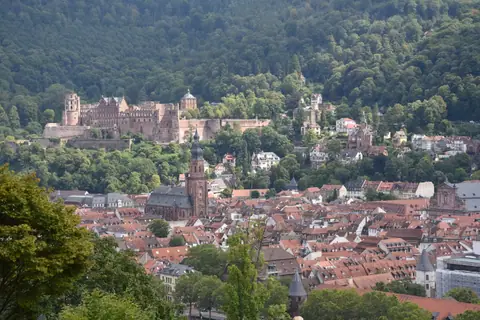
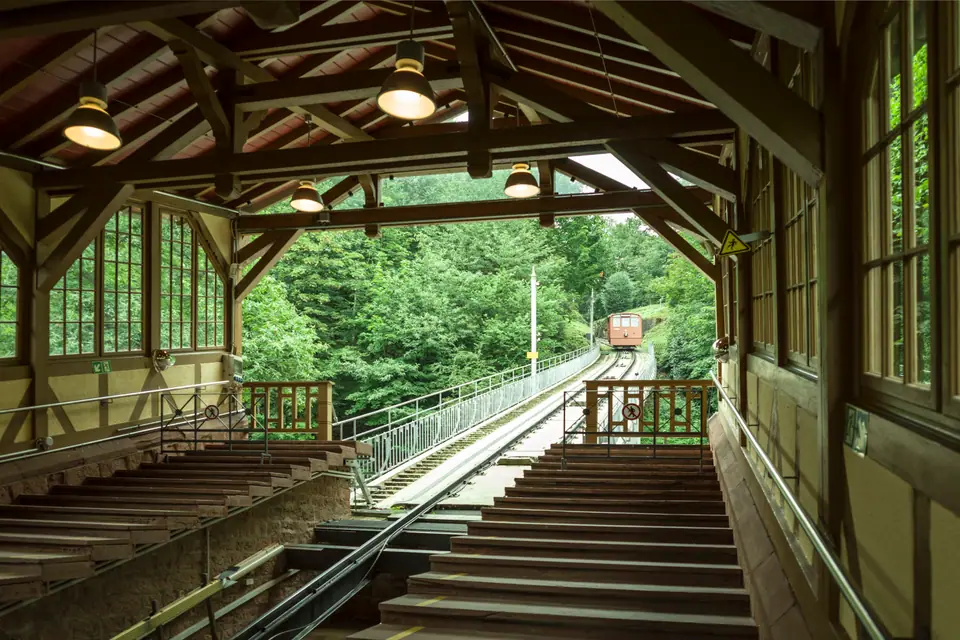
Rising 567.8 metres (usually rounded to 568 metres) above the Neckar valley, wooded Königstuhl (KUR-nikh-shtool, "King's Seat") forms the highest ridge framing Heidelberg. Its shaded crest towers 454 metres above Old Town squares. Riding uphill on the Heidelberger Bergbahn (BAIRK-bahn) turns mountain transit into two distinct chapters of engineering history. Sleek modern glass cars carry riders halfway up before passengers transfer onto Germany's oldest electrically driven cable railway still running wooden carriages from 1907. Shifting cars halfway up marks a clear woodland transition from terraced castle slopes into shaded northern beech trees.
1890 Modern Funicular vs 1907 Wooden Mountain Railway
Operated by municipal transit authority Heidelberger Straßen- und Bergbahn (HSB), the full mountain climb spans 1,491 metres of inclined track across four stations: Kornmarkt, Schloss, Molkenkur (MOL-ken-koor), and Königstuhl. Riding straight through gains 431 vertical metres inside fourteen minutes of rolling travel. Yet its lower and upper sections remain completely distinct in age, gradient, and passenger capacity.
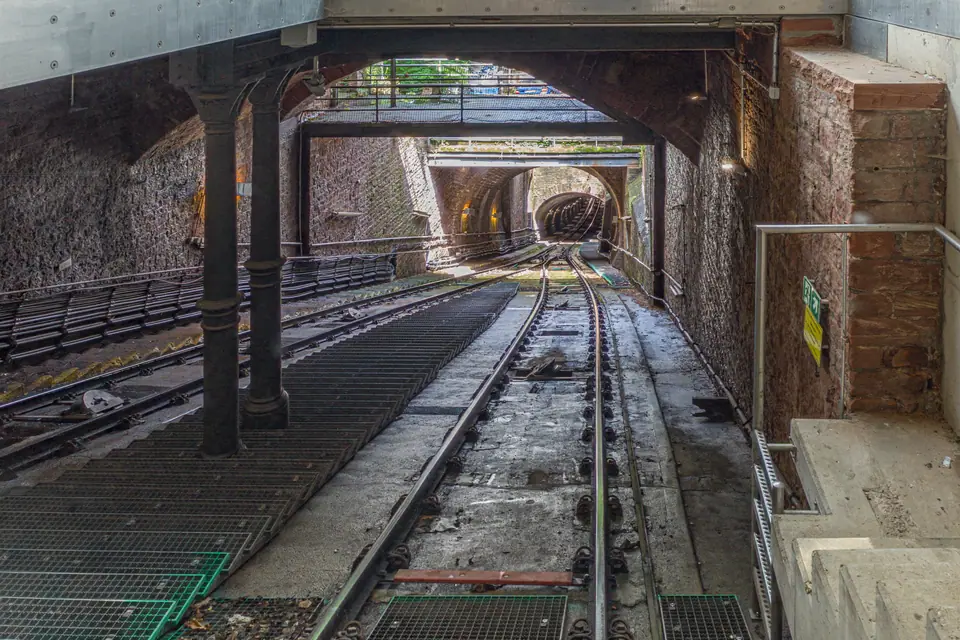
Opened in 1890 using water ballast and electrified in 1907, the lower Molkenkurbahn gained modern upgrades in 1961 to 1962 and 2003 to 2005. Bright modern cabins climb 471 metres up a steep 43 percent maximum gradient. Wide picture windows pass sandstone retaining walls before plunging briefly inside dark hillside brick tunnels below garden terraces. Departing every ten minutes, two wide carriages holding 130 passengers each reach Heidelberg Castle and Molkenkur in five minutes. Riders look back through slanted glass onto widening terracotta roofs far below. Stepping off at Molkenkur leads travellers straight onto a timber platform serving the historic upper Königstuhlbahn.
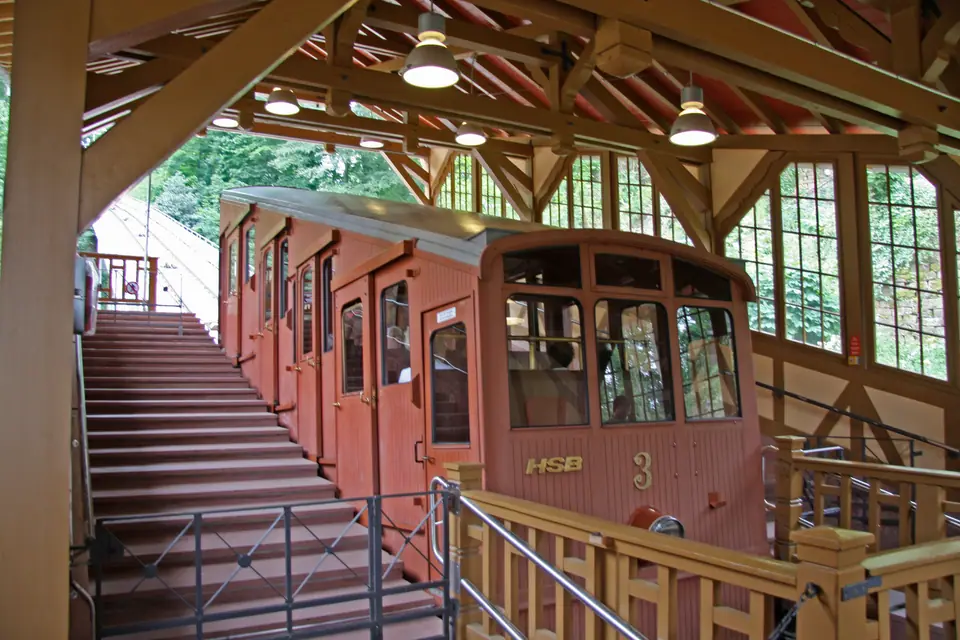
Inaugurated in 1907 seventeen years after the lower line, that upper wooden railway underwent careful restoration from April 2003 to March 2005. Carpenters preserved authentic 1907 bodywork profiles while installing modern safety systems underneath. Its 1,020-metre forest incline climbs 260 vertical metres at up to 41 percent gradient in nine minutes, departing every twenty minutes. Varnished mahogany benches and wide sash windows catch cool pine air drifting across wooded slopes. Brass bell signals mark each smooth departure while steel haulage cables hum steadily beneath polished wooden floorboards.
The Molkenkur Transfer Bottleneck and Winter Maintenance
Capacity numbers explain straight away why sunny afternoon queues stall halfway up the hillside. Wide lower cars shuttle 130 passengers every ten minutes, delivering up to 780 riders hourly onto a modest mid-mountain interchange. Upstairs, the wooden cars hold just 50 passengers every twenty minutes, capping summit flow near 150 riders hourly. Missing a transfer at Molkenkur stretches door-to-summit rides up to 44 minutes when holiday queues pack platforms.
Dodge that bottleneck cleanly by catching early morning departures straight to the summit before touring the Castle on your descent. Taking corner window seats at Kornmarkt gives front views where descending cars cross halfway uphill on dual passing loops. On crisp dry days, energetic walkers skip mid-mountain waits altogether by following woodland paths upward from Schloss terraces to Molkenkur. Timber tables outside Molkenkur station look serenely over flat valley rooftops and tiny river barges creeping westward.
Verify ticket boundaries and seasonal maintenance schedules closely before scanning passes at Kornmarkt barriers. Neither standard VRN local transit tickets nor Germany's nationwide Deutschlandticket cover any segment of the Bergbahn. Both the HeidelbergCARD and standard Schlossticket cover solely the lower funicular between Kornmarkt, Schloss, and Molkenkur, requiring an added summit ticket for the historic upper wooden leg. Seasonal operating schedules shorten noticeably every November as autumn daylight fades. Annual maintenance crews pause service for multi-week technical revisions between January and late March, while Molkenkur lift outages occasionally restrict step-free access.
At 568 Metres: Landessternwarte, Forest Paths and Views
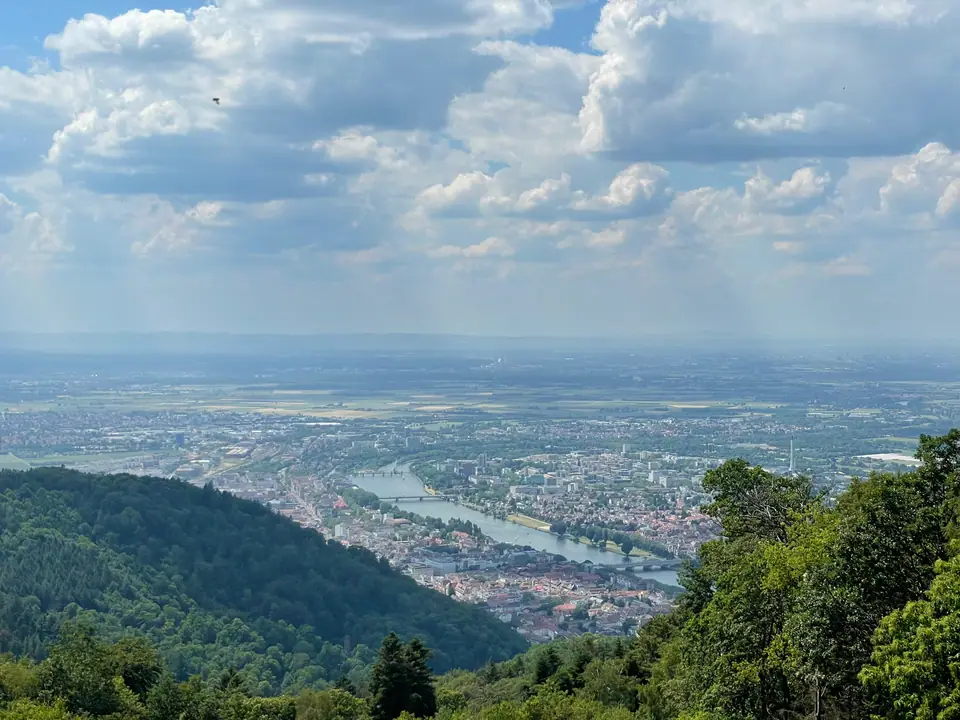
Stepping onto the shaded summit clearing brings noticeably crisper air and steady ridge breezes. Remember our seasonal guide cites annual rainfall of 1,019.5 millimetres and a 9.1 °C yearly mean up here compared with milder valley benches below. Just west of the stone upper station platform, open viewing terraces sweep broadly over town roofs. Clear mornings frame the Neckar river bend sweeping onto the flat Upper Rhine Plain toward distant Palatinate hills. After damp autumn nights, pale river mist pools smoothly along valley floor streets while summit benches sit calmly beneath bright blue sky. Nearby viewing railings display brass ridge maps identifying distant spires and vineyard hills across the western plain.
Forest trails nearby pass the historic Landessternwarte Heidelberg-Königstuhl observatory founded in 1898, where astronomer Karl Wilhelm Reinmuth discovered nearly 400 asteroids between 1912 and 1957. Modern domes of the Max Planck Institute for Astronomy sit nearby beside broadcast towers, a quiet former US tower, and family woodland paths. Painted trail markers beside timber shelters point toward woodland springs and calm forest clearings. Clear gravel loops carry walkers gently under tall spruce boughs before linking back onto wider ridge lanes. Waymarked hiking loops descend comfortably through beech woods past Molkenkur or down steep sandstone steps beside the Castle gardens whenever afternoon return queues grow long. Pausing briefly on garden benches halfway down eases knee strain well before reaching Old Town cobbles.
- Climb straight to Königstuhl early: Beat midday Molkenkur queues by riding straight to 568 metres early, then stopping at Heidelberg Castle on your descent.
- Separate Bergbahn from rail passes: Deutschlandticket and standard VRN bus and tram passes are invalid here, and HeidelbergCARD stops at Molkenkur unless upgraded.
- Verify winter overhaul dates: Check bergbahn-heidelberg.de before riding between January and late March when annual chassis and wooden-carriage revisions pause service.
- Pack one extra fleece layer: Expect cooler temperatures and damp Odenwald ridge breezes even on sunny Neckar summer afternoons.
Where it is
- 1Riding the 1907 Wooden Mountain Railway up the Königstuhl
- Frankfurt Main Airport (FRA) · about 71 km from here in a straight line
- Directions in Google Maps
Stations and taxi ranks: OpenStreetMap. Airports: OurAirports. Distances are in a straight line.
Traveller tips
Real advice from people who have been to Heidelberg. Every tip is read by our team before it goes live.
No tips yet. Been here? Yours could be the first.
Thank you! Your tip will appear here after a quick review.
More in Heidelberg
Continue exploring Heidelberg with related neighbourhood, food, and planning guides