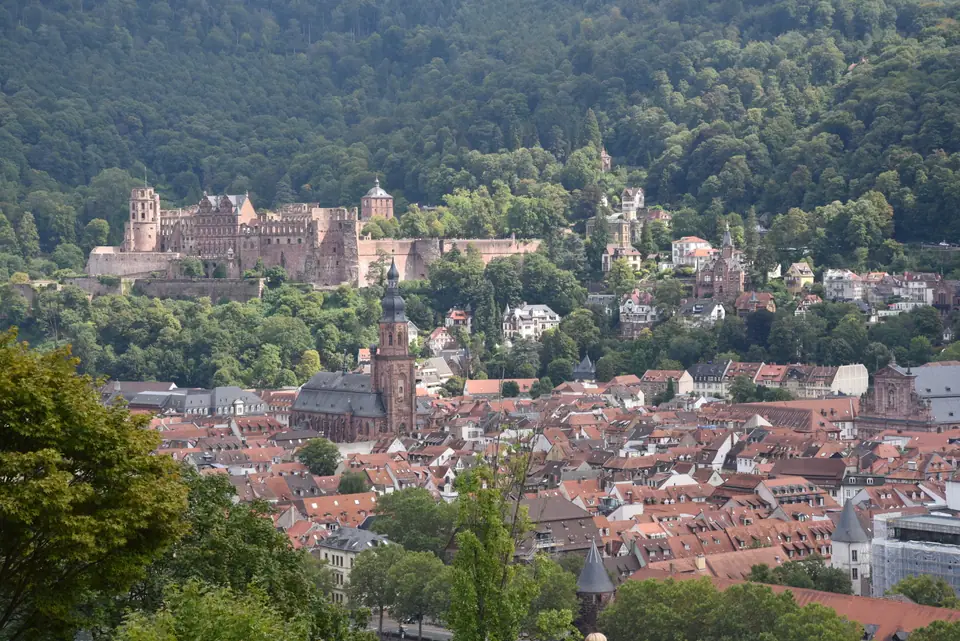
Photo: R. J. Mathar · CC BY-SA 4.0
Heidelberg on the Neckar: Baroque Lanes Below Sandstone Ruins
How geography, French seventeenth-century wars, an intact 1945 Old Town, and Germany oldest university built Heidelberg.
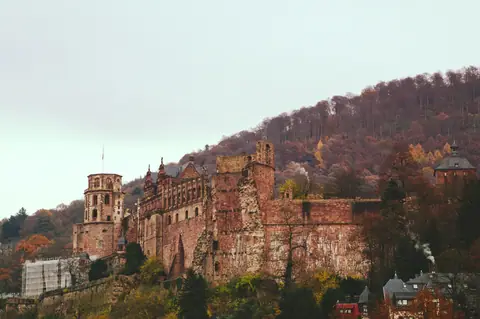
Few German cities explain themselves as clearly from one riverbank bend as Heidelberg. Stand where the Neckar emerges from wooded Odenwald hills onto the flat Upper Rhine Plain. Every force that built this place sits within one glance. Rising 80 metres up the northern flank of Königstuhl (KUR-nikh-shtool) stand the red sandstone shells of Heidelberg Castle. Below them stretches a tight wedge of terracotta roofs, baroque church spires, and university halls framed by water and forest.
Home to roughly 156,092 residents across 108.83 square kilometres, Baden-Württemberg's fifth-largest city feels smaller and younger than its population suggests. Roughly one-quarter of residents are university and college students. Their term calendars lend narrow lanes steady daytime life without heavy industrial sprawl. Seeing why those streets look Baroque rather than medieval explains the whole city before you step onto the cobbles.
Why Heidelberg Survived 1945 Intact While Neighbours Burned
Travellers arriving straight from Frankfurt, Mannheim, or Cologne notice an immediate shift in street height and stonework. Germany's industrial river ports endured devastating Second World War air raids between 1942 and 1945. Heidelberg escaped Allied saturation bombing almost untouched. Two strategic realities spared its steep roofs and university quadrangles. The narrow valley core held minimal heavy war manufacturing compared with neighbouring Mannheim, and Allied planners earmarked the university town for post-war military headquarters and hospital duty.
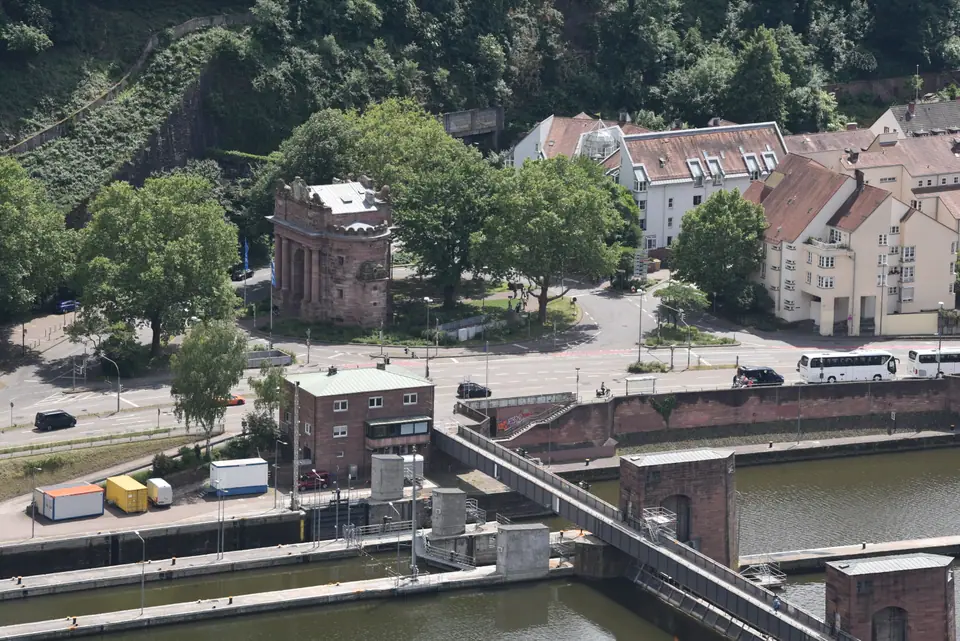
Combat brushed the river edge in the final hours of fighting. On 29 March 1945, retreating German units blew up three arches of the Old Bridge to delay river crossings. American forces entered intact streets unopposed on 30 March 1945. Post-war military commands stationed US Army Europe and NATO land headquarters at Campbell Barracks until American forces departed in 2015. Former military riding stables in Südstadt now host the relocated Karlstorbahnhof cultural venue, which opened there in October 2022.
1689 and 1693: How French Cannon Shaped a Baroque Town
Avoiding 1945 air raids does not mean Heidelberg's Old Town looks medieval. Neighbouring Bergheim enters written records in 769 and Heiligenberg monastic foundations date to 870, while an abbey charter documented Heidelberg in 1196. As seat of the Electorate of the Palatinate, town grew steadily after Elector Rupert I established Germany's oldest university here in 1386. Catholic League armies took town after a two-month siege in 1622. Worse destruction struck during the Nine Years' War.
French troops entered in October 1688, torched the palace, and blew up its bridge on 2 March 1689. Returning in May 1693, French engineers levelled city walls and timber lanes with gunpowder mines. After the Palatine court moved to grid-planned Mannheim in 1720 and town passed to Baden in 1803, returning citizens rebuilt above cramped medieval house plots using uniform Baroque stone facades. Local masons quarried red Buntsandstein from nearby Odenwald hillsides for townhouses, civic offices, and the Jesuitenkirche (built from 1712 to 1759).
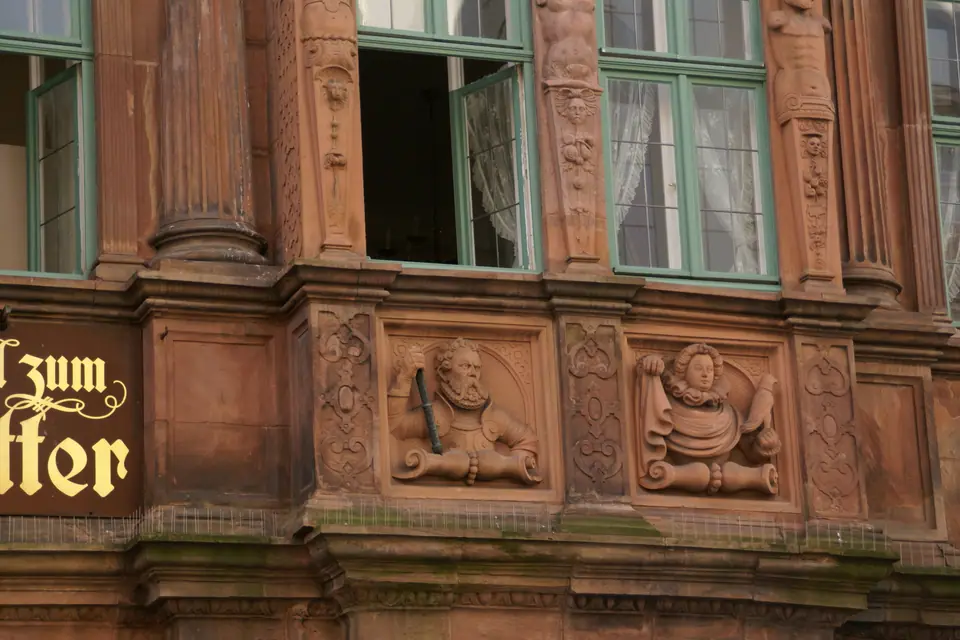
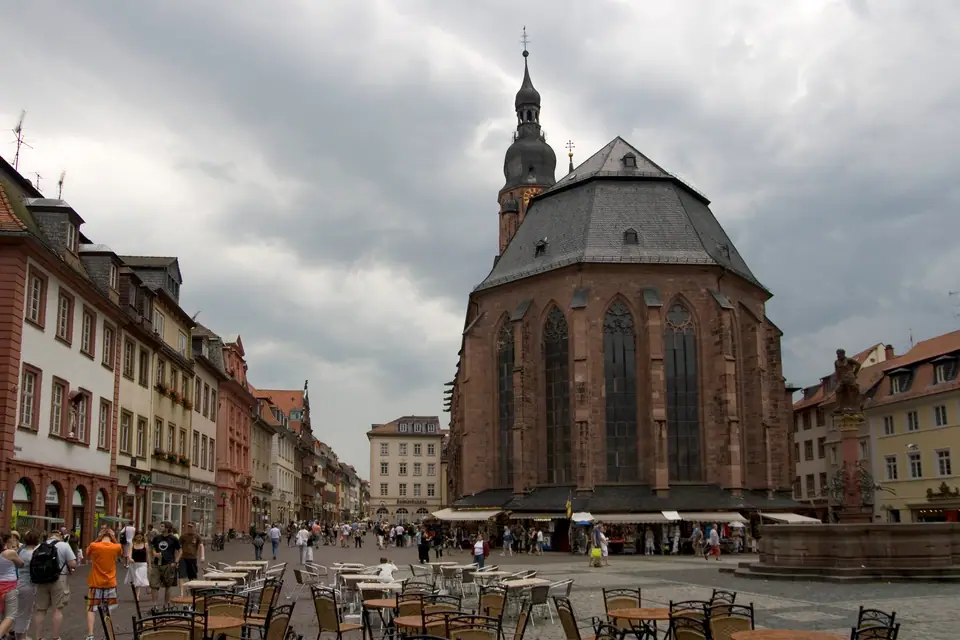
Just one major bourgeois mansion survived those seventeenth-century fires intact: the richly carved 1592 Renaissance Haus zum Ritter facing Marktplatz. Even late-Gothic Heiliggeistkirche (HY-likh-gyst-KEER-kheh) wears a Baroque roof and onion dome added after 1709. Walking between Kornmarkt and Universitätsplatz shows uniform three-storey cornices layered calmly above tight medieval curves.
River Bottleneck Between Odenwald Sandstone and Rhine Plain
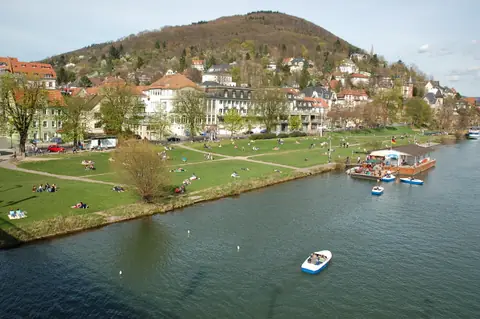
Steep valley slopes squeeze every central route into a tight east-west corridor. The river floor sits roughly 114 metres above sea level. Hills pin it cleanly between the 568-metre Königstuhl ridge on the south and 445-metre Heiligenberg across the Neckar, with Gaisberg rising to 375 metres nearby. Because cliffs drop fast on both banks, Altstadt 69117 grows linearly rather than circling outward around ring boulevards. Side lanes plunge north from busy shopfronts straight toward the water, giving tired walkers immediate views across river barges toward forested slopes.
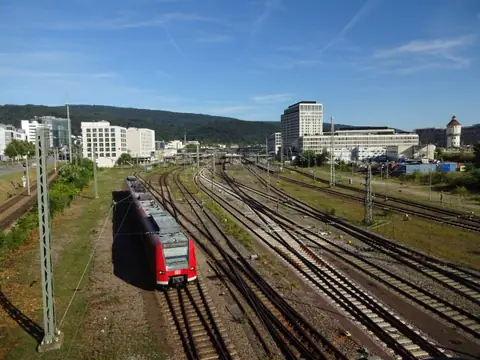
Down its spine runs pedestrianised Hauptstraße, stretching 1.6 to 1.8 kilometres from modern Bismarckplatz east to the neoclassical Karlstor gate erected between 1775 and 1781. Celebrated as one of Europe's longest continuous pedestrian streets, Hauptstraße links plazas, bookshops, and municipal galleries inside an unhurried twenty-minute walk. When rail engineers replaced the cramped 1840 station in 1955 and shifted platforms two kilometres west, central blocks gained lasting breathing room free of freight yards. Beyond Bismarckplatz, the valley floor widens into nineteenth-century grids across Bergheim and Weststadt.
Student Rhythm, Sonntagsruhe and Life Beyond the Postcard
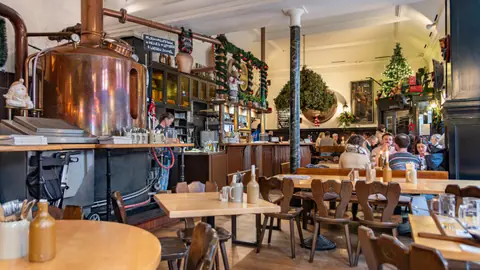
Living university rhythms soften daytime tour-bus crowds once afternoon excursion groups depart. Morning hours belong to bread deliveries, bicycle commuters rolling off the Alte Brücke, and students crossing Universitätsplatz between seminars. Midday visitors pack Kornmarkt and Hauptstraße, yet stepping one lane north toward the water restores calm within seconds. Evening tables fill warmly across Untere Straße and Steingasse after shop shutters drop. Bookshops, bakeries, and stone courtyards stay woven together inside easy walking distance without requiring metro passes between stops. Once day coaches roll back toward the motorway, candlelit tables and riverside benches belong again to residents, seminar groups, and unhurried evening strollers.
Basic German practicals keep daily schedules smooth across any stay length. Germany uses the euro (EUR), Type F wall sockets at 230 volts and 50 hertz, and clean municipal tap water. Baden-Württemberg enforces strict Sonntagsruhe laws closing standard supermarkets on Sundays, leaving bakeries and Hauptbahnhof station kiosks for weekend groceries. Non-EU visitors follow Schengen rules permitting 90 days in any 180-day period on passports issued under 10 years ago and valid 3 months past exit.
Pair busy castle mornings with quiet north-bank lawns or early climbs above town roofs. Stepping across the Neckar restores relaxed local scale quickly, setting up unhurried dinners inside Kurpfalz taverns away from midday bottlenecks. Frequent fast rails place Stuttgart and Frankfurt inside effortless single-hour reach whenever onward travel begins. Clear riverside promenades along Neckarmünzplatz and Karlstor reward slow dusk strolls long after coach groups board buses west. Taking one slow loop across the river before sunset reveals how water, forest rock, and student life balance one another effortlessly.
Where it is
- 1Heidelberg
- Frankfurt Main Airport (FRA) · about 70 km from Heidelberg in a straight line
- Directions in Google Maps
Stations and taxi ranks: OpenStreetMap. Airports: OurAirports. Distances are in a straight line.
Traveller tips
Real advice from people who have been to Heidelberg. Every tip is read by our team before it goes live.
No tips yet. Been here? Yours could be the first.
Thank you! Your tip will appear here after a quick review.
More in Heidelberg
Continue exploring Heidelberg with related neighbourhood, food, and planning guides