Jaipur
Terracotta-pink crenellated walls, honey-stone Rajput hill forts crowning the Aravalli ridges, monumental masonry astronomical instruments, block-print bazaars and spiced Rajasthani feasts.
Quick decisions
How many days?
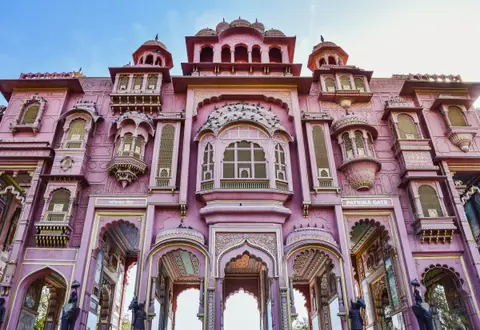
3 days: the walled Pink City, Hawa Mahal, City Palace and Jantar Mantar on day one, Amber Fort, Panna Meena ka Kund and Nahargarh sunset on day two, plus Patrika Gate, Albert Hall Museum and bazaars on day three. Follow our three-day route.
Where should I stay?
Bani Park and Civil Lines: leafy heritage havelis with peaceful courtyards. MI Road and C-Scheme: central dining and easy transit. Walled Pink City or Amer Road: historic palace views. Compare areas in our neighbourhood overview.
Do I need a car?
No. Never self-drive in Jaipur traffic. Use the air-conditioned Jaipur Metro Pink Line for the east-west corridor, app-hailed auto-rickshaws and cabs for short hops, or hire a car with a local driver for the hill forts.
Best for
Rajput architecture: mirrored palace halls, geometric stepwells and honeycombed sandstone facades. Craft shoppers: hand-carved wooden block prints, blue pottery and cut gemstones. Food lovers: flaky onion kachoris and clay-cup lassi.
Before you go
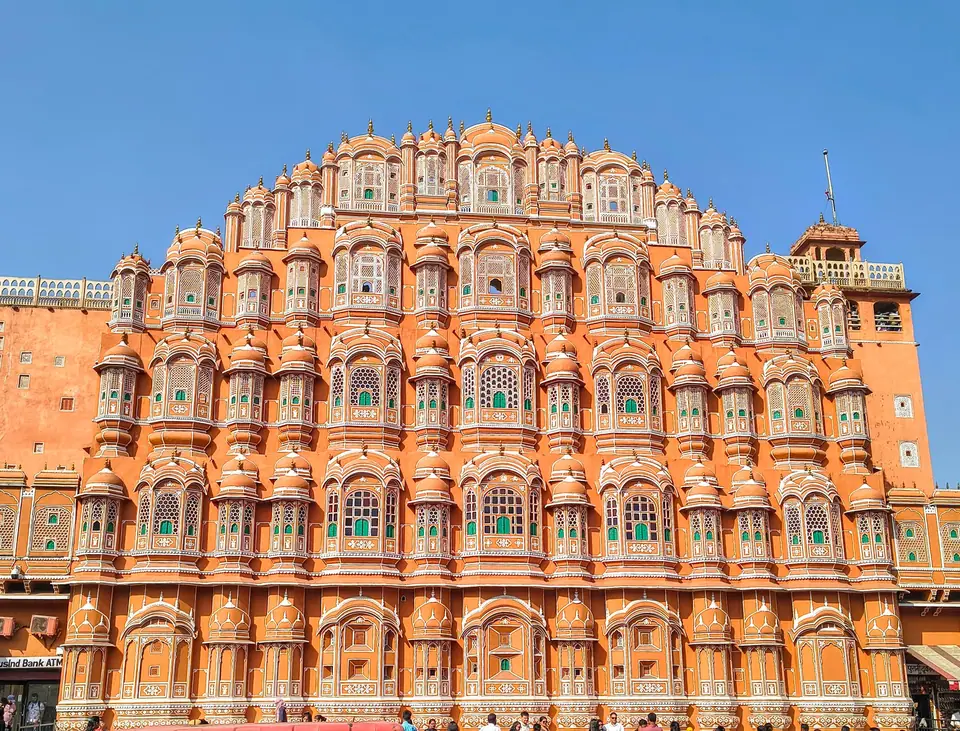
Start at opening time for Amber Fort and Hawa Mahal: morning light illuminates the east-facing Wind Palace facade and lets you tour Amer before tour coaches arrive from Delhi. Read our practical briefing.
Getting around
From Delhi and Agra: Vande Bharat and Shatabdi Express trains link New Delhi to Jaipur Junction, while Jaipur International Airport sits south in Sanganer. Details in arrival and transport.
Continue your trip
Jaipur anchors India's Golden Triangle with New Delhi and Agra, and serves as the rail gateway west into Rajasthan toward Jodhpur, Udaipur and Jaisalmer.
Overview
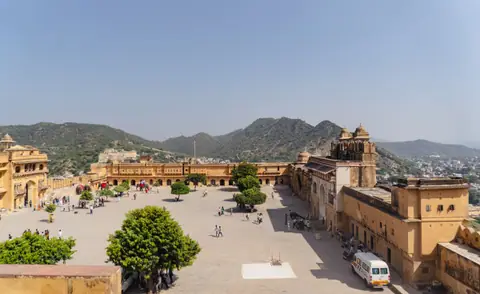
Founded in 1727 by the astronomer-king Sawai Jai Singh II and designed by architect Vidyadhar Bhattacharya according to ancient Vastu Shastra grid principles, Jaipur was North India's first planned city. While earlier Rajput rulers sheltered high on the rocky Aravalli hills at Amber Fort, Jai Singh laid out nine rectangular sectors on the plain below, enclosed by crenellated walls and gates painted a warm terracotta pink to welcome a royal visit in 1876.
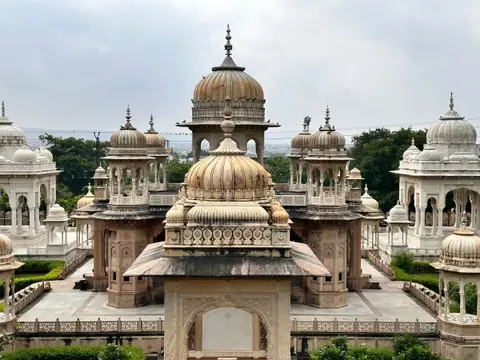
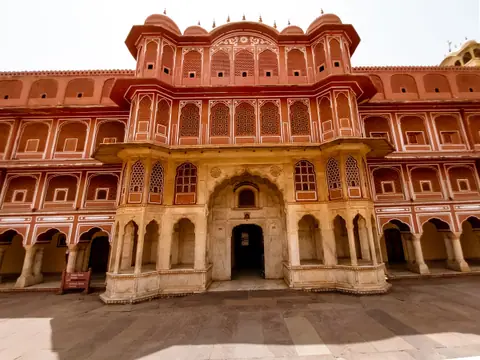
Within those gates stand the five-storey honeycomb screen of Hawa Mahal, the courtyards of the City Palace and UNESCO-listed Jantar Mantar, and arcaded bazaars grouped by traditional craft. Start with our first-timer briefing before mapping your days.
Getting there
Jaipur International Airport (JAI) sits in Sanganer about 12 kilometres south of the centre, with direct flights across India and selected Asian hubs. By rail, fast air-conditioned Vande Bharat and Shatabdi Express services run from New Delhi and Gurgaon to Jaipur Junction, while afternoon trains link Agra Fort and Sawai Madhopur. See how to get to Jaipur and move around.
Where to stay
Sleeping in a converted courtyard mansion (haveli) is one of Rajasthan's great pleasures. Quiet residential quarters like Bani Park and Civil Lines offer shaded gardens and rooftop pools away from horn noise, whereas C-Scheme and MI Road keep you beside cafes and boutiques. We compare all main bases in where to stay in Jaipur.
Things to do
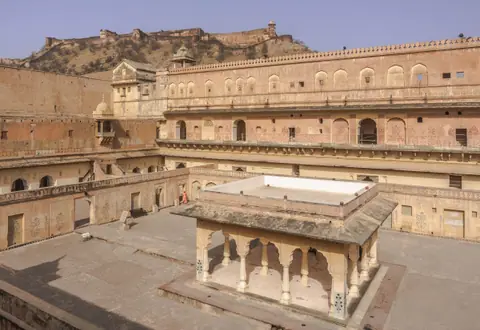
Catch morning sunlight on the 953 latticed windows of Hawa Mahal, decipher the giant stone sundials of Jantar Mantar and the Peacock Gate of the City Palace, climb up to the mirrored Sheesh Mahal at Amber Fort and Panna Meena ka Kund stepwell, and watch dusk settle over the Aravalli hills from Nahargarh Fort. See the full list in things to do in Jaipur.
Food and drink
Rajasthani cooking developed for an arid desert climate, using clarified butter (ghee), lentils, gram flour, buttermilk and dried red chillies to create rich, deeply comforting dishes. Sample crisp pyaaz kachori (spiced onion pastries), baked wheat balls dipped in ghee with three-lentil stew (dal baati churma), fiery laal maas mutton curry and thick lassi served in disposable terracotta cups. Read where to eat in our bazaars and Rajasthani food overview.
Culture
When Maharaja Sawai Jai Singh II moved his capital down from Amer in the 1720s, he invited master artisans from across the subcontinent to settle in dedicated workshop lanes (mohallas). Three centuries later, families still carve wooden printing blocks in Sanganer, tie-dye leheriya wave silks, set Kundan jewellery in Johari Bazaar and glaze turquoise quartz pottery without clay.
Weather by month
Jaipur is warmest in May, with average highs around 40°C, and coldest in January, when nights drop to about 9°C. July is the wettest month, with rain on about 11 days. For mild weather with fewer rainy days, aim for January and December.
| Month | Low | Range | High | Rain | Rainy days |
|---|---|---|---|---|---|
| Jan | 9°C | 22°C | 8 mm | 1 d | |
| Feb | 12°C | 26°C | 10 mm | 1 d | |
| Mar | 17°C | 32°C | 6 mm | 1 d | |
| Apr | 22°C | 37°C | 7 mm | 1 d | |
| May | 26°C | 40°C | 15 mm | 2 d | |
| Jun | 27°C | 39°C | 58 mm | 5 d | |
| Jul | 26°C | 34°C | 198 mm | 11 d | |
| Aug | 25°C | 32°C | 189 mm | 11 d | |
| Sep | 24°C | 33°C | 76 mm | 5 d | |
| Oct | 19°C | 33°C | 12 mm | 1 d | |
| Nov | 14°C | 29°C | 3 mm | 0 d | |
| Dec | 10°C | 24°C | 5 mm | 1 d |
Averages of daily values from 2015 to 2024. Rainy days are days with at least 1 mm of rain. Source: Open-Meteo · Compare destinations by month.
Jaipur on the map
Every place we cover in Jaipur. Tap a category or pin to explore.
In-depth Jaipur guides
Browse the guides grouped by topic: sights, neighbourhoods, food, transport, day trips and trip planning.
Sights, Landmarks & Parks
Key monuments, viewpoints, museums and nature trails.
- Best Things to Do in JaipurHoney-stone hill forts, geometric stepwells, royal astronomical instruments, palaces and craft lanes.
- Amber Fort, Panna Meena ka Kund, Jaigarh and NahargarhHow to combine Amer Fort, Panna Meena ka Kund stepwell, Jaigarh and sunset at Nahargarh Fort.
- The Walled Pink City: Hawa Mahal, City Palace and Jantar MantarWalking the royal core of the Pink City from Hawa Mahal through the City Palace and Jantar Mantar.
Neighbourhoods & Where to Stay
Districts, historic quarters and the best bases for your stay.
Food & Drink
Local dishes, markets, cafés and dining districts.
Getting Around & Arrival
Airport transfers, public transit, passes and driving rules.

Trip Planning & Itineraries
When to visit, what to pack and day-by-day routes.
- Jaipur: What to Know Before You GoUnderstanding Jaipur's walled grid versus the northern hill forts, ticket options and bazaar etiquette.
- Best Time to Visit JaipurSunny winter days from November to February, spring festivals, scorching desert summers and monsoon greenery.
- What to Wear in JaipurNatural fabrics for desert sun, warm layers for December nights and practical footwear for fort ramps.
- Jaipur 3-Day Itinerary: Pink City Palaces, Hill Forts and CraftsA logical three-day route splitting the walled Pink City, the northern Aravalli hill forts and craft quarters.


Need your embassy or consulate in India? See embassies and consulates in India.
Reviews
Log in to write a review.
No reviews yet.