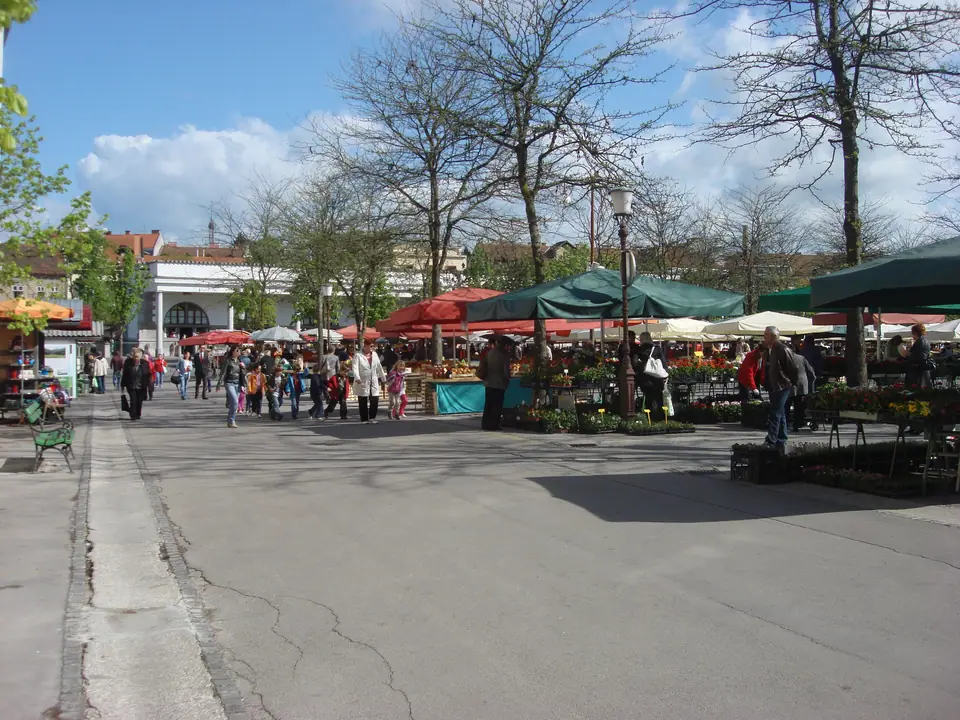
Photo: Sebastian Bergmann from Siegburg, Germany · CC BY-SA 2.0
The Plečnik Trail
Bridges, library, market and Tivoli promenade by the architect UNESCO listed in 2021.
Few cities owe their character to one person as much as Ljubljana owes it to Jože Plečnik. Born in the city in 1872 and dead here in 1957, he worked on bridges, a library, market halls, parks and a cemetery, and in 2021 UNESCO inscribed his works in Ljubljana as an example of human-centred urban design. This guide turns that legacy into a walking route, with the reason to stop at each place.
The route links with the Old Town guide, since several stops lie along the river.
From Prague Castle to Ljubljana's 2021 UNESCO heritage
From 1920 to 1934 Plečnik was chief architect for the renovation of Prague Castle, where he worked on gardens, courtyards, monuments and interiors, including the Plečnik Hall, completed in 1930. He returned to Ljubljana and reshaped it. The 2021 inscription, titled The works of Jože Plečnik in Ljubljana - Human Centred Urban Design covers 19.138 hectares and includes selected works in Črna Vas.
| Work | Dates | What to look for |
|---|---|---|
| Tivoli Park renovation | 1921 to 1939 | The Jakopič Promenade and its axis |
| Trnovo Bridge | 1929 to 1932 | A road bridge from the same years as the Triple Bridge |
| Cobblers' Bridge | 1930 | A small crossing built in 1930 |
| Triple Bridge | 1929 to 1932 | Two added footbridges and poplars |
| National and University Library | Plans 1930 to 1931, built 1936 to 1941 | Brick and stone facade, dark stone columns |
| Central Market | Designed 1931 to 1939, built 1940 to 1942 | Halls along the river |

Turjaška, Gosposka and Vegova ulica at the National Library
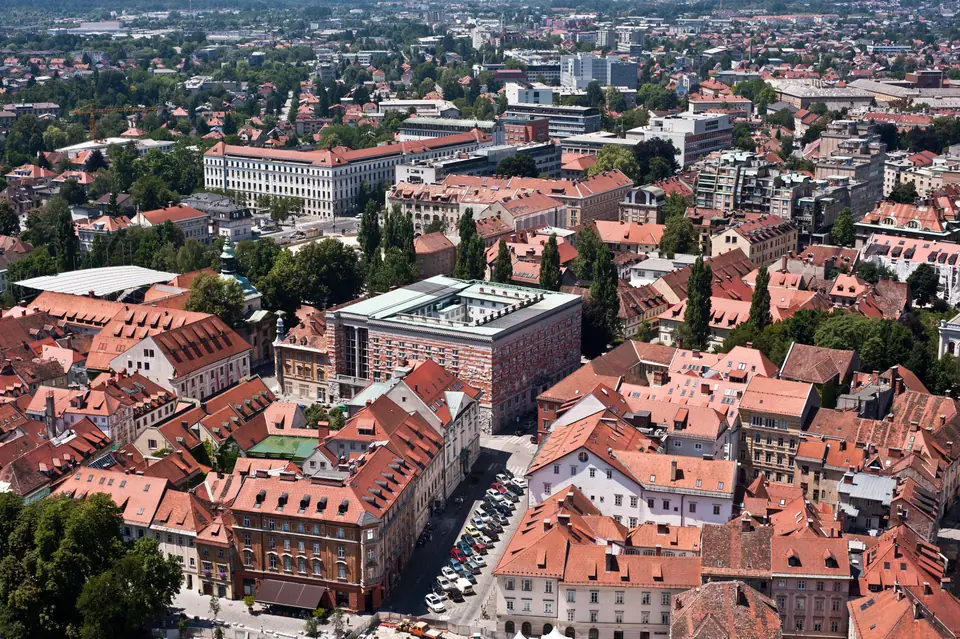
The National and University Library traces its origin to 1774, when Maria Theresa founded it after the dissolution of the Jesuits. Plečnik's building rises between Turjaška ulica, Gosposka ulica and Vegova ulica as his most monumental work in Slovenia. Its textured facade contrasts warm red brick with carved pale stone incorporating Roman blocks unearthed on the site. Inside, a sombre dark Podpeč marble staircase of 32 columns leads deliberately upward out of shadow into the bright, sunlit main reading room with chandeliers and tall windows.
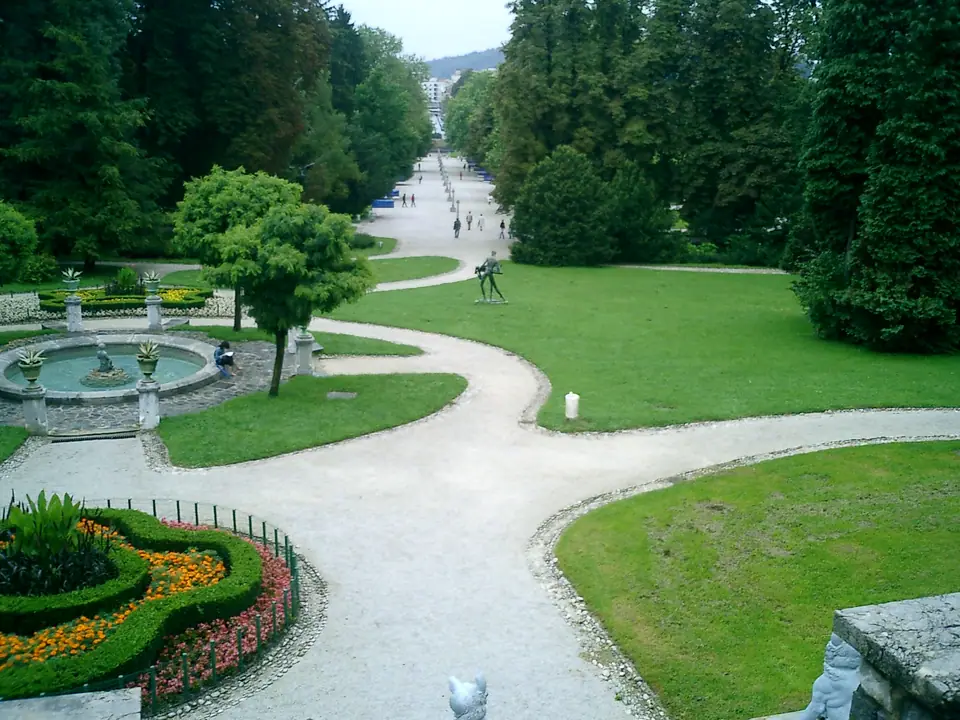
Green axis from Tivoli Castle along Jakopič Promenade
The promenade is a single axis that runs from Tivoli Castle through Cankar and Čop Streets to Prešeren Square, over the Triple Bridge and up to Ljubljana Castle. Tivoli Park itself was laid out in 1813 by the engineer Jean Blanchard, when Ljubljana was the capital of the French Illyrian Provinces. A pond was excavated in 1880 and a tree nursery established in 1894, and Plečnik renovated the park in the 1920s. Tivoli Castle is a 17th-century mansion built over Renaissance foundations. Nearby, the Cekin Mansion of 1720, designed by Fischer von Erlach, has housed the Museum of Contemporary History of Slovenia since 1951.
Plečnik's open-air courtyard theatre at Križanke
The Monastery of the Holy Cross at Trg francoske revolucije 1 was built for the Teutonic Order, with construction believed to have started in 1228. In 1952 the city asked Plečnik to remodel the derelict complex, and he finished the work in 1956. He turned it into an open-air theatre and festival space with a large retractable canopy over the southern courtyard, and it remains one of the principal venues of the Ljubljana Festival.
Dual land and water axes protected by UNESCO
The inscription is built around two axes. The land axis is the Green Promenade from Trnovo Bridge to Zvezda Park, and the water axis is the Ljubljanica embankments and bridges, with transversal routes tying them into the street network. Named components include Žale (the Garden of All Saints), the library, the churches of St Michael and St Francis of Assisi, Cobblers' Bridge, Triple Bridge and the Central Market. Congress Square with Zvezda Park, the Square of the French Revolution, Trnovo Bridge and Quay, the Roman wall archaeological park and the embankments complete the ensemble. The listing describes the approach as improving the city with small and large interventions rather than rebuilding it, and treats the spaces as serving spiritual, recreational, commercial, social and cultural uses at once.
Reaching the Garden of All Saints at Žale cemetery
Plečnik also designed the Ljubljana cemetery at Žale, where he was given a state funeral in 1957. Its white neoclassical portal and cluster of chapels sit outside the walkable Old Town, so ride a local LPP city bus north when your schedule allows an extra hour.
Walking the library, Cobblers' Bridge and Križanke route
- Begin at Tivoli Castle and walk the Jakopič Promenade towards Prešeren Square.
- Cross the Triple Bridge and stroll beneath the riverside market colonnade towards Dragon Bridge.
- Turn inland across Cobblers' Bridge to the library on Gosposka ulica, admiring the horse-head door handles and dark staircase.
- Finish at quiet Trnovo Bridge before returning along Vegova ulica to Križanke courtyard.
The walk fits cleanly into half a day at an unhurried pace. Confirm public library visiting windows on its official site before planning a peek into the upper reading room. For seasons and weather, see best time to visit.
Where it is
- 1The Plečnik Trail
- Ljubljana Jože Pučnik Airport (LJU) · about 20 km from here in a straight line
- Zagreb Franjo Tuđman International Airport (ZAG) · about 126 km from here in a straight line
- Directions in Google Maps
Stations and taxi ranks: OpenStreetMap. Airports: OurAirports. Distances are in a straight line.
Traveller tips
Real advice from people who have been to Ljubljana. Every tip is read by our team before it goes live.
No tips yet. Been here? Yours could be the first.
Thank you! Your tip will appear here after a quick review.
More in Ljubljana
Continue exploring Ljubljana with related neighbourhood, food, and planning guides