Photo: Guilhem Vellut · CC BY 2.0
Croix-Rousse, the Canuts and the Lumières
The silk hill, the uprisings of 1831 and 1834 and the brothers who filmed workers in 1895.
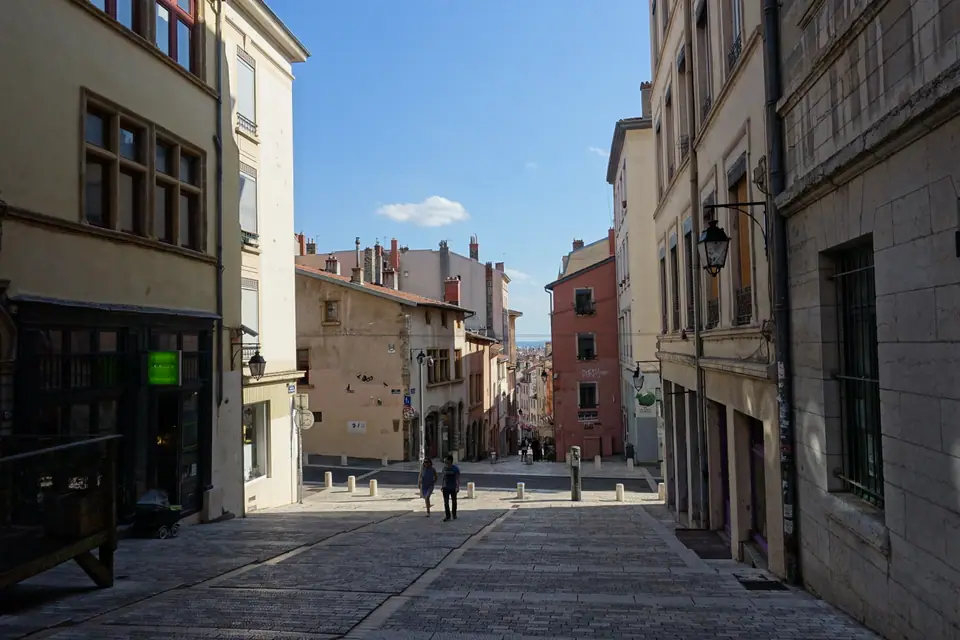
Facing Fourvière from the northern rise above Place des Terreaux, Croix-Rousse built modern Lyon out of wooden silk looms, worker solidarity and nineteenth-century invention. Residents still call it the hill that works. Steep cobbled alleys cut across Les Pentes in the first arrondissement, while flat market boulevards top le Plateau in the fourth. Adding the Lumière workshops in Monplaisir shows how textile mechanics and early cinema grew out of one practical craft culture.
Steep slopes and four-metre silk workshops
Silk production expanded uphill out of cramped Vieux Lyon during the eighteenth and nineteenth centuries. Joseph-Marie Jacquard's punched-card looms required tall workrooms and broad daylight. Residential blocks across Les Pentes and le Plateau stand out immediately for tall windows set under four-metre timber ceilings. Builders designed high rafters to anchor heavy loom frames above mezzanine sleeping decks. Included inside the 1998 UNESCO zone, hillside blocks connect downward through covered traboules. Workers carried finished brocades smoothly downhill to riverside merchants without risking sudden rain damage.
The Cour des Voraces and silk-worker uprisings
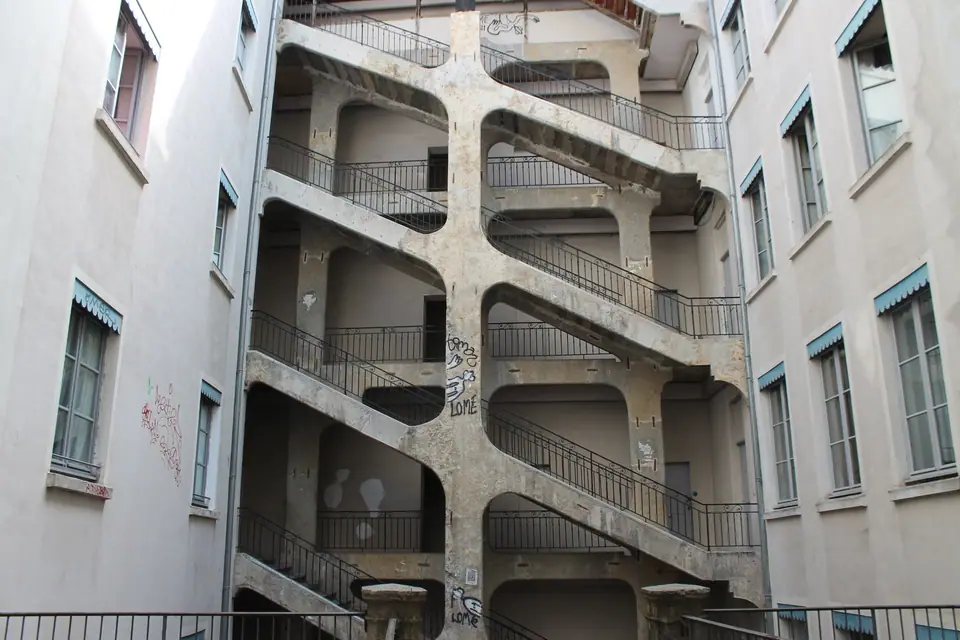
Hit by harsh piecework wage cuts, Lyon's silk weavers, called canuts, mounted major revolts in October 1831 and April 1834. Both stand among Europe's earliest industrial worker uprisings. No site reflects that era more vividly than the Cour des Voraces. Built around 1840, it links 9 Place Colbert, 29 Rue Imbert-Colomès and 14 Montée Saint-Sébastien. Stepping inside reveals a bold six-storey open-air staircase carved in cut stone (pierre de taille) rather than concrete. Cantilevered flights and a perforated stone inner wall sheltered mutual-aid meetings during unrest in 1848 and 1849. Private flats open directly onto every balcony, so speak softly and keep strictly to daytime open gates.
| Canut & cinema milestone | Date | Location or context |
|---|---|---|
| First & second Canut uprisings | Oct 1831 & 1834 | Barricades across Les Pentes and le Plateau |
| Cour des Voraces construction | c. 1840 | 9 Place Colbert to 29 Rue Imbert-Colomès |
| First Croix-Rousse funicular | 1862 to 1968 | Converted later into Croix-Rousse road tunnel |
| Gros Caillou boulder unearthed | 1861 to 1862 | Placed near Boulevard de la Croix-Rousse |
| Cinématographe patent & film | Feb & Mar 1895 | 25 Rue du Premier-Film, Monplaisir |
| Mur des Canuts mural | 1987 (updated 1997, 2013) | 1,200 m² facade on Boulevard des Canuts |
Maison des Canuts, Gros Caillou and Mur des Canuts
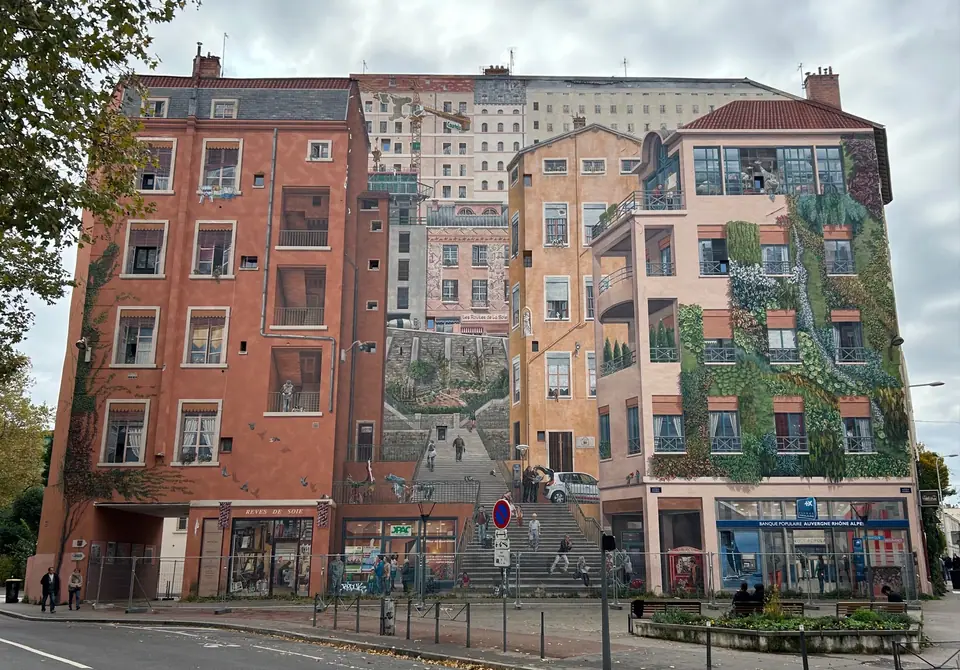
Up on le Plateau at 10 and 12 Rue d'Ivry in the fourth arrondissement, the compact Maison des Canuts brings Jacquard handlooms to life during guided weaving demonstrations. Watching punched cardboard cards drop overhead explains silk mechanics far faster than static plaques. Nearby, Croix-Rousse annexed into Lyon in 1852, and workers demolished its old plateau fortifications around 1865 to open the tree-lined Boulevard de la Croix-Rousse. At the eastern promenade stands the Gros Caillou, a 24-ton Triassic quartzite boulder swept down by Alpine glaciers roughly 140,000 years ago and unearthed between 1861 and 1862 during funicular tunnelling. Ten minutes west rises the Mur des Canuts, a 1,200-square-metre trompe-l'œil mural painted in 1987 by collective CitéCréation. Updates in 1997 and 2013 aged its neighbourhood portraits gradually over time.
Lost hill funiculars and Metro Line C
Climbing Croix-Rousse once relied on two nineteenth-century cable lines before rapid transit arrived. Opened in 1862 between Rue Terme and Boulevard de la Croix-Rousse, the western incline closed in 1968. Its shaft now carries vehicles through a widened road tunnel. Further east from Croix-Pâquet, an 1891 funicular converted to rack-and-pinion traction in 1974. Engineers extended that route into today's 2.5-kilometre, five-station Metro Line C linking Hôtel de Ville directly up to Hénon and Cuire.
Birthplace of cinema at the Institut Lumière
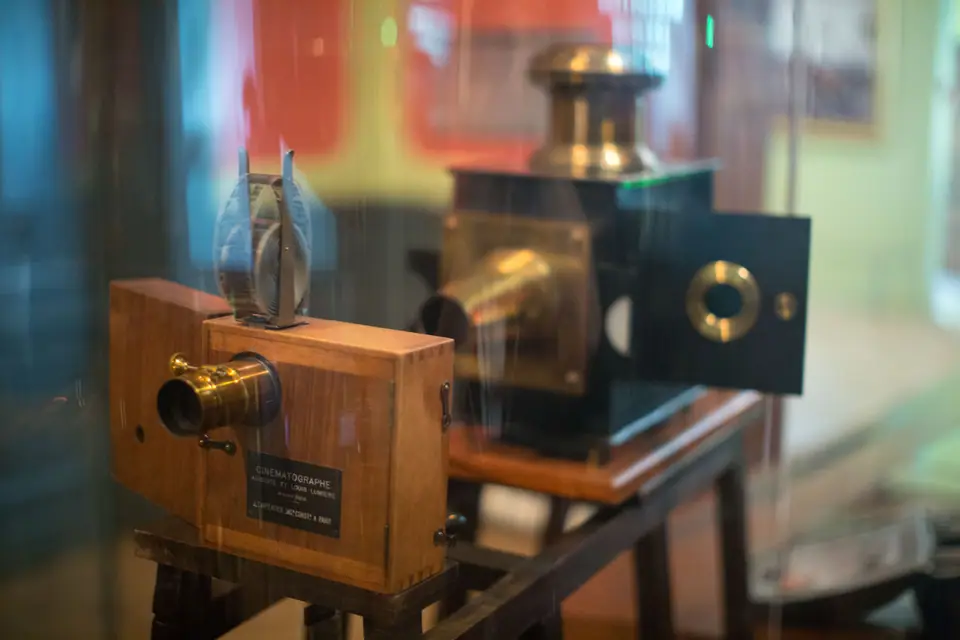
Cross the Rhône on Metro Line D to Monplaisir-Lumière in the eighth arrondissement. There industrialist Antoine Lumière opened brick photographic-plate workshops at 25 Rue du Premier-Film in 1882. In February 1895, brothers Auguste and Louis Lumière patented their portable Cinématographe camera-and-projector. One month later in March 1895, they filmed staff walking past factory exit gates for La Sortie de l'usine Lumière à Lyon. Founded in 1982 inside the family's 1899 to 1902 Art Nouveau Villa Lumière, the Institut Lumière displays hand-cranked projectors and early Autochrome glass plates beside the brick hangar. Riding Metro Line D straight east from Bellecour avoids any interchange.
Downhill morning walk from plateau to Place des Terreaux
Save your legs by riding Metro Line C straight up to Croix-Rousse station while market canopies line Boulevard de la Croix-Rousse. Regular outdoor food markets draw cooks across northern Lyon for cheeses, bread and seasonal fruit. Browse local bookshops and neighbourhood bakers on le Plateau, tour Maison des Canuts and stop before the Mur des Canuts. Wander gently downhill through Place Colbert and the cut-stone galleries of the Cour des Voraces. Follow steep stepped walkways down Montée de la Grande-Côte back to Place des Terreaux, pausing on open terraces overlooking Fourvière Basilica and distant Vieux Lyon rooftops. That descent builds a sharp appetite for cervelle de canut before afternoon views from Fourvière. Returning on foot after dusk in December reveals candlelit windows across Les Pentes during the Fête des Lumières, rewarding sturdy waterproof boots.
Pairing those hillside silk courtyards with an hour in Monplaisir connects industrial weaving craft directly to the birth of moving film.
Where it is
- 1Croix-Rousse, the Canuts and the Lumières
- Lyon Saint-Exupéry Airport (LYS) · about 21 km from here in a straight line
- Directions in Google Maps
Stations and taxi ranks: OpenStreetMap. Airports: OurAirports. Distances are in a straight line.
Traveller tips
Real advice from people who have been to Lyon. Every tip is read by our team before it goes live.
No tips yet. Been here? Yours could be the first.
Thank you! Your tip will appear here after a quick review.
More in Lyon
Continue exploring Lyon with related neighbourhood, food, and planning guides