Photo: Phyrexian · CC BY-SA 4.0
Fourvière, the Basilica and Roman Lugdunum
A vow made in 1870, a basilica started in 1872 and a hill where the Romans founded the city.
Crowning the steep western ridge above the Saône, Fourvière commands Lyon's skyline while preserving Roman foundations beneath pine parks and terrace walls. Residents paired it traditionally as the hill that prays opposite working Croix-Rousse across town. Within a five-minute hilltop walk, nineteenth-century gold mosaics overlook France's oldest Roman stone theatre and underground museum galleries.
A hilltop shrine and the 1870 civic vow
Christian pilgrims climbed Fourvière centuries before the present basilica rose, visiting a medieval hillside chapel documented since 1170. On 8 December 1852, Lyon unveiled sculptor Joseph-Hugues Fabisch's gilded Virgin statue atop the older bell tower. Window candles lit across town that evening launched the annual Fête des Lumières. During the Franco-Prussian War of 1870, local citizens vowed to finance a grand sanctuary if Prussian armies spared the city. Troops halted short of the Rhône. Private donations backed architect Pierre Bossan's designs, developed from sketches begun around 1846 and built with Louis Sainte-Marie Perrin.
Architecture and scale of Notre-Dame de Fourvière
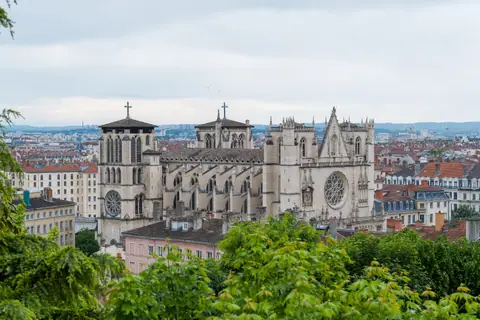
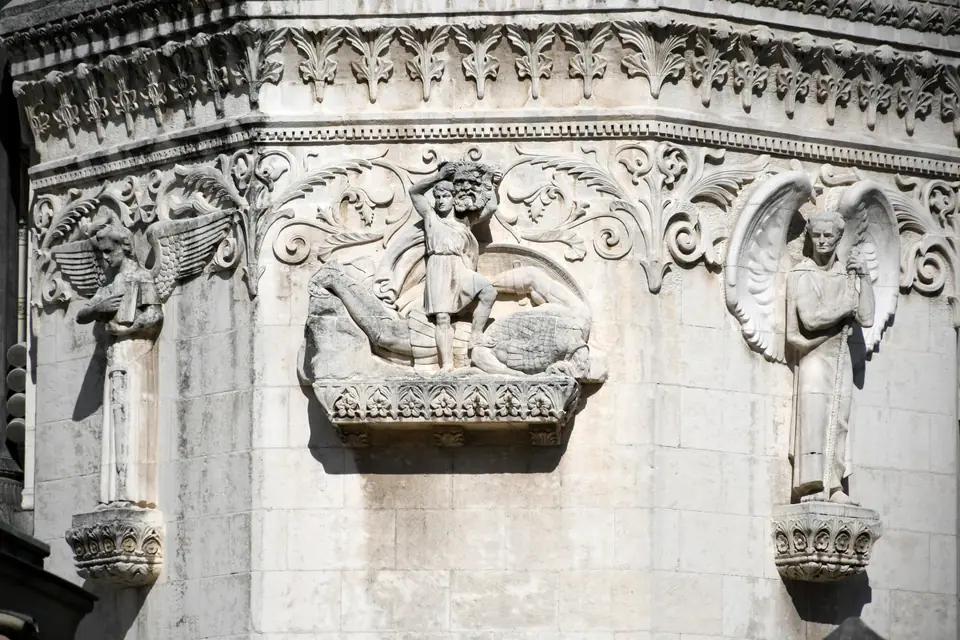
Standing at 8 Place de Fourvière, the Basilica of Notre-Dame de Fourvière took shape between 1872 and 1896 around an 1884 structural shell. Interior mosaics concluded in 1964. Drawing close to 2 million visitors annually, the 86-by-35-metre church rises with four octagonal corner towers and one bell tower. Its severe outer silhouette earned the local nickname upside-down elephant.
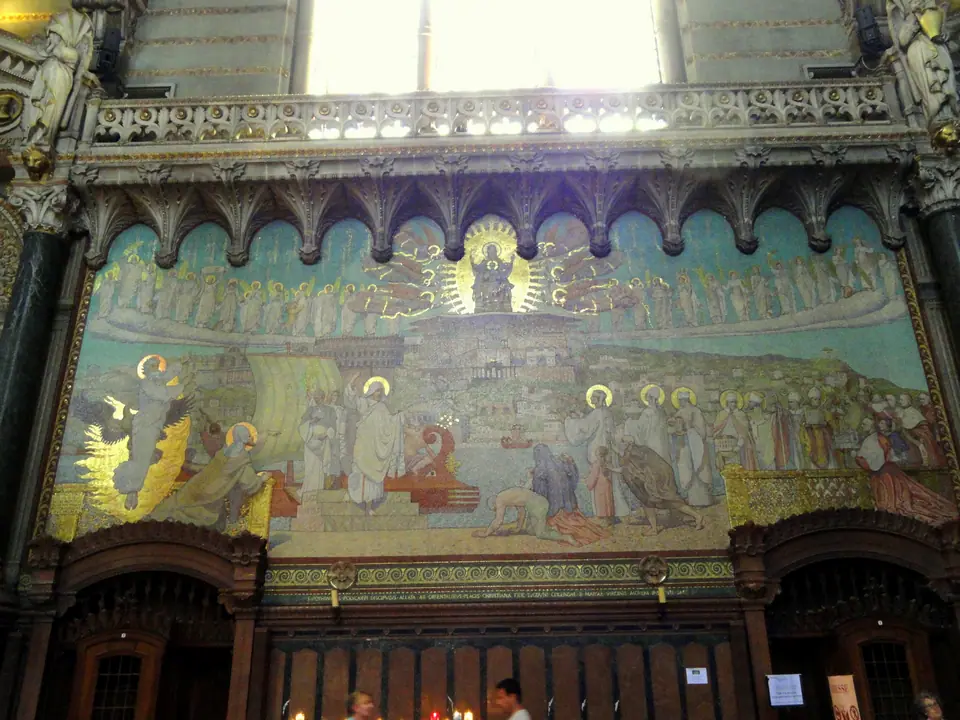
Stepping through the porch replaces that heavy exterior immediately with a luminous two-level sanctuary. Columns of white marble, blue marble, pink granite and green onyx support golden mosaics framing Marian scenes across the upper nave. Below lies the pale stone crypt of Saint Joseph, where side chapels sit in quiet half-light. Resident choir Les Petits Chanteurs de Saint-Marc rehearses nearby, while the adjoining Museum of Sacred Art mounts seasonal exhibitions. Admission to both sanctuary levels stays free daily outside major ticketed special events.
| Fourvière landmark | Key dimensions and dates |
|---|---|
| Basilica construction | 1872 to 1896 structure; interior completed 1964 |
| Basilica footprint | 86 m long, 35 m wide, four corner towers and bell tower |
| Ancient Theatre | c. 15 BC under Augustus; 108 m diameter, ~10,000 seats |
| Roman Odeon | 2nd century AD; 73 m diameter, ~3,000 seats |
| Lugdunum Museum | Opened 1975 by architect Bernard Zehrfuss; 17 Rue Cléberg |
The panoramic esplanade and 345-step roof
Just south-east of the basilica porch stretches the free viewing esplanade that clarifies Lyon's layout in seconds. Orientation dials name landmarks across every quarter below. Clay roofs cover Vieux Lyon, bridges span both parallel rivers, glass towers crown Part-Dieu and winter frost reveals snow peaks toward Mont Blanc. Travellers wanting higher framing can book a guided rooftop climb. That ascent rises 345 spiral steps above the nave vaults onto the Saint-Michel terrace for a wide 180-degree horizon.
Lugdunum: France's oldest Roman theatre
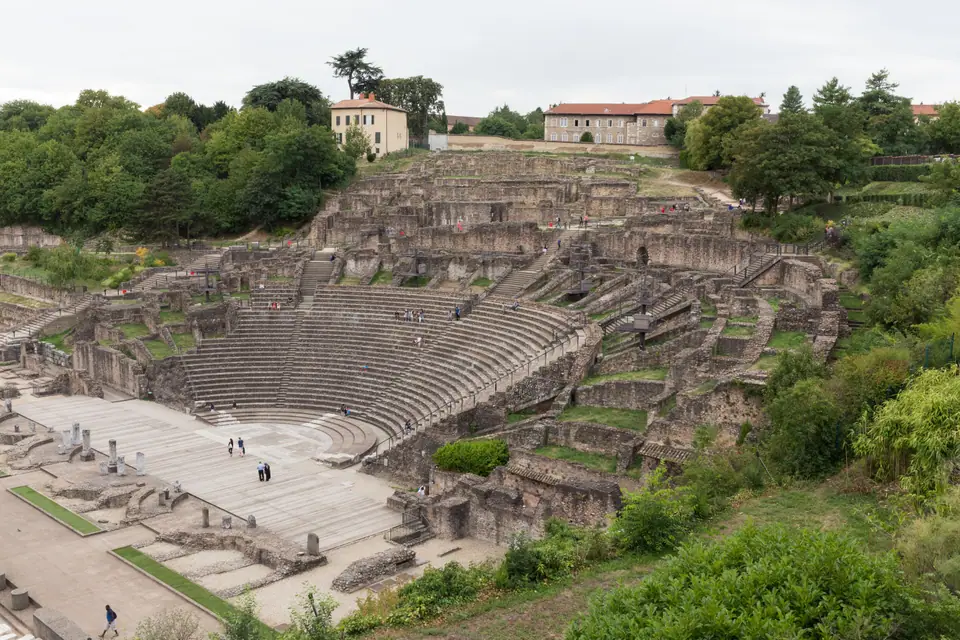
Five minutes south along paved park paths lies Roman Lugdunum, founded on Senate orders in 43 BC under Lucius Munatius Plancus. Rapidly elevated as capital of Gallia Lugdunensis, the hilltop city drew water via extensive stone aqueducts. Future Emperor Claudius was born on this ridge on 1 August 10 BC. Built around 15 BC under Augustus and enlarged under Hadrian, the Ancient Theatre of Fourvière measures 108 metres across. Seating roughly 10,000 spectators, it stands as France's oldest Roman theatre. Beside it sits the smaller second-century AD Odeon, spanning 73 metres for around 3,000 listeners. Delicate coloured marble bands still pattern the Odeon orchestra floor.
Inside the Lugdunum Museum
To keep grass hillsides clear of concrete facades, architect Bernard Zehrfuss sank the 1975 Lugdunum Museum into the slope at 17 Rue Cléberg. Natural daylight drops through angled window cannons onto descending concrete spirals filled with chariot-race mosaics, silver hoards and Roman altars. Its chief artefact is the bronze Claudian Tablet, unearthed on Croix-Rousse in 1528. The surviving lower half preserves Emperor Claudius's AD 48 Senate speech urging Rome to admit Gallic nobles into imperial office.
Summer concerts and free ruins access
Entry to the open-air stone seating tiers of both the Ancient Theatre and Odeon stays free daily throughout the year. Each June and July, stage lights illuminate those Roman tiers after dusk during Les Nuits de Fourvière. Concerts, dance and live theatre unfold high above Vieux Lyon.
Funicular rides uphill and garden descents
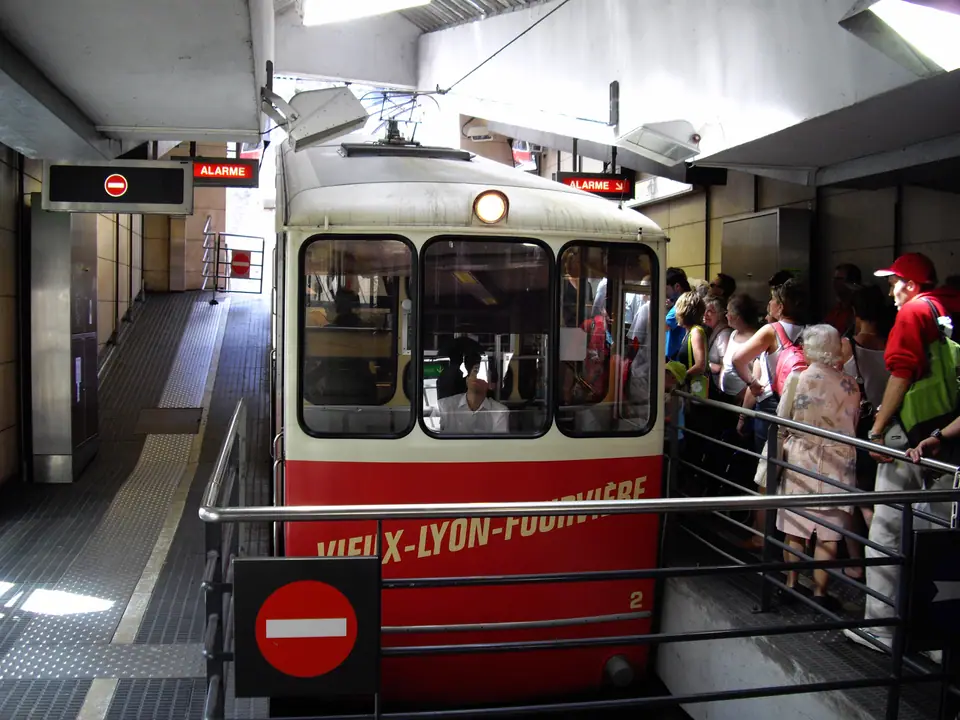
- By F2 funicular: Board inside Vieux Lyon metro station to climb the 431-metre, 30 per cent gradient straight onto Place de Fourvière.
- By F1 funicular: Step off midway at Minimes - Théâtres Romains on the 1878 Saint-Just shaft directly beside the Roman theatre gates.
- Downhill garden descent: Walk downhill through the shaded zigzag beds of Jardins du Rosaire straight into Vieux Lyon. From there, bridges reach the Presqu'île within minutes.
Timing your morning on the hilltop
Reach the basilica terrace soon after breakfast before coach groups fill Place de Fourvière. Stroll south toward the quieter Roman ruins once Lugdunum doors open. Curved stone tiers across the hillside theatre offer quiet ledges for resting between gallery visits. Descending at noon via the shaded Jardins du Rosaire or Montée Saint-Barthélemy puts you smoothly back inside Saint-Jean right before lunch. Pack water and sun hats during summer because stone seating tiers carry almost no midday shade.
Where it is
- 1Fourvière, the Basilica and Roman Lugdunum
- Lyon Saint-Exupéry Airport (LYS) · about 21 km from here in a straight line
- Directions in Google Maps
Stations and taxi ranks: OpenStreetMap. Airports: OurAirports. Distances are in a straight line.
Traveller tips
Real advice from people who have been to Lyon. Every tip is read by our team before it goes live.
No tips yet. Been here? Yours could be the first.
Thank you! Your tip will appear here after a quick review.
More in Lyon
Continue exploring Lyon with related neighbourhood, food, and planning guides