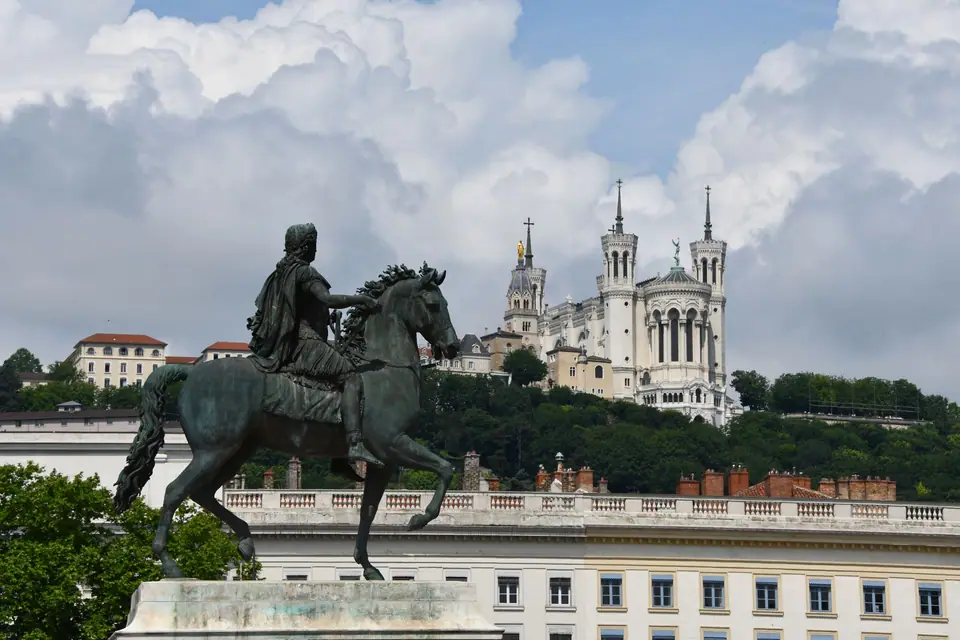
Photo: Herbert Frank · CC BY 2.0
Lyon Orientation: Two Rivers, Traboules & Fourvière
A city shaped by two rivers and two hills, where Roman ruins, silk workshops and traditional bouchons sit within easy reach.
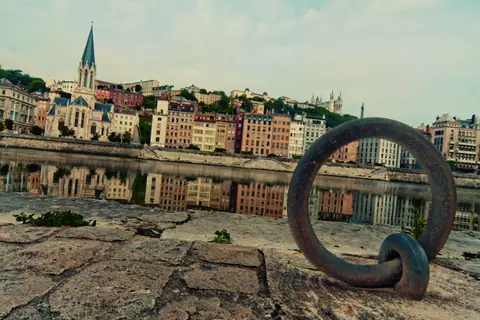
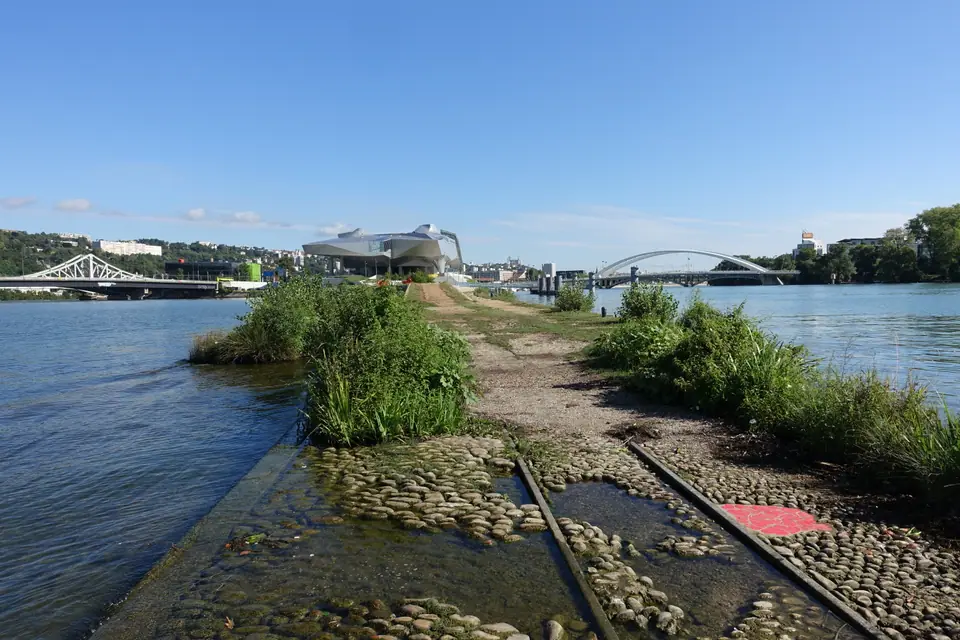
Lyon makes immediate visual sense once its rivers and hills are read together across the map. Two major waterways flow south toward their junction: the fast Alpine Rhône and the calmer Saône, framing a narrow, flat peninsula right between them. Above the outer riverbanks rise two contrasting heights that shaped distinct chapters of urban life. To the west stands Fourvière (foor-vyair), crowned by churches and Roman ruins. To the north climbs Croix-Rousse (krwah-rooss), engineered for silk-weaving workshops.
Knowing those four landforms turns a sprawling regional capital into a walkable route. Footbridges, four underground metro lines and steep hillside funiculars stitch every terrace cleanly together.
Geography, scale and France's river crossroads
Within its municipal border, Lyon held 519,127 residents in 2023, making it the third most populous city in France behind Paris and Marseille. Its broader metropolitan area counted 2,338,789 inhabitants, ranking second nationally only to Paris. Because heavy modern residential growth spread east of the Rhône into suburbs such as Villeurbanne, the historic core feels surprisingly compact on foot.
Situated 425 kilometres south-east of Paris by high-speed rail and 113 kilometres south-west of Geneva, Lyon prospered wherever northern European merchants met Mediterranean river trade climbing the Rhône Valley.
| Measure | Figure | Context |
|---|---|---|
| City population (2023) | 519,127 | Third largest municipality in France |
| Metropolitan population (2023) | 2,338,789 | Second largest metropolitan area in France |
| UNESCO core area (1998) | 427 hectares | Supported by a 323-hectare buffer zone |
| Rail distance from Paris | 425 km | Via LGV Sud-Est to Lyon Part-Dieu |
| Distance to Geneva | 113 km | Straight-line north-east across the Alps fringe |
Two millennia from Lugdunum to UNESCO heritage
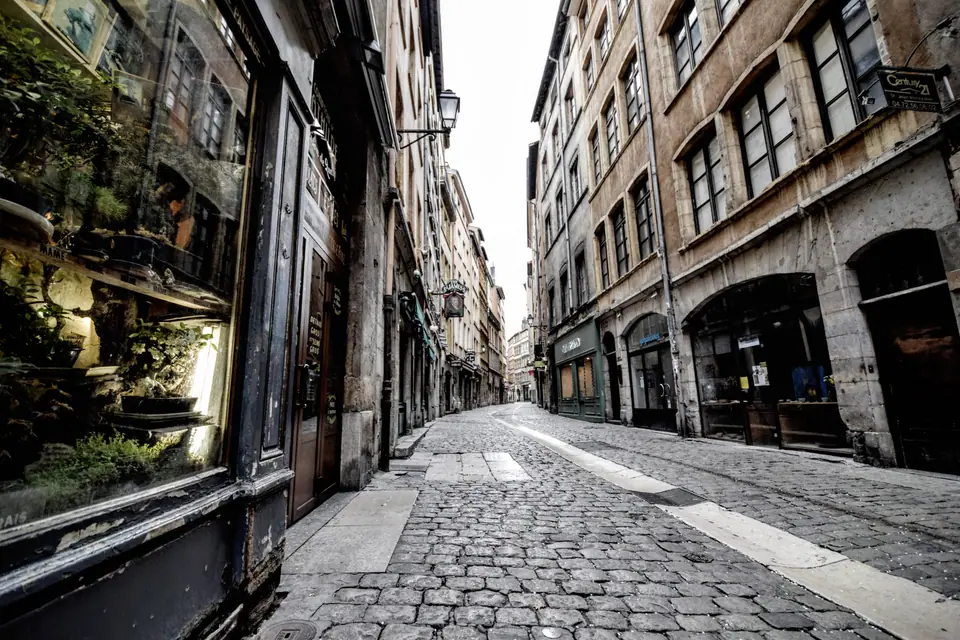
According to Roman historian Cassius Dio, Lucius Munatius Plancus founded the colony of Lugdunum on Fourvière hill in 43 BC. Within a generation, the hillside town served as the administrative capital of Roman Gaul. Centuries later, Renaissance trade fairs attracted Italian bankers and printers to the Saône quays. Merchants raised ochre townhouses pierced by shaded ground-floor passageways known locally as traboules (tra-bool).
During the nineteenth century, mechanised Jacquard looms shifted textile wealth onto Croix-Rousse hill. Then in 1895, Auguste and Louis Lumière filmed workers stepping out of their Monplaisir brick factory. UNESCO inscribed 427 hectares across Fourvière, Vieux Lyon, the Presqu'île (presk-eel) and the Croix-Rousse slopes in 1998, protecting an intact historic urban plan.
The four historic districts on the ground
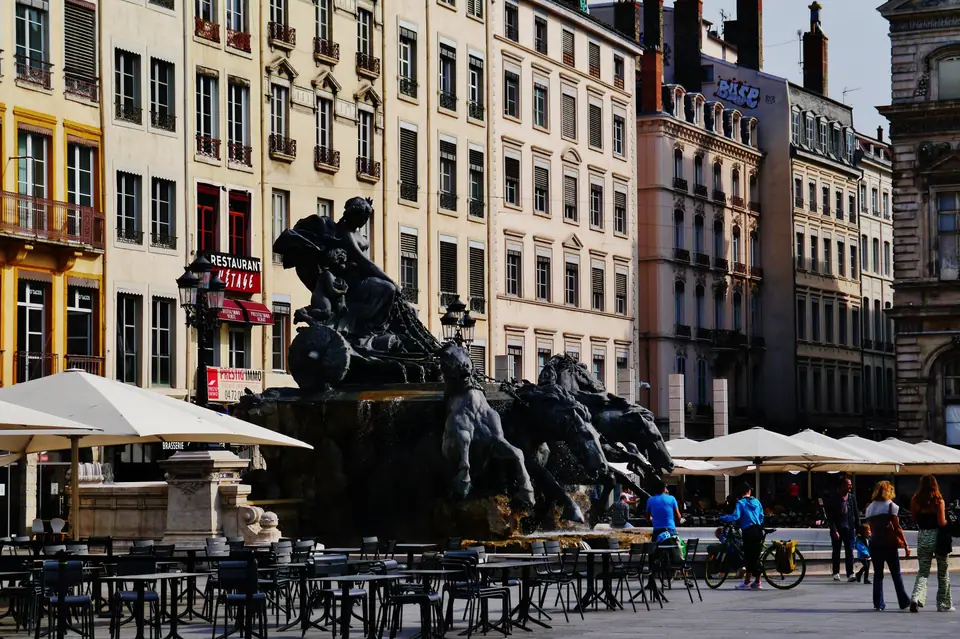
Most visits centre on four neighbouring quarters with sharply different street textures. Beneath the western cliff stretches Vieux Lyon, a tight strip linking medieval Saint-Paul, Saint-Jean's Gothic cathedral and southern Saint-Georges. Directly overhead rises Fourvière, uniting a nineteenth-century white basilica with Roman amphitheatres overlooking both rivers. Across the Saône footbridges, the Presqu'île runs south from Place des Terreaux through Place Bellecour to the modern Musée des Confluences. To the north, Croix-Rousse pairs public staircases with tall weavers' tenements.
| Quarter | Defining character | Principal landmarks |
|---|---|---|
| Vieux Lyon | Medieval and Renaissance river strip | Saint-Jean Cathedral, Longue Traboule, Gadagne |
| Fourvière | Western sanctuary and Roman ridge | Fourvière Basilica, Ancient Theatre, Lugdunum |
| Presqu'île & Confluence | Civic squares and modern tip | Place Bellecour, Hôtel-Dieu, Musée des Confluences |
| Croix-Rousse | Former silk-weaving slopes and plateau | Cour des Voraces, Mur des Canuts, Maison des Canuts |
Pacing your stay across one to four days
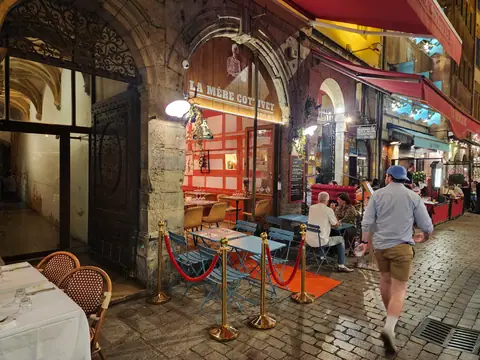
Mealtimes dictate daily pace in Lyon as firmly as monument schedules. Kitchens revolve around proper sit-down lunches and evening tables rather than constant street grazing. One short day covers the Fourvière view, Saint-Jean Cathedral and a quick Saône crossing. Two full days balance Vieux Lyon, the Presqu'île galleries and an unhurried bouchon lunch. Three days add morning silk workshops on Croix-Rousse, Les Halles Paul Bocuse and the Musée des Confluences, while four days reach Beaujolais vineyards or Lake Geneva.
Climbing hills and crossing both rivers
Slope gradients feel demanding after lunch, so let urban transit lift you uphill before descending on foot. Two cable funiculars depart directly from Vieux Lyon metro station up Fourvière hill. Meanwhile, Metro Line C climbs from Hôtel de Ville onto Croix-Rousse using a cog-assisted rail track. Footbridges such as Passerelle du Palais de Justice make crossing between the old town and central peninsula take only minutes, and wide riverside quays host open-air morning food markets along Quai Saint-Antoine. Paved waterfront walkways link quiet medieval alleys straight to busy downtown squares without confusing junctions. Airport trams, TGV links and low-emission rules sit in our transport guide.
Choosing a neighbourhood base
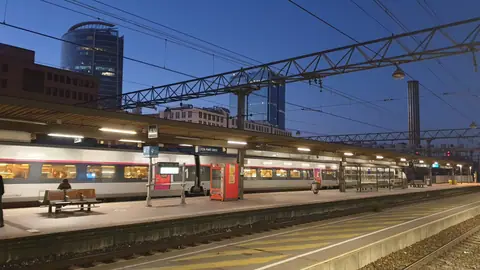
Evening atmosphere shifts noticeably from bank to bank once shops close. Staying on the Presqu'île places Metro Lines A and D right outside flat central avenues near restaurants and theatres. Sleeping in Vieux Lyon grants peaceful dawn walks past medieval courtyards before daytime coaches arrive. Travellers chasing early departures often prefer Part-Dieu blocks beside the main railway station, compared directly in where to stay in Lyon.
Seasons, weather swings and light
July afternoon highs average 28 °C, cooling to brisk 4.8 °C days and misty river mornings in December. Late May and June deliver reliable climbing warmth before summer peaks, whereas wetter autumn afternoons suit indoor museums and long bistro tables. Every December, the four-night Fête des Lumières draws crowds starting on 8 December, outlined in best time to visit Lyon.
Where it is
- 1Lyon
- Lyon Saint-Exupéry Airport (LYS) · about 20 km from Lyon in a straight line
- Directions in Google Maps
Stations and taxi ranks: OpenStreetMap. Airports: OurAirports. Distances are in a straight line.
Traveller tips
Real advice from people who have been to Lyon. Every tip is read by our team before it goes live.
No tips yet. Been here? Yours could be the first.
Thank you! Your tip will appear here after a quick review.
More in Lyon
Continue exploring Lyon with related neighbourhood, food, and planning guides