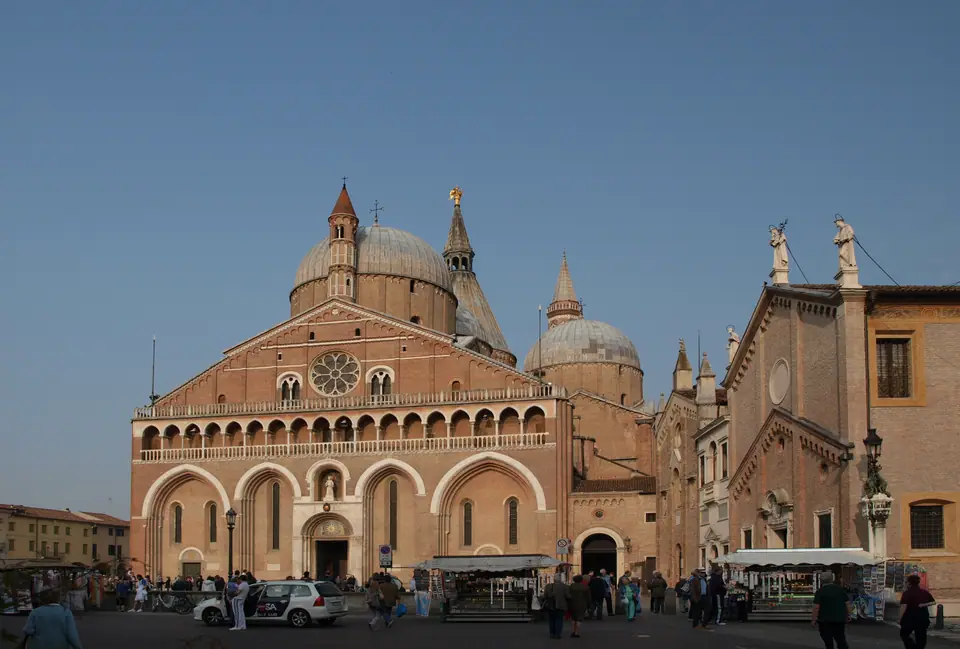
Photo: Petar Milošević · CC BY-SA 3.0
The Basilica of Saint Anthony: Domes, Relics and Donatello
Architectural layers, Tomb Chapel relics, Donatello's High Altar bronze and current 2025 to 2027 Gattamelata workshop updates at Il Santo.
South of Palazzo Bo, eight lead domes and slim brick turrets cluster boldly above open Piazza del Santo. Locals call the pontifical minor Basilica of Saint Anthony simply Il Santo, drawing devout pilgrims worldwide even though Padua's actual Cathedral stands west on Piazza Duomo. Passing its warm Romanesque-Gothic brick facade brings Venetian Byzantine dome geometry, Donatello's groundbreaking Renaissance bronze work and fourteenth-century UNESCO frescoes cleanly together inside one vast church.
Byzantine Domes Rising Around a Medieval Tomb
Born Fernando Martins de Bulhões in Lisbon on 15 August 1195, Franciscan friar Anthony founded a Padua convent in 1229 and quickly earned huge renown for his sermons. Exhausted after intense Lenten preaching, he died on 13 June 1231 aged thirty-five at the Poor Clare house in Arcella. Rapid miracles prompted Pope Gregory IX to canonise him in Spoleto on 30 May 1232. Later, Pope Pius XII named him Doctor of the Church on 16 January 1946, cementing 13 June as Padua's greatest civic feast.
Construction around his modest burial church of Santa Maria Mater Domini began around 1231 to 1232, finishing its core campaign in 1310. Nine radiating Gothic ambulatory chapels and structural additions continued growing into the mid-fifteenth century. Outside, designers blended Saint Mark's-inspired domes with northern Italian brick masonry and minaret-like bell spires. Entry to the basilica stays free daily; check Mass schedules beforehand and cover shoulders and knees cleanly before crossing the porch doors.
Cappella dell'Arca and Parodi's Baroque Reliquary Hall
Pilgrims gather quietly around two deeply contrasting shrines inside, where respectful silence and strict no-photography notices govern every step. Visitors move slowly down side aisles past quiet chapels and carved marble confessionals before pausing inside the northern transept. Faithful guests file behind the saint's green-marble sarcophagus inside Cappella dell'Arca, resting fingertips gently along carved reliefs sculpted by Tullio Lombardo and Antonio Lombardo while murmuring silent prayers.
| Chapel or Complex | Key Dates and Artists | Primary Focus Inside Il Santo |
|---|---|---|
| Tomb Chapel (Cappella dell'Arca) | 1350 translation; Tullio and Antonio Lombardo reliefs | Saint Anthony's tomb shrine in the northern transept |
| Treasury Chapel (Relics) | 1691 Filippo Parodi Baroque sculpture; 1350 and 1436 cases | Incorrupt tongue (discovered 1263), jawbone, vocal folds |
| High Altar (Presbytery) | Begun 1443 by Donatello; 1515 Andrea Briosco candelabrum | Bronze Virgin and Child, six saints, Passion reliefs |
| Chapel of San Giacomo | 1370s Altichiero da Zevio for Bonifacio Lupi | UNESCO Reference 1623 narrative fresco cycles |
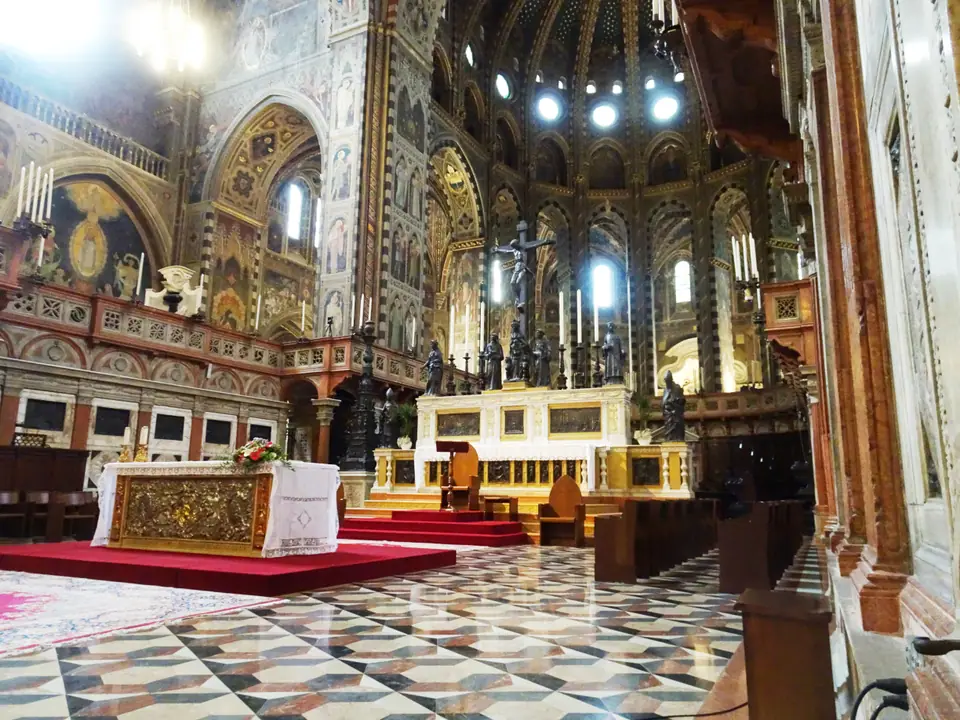
Circle behind the sanctuary apse to enter the exuberant Baroque Treasury Chapel carved in dramatic white marble by Filippo Parodi in 1691. Central reliquaries preserve Saint Anthony's Franciscan habit and wooden coffin beside his jawbone (crafted in Padua in 1350) and vocal apparatus. Famous above all sits his incorrupt tongue, found intact during Saint Bonaventure's 1263 exhumation and housed in Giuliano da Firenze's Gothic 1436 vessel. Fabric stewardship remains led by the Veneranda Arca, chartered back in 1396.
Donatello's High Altar Bronze and San Giacomo
Walk toward the central presbytery rail to examine how Florentine master Donatello permanently transformed northern Italian sculpture after arriving in Padua in 1443. His majestic bronze High Altar ensemble groups a calm Virgin and Child with six expressive saints, four dramatic miracle reliefs and a poignant stone-and-bronze Deposition. Pause beside the nave rail to trace sharp architectural perspective lines Donatello cast in low bronze relief. Look nearby for Andrea Briosco's tall 1515 bronze Easter Candelabrum beside the choir steps. On surrounding sanctuary walls, Lodovico Pogliaghi's shimmering mosaics executed between 1927 and 1936 frame side chapel arcades.
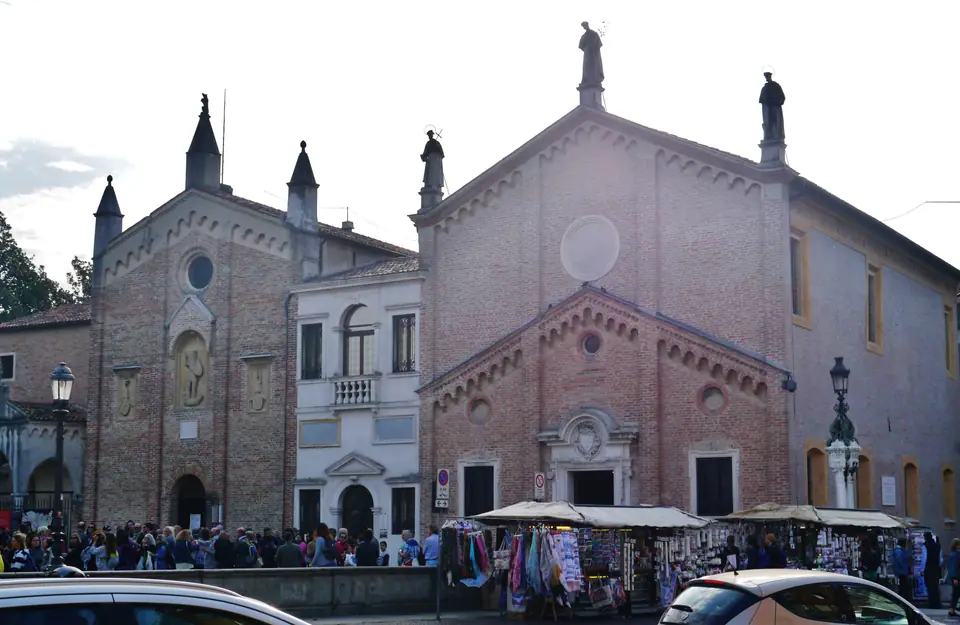
Opposite the Tomb Chapel in the southern transept shines the frescoed Chapel of San Giacomo, commissioned by Bonifacio Lupi and painted in the 1370s by Altichiero da Zevio. Seek out Rainaldino di Puy-l'Évêque's revered 1396 Madonna Mora sculpture before strolling through peaceful green cloister gardens under the domes. Outside on Piazza del Santo, warm brick gables mark the adjoining Oratory of Saint George (frescoed by Altichiero between 1379 and 1384) next to the historic Scuola del Santo.
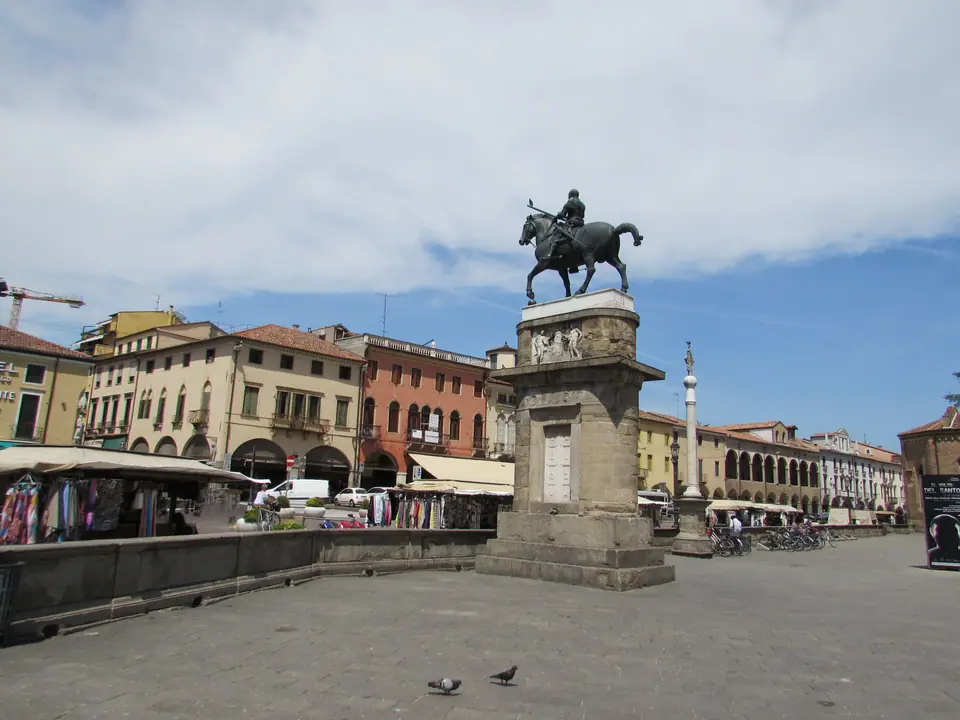
Gattamelata's Temporary Workshop at Boito
Directly outside the basilica porch sits the trachyte and Istria stone pedestal built for Donatello's 1447 to 1453 statue of Venetian general Erasmo da Narni, known as Gattamelata (died 1443). Cast as the first life-size equestrian bronze cast since antiquity (340 by 390 centimetres astride a 780-by-410-centimetre stone base), the sculpture left its outdoor plinth on 8 and 9 October 2025. Conservators lifted it in only its third removal across nearly six centuries, after World War I and World War II safekeeping.
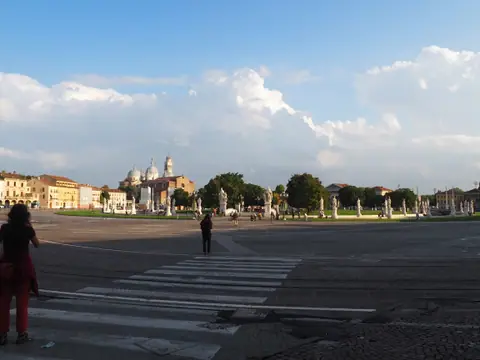
Severe bronze cancer threatened the 450-kilogram rider and 1,600-kilogram horse, prompting partners including the Pontifical Delegation, Save Venice, Friends of Florence, ICR and the University of Padua to launch major conservation. Save photography for sunlit outer courtyards away from quiet prayer halls inside. Visitors can check access schedules for the temporary viewing workshop inside the former Boito Civic Museum, where technical work continues into 2027. After stepping out past green basilica cloisters and brick courtyard arches, stroll peacefully south toward Prato della Valle and Padua's Botanical Garden or rest along quiet Via del Santo cafés.
Where it is
- 1The Basilica of Saint Anthony
- Treviso Airport (TSF) · about 37 km from here in a straight line
- Directions in Google Maps
Stations and taxi ranks: OpenStreetMap. Airports: OurAirports. Distances are in a straight line.
Traveller tips
Real advice from people who have been to Padua. Every tip is read by our team before it goes live.
No tips yet. Been here? Yours could be the first.
Thank you! Your tip will appear here after a quick review.
More in Padua
Continue exploring Padua with related neighbourhood, food, and planning guides