Photo: Twice25 · CC BY-SA 3.0
The Scrovegni Chapel: Giotto, Reservation Rules and Climate Lock
Historical background, wall-by-wall reading plan and mandatory CTA climate chamber booking rules for Giotto's Scrovegni Chapel.
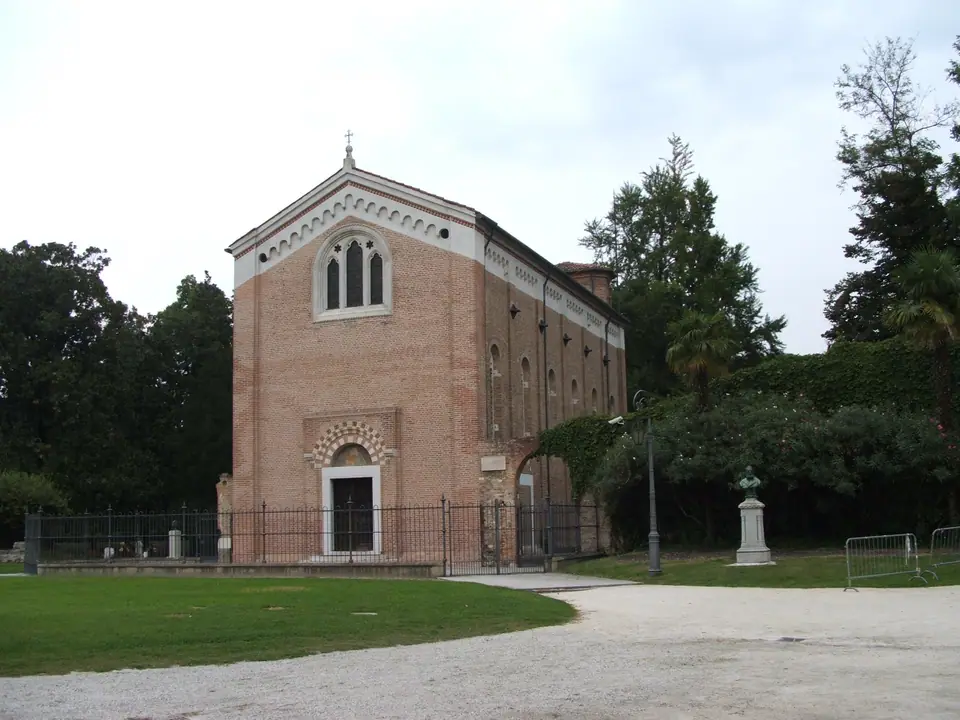
Barely twenty metres long behind unassuming terracotta brickwork in Giardini dell'Arena, Cappella degli Scrovegni marks the dramatic shift from flat medieval symbols to breathing human emotion in European painting. Plain brick exterior walls beside quiet park lawns preserve modest simplicity, leaving new visitors visibly startled by the saturated lapis colour waiting indoors. Between 1303 and 1305, Florentine master Giotto di Bondone transformed plain chapel plaster into urgent narrative depth. Entering requires advance reservation, exact punctuality and a short climate wait, yet few interiors in Italy repay careful preparation so deeply.
Enrico Scrovegni's 1300 Arena Purchase and Atonement
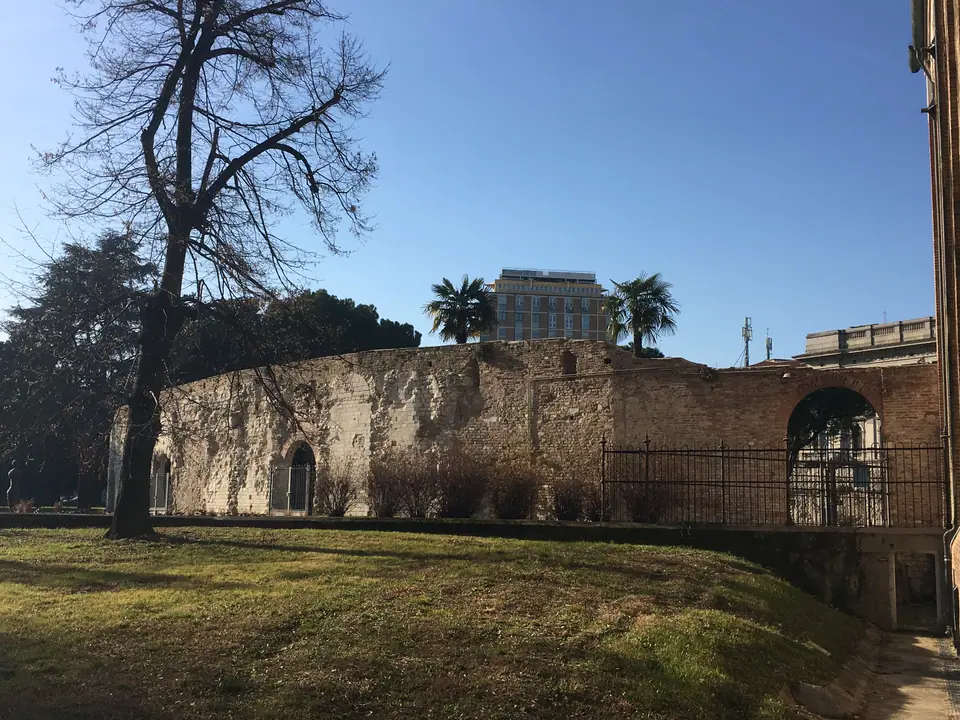
Wealthy Paduan banker Enrico Scrovegni bought grounds inside the ancient Roman Arena amphitheatre from Manfredo Dalesmanini on 6 February 1300 to raise a private funerary oratory beside his family palace. Dedicated to Santa Maria della Carità and approved by Bishop Ottobono dei Razzi before 1302, masons built the chapel cleanly atop ancient stone foundations. Dante Alighieri famously placed Enrico's father Reginaldo Scrovegni among condemned usurers in Canto 17 of the Inferno. That biting literary portrait shaped lasting interpretations of Enrico's commission as costly spiritual atonement.
Workmen celebrated an initial consecration on the Feast of the Annunciation on 25 March 1303 before Pope Benedict XI granted official indulgences on 1 March 1304. Neighbouring Eremitani friars protested formally in January 1305 against what looked less like a modest private chapel than a proud rival church. Definitive consecration followed on 25 March 1305 accompanied by a ceremonial motet attributed to Marchetto da Padova. Giotto (born around 1267) painted the ensemble with roughly forty workshop assistants across about 625 working days (giornate).
History nearly erased the chapel after Enrico's adjoining palace fell to demolition in 1827. City councillors debated urgent preservation on 10 May 1880 and purchased the building directly in 1881 to stop damp structural collapse. External reinforcement completed in 2000 enabled comprehensive fresco conservation led by Giuseppe Basile from June 2001 until March 2002. In July 2021 at its 44th session, UNESCO inscribed the building under Reference 1623 (criteria ii and iii) anchoring Padova Urbs Picta.
Three Fresco Registers Under Giotto's Starry Vault
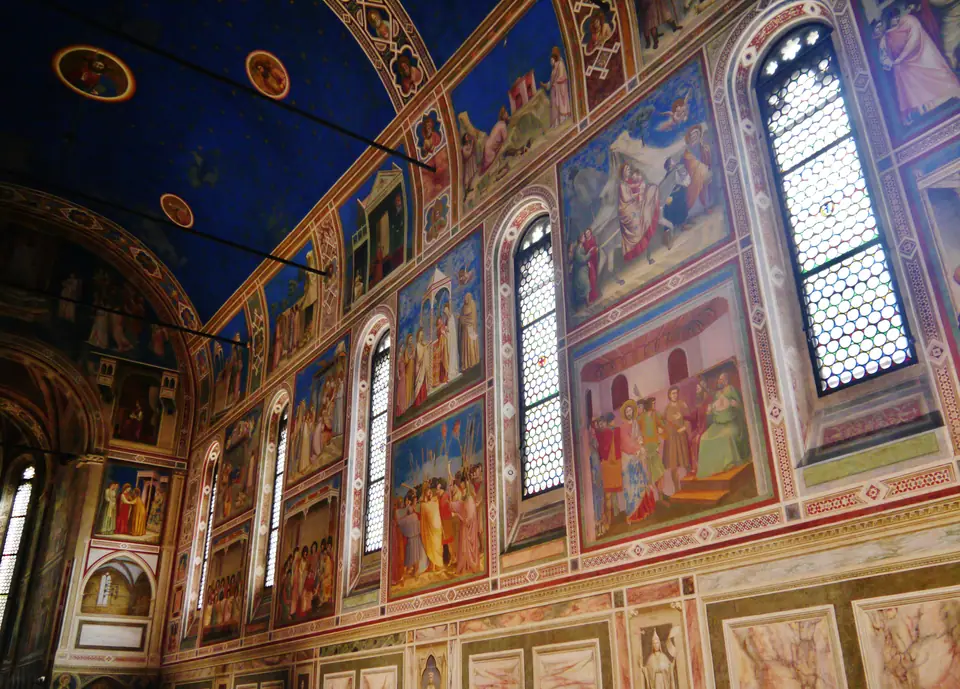
The compact barrel-vaulted nave measures 20.88 metres long, 8.41 metres wide and 12.65 metres high. Six slender lancet windows slice down the sunlit south flank, illuminating a 4.49-by-4.31-metre square apse extended by a 2.57-metre pentagonal choir. Overhead sits a saturated lapis-lazuli blue vault studded with stars and eight medallions framing Old Testament prophets plus John the Baptist. Read the painted walls systematically from top to bottom rather than drifting aimlessly once viewing time begins ticking.
Upper panels on both sides narrate the tender lives of Joachim, Anna and the Virgin Mary, opening naturally toward the triumphal arch Annunciation (230 by 690 centimetres). Middle and lower tiers trace Christ's Nativity, ministry, betrayal and Passion across uniform 200-by-185-centimetre compartments filled with sorrow, sculpted drapery folds and expressive gestures. Near the chancel arch, painted fake choir alcoves fool the eye into seeing stone vaults receding behind flat plaster. Along the lowest dado, fourteen crisp monochrome grisaille paintings pit seven pale grey Vices on the chilly north wall against seven matching Virtues warmed by south light.
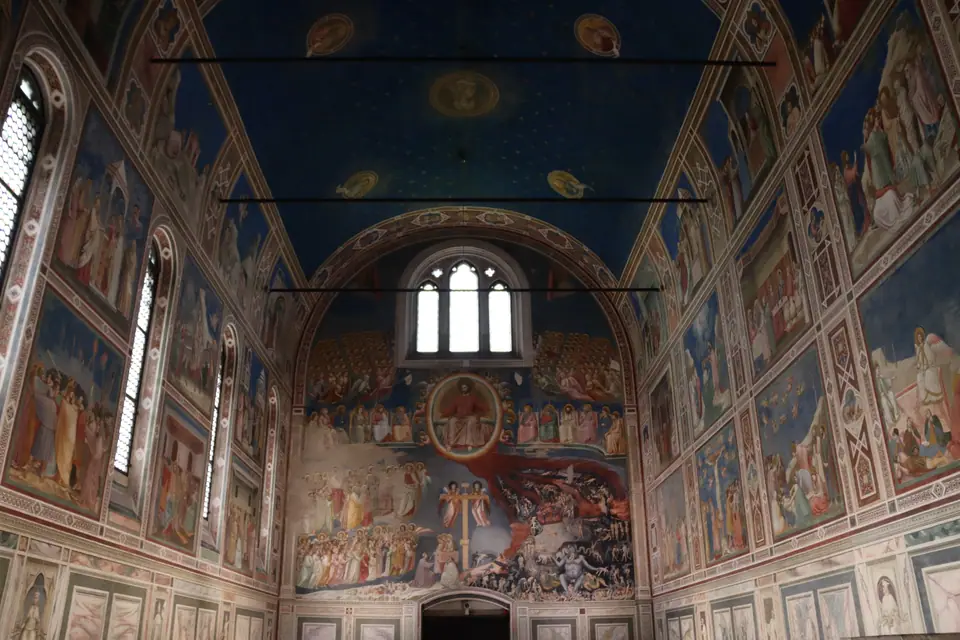
Reserve your last quiet minutes inside to face squarely backward toward the western entrance wall. Spreading across 1,000 by 840 centimetres (nearly eighty-four square metres), Giotto's colossal Last Judgement places Enrico Scrovegni himself at centre-bottom kneeling beside the Virgin Mary. Look closely as the banker presents a miniature carved model of his completed chapel directly opposite fierce red devils dragging tormented usurers into hell.
CTA Climate Lock, Locker Rules and Timed Slots
Strict humidity preservation protects Giotto's fragile plaster, making spontaneous visits nearly impossible. Book timed entry weeks ahead online through the official chapel site or attach mandatory slot reservations onto your Padova Urbs Picta Card. Verify current prices and opening timetables on official listings, and arrive at Piazza Eremitani early because latecomers forfeit scheduled slots without refunds. Building in extra buffer before check-in lets you pick up printed barcoded tickets calmly without sprinting across park paths.
Every visitor deposits coats, umbrellas, camera bags and rucksacks into free lockers at the museum entrance before scanning passes. Keeping a light pocket ready holds locker tokens and ticket stubs securely without delaying queues. Groups up to 25 people gather inside an air-filtered chamber called the Corpo Tecnologico Attrezzato (CTA) for an exact 15-minute stabilisation wait. Sealed filters shed body moisture while a short film introduces Giotto's visual cycle clearly. Doors then open onto your exact 15-minute viewing inside the painted nave (30 minutes total indoors), releasing visitors outdoors past Roman Arena stone piers.
Save unhurried time after stepping back out into daylight. Paired entry unlocks the adjoining Musei Civici Eremitani right across the paved courtyard. Quiet monastic cloisters guide guests smoothly through Roman archaeological halls, antique lapidary fragments, Venetian paintings inside the Pinacoteca and onward downtown squares.
Where it is
- 1The Scrovegni Chapel
- Treviso Airport (TSF) · about 36 km from here in a straight line
- Directions in Google Maps
Stations and taxi ranks: OpenStreetMap. Airports: OurAirports. Distances are in a straight line.
Traveller tips
Real advice from people who have been to Padua. Every tip is read by our team before it goes live.
No tips yet. Been here? Yours could be the first.
Thank you! Your tip will appear here after a quick review.
More in Padua
Continue exploring Padua with related neighbourhood, food, and planning guides