The Medina of Tunis and Avenue Habib Bourguiba
Guild souks, Husainid palaces and rooftop terraces in the medieval Medina, plus French-era Centre Ville.
Inscribed as a UNESCO World Heritage site in 1979, the Medina of Tunis contains more than seven hundred monuments, including palaces, mosques, medersas (theological colleges), mausoleums and vaulted souks dating from the Almohad, Hafsid, Ottoman and Husainid eras. Immediately outside its eastern gate of Bab el-Bhar (Porte de France), the medieval labyrinth gives way at a single step to the wide grids and Art Deco facades of the 19th- and 20th-century Centre Ville.
Zitouna Mosque and the traditional craft souks
At the physical and spiritual heart of the Medina stands the Ez-Zitouna Mosque (Mosque of the Olive Tree), founded in 698 AD and rebuilt in the 9th century under the Aghlabids using 184 antique Roman and Byzantine marble columns salvaged from Carthage. Non-Muslim visitors cannot enter the prayer hall, but in the morning you can view the colonnaded courtyard from the eastern gallery or climb to the tiled rooftop terrace of a neighbouring former caravanserai (such as Café Panorama) for mint tea studded with floating pine nuts (thé aux pignons) beside the minaret.
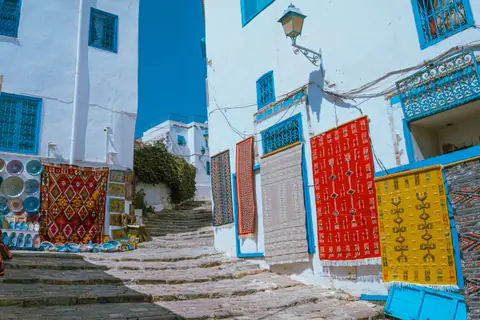
Radiating directly off the mosque walls are the historic guild souks, where the noblest trades were placed closest to the sanctuary:
- Souk el-Attarine (Perfumers' Souk): built in the 13th century, lined with tiny alcoves selling distilled orange-blossom water, rosewater, jasmine essence, incense and solid ambergris.
- Souk ech-Chaouachine: just west toward the Kasbah, master artisans knit, boil, felt and block the traditional crimson woollen chechia cap introduced by Andalusian Moors in the 17th century.
- Souk el-Berka and Souk des Étoffes: a vaulted square resting on painted columns where goldsmiths and jewellers trade beside silk and wool drapers.
Husainid palaces, medersas and Place de la Kasbah
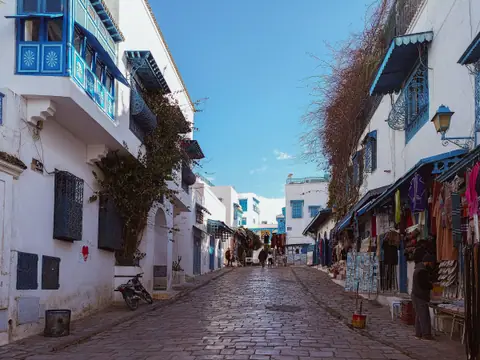
Beyond the souks, follow the residential lanes painted white with yellow-ochre stone door frames configured in black-and-white nail patterns. Step inside Dar Lasram, an early-19th-century mansion blending Italianate marble columns with Andalusian stucco and Qallaline glazed tiles, and visit the green-domed royal mausoleum of Tourbet el-Bey and the 17th-century courtyards of Medersa Slimania and Medersa el-Bachia. At the top of the hill, the Medina opens onto Place de la Kasbah, anchored by the 1230 Almohad minaret of the Kasbah Mosque.
Bab el-Bhar, Avenue Habib Bourguiba and the Marché Central
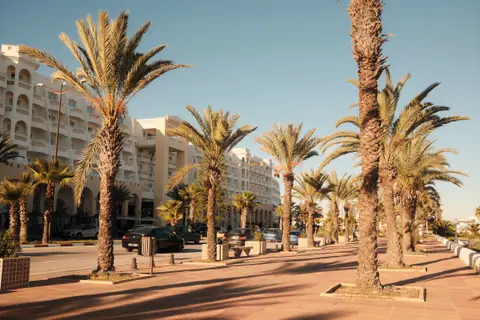
Exit east through Bab el-Bhar onto Place de la Victoire and walk down Avenue Habib Bourguiba, shaded by ficus trees past the twin towers of the 1897 Cathedral of St Vincent de Paul, the white Art Nouveau facade of the Théâtre Municipal (1902) and the morning fish and spice halls of the Marché Central. Continue your history walk at the Bardo National Museum.
Traveller tips
Real advice from people who have been to The Medina of Tunis and Avenue Habib Bourguiba. Every tip is read by our team before it goes live.
No tips yet. Been here? Yours could be the first.
Thank you! Your tip will appear here after a quick review.
More in Tunis
Continue exploring Tunis with related neighbourhood, food, and planning guides