Fushimi Inari Shrine Hike
A walk up a sacred mountain in southern Kyoto through tunnels of vermilion torii gates, free and open at any hour.
Overview
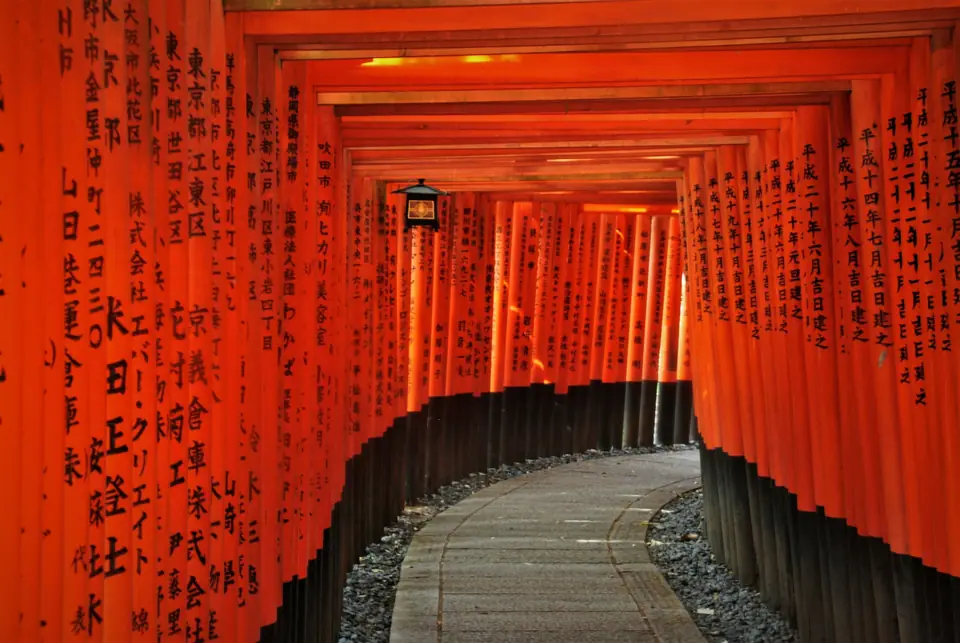
Fushimi Inari Taisha is the head shrine of Inari, the Shinto deity of rice, harvests and business, and the mountain behind it is the shrine. The paths that climb Mount Inari are lined with thousands of vermilion torii, each one given by a company, a family or a single person, with the donor's name and the date painted in black on the back. Walking up through them is the experience. There is no ticket, no gate that shuts at night and no set route you must follow, which is exactly why it rewards a bit of planning.
The torii tunnels
Just behind the main halls, the path splits into the Senbon Torii ("thousand gates"), two parallel corridors of gates set so close together that the light comes through in stripes. This is the stretch in every photograph, and it is also the shortest and most crowded part of the walk. Many visitors get no further. Above it, the gates continue up the mountain for kilometres, sometimes in tight tunnels, sometimes spaced out along stone steps, with small sub-shrines, stone foxes and stacks of miniature torii left as offerings.
Yotsutsuji or the full loop
The real decision is where to turn round. The Yotsutsuji crossroads, roughly half way up, has a small tea house and an open view over southern Kyoto towards the city centre. Most people climb this far, look out, and go back down. It takes about an hour to an hour and a half there and back.
Above Yotsutsuji a loop runs round the upper mountain and over the summit, Ichinomine, at 233 metres. It adds about an hour and a lot of steps, and the top has no view at all, just a cluster of shrines in the trees. What you get instead is quiet: the crowds thin sharply above the crossroads, and the upper tunnels in the forest feel more like a place of worship than a photo set. For our full route description, see the Fushimi Inari guide.
A working shrine
This is not a museum. People come to pray for their businesses, shop owners leave offerings, and priests hold rituals in the main halls. The foxes you see everywhere, in stone and bronze, are Inari's messengers, not the god itself. Many carry something in their mouths: a jewel, a scroll, a sheaf of rice or the key to a rice granary.
Who it suits
Almost anyone who can manage stairs. The lower tunnels are fine with children and older travellers, and nobody needs to go further than they want. The full loop suits people who like a walk and want an hour away from Kyoto's crowds. It is less suited to anyone with bad knees, to pushchairs above the first stretch, or to a midday visit in July and August, when the steps are hot and humid and there is little shade low down.
How to Book
You don't need to book anything. The shrine grounds are open 24 hours and entry is free, so you can simply turn up. Offices, amulet counters and the tea houses on the mountain keep shorter hours, so check the official site if you want to buy a charm or have a prayer said.
Getting there is easy. The JR Nara line runs two stops from Kyoto Station to Inari Station, which faces the shrine's first torii. The Keihan line's Fushimi-Inari station is a few minutes' walk away and is the better choice from Gion and the eastern side of the city.
Guided walks are sold by many companies, often as early-morning tours or combined with other southern Kyoto sights. They suit people who want the history and symbols explained, but they are not needed to find the way. If you book one, look for:
- A start time before the crowds, ideally soon after sunrise.
- A clear note on how far up the walk goes (Yotsutsuji or the summit).
- Small group size, since the tunnels are narrow.
- Free cancellation, as rain makes the upper steps slippery.
For the seasons and crowd levels across the year, see our best time to visit guide.
Tips
- Go at dawn or in the evening. Before 8am the Senbon Torii is nearly empty. After dark the lower paths are lit and very atmospheric, but carry a torch higher up and don't go to the summit alone at night.
- Bow at the torii and rinse your hands at the water basin near the main hall, left hand, right hand, then a little water into your cupped hand for the mouth. Nobody will scold you for getting it wrong.
- Don't touch, lean on or write on the gates, and leave offerings where they are.
- Keep your voice down near people praying, and step aside for photos rather than blocking the tunnel.
- Wear shoes with grip. Our what to wear guide explains why sandals are a poor idea here.
- Carry water. There are vending machines on the way, and they get pricier the higher you climb.
Reviews
Log in to write a review.
No reviews yet.