Athens Acropolis and Plaka Guide: Ancient Sites, Old Lanes and Tavernas
How to see ancient Athens and its oldest neighbourhood in the right order: the Acropolis, the museum, the Agora, the lanes of Plaka and where to eat.
Few cities wear their age as openly as Athens. A limestone hill crowned with a marble temple rises out of a sea of apartment blocks, and around its foot lie the markets, theatres, libraries and lanes where the ancient Greeks argued, traded and invented ideas that still shape the world. Democracy, drama, philosophy and the Olympic Games all have roots in this small area, and you can walk between the places where they happened in an afternoon.
The centre of Athens is compact, noisy and sometimes rough at the edges, but its heart is a rewarding place to explore on foot. This guide covers the Acropolis, the new museum at its foot, the Ancient Agora, and the neighbourhoods of Plaka, Anafiotika and Monastiraki, with a sensible route, advice on avoiding the worst of the heat and the crowds, and notes on where to eat, stay and get your bearings.
Ancient Athens in one glance
- How long? One full day covers the Acropolis, the museum and a stroll through Plaka. Two days let you add the Agora, the Temple of Olympian Zeus and a slow evening.
- Where to start? At the Acropolis, as early as you can manage, before the sun and the tour groups arrive.
- The signature view: the Parthenon from the Areopagus rock or from a rooftop bar at sunset.
- The best free sights: the lanes of Plaka, the pedestrian promenade at the foot of the Acropolis, Hadrian's Arch and the exterior of the major monuments.
- The classic evening: dinner in a taverna with a view of the floodlit rock.
- The biggest mistake: climbing the Acropolis in the middle of a summer afternoon.
- When to go: spring and autumn, covered in our best time to visit Athens guide.
- Where to sleep: Plaka or Koukaki for walking distance, or Syntagma for transport. More in our Athens where to stay guide.
The route that works: climb the Acropolis first, drop down to the museum, walk through the Agora and Monastiraki, and finish in the lanes of Plaka at dusk. Our Athens 3-day itinerary shows how it fits into a longer stay, and the Acropolis guide and Plaka guide cover the two main areas in detail.
A map of the old centre
The historic centre of Athens is a triangle bounded by the Acropolis to the south, Syntagma Square to the north-east and Monastiraki to the north-west. Plaka occupies the slopes on the north and east side of the rock, Koukaki and Makrygianni lie to the south, and the ancient marketplace, the Agora, stretches out beside Monastiraki. A broad pedestrian promenade, Dionysiou Areopagitou, wraps around the south and west flanks of the Acropolis and links most of the major sights.
Because everything is on or around the rock, you will always have a landmark. The floodlit Parthenon can be seen from dozens of streets, and if you lose your bearings you can usually spot it above the rooftops. The slopes are steep and the pavements are polished smooth, so sturdy shoes matter more than a guidebook.
The Acropolis
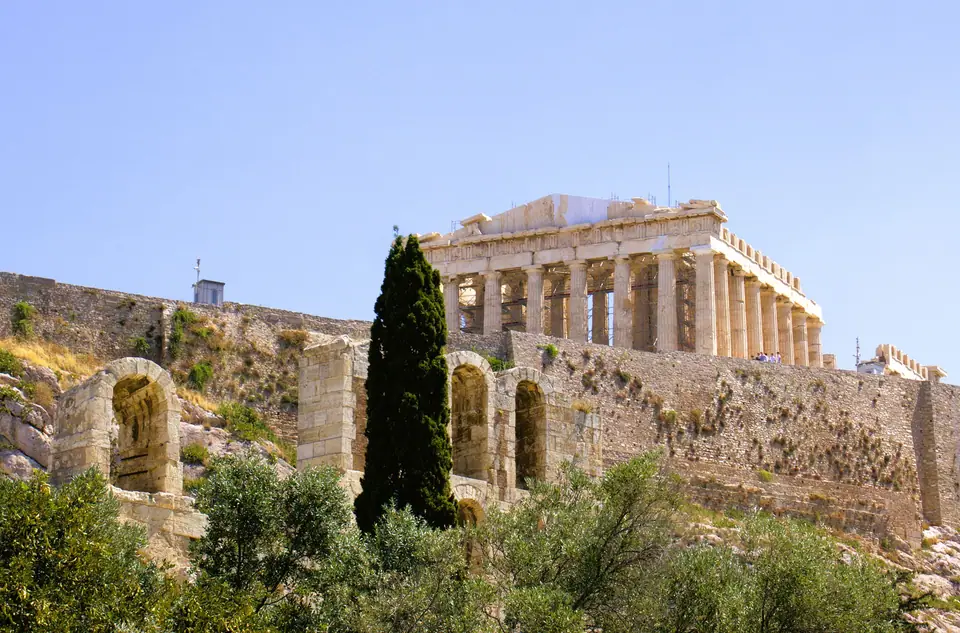
The Acropolis is the reason most people come to Athens, and it lives up to its reputation. The rock was a fortress and a sanctuary for thousands of years, and in the fifth century BC the statesman Pericles launched a building programme that produced the temples we see today. At the summit, the Parthenon, dedicated to the goddess Athena, is the most famous: a vast Doric temple whose columns curve subtly to correct the eye, so that the lines look perfectly straight.
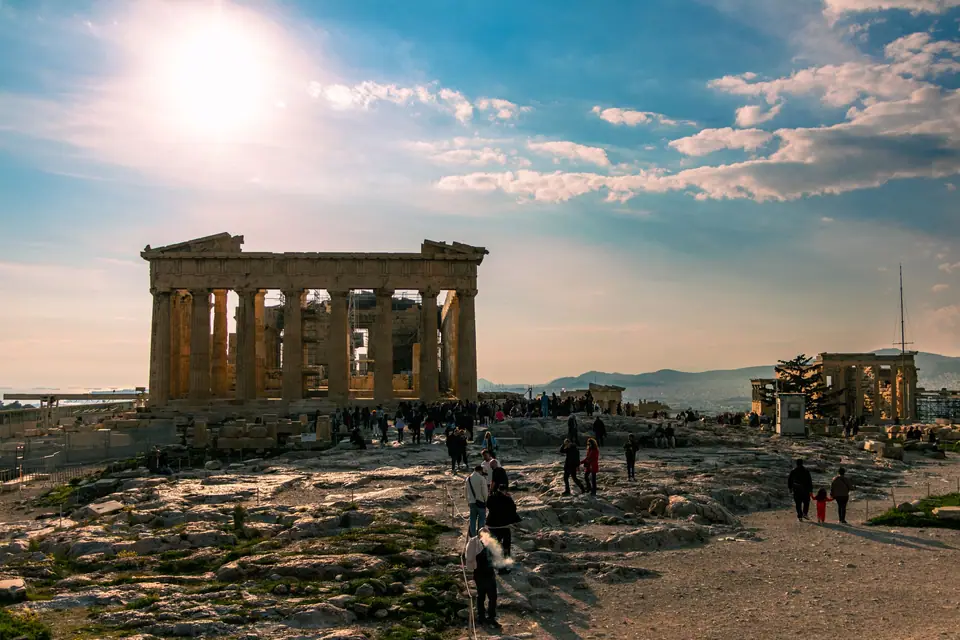
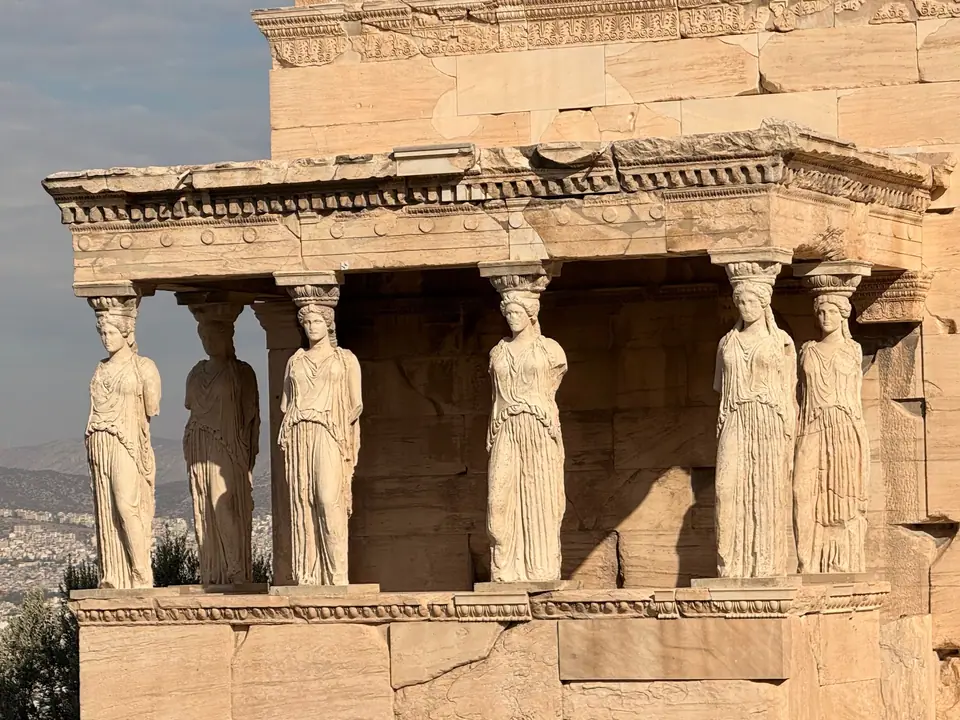
The path to the top passes through the Propylaia, the monumental gateway, and by the small temple of Athena Nike. On the north side, the Erechtheion is known for its porch of six female statues, the Caryatids. The ones on the rock are copies, and the originals are inside the museum nearby. Information boards describe what you are looking at, and a guided tour, such as our Acropolis guided tour, brings the stories to life.
Visit as early as you can. In summer the marble reflects the heat and the glare is intense, there is almost no shade, and the narrow paths become packed in the late morning. Take water, a hat and sunglasses, and wear shoes with a firm grip, since the stone is worn and slippery. Bags and large items may be restricted, and the site can close in extreme heat, so keep a flexible plan.
The theatres on the slope
On the south side of the rock, two theatres are easy to overlook. The Theatre of Dionysus is the oldest in the world, the place where the great tragedies of Aeschylus, Sophocles and Euripides were first performed. Its stone seats and carved front-row thrones can still be seen. Further west, the Odeon of Herodes Atticus is a Roman-era concert hall that still hosts performances in summer under the stars, with the Acropolis walls as its backdrop.
Both are included in the combined ticket for the main ancient sites, which also covers the Ancient Agora, the Roman Agora, Hadrian's Library, the Temple of Olympian Zeus and several other monuments. Buying the combined ticket early, and spreading the sites over several days, is the simplest way to see them without rushing.
The Acropolis Museum
At the foot of the rock, the Acropolis Museum is one of the finest museums in Europe and a natural companion to the climb. The glass and concrete building floats on pillars above an excavated ancient neighbourhood, which you can see through glass floors as you enter. Galleries lead up through the archaic, classical and later periods, and the top floor is devoted to the Parthenon, with a glass hall oriented to match the temple itself and a frieze that you can see at eye level.
Some of the frieze sculptures are plaster casts, since the originals were removed in the early nineteenth century and are in the British Museum, a dispute that Greece continues to raise. The museum is air-conditioned, which makes it a very welcome stop in the middle of the day. Its restaurant terrace has one of the best views of the Parthenon in the city, so plan a coffee or a lunch there.
Plaka: the neighbourhood of the gods
Plaka, spread over the northern slopes of the Acropolis, is the oldest continuously inhabited neighbourhood in Athens and for many visitors the prettiest. Its lanes are lined with neoclassical houses painted in ochre, pink and white, with bougainvillea tumbling over the balconies, tiny churches on every corner and tavernas with tables spilling into the street. It is entirely pedestrian in the old core, so the pace is relaxed.
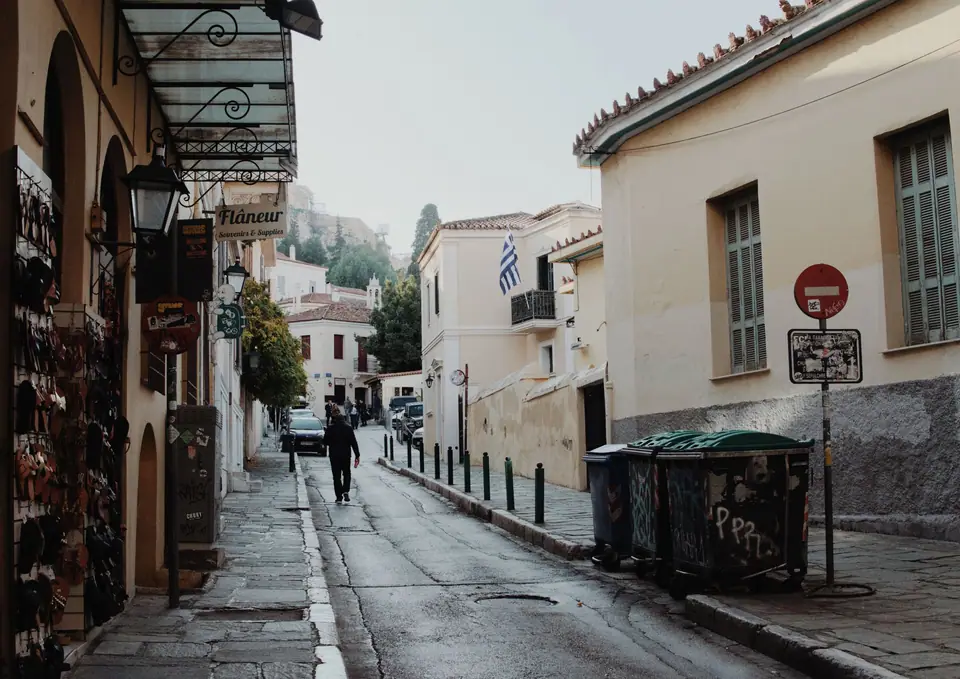
Plaka has become touristy, and the main streets near Monastiraki are lined with souvenir shops and restaurants of mixed quality. Move away from the busiest lanes and you reach quieter corners with small museums, Byzantine churches and local cafes. The Monument of Lysicrates, a small circular monument from the fourth century BC, stands in a quiet square and is a pleasing detour. Staying in Plaka is atmospheric, though the lanes can be noisy in the evening.
Anafiotika, a village in the city
Hidden high up on the slope of the Acropolis, Anafiotika feels like a Greek island that has been dropped into the capital. It was built in the nineteenth century by builders from the island of Anafi, who came to Athens to work on the royal palace and recreated their whitewashed Cycladic houses on the hillside. Narrow stairways and alleys wind between cubic white houses, bright with potted plants and flowers, and cats sleep on the steps.
It is a residential area, so keep your voice down, do not step into courtyards and be considerate when you take photographs. The little church of Agios Georgios tou Vrachou stands near the top. It is best visited in the morning, when the light is soft and few people are around, and it makes a pleasant route towards the Acropolis entrance from the Plaka side.
The Ancient Agora and Monastiraki
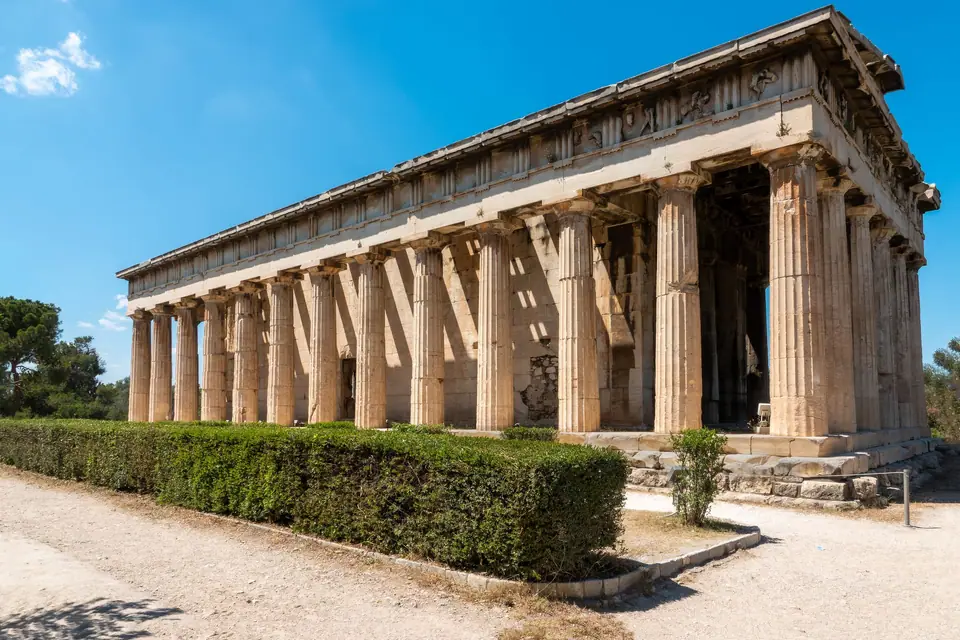
Northwest of the Acropolis, the Ancient Agora was the beating heart of classical Athens, a marketplace, a courthouse and a meeting place. It is a quieter and greener site than the rock, with trees, paths and wildflowers in spring. Its centrepiece is the Temple of Hephaestus, the best-preserved ancient Greek temple in the country, standing on a low hill at the western edge. The reconstructed Stoa of Attalos, a long two-storey colonnade, now houses a museum of finds from the site.
Monastiraki, beside it, is the busy square at the junction of the metro lines, with a small mosque, a flea market and views up to the Acropolis. On Sundays, the flea market on the nearby streets sells antiques, vinyl, second-hand clothes and curios. The nearby Roman Agora has the octagonal Tower of the Winds, an ancient weather station with carved figures of the eight winds, and Hadrian's Library is just next door. Both are small, cheap to visit and rarely crowded.
Hills with a view: the Areopagus and Filopappou
Two rocky hills west of the Acropolis offer the best free views in the city. The Areopagus, a bare limestone outcrop just below the Acropolis entrance, was the meeting place of an ancient court, and the Apostle Paul is said to have preached here. Its polished steps are slippery, so go slowly, but from the top you look straight up at the Parthenon and down over the Agora. A little further on, the pine-covered hill of Filopappou has shaded paths, a Roman monument at the summit and a classic panorama of the Acropolis with the sea beyond. Both are lovely at sunset, and locals bring wine and snacks to watch the light change.
Syntagma, the Zappeion and the Olympic stadium
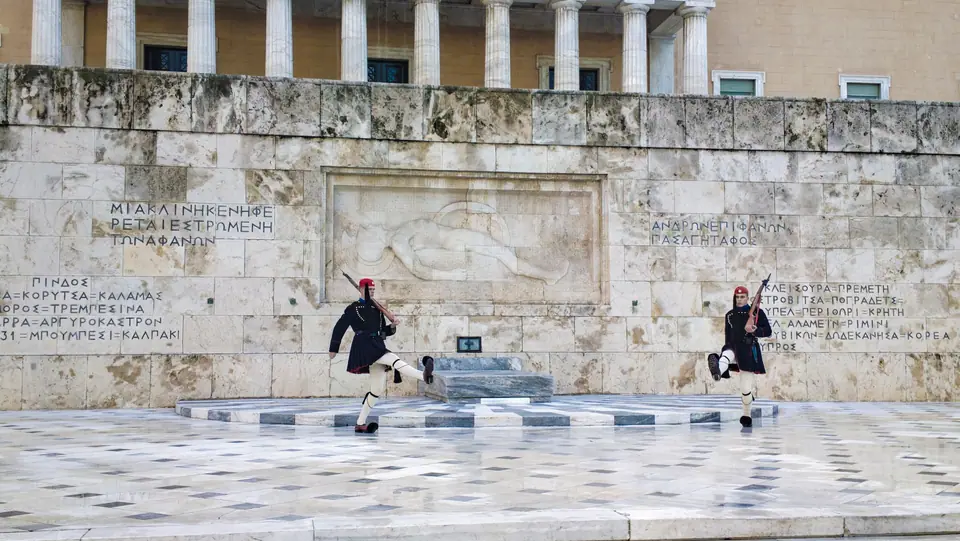
A short walk to the east, Syntagma Square faces the Greek Parliament, where soldiers in traditional uniform, the Evzones, guard the Tomb of the Unknown Soldier. Every hour the guards change in a slow, high-stepping ceremony, and on Sunday mornings a larger parade takes place with the full dress uniform. South of the square, the National Garden is a green retreat, and beyond it stands the Zappeion exhibition hall.
The Panathenaic Stadium, a marble stadium that hosted the first modern Olympic Games in 1896, is a short walk further on. You can walk around the track and stand on the winners' podium, which is a fun way to end the day. Nearby, Hadrian's Arch and the towering columns of the Temple of Olympian Zeus mark the Roman city, and the view of the Acropolis from there is magnificent in the afternoon light.
A day from the rock to the lanes
- Early morning: climb the Acropolis as soon as it opens, with water and a hat.
- Mid-morning: walk down to the Theatre of Dionysus and along the promenade to the Acropolis Museum.
- Midday: have lunch on the museum terrace or in a quiet taverna, and cool off inside.
- Afternoon: visit the Ancient Agora and the Temple of Hephaestus when the sun is lower.
- Late afternoon: wander Monastiraki, then the lanes of Plaka and Anafiotika.
- Sunset: climb the Areopagus rock or visit a rooftop bar for the view.
- Evening: dinner in a taverna, then a walk under the floodlit Parthenon.
It is a long day in the heat, so in summer swap the order and rest in the middle. The route also works in reverse if you prefer to end at the Acropolis for the sunset.
Stretching the visit to a second day
With more time, add the Temple of Olympian Zeus, the Kerameikos cemetery, Lycabettus Hill for a panorama of the city, or the National Archaeological Museum, with its golden masks and bronzes. The city also has excellent day trips, including Cape Sounion, with its clifftop temple of Poseidon, and the island of Aegina, described in our Athens day trips guide. Our things to do in Athens page lists more.
Metro lines, walking links and the airport
Central Athens is easy to navigate on foot, and the metro covers the rest. The Acropoli station on line 2 is closest to the museum and Plaka, Monastiraki connects lines 1 and 3 and puts you at the Agora, and Syntagma links lines 2 and 3. The airport express metro and the bus both reach the centre in about forty minutes, as we explain in our how to get to Athens guide.
Taxis are plentiful and reasonable, but agree on the meter before you start, and use a ride-hailing app if you are unsure. The old centre has plenty of one-way streets and steps, which makes taxis less useful there than on foot. Occasional strikes and demonstrations can close the metro or the monuments for a day, so keep an eye on local news.
Where to base yourself
Plaka is the most atmospheric base, with the Acropolis at the end of the street and restaurants on the doorstep. Its drawback is noise at night and higher prices. Koukaki, just south of the museum, is a calmer residential area with local cafes, and Monastiraki and Psyrri are lively and well connected, though more chaotic. Syntagma is the most practical for transport. Our Athens where to stay guide compares them in detail, and a room with an Acropolis view is a memorable treat if one is free.
Souvlaki, meze and a sweet finish
Greek food in Athens is simple and satisfying. Start with a souvlaki or gyros, grilled meat wrapped in a flatbread with tomato, onion and yoghurt sauce, or a spanakopita, a flaky pie of spinach and feta. In a taverna, order several small dishes to share, such as grilled octopus, fried courgette, tzatziki, fava puree and a Greek salad topped with a slab of feta. Grilled fish and lamb are the main courses.
For a sweet snack, try loukoumades, hot honey-soaked doughnuts, or a slice of baklava, and drink a Greek coffee or an iced frappé. In the evening, ouzo or the local white wine goes well with a plate of meze. The best tavernas are often away from the main squares, down side streets filled with locals, and the waiters at touristy restaurants who beckon you in rarely bring the best meal.
Gifts from the lanes
Plaka and Monastiraki are full of souvenirs, from olive oil soap and sponges to ceramics, leather sandals and worry beads. Look for small workshops that make jewellery, icons and handmade sandals, many of them in the lanes below the Acropolis. Food gifts such as honey, herbs, olives and pistachios from Aegina travel well. For something more distinctive, the shops around the Agora sell reproductions of ancient coins, vases and statues that make a lasting keepsake of the trip.
Heat, crowds and common sense
Athens is safe by the standards of a large capital, but there are a few things to watch. Pickpockets work the metro, Monastiraki and the Acropolis queues, so keep valuables in a front pocket. Some areas to the north of Omonia Square are rough at night, and it is simplest to avoid them. Bar touts who invite you in for a drink and then present a huge bill are a known trick. Drink plenty of water, since the tap water is safe, and take shade breaks in summer. Our what to wear in Athens guide covers clothes for the heat and the stones.
The monuments close early in winter and on public holidays, and some sites close on certain days of the week, so verify the schedule on the official site before you set out.
Summer heat, winter calm
Spring is the finest season, with wildflowers on the hills and mild temperatures. Autumn is warm and pleasant, with fewer crowds after the summer peak. Summer is hot, often above thirty-five degrees, and the Acropolis can be punishing in the afternoon. Winter is cool and sometimes rainy, but the monuments are quiet, and the light is sharp and beautiful on clear days. The Athens and Epidaurus Festival fills the summer evenings with theatre and music, including performances at the Odeon.
Beyond the centre
The wider Athens area has much more to see. The port of Piraeus and the seaside suburbs of the Athenian Riviera offer beaches and seafood. The National Archaeological Museum, the Benaki Museum and the hip neighbourhoods of Exarchia and Kolonaki each reward a half day. The ferries from Piraeus lead to the islands, which are the natural next step for many visitors.
Stitching Athens into a Greek journey
Most visitors treat Athens as the gateway to Greece. Our Athens travel guide covers money, transport and etiquette, and our Greece guides help you connect the capital to the islands, Delphi and the mainland.
What first-time visitors ask about Athens
Is one day enough for ancient Athens?
One day covers the Acropolis, the museum and Plaka. Add a second day for the Agora, the Olympian Zeus temple and a slower pace.
When is the best time to climb the Acropolis?
Early in the morning or in the last part of the afternoon, avoiding the midday heat. In summer, early is essential.
Do I need to book tickets in advance?
For the Acropolis, yes, especially in high season. A timed online ticket saves a long queue at the gate.
Is the Acropolis accessible?
There is a lift for visitors with limited mobility, and the museum is fully accessible. The paths are steep and uneven, so consult the official site for current arrangements.
Is Plaka too touristy?
The main lanes are, but the upper streets and Anafiotika are peaceful. Walk a few streets uphill and the crowds thin out.
What should I wear at the ancient sites?
Light clothes, a hat, sunglasses and shoes with a firm grip. There is no strict dress code, but cover your shoulders if you plan to visit a church.
Is Athens a stopover or a destination?
Yes. Two or three days let you see the ancient sites without hurry, eat well in the evenings and add a day trip to the coast or an island.
Can I visit the Acropolis with children?
Yes, though the climb is hot and the stone is uneven. Go early, carry water, and keep younger children close to the edges and steps.
For everything else, the pages linked above cover the practical details of your stay.