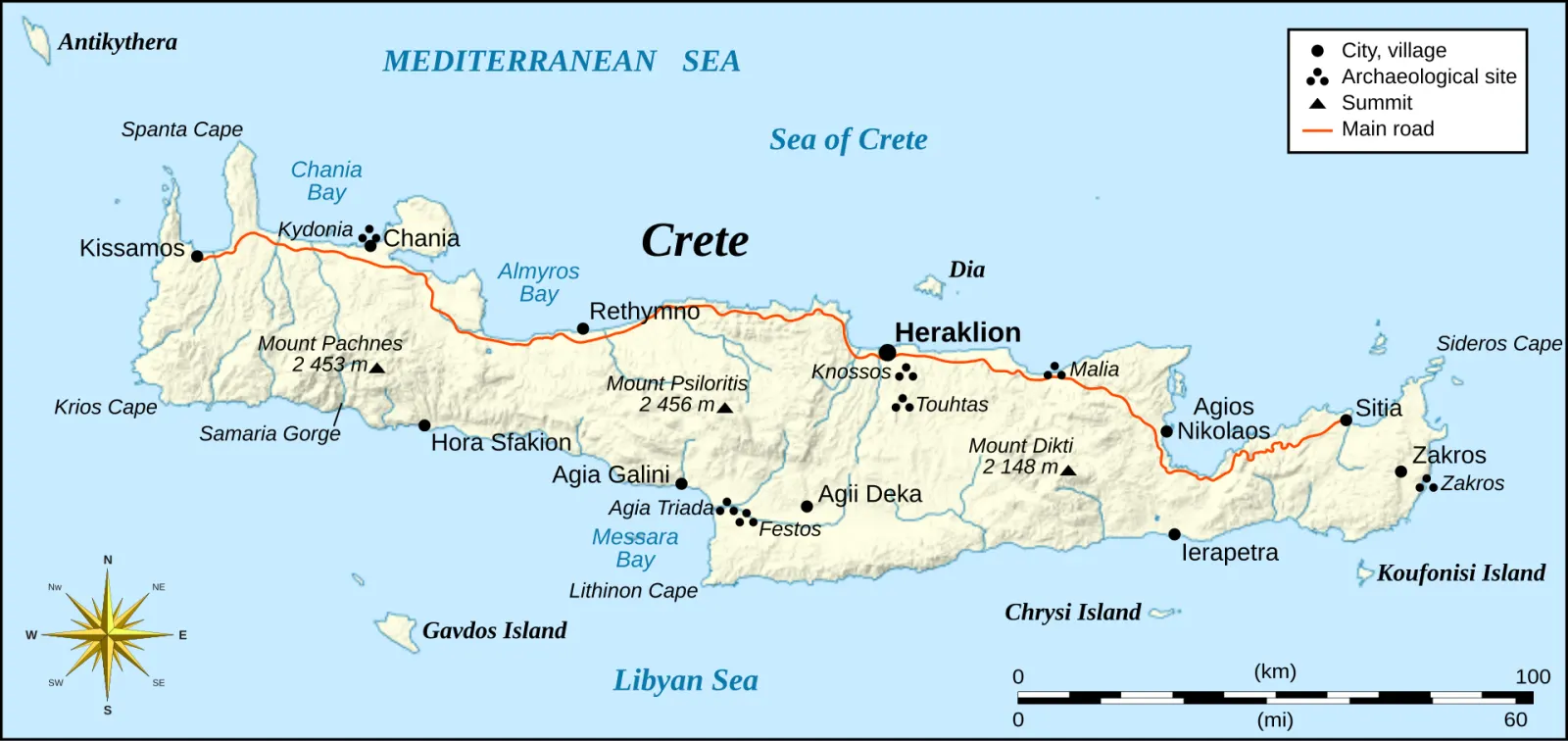
A detailed archaeological and Venetian harbour route across Crete: Europe’s oldest Bronze Age civilization at Knossos and Phaistos, and the walled ports of Heraklion, Rethymno, and Chania.
Bronze Age Labyrinthine Courts to the Venetian Kingdom of Candia
Between 2700 and 1450 BC, Crete gave birth to the Minoan civilization, Europe's earliest literate urban society, centred on multi-storey labyrinthine palace complexes at Knossos, Phaistos, Malia, and Zakros, where artists created the Bull-Leaping fresco, the Phaistos Disc, and Kamares polychrome pottery. Following Classical Greek, Roman (centred on Gortyn and its fifth-century BC Law Code), Byzantine, and Andalusian Arab (Chandax) eras, the Republic of Venice ruled Crete from 1205 to 1669 as the Kingdom of Candia.
Venetian military engineers led by Michele Sanmicheli enclosed Heraklion, Rethymno, and Chania inside vast bastioned walls, vaulted shipyards (Neoria), and marble fountains, where the Cretan Renaissance produced painter Domenikos Theotokopoulos (El Greco) and poet Vitsentzos Kornaros.
Minoan Palace of Knossos & Heraklion Archaeological Museum
Palace of Knossos West Court & Procession Corridor, Horns of Consecration South Propylaeum, Central Court, Throne Room of King Minos & Griffin Frescoes, Grand Staircase & Queen’s Megaron Dolphin Fresco, North Lustral Basin & Bull Relief Bastion, Heraklion Archaeological Museum (Phaistos Disc, Snake Goddess Figurines, Bull’s-Head Rhyton & Agia Triada Sarcophagus)
West Court of Knossos
The West Court served as the principal public gathering space between the settlement and the western facades of the palace. Raised stone causeways cross the paved flags, leading visitors toward the ceremonial entrances. Three large circular stone-lined pits, known as kouloures, were set into the floor to store grain or receive sacred offerings.
Corridor of the Procession
This narrow, elongated corridor once led dignitaries from the West Court into the heart of the palace compound. Painted plaster reproductions line the walls, depicting rows of youthful gift bearers carrying conical rhytons and offerings toward a central female figure. The surviving layout reveals how Minoan architects used angled turns to orchestrate ceremonial movement.
South Propylaeum
Excavated by Sir Arthur Evans, this grand gateway served as a primary monumental entrance to the upper reception halls. A large pair of sculpted limestone Horns of Consecration stands on the balustrade, framing views over the southern terraces. Replicas of the Cup-Bearer fresco decorate the walls, illustrating Minoan court costumes and physical ideals.
Central Court of Knossos
Measuring over fifty metres long, this paved rectangular plaza linked the domestic, administrative, and religious quarters of the Minoan complex. Scholars propose that ritual gatherings and athletic events, such as the dangerous bull-leaping rituals, unfolded in this central space. Its orientation allows natural light and cool breezes to ventilate the surrounding labyrinthine chambers.
Throne Room of Knossos
Dating to the Late Minoan period, this chamber features an intact gypsum seat flanked by low stone benches and vivid wall paintings. Wingless griffins resting amidst flowering papyrus reeds guard the seat, symbolising divine authority. Opposite the throne, stone steps descend into an enigmatic sunken lustral basin thought to have hosted ritual purification ceremonies.
Grand Staircase of Knossos
Carved deep into the eastern hillside, this four-tiered staircase provided access to the royal living quarters. Evans used reinforced concrete to rebuild the descending flights, which wrap around a central lightwell supported by downward-tapering wooden columns. The architectural arrangement channelled sunlight and fresh air into subterranean halls while keeping out summer heat.
Queen's Megaron
Located in the eastern domestic quarter, this suite reflects the sophisticated private life of the Minoan elite. A reconstructed frieze of blue dolphins swimming amongst schooling fish and sea urchins adorns the upper wall above a low couch. Adjoining the hall is an advanced terracotta drainage and bathroom system that astonished early twentieth-century archaeologists.
North Pillar Crypt
This dimly lit stone chamber contains heavy square pillars carved with double axe mason marks, or labrys. Minoan priests gathered here for underworld rites, pouring wine or oil into shallow basins carved directly into the floor slabs. The subterranean position and robust masonry protected these cult rooms from tremors that frequently shook the island.
North Entrance and Bull Relief Bastion
A paved ramp led into the complex from the northern port facilities, passing beneath an elevated open-air portico. A reconstructed painted stucco relief dominates the bastion, depicting a charging red bull against an olive tree background. This entrance channelled trade goods, ambassadors, and ritual processions from the Aegean coastline into the administrative centre.
North Lustral Basin
Positioned just outside the northern entrance, this sunken rectangular chamber is reached by a short flight of stone steps. Lined with polished gypsum slabs, the basin lacked a drainage outlet, indicating it served for ritual anointing rather than ordinary washing. Visitors arriving from northern ports may have performed purification ceremonies here before entering the sacred royal quarter.
Royal Road of Knossos
Constructed with meticulously dressed limestone slabs flanked by stone kerbs, this roadway linked Knossos to the Little Palace and the harbour. In antiquity, the central raised path allowed messengers and royal carriages to move quickly through the surrounding urban quarters. It terminates at the so-called Theatral Area, where stone steps accommodated spectators watching civic ceremonies.
Heraklion Archaeological Museum
Built on the site of a Venetian Franciscan monastery, this modern museum houses the most complete Minoan collection in existence. Its twenty-seven galleries follow a chronological sequence from the Neolithic era to the Roman period. Visitors find original wall frescoes removed from Knossos alongside gold jewellery, bronze weaponry, and carved stone vessels recovered from palace excavations.
Phaistos Disc Gallery
Enclosed in a secure display case within the museum, this fired clay disc dates to the second millennium BC and remains undeciphered. Both faces feature 241 stamped hieroglyphic symbols arranged in a clockwise spiral running toward the centre. Produced with reusable stamps, it represents an isolated prehistoric forerunner of moveable typographic printing.
Snake Goddess Figurines Display
Excavated from temple cists at Knossos, these glazed earthenware sculptures depict bare-breasted priestesses holding writhing serpents. Their flounced skirts, tight bodices, and feline-topped headdresses exemplify Bronze Age fashion and ritual iconography. The figurines highlight the dominant role of female deities and nature spirits in Minoan religious practice.
Bull's-Head Rhyton Display
Carved from black steatite, this fifteenth-century BC libation vessel demonstrates the extraordinary skill of Minoan stone carvers. The head features inlaid eyes of rock crystal and red jasper, with gilded wooden horns restored according to original fragments. Liquid was poured into the neck and released through the muzzle during sacred animal sacrifice rituals.
Agia Triada Sarcophagus Gallery
This painted limestone sarcophagus from the fourteenth century BC blends Minoan artistic traditions with contemporary Mycenaean influences. Detailed fresco panels on all four sides show libations, animal sacrifices, double axes, and offerings presented to a departed chieftain. The imagery provides scholars with primary visual evidence concerning Aegean beliefs about the afterlife.
Koules Fortress
Constructed by the Republic of Venice to defend the port against Ottoman assaults, this fortress features massive stone walls and gun ports. Marble reliefs of the Lion of Saint Mark remain set into its exterior facades. Inside, vaulted ground-floor storehouses and gunpowder depots lead to a broad roof platform that surveyed naval approaches.
Morosini Fountain
Inaugurated in 1628 by Governor Francesco Morosini, this central monument delivered fresh spring water via an elaborate fifteen-kilometre aqueduct. Four crouching lions support the upper basin, which is carved with relief figures from classical mythology, including tritons, dolphins, and sea nymphs. It remains the social focal point of modern Lions Square.
Agios Titos Church
Originally established during the Byzantine recovery of Crete, this structure underwent conversions into a Catholic cathedral under the Venetians and a mosque under the Ottomans. The current building displays nineteenth-century Ottoman eclectic architecture following an earthquake rebuild. Within its serene interior lies the revered silver reliquary housing the skull of Saint Titus.
Loggia of Heraklion
Erected in the 1620s under Francesco Morosini, this two-storey arcaded building provided Venetian nobility with a private club for civic and commercial business. It displays Doric columns on the ground level and Ionic pilasters across the upper storey, echoing classical Italian Renaissance design. Carefully restored after twentieth-century wartime damage, it functions today as Heraklion's municipal headquarters.
Venetian Heraklion (Candia): Koules Fortress, Loggia & Ramparts
Rocca a Mare (Koules Venetian Sea Fortress, 1523, 1540), Venetian Arsenali Shipyards, 25th August Street, Church of Saint Titus, Venetian Loggia (1628 by Francesco Morosini), Lions Square & Morosini Fountain, Basilica of Saint Mark, St Minas Cathedral & St Catherine of Sinai Icon Museum, Bembo Fountain, and Martinengo Bastion (Nikos Kazantzakis Grave)
Koules Fortress
Constructed by the Republic of Venice between 1523 and 1540, this solid stone fortress withstood Ottoman bombardments during the prolonged Siege of Candia. Massive relief plaques carved with the winged Lion of Saint Mark still adorn its exterior limestone ramparts. Inside, vaulted chambers house displays of recovered amphorae, antique bronze cannons and maritime military artefacts.
Venetian Arsenals
Dating from the sixteenth century, these imposing stone structures served as dry docks and repair workshops for the Venetian navy. The surviving bays retain broad barrel vaults designed to accommodate large galleys and supplies of naval timber. Visitors can inspect the masonry along the waterfront, which illustrates the industrial engineering of Venetian Crete.
Church of Saint Titus
Founded in 961 following the Byzantine recapture of Crete, this sacred site underwent numerous reconstructions under Venetian rule and Ottoman occupation. The current building exhibits nineteenth-century Ottoman eclectic design, featuring arched windows and an ornamental stone entrance. A reliquary inside preserves the skull of Saint Titus, returned from Venice to Heraklion in 1966.
Venetian Loggia
Commissioned by Governor Francesco Morosini in 1628, this elegant two-storey building served as an exclusive gathering hall for Venetian aristocrats. The exterior incorporates classical Doric and Ionic orders, embellished with carved stone metopes and relief coats of arms. Fully restored after wartime damage, it now functions as the municipal town hall of Heraklion.
Morosini Fountain
Inaugurated in 1628, this public fountain supplied freshwater via an ambitious viaduct from the springs of Mount Juktas. Four sculpted stone lions support an octagonal basin ornamented with relief scenes depicting mythical nymphs, dolphins and marine deities. It remains the principal meeting point of central Heraklion, situated at the core of Lions Square.
Basilica of Saint Mark
Erected by the Venetians in 1239 opposite the ducal palace, this broad basilica was dedicated to the patron saint of the republic. Later converted into the Defterdar Mosque under Ottoman rule, the structure retains its heavy stone portico and timber-roofed nave. Today the hall accommodates temporary exhibitions of contemporary Greek fine art and local cultural artefacts.
Bembo Fountain
Erected in 1588 by Gian Matteo Bembo, this ornate water fountain was the first to supply running spring water to Candia. The central alcove incorporates a headless marble statue retrieved from a Roman site, flanked by carved coats of arms. Directly beside it stands a preserved octagonal Ottoman sebil kiosk, now repurposed as a cafe.
Saint Minas Cathedral
Constructed between 1862 and 1895, this imposing cruciform church ranks among the largest cathedrals across the Greek islands. Twin bell towers flank its neoclassical facade, while the interior features grand frescoes and a carved marble iconostasis. Outside the cathedral, visitors can view a defused aerial bomb that landed during the Battle of Crete without detonating.
Church of Saint Catherine of Sinai
Built in the sixteenth century as a dependency of the Sinai monastery, this stone church served as an influential educational centre of the Cretan Renaissance. The interior now houses a museum displaying notable post-Byzantine religious icons, wall frescoes and ecclesiastical metalwork. Highlights include six panel masterpieces painted by the master iconographer Michael Damaskinos.
Martinengo Bastion
Designed by military architect Michele Sanmicheli, this arrowhead bastion formed the strongest defensive point of the Venetian land walls. The summit offers broad views across the rooftops of Heraklion and the southern approaches to Mount Juktas. A simple unpolished stone slab marks the grave of author Nikos Kazantzakis, inscribed with his famous personal epitaph.
Jesus Gate
Constructed in 1587, the Jesus Gate served as the primary southern access portal for farmers and traders entering Candia. The exterior stone facade exhibits classical Renaissance proportions, decorated with a dedicatory inscription and relief roundels. Inside the vaulted subterranean passage, an informative exhibition details the architectural evolution of the city fortifications.
Chanioporta
Originally named the Gate of Saint Andrew, this fortified breach provided controlled passage through the western defensive line towards western Crete. The monumental stone portal features a central relief carving of the Venetian winged lion above rusticated masonry blocks. Modern road traffic bypasses the original vaulted pedestrian archway, which remains intact and accessible to walkers.
Sabbionara Bastion
Guarding the eastern flank of the harbour, the Sabbionara Bastion was engineered to withstand naval cannonades using massive battered stone walls. A prominent marble relief plaque of the Venetian lion marks the coastal corner of the redoubt. The broad upper platform now offers pleasant walking routes overlooking the commercial port and the northern coastline.
Priuli Fountain
Erected in 1666 by Venetian Provveditore Generale Antonio Priuli, this ornate fountain represents the final major civic waterwork built before Ottoman conquest. Corinthian columns frame the stone wall, which displays classical entablatures and carved coats of arms. It stands recessed behind modern buildings near the riverbed of the former Derykades stream.
Historical Museum of Crete
Housed within an elegant 1903 neoclassical residence along the coastal promenade, this museum chronicles the island from early Christian times onward. The permanent collection includes rare Byzantine ceramics, Venetian stone carvings and historical textiles from the Ottoman era. A dedicated gallery displays two original paintings by El Greco, alongside the reconstructed study of Nikos Kazantzakis.
Church of Saint Peter and Saint Paul
Constructed around 1250 by Dominican friars, this massive church is one of the oldest preserved European monastic foundations on the island. The building features an expansive single-aisled nave with soaring lancet windows and Gothic stone ribs supporting the vaulted sanctuary. Thorough structural restorations have rescued the monument, which now serves as a venue for ecclesiastical conferences.
Palipetra Venetian Barracks
Constructed during the late sixteenth century, this broad stone complex accommodated military garrisons stationed within Candia during the Ottoman siege. The exterior walls preserve thick ashlar stonework, vaulted chambers and rectangular firing ports typical of Venetian defensive quarters. Later adapted as administrative offices during the Ottoman period, it remains an integral element of central military architecture.
Vituri Bastion
Part of the monumental land-wall circuit completed under Venetian authority, the Vituri Bastion served to cover the approach between Jesus Gate and the sea. Its broad stone-paved platform has been landscaped with Mediterranean pines, walking paths and leisure seating. Exploring the ramparts provides visitors with clear views into the dry moat and the surrounding eastern suburbs.
Little Saint Minas Church
Erected in 1735, this small stone church served as the municipal cathedral of Heraklion before the adjacent grand cathedral was completed. The interior contains an intricately carved gilt-wood iconostasis created by Cretan craftsmen during the late eighteenth century. Remarkable post-Byzantine devotional icons and period wall lamps line the intimate, barrel-vaulted prayer hall.
Saint George Gate
Engineered in 1565 to allow military egress towards the eastern plains, this barrel-vaulted passage cut through the defensive curtain wall. The monumental portal opening onto the moat retains a prominent pediment carved with the image of Saint George slaying the dragon. Today the subterranean stone hall hosts temporary public cultural exhibitions and historical lectures.
Phaistos, Gortyn, Matala, Arkadi Monastery & Rethymno
Minoan Palace of Phaistos overlooking the Messara Plain, Agia Triada Royal Villa, Gortyn Basilica of St Titus & 5th-Century BC Great Law Code Inscription, Matala Roman Cliff Tombs, Arkadi Monastery (1587 Baroque Facade), Rethymno Venetian Fortezza Citadel, Rimondi Fountain (1626), Neratze Mosque Minaret, and Venetian Harbour of Rethymno
Phaistos Palace
Set on a commanding ridge, this Bronze Age palace served as the political and administrative hub of southern Crete. Visitors can inspect the grand monumental staircase, theatrical area, and central court, preserved without the extensive concrete reconstructions found at Knossos. The site famously yielded the enigmatic fired-clay Phaistos Disc during twentieth-century excavations.
Agia Triada Royal Villa
Positioned close to the Geropotamos River, this ancient settlement served as a seasonal residence or administrative satellite for Minoan nobility. The ruins reveal residential quarters lined with gypsum, light wells, and storerooms with sunken jars. Archeologists recovered exquisite frescoes and the famed painted limestone sarcophagus from the adjoining cemetery chambers.
Gortyn Law Code Inscription
Housed within the curved wall of a Roman odeon, this monumental Dorian epigraphic text represents the oldest comprehensive legal code in Europe. Carved in boustrophedon style, with alternating lines reading left-to-right and right-to-left, the limestone blocks record civil statutes covering property rights, divorce, and civic obligations. It remains an exceptional archive of classical Greek jurisprudence.
Basilica of Saint Titus at Gortyn
Constructed from dressed sandstone blocks, this ruined cathedral marks the ancient ecclesiastical capital of Roman and Byzantine Crete. Travellers can observe the preserved semicircular apse, side chapels, and original stone masonry that survived severe seismic damage over centuries. The structure commemorates Titus, appointed by the Apostle Paul to lead the Christian community across the island.
Matala Roman Cliff Tombs
Carved into the sheer sandstone bluffs enclosing the bay, these multi-chambered caverns initially served as tombs during the Roman and early Christian periods. The interiors contain chiseled stone beds, decorative niches, and entrance lintels cut directly into the cliff face. In the 1960s, international countercultural travellers famously used the ancient rock chambers for communal shelter.
Kommos Archaeological Site
Positioned along the southern coastline, Kommos operated as the primary international port for both Phaistos and Agia Triada. Excavations exposed Minoan dry docks used for ship wintering, as well as a subsequent classical Greek sanctuary complex. Imported pottery recovered from the foundations verifies sustained trade routes linking Crete to ancient Egypt, Phoenicia, and Cyprus.
Church of Agios Pavlos at Agia Roumeli
Constructed directly upon beach pebbles on the remote southern coast, this cross-in-square Byzantine chapel marks the traditional disembarkation point of Saint Paul. Built from sea pebbles and mortar, the compact interior contains fragments of medieval frescoes and original stone vaults. The remote shoreline location makes it an important maritime landmark for walkers on coastal tracks.
Arkadi Monastery
Renowned for its role in the nineteenth-century Cretan struggle for independence, this walled monastic sanctuary incorporates a twin-nave church with an ornate Renaissance and Baroque front. Visitors can walk through the arched cloister, the refectory, and the powder storehouse where besieged locals lost their lives in 1866. The site stands as a central historical monument of modern Greece.
Rethymno Venetian Fortezza
Erected by the Republic of Venice between 1573 and 1580, this vast star-shaped citadel crowns Paleokastro hill to defend against Ottoman naval incursions. The grounds contain heavy bastions, gunpowder magazines, underground cisterns, and the Sultan Ibrahim Mosque, formerly the Catholic cathedral of Saint Nicholas. From the battlements, visitors enjoy panoramic views over the old town.
Rimondi Fountain
Commissioned in 1626 by the Venetian governor Alvise Rimondi, this civic fountain provided fresh drinking water to townspeople via a system of aqueducts. The marble facade features Corinthian columns, carved lion heads spouting water, and an entablature bearing the governor's coat of arms. It sits in Platanos Square, a historical meeting place in the heart of old Rethymno.
Neratze Mosque Minaret
Originally consecrated as the Venetian church of Santa Maria, this prominent edifice was converted into a principal Ottoman mosque during the seventeenth century. The adjoining minaret, completed in 1890 with two circular balconies, ranks as the tallest surviving minaret in Rethymno. Today, the domed building operates as an auditorium and municipal conservatory for musical performances.
Venetian Harbour of Rethymno
Constructed in the fourteenth century, this compact port is sheltered by a long stone breakwater and framed by historic merchant residences. At the outer sea mole rises a stone lighthouse, built by Egyptian authorities in the 1830s during their brief administration of Crete. The waterfront remains active with traditional wooden fishing boats anchored along the quay.
Loggia of Rethymno
Designed by the military architect Michele Sanmicheli in the late sixteenth century, this square limestone building served as an assembly hall for aristocratic citizens. The structure incorporates classical semi-circular arches, rustic stonework, and a moulded cornice supporting a pyramidal roof. Over time, it served varied roles including an Ottoman mosque and an archeological warehouse.
Great Gate of Rethymno
Known locally as Porta Guora, this stone gateway constituted the central entry point through the landward fortification wall of Venetian Rethymno. Built during the governance of Jacopo Guoro, the passage preserves its ashlar barrel vault and exterior relief mouldings. The gate marks the transition point between the contemporary commercial district and the pedestrianised historic quarter.
Archaeological Museum of Rethymno
Currently located within the Church of Saint Francis, this municipal collection displays discoveries excavated across the regional unit of Rethymno. The galleries feature painted Late Minoan clay larnakes from Armenoi, archaic sculpture, Roman glass, and bronze weaponry. The building itself exhibits notable Venetian stonework, including a finely sculpted marble doorway.
Late Minoan Cemetery of Armenoi
Discovered among oak groves, this extensive prehistoric necropolis contains more than two hundred chamber tombs cut directly into soft limestone. Each family sepulchre is accessed via an inclined trench or dromos leading down to a rectangular subterranean vault. Excavators recovered painted pottery, bronze weapons, and intact skeletal remains that shed light on Minoan health and burial customs.
Kara Musa Pasha Mosque
Constructed shortly after the Ottoman conquest of Rethymno, this complex incorporates a domed prayer hall, a vaulted fountain, and an adjacent cemetery. The site occupied the grounds of a former Venetian monastery dedicated to Saint Barbara, reusing elements of earlier masonry. The preserved ablution fountain features carved ornamental details typical of provincial Ottoman civic architecture.
Preveli Monastery
Perched on clifftops above the southern coast, this historic monastic centre consists of two distinct units, Kato Preveli and Piso Preveli. The operating upper complex contains a twin-aisled church, a museum of ecclesiastical heirlooms, and a revered processional cross. The monastery provided refuge to Allied soldiers awaiting submarine rescue following the 1941 Battle of Crete.
Kourtaliotiko Gorge Stone Bridge
Constructed in the nineteenth century, this arched masonry bridge spans the river at the southern mouth of the limestone gorge. Built by regional masons using local rubble stone and mortar, it carried mule traffic between rural villages before modern roads were engineered. The surrounding canyon walls rise several hundred metres and host vital colonies of native birds of prey.
Church of the Four Martyrs
Standing opposite the municipal gardens, this prominent three-aisled basilica honors four local citizens executed under Ottoman authority in 1824. Completed in the mid-twentieth century on the site of two earlier sanctuaries, the church features twin bell towers and an ornate iconostasis. Inside, silver reliquaries house the remains of the martyred figures.
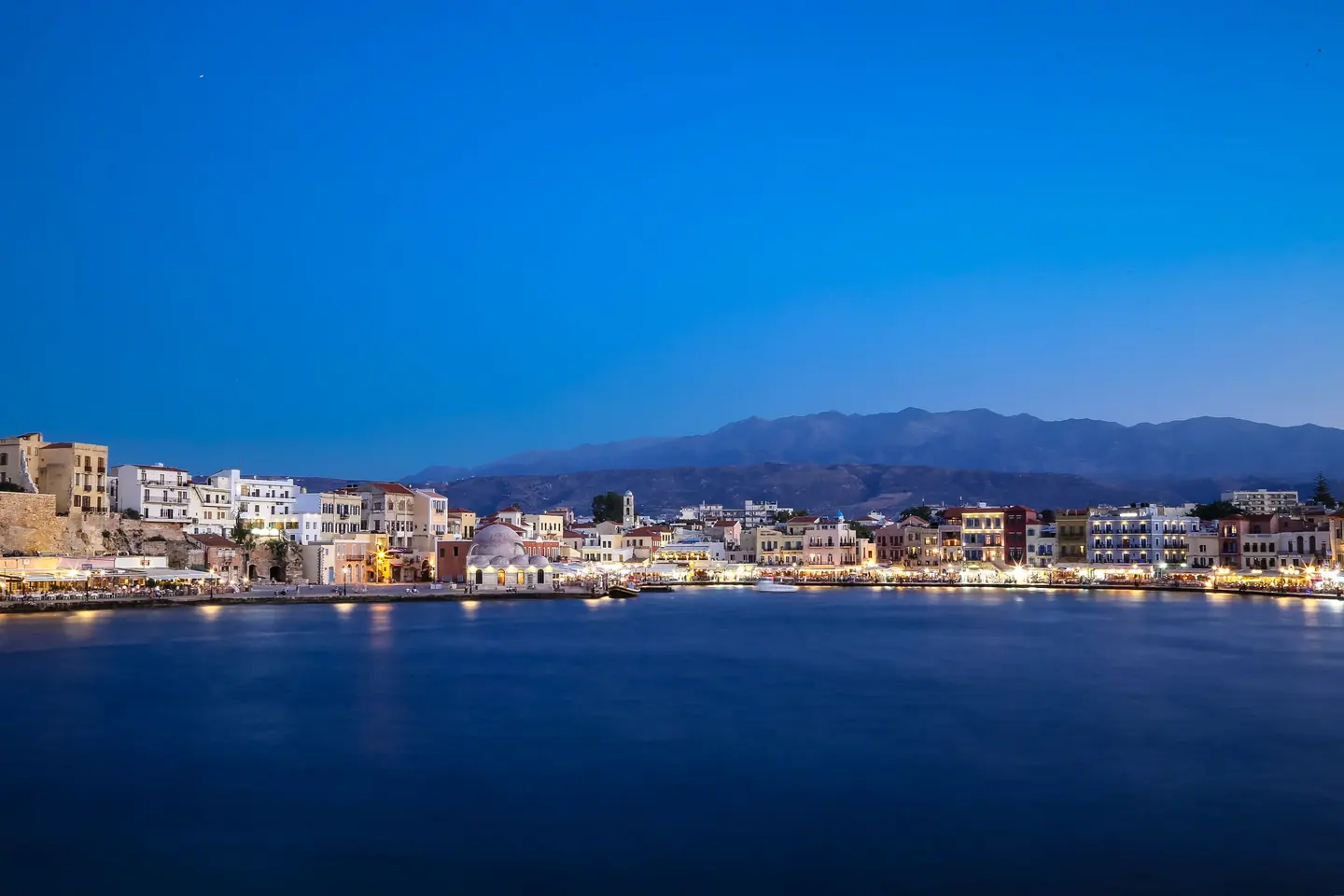
Chania Old Venetian Harbour, Lighthouse & Splantzia Quarter
Chania Old Venetian Harbour, 16th-Century Egyptian-Venetian Lighthouse on the Mole, Küçük Hasan Mosque (Yiali Tzami), Grand Arsenal & 7 Surviving Venetian Neoria Shipyards, Splantzia Square & Church of Agios Nikolaos (with both Bell Tower and Minaret), Trimartiri Cathedral, Etz Hayyim Synagogue, Firka Fortress, and Tabakaria Tanners’ Coast
Chania Venetian Harbour
Constructed by the Republic of Venice between 1320 and 1356, this sweeping basin shielded merchant fleets from pirate raids and northern gales. Stone quays curve around the waterfront, lined with pastel merchant houses and arched fortifications. Visitors can observe the original sea wall alongside fragments of dockside stone mooring rings.
Chania Lighthouse
Standing at the outer harbour entrance, this stone beacon was originally raised by Venetian engineers in the late sixteenth century. Egyptian forces rebuilt the structure in the 1830s, fashioning its shaft to resemble a traditional minaret. The surrounding defensive mole displays layered masonry from successive Venetian, Ottoman, and Egyptian engineering campaigns.
Küçük Hasan Mosque
Erected in 1645 following the Ottoman capture of the city, this monument honours the garrison commander Küçük Hasan Pasha. Six secondary domes flank a large central hemispherical roof, resting on thick limestone walls without internal pillars. The structure now hosts municipal cultural exhibitions, though its destroyed minaret base remains visible outside.
Grand Arsenal of Chania
Built around 1600, the Grand Arsenal served as the flagship pavilion among the port dry docks, housing ship repair facilities and naval offices. The edifice features thick masonry walls and elevated barrel vaults that accommodated long galleys. Today it accommodates the Centre of Mediterranean Architecture, displaying scale models and maritime diagrams.
Venetian Neoria of Chania
Seven intact stone vaults survive from the original complex of seventeen shipyards constructed across the sixteenth century. Galleys entered these open-fronted chambers directly from the sea for winter maintenance and hull caulking. Their deep interior spaces demonstrate heavy brick arches, timber supports, and utilitarian stonework built to withstand coastal dampness.
Splantzia Square
Serving as the heart of the Turkish residential sector after 1645, this leafy public square was historically known as Plateia 1821. An ancient plane tree dominates the centre, beside an Ottoman marble drinking fountain. The plaza stands as a primary crossroads connecting residential alleyways to ecclesiastical monuments and local workshops.
Church of Agios Nikolaos, Chania
Constructed around 1320 as the Catholic monastery of Saint Nicholas of the Dominicans, this structure was converted into the Sovereign Mosque under Sultan Ibrahim. Unique architectural modifications left both a Venetian western bell tower and a towering Ottoman minaret with twin balconies. Inside, pointed stone arches frame an Orthodox iconostasis installed in 1918.
Trimartiri Cathedral
Completed in 1860 upon the foundations of an earlier fourteenth-century Venetian church, this three-aisled basilica displays understated neoclassical styling. The facade features carved pediments, paired stone pilasters, and an elaborate multi-storey bell tower. Rich hagiographical frescoes cover the interior nave, commemorating the patron saints of Crete through traditional Byzantine imagery.
Etz Hayyim Synagogue
Dating back to the seventeenth century, this modest prayer hall sits within the old Jewish quarter of Evraiki. The building follows Romaniote architectural traditions, placing the Holy Ark and the reading Bimah on an east-west axis. Restored in 1999, the peaceful courtyard preserves historic rabbinical tombs and a traditional ritual mikveh.
Firka Fortress
Venetian authorities erected this coastal fort in 1620 to shield harbour moorings from artillery bombardments. Its thick ramparts, vaulted casemates, and subterranean cisterns once accommodated barracks and gunpowder magazines. On 1 December 1913, the Greek flag was officially raised on the fortress watchtower, marking the formal union of Crete with Greece.
Maritime Museum of Crete
Inaugurated in 1973, this museum presents maritime artefacts spanning the Bronze Age to modern twentieth-century naval engagements. Two floors display navigation instruments, nautical charts, ship models, and relics recovered from the Battle of Crete. Visitors can inspect an authentic reconstructed Bronze Age Minoan vessel housed at the nearby dockyards annex.
Tabakaria Tanners Coast
Occupying a rocky coastal strip east of the centre, this district developed in the mid-nineteenth century to house the city leather industry. Stone two-storey buildings feature sea-facing wooden slipways used to wash cattle hides in salt water. Several preserved workshops retain original stone soaking basins, iron press wheels, and drying lofts.
Church of Saint Rocco
Built in 1630 to invoke Saint Rocco against bubonic plague epidemics, this single-nave church exhibits refined Venetian Renaissance stonework. The western facade features a pedimented portal framed by pilasters and a circular oculus. Latin inscriptions carved into the frieze record the dedication date and civic prayers offered during the Venetian administration.
Moro Neorio
Constructed in 1607 under Provveditore Generale Gerolamo Moro, this structure formed the terminus of the eastern dockyard expansion. The cavernous stone building retains its original barrel-vaulted ceiling and rugged limestone walls. Currently serving maritime cultural societies, the site preserves traditional wooden boatbuilding craft traditions alongside the modern yacht basin.
Sabbionara Rampart
Also designated the Gate of the Sand, this sturdy bastion formed the northeastern corner of the Venetian defensive enceinte. Designed by engineer Michele Sanmicheli, the heart-shaped rampart commanded views across the open sea and adjacent coastal approaches. A weathered stone relief of the Lion of Saint Mark remains carved above the surviving sea wall.
Monastery of Saint Eleftherios
Tucked away among narrow alleys, this post-Byzantine monastic compound was established during the late Venetian period. The small katholikon church displays arched niches, traditional masonry, and a modest stone bell gable. The cloister rooms demonstrate how Venetian private chapels were incorporated directly into dense urban street patterns.
Venetian Sea Wall Promenade
Extending hundreds of metres out into the open sea, this monumental stone breakwater was engineered to dissipate heavy swells. Massive squared limestone blocks form the foundations, which have withstood centuries of winter storms. Walking the promenade reveals the contrast between the calm inner harbour and the open Aegean coastline.
Municipal Market of Chania
Modelled on the covered food market of Marseilles, this cross-shaped municipal hall was inaugurated during the unification celebrations of Crete. The structure combines industrial ironwork with neoclassical stone facades across four grand entry pavilions. Four wings historically segregated regional trade, housing cheesemakers, fishmongers, butcheries, and Cretan herbalists.
Church of Saint Catherine, Chania
Dating from the late sixteenth century, this dual-nave church incorporates both Gothic and Renaissance stylistic details. Slender stone rib vaults support the roof, while the facade displays carved moulding and decorative lintels. Converted into an oil storage depot during Ottoman rule, the building has been conserved and returned to ecclesiastical use.
San Salvatore Bastion
Anchoring the western end of the maritime defences, this polygonal bastion guarded the landward approaches to the harbour. Named after the neighbouring Franciscan monastery of San Salvatore, the site encompasses subterranean casemates and cannon platforms. The adjacent church and cloister now house the Byzantine and Post-Byzantine Collection of Chania.
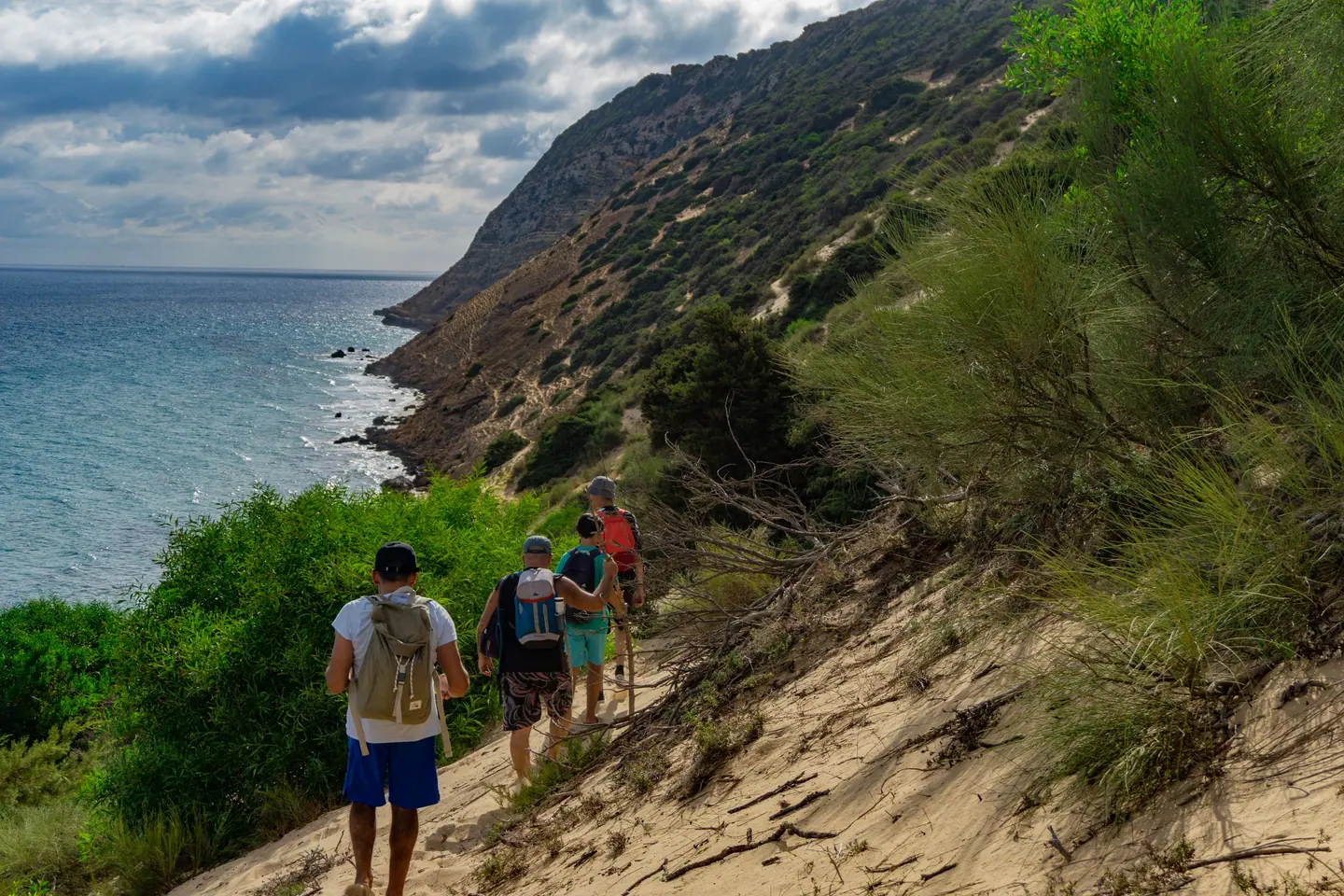
Samaria Gorge, Balos, Spinalonga & Lasithi Plateau
Agia Triada Tzagaroli Monastery on Akrotiri, Samaria Gorge Iron Gates (Portes) & Agia Roumeli, Balos Turquoise Lagoon & Gramvousa Venetian Island Castle, Elafonisi Pink Sand Spit, Malia Minoan Palace, Dikteon Cave (Mythical Birthplace of Zeus on Lasithi Plateau), Agios Nikolaos Lake Voulismeni, and Spinalonga Venetian Fortress Island
Agia Triada Tzagaroli Monastery
Constructed in the early seventeenth century by Venetian Cretan monks of the Zangaroli family, this fortified monastery features a grand Doric portico and three-domed church. Travellers can examine decorative stone pediments, visit an adjoining museum of historical icons, and inspect the vaulted cellar housing traditional olive oil and wine storage vessels.
Gouverneto Monastery
Built between 1537 and 1548, this monastery resembles a Renaissance fortress with stout perimeter walls, four corner towers, and carved monster reliefs embellishing the central courtyard chapel. Dedicated to the Virgin Mary, it contains fifty monk cells arranged around a stone-flagged quadrangle that opens onto a footpath leading down to coastal hermitages.
Katholiko Monastery
Dating back to the eleventh century, Katholiko stands abandoned inside the Avlaki Gorge, anchored by a monolithic arched stone bridge crossing the ravine. The complex contains rock-cut cells where Saint John the Hermit lived, an ancient domed chapel built directly into the cliff face, and ancient water reservoirs carved into bedrock.
Samaria Gorge Iron Gates
The Iron Gates, known locally as Portes, form the most dramatic constriction of the Samaria Gorge, narrowing to four metres across between vertical limestone cliffs rising three hundred metres. Wooden footbridges guide hikers across the seasonal Tarraios stream bed, offering close inspections of ancient geological folding and high, eroded karst formations.
Agia Roumeli Church of Panagia
Located near the southern exit of the Samaria Gorge on the Libyan Sea, this stone church stands directly over the ancient ruins of Tarrha, an ancient Greek religious centre. Travellers can observe incorporated antique column drums, preserved floor mosaics, and fragments of ancient pottery embedded into neighbouring domestic structures and stone walls.
Gramvousa Venetian Island Castle
Constructed between 1579 and 1584 to protect the northwest approaches to Crete from Ottoman naval incursions, this fortress crowns a sheer islet 137 metres above sea level. The perimeter exhibits robust bastions, vaulted rainwater cisterns, and historical cannon batteries, having later served as an independent insurgent base during the Greek War of Independence.
Balos Lagoon Viewpoint
Perched at the end of the unpaved track across the Platiskinos peninsula, this elevated lookout offers a sweeping perspective over the shallow coastal lagoon and connecting sand spit. The vantage demonstrates the geological uplifting that raised western Crete over millennia, exposing white carbonate sandbars and shallow waters between the mainland and Tigani peninsula.
Ancient Falasarna
Falasarna served as a fortified naval stronghold and pirate haven during the Hellenistic period, famous for its enclosed artificial basin. Following a massive earthquake in 365 AD that uplifted the western coast by several metres, the ancient harbour and defensive stone towers now rest completely inland, displaying well-preserved quay edges and military fortifications.
Chrysoskalitissa Monastery
Dating from the seventeenth-century Venetian period, this whitewashed monastery stands thirty-five metres above the sea on an imposing promontory. Its folk name refers to ninety stone steps leading to the main entrance, one legendarily fashioned of pure gold; the upper complex houses a church dedicated to the Dormition of the Virgin and ecclesiastical artefacts.
Elafonisi Island Channel
This shallow channel separates the Cretan mainland from Elafonisi Island, enabling travellers to wade across knee-deep water through deposits of crushed pink foraminifera shells. On the island itself stands an Austrian memorial commemorating the tragic 1907 shipwreck of the passenger steamer Imperatrix, alongside rare sand dune juniper habitats.
Palace of Malia
Dating to roughly 1900 BC, Malia was the third-largest Minoan urban centre in Crete, arranged around a central court paved with flagstones. Highlights include the royal living apartments, stone grain storage silos (koulouras), and the famous circular stone kernos used for agricultural libations, yielding insight into ancient Aegean religious ceremonies.
Dikteon Cave
Situated at an altitude of 1,025 metres above the village of Psychro, this deep karst cave served as a Bronze Age votive sanctuary linked with the mythical birth of Zeus. Visitors descend into the damp interior through natural limestone halls filled with stalagmites, stalactites, and a subterranean lake where Minoan bronze blades were historically deposited.
Lasithi Plateau Windmill Park
Covering roughly 25 square kilometres within the Dikti mountains, the Lasithi Plateau was drained and parcelled into agricultural plots by Venetian surveyors in the fifteenth century. Scattered across the fertile farmland are hundreds of stone-and-metal wind pumps built in the twentieth century, originally constructed with white canvas sails to lift water into potato fields.
Kera Kardiotissa Monastery
Located on the northern approach to the Lasithi Plateau, this historic convent is famed for its mediaeval frescoes dating from the early Palaiologan era. The central stone church features a four-tiered iconostasis, a carved marble doorway, and a renowned replica of an old miracle-working icon of the Virgin, historically chained to an outdoor column.
Lake Voulismeni
This circular geological formation measures 137 metres wide and plunges to a depth of sixty-four metres, connected to the outer harbour by a channel excavated in 1870. Ringed by red rock cliffs on its western edge, the lake displays an open-air sculpture garden, traditional fishing boats, and several waterfront avenues tracing the shoreline.
Agios Nikolaos Archaeological Museum
Established to preserve archaeological finds from the Lasithi region, this museum houses an important collection extending from the Neolithic era to Roman times. Key exhibits include the early Minoan Goddess of Myrtos vessel, elaborate gold funeral diadems found on Mochlos, and sculpted terracotta figurines discovered across Minoan peak sanctuaries.
Spinalonga Venetian Fortress
Erected by the Venetians in 1579 over an ancient acropolis, this insular fortification withstood Ottoman attacks until 1715 before later operating as Greece's primary leper colony from 1903 to 1957. Visitors can walk through preserved stone bastions, explore deserted nineteenth-century residential streets, and tour the former disinfection station and hospital facilities.
Ancient Lato
Positioned defensively between two rocky peaks overlooking the Gulf of Mirabello, Lato is one of the most complete Classical-era city layouts in Greece. Travellers can climb ancient stepped staircases to inspect the central agora, the prytaneion council chamber with its civic hearth, and the foundations of a fourth-century BC temple to Ilithyia.
Panagia Kera Church, Kritsa
Located just outside the hillside village of Kritsa, this three-aisled vaulted church preserves the most comprehensive Palaiologan-era fresco cycles in Crete. The murals depict vivid narratives of the Gospels, the life of Saint Anne, and the Last Judgement, displaying distinctive Byzantine painting traditions that evolved under contemporary Venetian provincial governance.
Sunken City of Olous
Olous was a prosperous maritime city-state that flourished throughout Minoan and Classical times before sinking gradually during tectonic subsidence events. Today, travellers crossing the Elounda causeway can see ancient stone foundations, submerged harbour walls, and preserved Early Christian basilica floor mosaics lying just beneath the surface of the shallow lagoon.
Connecting Crete’s North Coast Ports with the Messara Plain
For neighbourhood accommodation notes, seasonal weather tables and airport transfer details, consult our Crete destination guide, or browse other city and regional walking routes across the atlas.