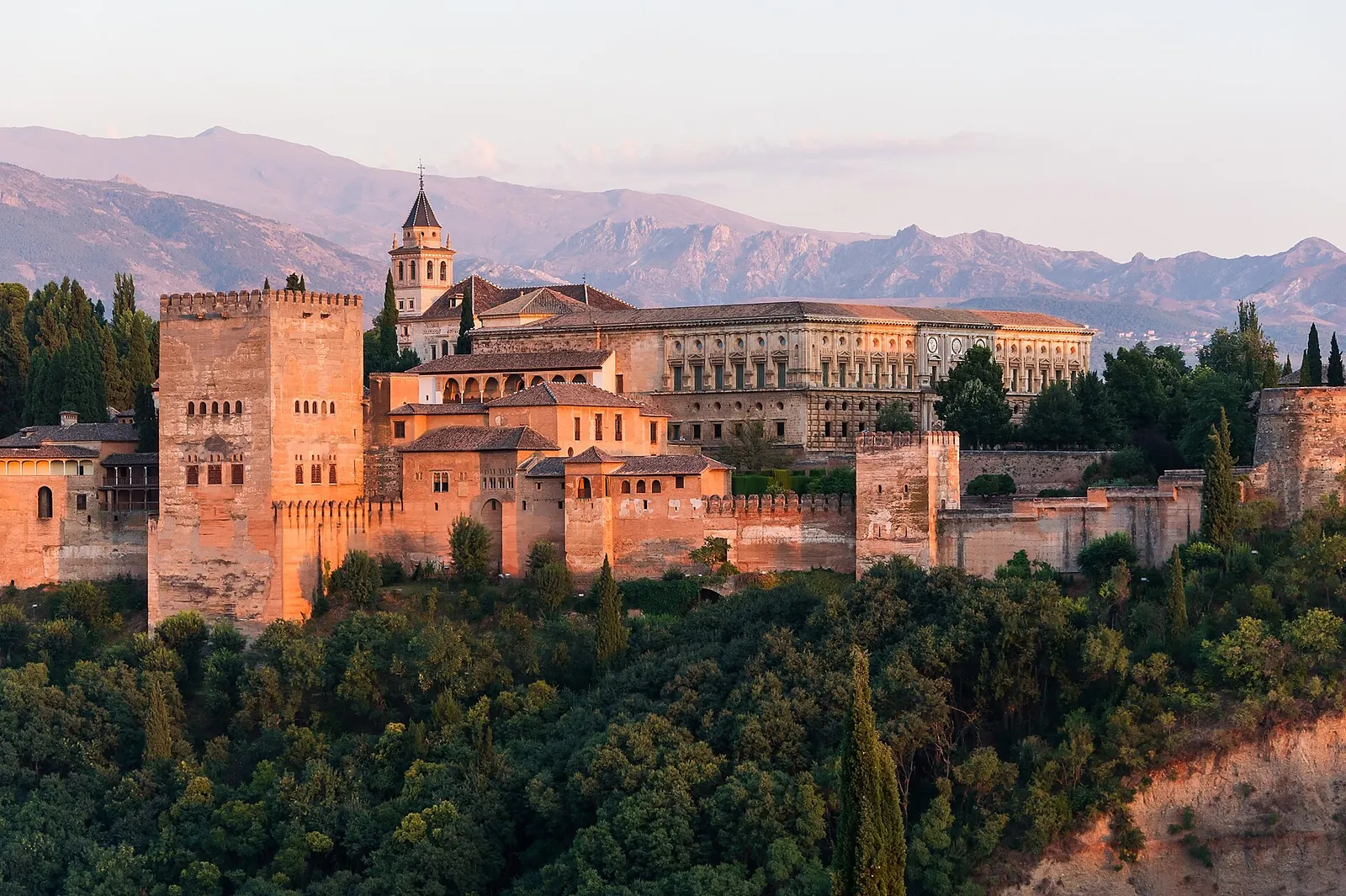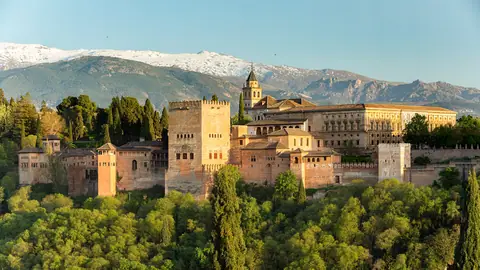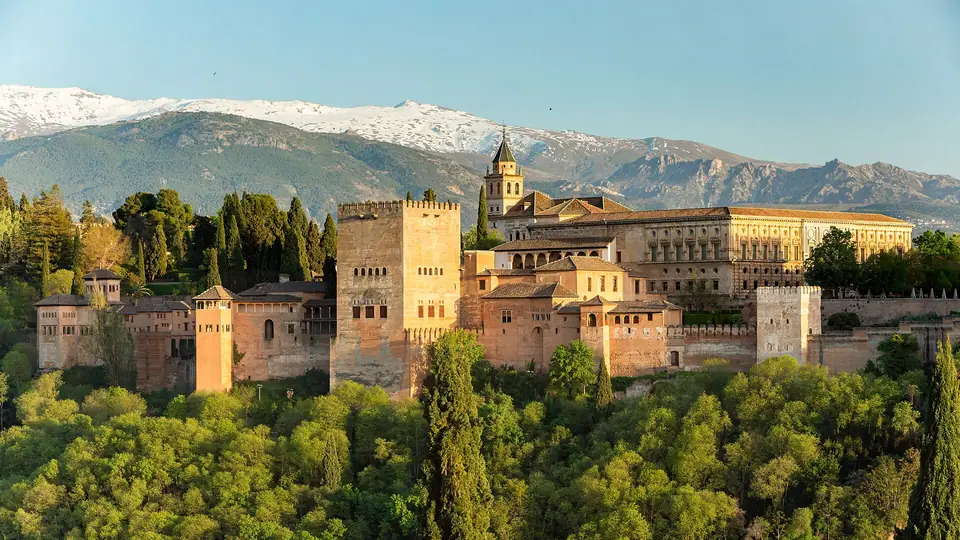
All 100 essential sights across the Alhambra, Generalife, Albaicín, Sacromonte, Carrera del Darro, Royal Chapel, Granada Cathedral and Realejo mapped in walking order.
Zirid Walls and Nasrid Court Architecture Beneath the Sierra Nevada
Set at the confluence of the Darro and Genil rivers at the foot of the snow-capped Sierra Nevada, Granada rose in the eleventh century under the Zirid dynasty on the hill of the Albaicín and became from 1238 to 1492 the capital of the Nasrid Emirate of Granada, the longest-lasting Islamic kingdom on the Iberian Peninsula. Across two and a half centuries, Nasrid rulers Muhammad I, Yusuf I and Muhammad V built the fortified red palatine city of the Alhambra and the terraced summer gardens of the Generalife, crowning Islamic court architecture in the Courtyard of the Myrtles and the Courtyard of the Lions.
Following the capitulation of Granada to the Catholic Monarchs Ferdinand and Isabella in January 1492, the city was endowed with the Flamboyant Gothic Royal Chapel (Capilla Real), the towering Spanish Renaissance Cathedral designed by Diego de Siloe and the Palace of Charles V inside the Alhambra, creating a unique architectural dialogue between Nasrid stucco-and-tile work and Renaissance stone.
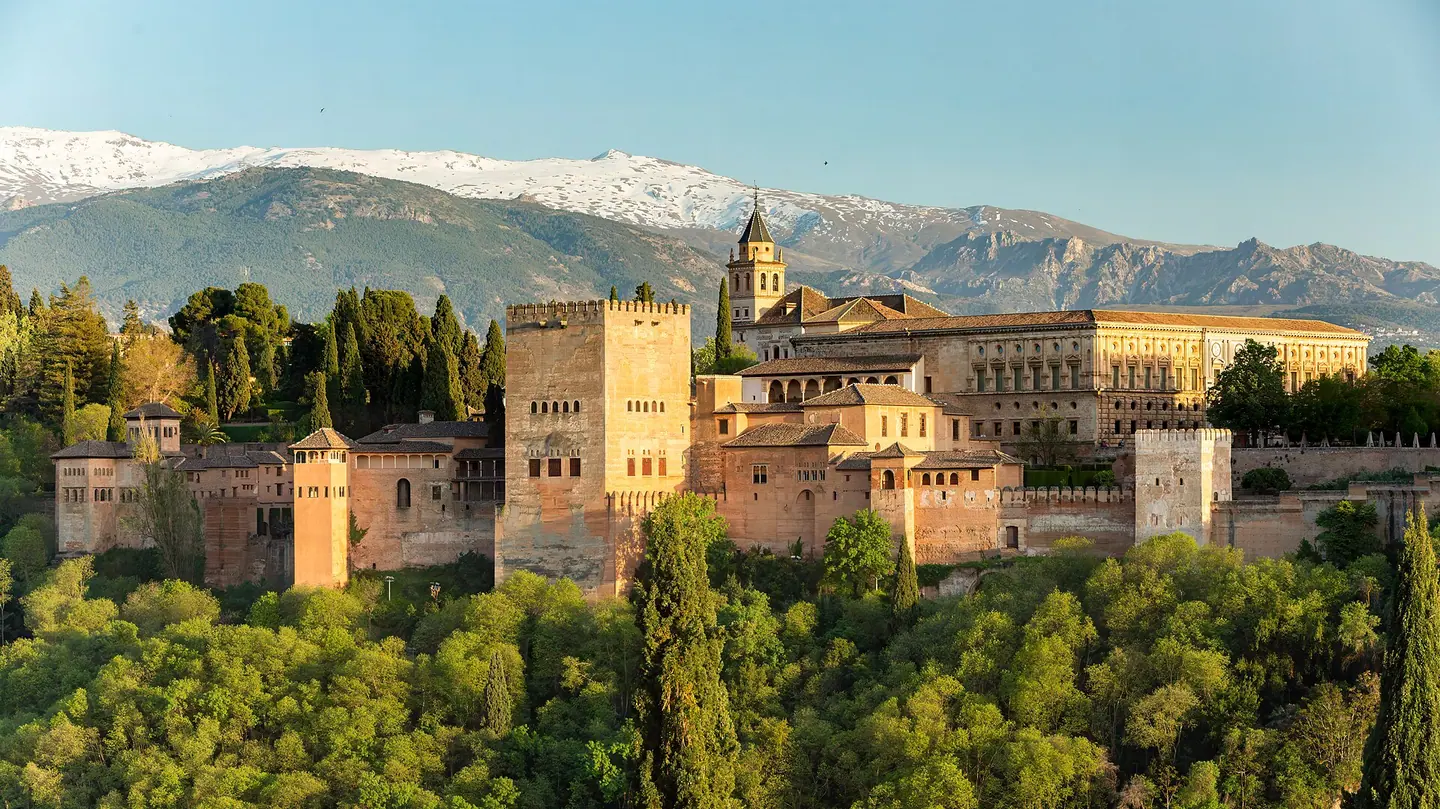
The Alhambra: Alcazaba, Nasrid Palaces, Partal & Palace of Charles V
Explore the red fortress of the Alhambra on the Sabika hill, from the watchtowers of the Alcazaba and the Nasrid Palaces to the Palace of Charles V and Parador gardens.
Puerta de la Justicia
Constructed as the primary ceremonial entry to the fortress, this massive horseshoe-arched tower displays a carved Hand of Fatima on its exterior keystone and a symbolic key above the inner arch. Inside, the passage bends in an L-shaped defensive elbow to thwart charging attackers. A Renaissance niche containing a statue of the Virgin Mary stands above the inner portal.
Puerta del Vino
Dating to the reign of Muhammad III, this sandstone gatehouse stands on the Plaza de los Aljibes. Its western facade displays classic Nasrid decorative tiles and plasterwork, whereas the eastern side features later additions from the fourteenth century. It functioned as an internal security control point between the military barracks and the residential district.
Plaza de los Aljibes
Formed by filling the defensive ravine between the Alcazaba and the royal palaces, this wide square was engineered by the Count of Tendilla following the Christian conquest. Massive subterranean cisterns sit directly beneath the flagstones, designed to store spring water for the garrison. Today, the terrace affords wide views across the Darro valley to the whitewashed Albaicin.
Alcazaba of the Alhambra
This fortified bastion represents the oldest preserved section of the Alhambra complex, expanded by Muhammad I upon pre-existing ruins. Encased in reddish rammed-earth walls, it guarded the hilltop with a network of battlements, storehouses and barracks. Visitors can trace the foundations of the ancient military quarter laid out along central stone drainage channels.
Torre de la Vela
Rising four storeys, this prominent watchtower served as the principal defensive lookout over the Vega of Granada. Its bell historically tolled on schedule to govern irrigation shifts for local farmers across the fertile plain. The Spanish banner was raised on its parapet on 2 January 1492, signalling the formal surrender of the Emirate of Granada.
Barrio Castrense
Situated within the Alcazaba walls, this archaeological zone preserves the foundations of the soldiers' residences. Distinct ground plans reveal small, inward-facing houses arranged around central courtyards, accompanied by cisterns, communal baths and grain storage silos. The layout demonstrates how military personnel lived self-sufficient lives within the enclosed garrison perimeter.
Torre del Homenaje
Positioned at the northeastern corner of the Alcazaba, this formidable tower served as the early residence of Muhammad I before palace construction began. Built across six levels, it held grain reserves, a private cistern and command posts. The robust defensive walls were engineered to withstand prolonged siege artillery from the valley below.
Mexuar
Serving as the public reception room of the royal complex, the Mexuar allowed ministers and the sultan to conduct state administration. The hall features four central columns supporting carved wooden ceilings, alongside later sixteenth-century modifications added to create an imperial chapel. Intricate tile dados display geometric star designs below extensive stucco inscriptions.
Oratory of the Mexuar
Opening directly from the north wall of the council chamber, this compact prayer room provided space for royal devotions. Double-arched windows frame views of the Albayzin district, while an intricately carved plasterwork mihrab indicates the direction of prayer. Skilfully executed Arabic calligraphy around the windows weaves Koranic verses with dynastic praise.
Cuarto Dorado
Named after its ornate painted and gilded wooden ceiling, this transitional chamber opens onto an intimate courtyard. Opposite stands the monumental facade of the Palacio de Comares, celebrated for its twin doors and carved stucco panels. The space functioned as an official antechamber where visitors awaited formal audiences with the Nasrid ruler.
Patio de los Arrayanes
Centred around a rectangular pool paved in white marble, this serene courtyard forms the heart of the Comares Palace. Dense myrtle bushes flank the water, engineered to mirror the towering Comares tower without rippling the surface. Delicately carved arcades stand at the northern and southern ends, resting on slender marble capitals.
Salón de los Embajadores
The ceremonial core of Nasrid diplomacy occupies the interior of the defensive Comares Tower. Its remarkable domed ceiling contains over eight thousand individual pieces of cedar wood, joined to represent the seven heavens of Islamic cosmology. Fine plasterwork covering the walls displays calligraphic poems composed by royal vizier Ibn Zamrak.
Patio de los Leones
Commissioned by Muhammad V, this courtyard represents the zenith of Nasrid domestic architecture. One hundred and twenty-four white marble columns frame the cloister, supporting intricate fretwork arches and projecting pavilions. At its centre, twelve sculpted stone lions support a hydraulic basin, connected to four water channels that represent the rivers of paradise.
Sala de los Abencerrajes
Located on the southern flank of the Court of the Lions, this square room features a remarkable eight-pointed star vault formed of muqarnas honeycomb plasterwork. Daylight filters through sixteen clerestory windows situated at the base of the dome, illuminating a marble floor basin. Legend attributes dark stains on the marble fountain to a massacre of local nobles.
Sala de las Dos Hermanas
Taking its name from two identical twin slabs of white Macael marble set into the pavement, this north-facing chamber served as private royal quarters. Its ceiling contains the most complex muqarnas vault in the complex, consisting of thousands of tiny suspended cells. Deep alcoves flanking the hall provided private seating spaces overlooking interior courtyards.
Sala de los Reyes
Occupying the entire eastern wing of the Court of the Lions, this hall is divided into several vaulted alcoves. Uniquely, the central ceiling vault features paintings on sheepskin leather depicting ten seated Nasrid monarchs in formal council. Stylistic elements suggest Gothic and Islamic court influences working concurrently during the late fourteenth century.
El Partal
Constructed during the reign of Muhammad III, this structure is the oldest surviving palace building within the Alhambra. A five-arched portico supported by slender columns overlooks an expansive outdoor pool fed by continuous irrigation channels. Adjoining the pavilion stands the Torre de las Damas, which houses an interior observation tower and delicate plasterwork.
Torre de la Cautiva
This outer rampart tower was transformed by Yusuf I into an ornate tower-palace, blending external military strength with delicate interior appointments. Elaborate tile skirts, finely carved plaster inscriptions and miniature muqarnas vaults define the main living chamber. Historic accounts identify it as the residence where Christian captives of high rank were quartered.
Palace of Charles V
Commissioned in 1527 by Holy Roman Emperor Charles V and designed by Pedro Machuca, this building introduced high Renaissance Mannerism to southern Spain. The square exterior of rusticated ashlar contrasts sharply with a two-storey circular inner patio lined with Doric and Ionic stone colonnades. It currently houses the Alhambra Museum and the Fine Arts Museum.
Convento de San Francisco
Constructed by the Catholic Monarchs immediately after the conquest, this Franciscan convent incorporated substantial elements of an earlier fourteenth-century Nasrid palace. Isabella and Ferdinand were initially entombed within its chapel before their transfer to the Royal Chapel in the city centre. Today, the peaceful cloister and historic courtyard gardens operate as a state-run Parador hotel.
Generalife Gardens, Cuesta de los Chinos & Paseo de los Tristes (Carrera del Darro)
Walk through the water stairways and cypress patios of the Generalife down into the Darro valley past the eleventh-century Arab Baths (El Bañuelo) and Renaissance mansions.
Generalife
Constructed during the reign of Muhammad III, this historic estate provided Nasrid sultans with a peaceful retreat from court affairs. The compound integrates terraced orchards with whitewashed pavilions. Visitors can observe sophisticated irrigation channels that continue to direct water from the Royal Canal across the hillside.
Patio de la Acequia
This courtyard forms the architectural core of the Generalife, structured around a narrow water canal flanked by arched water jets. Slender porticoes and Nasrid plasterwork frame panoramic views across the Alhambra hill. The cross-axial layout demonstrates classic Islamic garden design adapted to the natural slope.
Patio de la Sultana
Also known as the Court of the Cypress, this enclosed garden features Italianate stone fountains and clipped hedges surrounding a quiet pool. Tradition links the trunk of an ancient cypress tree here to a legend involving Boabdil's wife. Baroque additions complement the underlying Nasrid stonework.
Escalera de Agua
This unusual stairway allowed royal residents to climb towards a high oratory while cooled by running water. Channels hollowed into the masonry balustrades carry fresh water straight from the Acequia Real. Canopies of bay trees create a shaded vaulted walkway over the stone steps.
Jardines Altos del Generalife
Arranged across elevated terraces behind the palace, these upper gardens were expanded during the nineteenth and twentieth centuries. Formal flowerbeds, rose collections and tall cypresses line paths paved with polished river pebbles. The terraces offer clear vistas towards the Albaicín quarter across the valley.
Teatro del Generalife
Built in the early 1950s, this outdoor amphitheatre hosts the annual International Festival of Music and Dance. Architect Francisco Prieto Moreno drew inspiration from traditional Moorish layouts, using sculpted cypresses as natural stage wings. The venue blends stone masonry with regional plant life.
Cuesta de los Chinos
Also called the Cuesta del Rey Chico, this cobblestone path descends sharply along the ravine separating Sabika hill from Cerro del Sol. The trail skirts the eastern fortifications and towers of the Alhambra complex. It connects the upper gardens directly to the banks of the Darro.
Torre de la Cautiva
Erected under Yusuf I, this defensive tower along the northern ramparts concealed an exquisite private apartment. Intricate plasterwork, carved epigraphy and glazed tile skirting survive inside the central hall. Its small size reflects the high status of the royal inhabitants housed within its thick walls.
Torre de las Infantas
Commissioned by Muhammad VII, this structure represents the final major residential tower constructed in the Alhambra. An unassuming defensive exterior opens to an inner courtyard complete with an octagonal fountain and plaster stalactite vaulting. Washington Irving set one of his famous tales inside its chambers.
Torre de los Picos
Distinguished by pointed corbels that give the tower its name, this bastion defended the Gate of Iron and access to the Generalife. The interior features Gothic vaulting constructed following the Christian conquest. Its strategic position protected the pathway leading down to the Darro riverbed.
Puerta del Arrabal
This fortified portal served as the primary sally port for the Alhambra garrison during emergencies. Located at the base of the tower ramparts, it permitted guarded movement between the fortress and the lower valley. Solid masonry arches protected the underground passage against enemy siege engines.
Paseo de los Tristes
Officially named the Paseo del Padre Manjón, this public square acquired its popular nickname as the route for nineteenth-century funeral processions heading to the cemetery. Situated beside the Darro, it provides direct views up to the Alhambra battlements. Cobbled paths and public benches define the promenade.
Puente del Aljibillo
This historical stone bridge links the lower Darro walkway to the ascent of the Cuesta de los Chinos. The span crossed near an ancient cistern that once served travellers and farmers. Built of local masonry, it marks the transition from the city streets to rural valley footpaths.
Palacio de los Córdova
Originally constructed in the sixteenth century on the Placeta de las Descalzas, this noble residence was carefully dismantled and rebuilt on this site in the twentieth century. It displays a classical stone portal, a Mudéjar courtyard and carved wooden ceilings. Today the building houses the municipal historical archive.
Casa del Chapiz
Composed of two connected houses, this complex belonged to wealthy Morisco families following the Reconquista. The architecture blends traditional Mudéjar wooden galleries and marble columns with European Renaissance elements. The site now serves as the headquarters for the School of Arabic Studies.
Iglesia de San Pedro y San Pablo
Architect Juan de Maeda designed this sixteenth-century church above the foundations of the historic Bath Mosque. The exterior features a Mannerist portal, while the single nave is covered by an ornate Mudéjar wooden ceiling with intricate carpentry joints. It stands prominent along the Carrera del Darro.
El Bañuelo
Dating from the Zirid dynasty, this bathhouse is one of the oldest preserved public Islamic structures in Spain. Brick vaults pierced by star-shaped skylights cover the cold, warm and hot rooms. Roman, Visigothic and Moorish capitals crown the slender columns supporting the horseshoe arches.
Convento de Santa Catalina de Zafra
Founded in 1520 by the widow of Hernando de Zafra, this convent incorporates remnants of earlier Muslim residences. The cloister contains a traditional pool and columns from the fourteenth century, adapted into Christian monastic use. Its understated exterior wall fronts the Carrera del Darro.
Casa de Castril
Constructed in 1539 by architect Sebastián de Alcántara, this mansion features an ornate Plateresque sandstone façade adorned with scallops and classical relief sculptures. The building currently accommodates the Archaeological Museum of Granada, displaying Iberian, Roman and Moorish artefacts. A carved corner balcony displays an enigmatic inscription.
Puente de Cabrera
This sixteenth-century masonry bridge crosses the river channel along the lower Carrera del Darro, linking the Albaicín with the Alhambra slope. Composed of stone ashlar, it withstands seasonal torrents from the Sierra Nevada. The bridge provides vantage points for viewing old riverside houses built directly above the water.
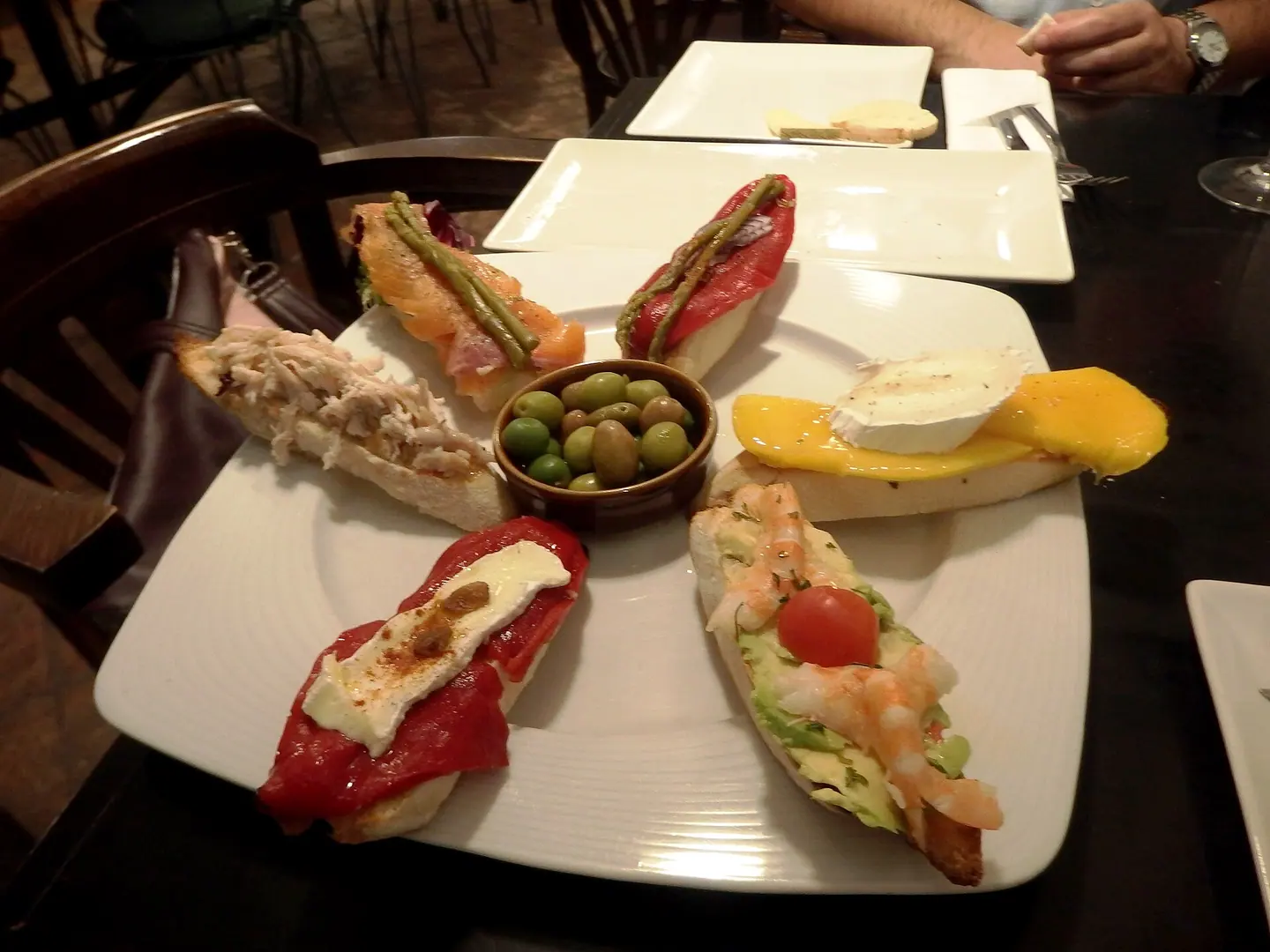
Historic Albaicín: Mirador de San Nicolás, Dar al-Horra, Cisterns & Moorish Gates
Climb the whitewashed carmen-lined lanes of the UNESCO Albaicín quarter to Mirador de San Nicolás, Palacio de Dar al-Horra, medieval aljibes (water cisterns) and Puerta de Elvira.
Puerta de Elvira
Constructed under the Zirid dynasty, this horseshoe arch served as the primary northern entrance to medieval Granada. Travellers can examine the surviving fortress walls and defensive barbican that once controlled entry into the lower Albaicín quarter.
Palacio de Dar al-Horra
Built as the residence of Sultana Aixa, mother of Muhammad XII, this palace exemplifies late Nasrid residential architecture. The complex features an inner courtyard with a pool, carved wooden ceilings, delicate plasterwork and a rooftop tower overlooking the upper district.
Mirador de San Nicolás
Paved in traditional stone cobbles, this famous square sits adjacent to the Church of San Nicolás. We observe uninterrupted vistas across the Darro ravine to the Nasrid palaces, Generalife gardens and the peaks of the Sierra Nevada.
Iglesia de San Nicolás
Erected in the early sixteenth century, the building incorporates Gothic and Mudéjar elements beneath a heavy brick bell tower. Inside, visitors find timber framework roofing and a reconstructed nave that survived severe damage during the Spanish Civil War.
Granada Mosque
Inaugurated in 2003, this modern complex was the first purpose-built mosque in Granada since 1492. It incorporates traditional Andalusian craft forms, including geometric tilework, a peaceful garden court and a minaret designed in the Almohad architectural style.
Plaza Larga
This expansive square has functioned as a central trading hub of the upper Albaicín since the medieval era. It connects directly to the Zirid ramparts through the Puerta de las Pesas, hosting daily morning food stalls beneath whitewashed facades.
Puerta de las Pesas
Dating from the eleventh century, this fortified gate formed part of the original fortress of the Alcazaba Cadima. The gate retains its traditional bent axis design, built to impede cavalry attacks, and displays confiscated merchant weights historically hung from its masonry.
Aljibe del Rey
Supplied by the ancient Aynadamar water channel, this eleventh-century underground cistern boasts a storage capacity exceeding three hundred cubic metres. The structure features four barrel-vaulted naves supported by stone arches and houses an interpretation centre dedicated to historic water management.
Carmen de la Victoria
Operated by the University of Granada, this classic carmen combines an orchard, fountains and ornamental gardens against dramatic hillside scenery. Its terraced walkways provide views of the Generalife, reflecting the regional domestic tradition of walled urban estates.
Iglesia de San Salvador
Constructed on the site of the Great Mosque of the Albaicín, this sixteenth-century church retains the original Islamic ablutions patio. The cloistered courtyard displays horseshoe arches supported by reused Roman and Visigothic capitals around a central fountain basin.
Mirador de San Cristóbal
Located near the church of the same name, this elevated platform offers open views across the western Vega plain and the old city walls. Visitors can trace sections of the eleventh-century stone ramparts that climb the rocky hillside directly below the terrace.
Iglesia de San Bartolomé
Finished in the mid-sixteenth century on the site of the Al-Bida mosque, this church features a Mudéjar single nave and fine timber ceilings. Its exterior brick tower exhibits decorative glazed ceramic insets and slender arched openings characteristic of post-conquest Christian architecture.
Puerta de Fajalauza
This pointed horseshoe arch guarded the northern perimeter of the extended Nasrid defensive ring. The adjacent quarter became celebrated for producing traditional tin-glazed Fajalauza ceramics, decorated with distinctive cobalt blue and green plant and bird motifs.
Carmen de Max Moreau
Also known as the Carmen de los Geranios, this property was bequeathed to the city by the Belgian painter Max Moreau. Visitors can explore the artist's conserved studio, living quarters and multi-tiered gardens looking towards the Alhambra.
Iglesia de San Juan de los Reyes
This was the first mosque converted into a Christian church following the surrender of Granada in 1492. The building preserves an intact thirteenth-century Almohad minaret, detailed with brick sebka ornamentation and horseshoe arches that survived later Gothic additions.
Convento de Santa Isabel la Real
Founded within former Nasrid palace grounds, this royal monastery combines late Gothic and Mudéjar styles. Its striking entrance portal, designed by Enrique Egas, leads to an expansive single-nave church with an elevated choir and an elaborate carved wooden ceiling.
Aljibe de San Nicolás
Positioned just beneath the parapet of the San Nicolás terrace, this covered stone reservoir served local water needs throughout the Nasrid period. The structure showcases simple masonry construction with a single barrel vault engineered to preserve collected mountain water.
Muralla Zirí
These imposing fortifications formed part of the primary defences of the early Zirid taifa kingdom. Constructed using the traditional tapial technique of rammed earth mixed with lime and river stones, they remain visible along the steep crest above the Darro.
Iglesia de San Miguel Bajo
Erected during the early sixteenth century, San Miguel Bajo displays a Plateresque portal and an interior Mudéjar timber framework. The adjacent square retains a public water cistern and stone cross, offering a quiet gathering space in the central quarter.
Casa de Porras
Now managed by the University of Granada, this noble residence features an entrance flanked by Corinthian columns and decorative stone armorials. Inside, an open central courtyard features stone pillars and carved wooden galleries that host community workshops and cultural exhibitions.
Sacromonte Cave Quarter, Abbey, Granada Cathedral, Royal Chapel & Alcaicería
Combine the whitewashed flamenco caves of Sacromonte with the Royal Chapel, Granada Cathedral, the silk-market lanes of the Alcaicería and the fourteenth-century Corral del Carbón.
Abadía del Sacromonte
Constructed atop Mount Valparaíso following the discovery of relics and engraved lead tablets, this monastic complex features an austere collegiate church and subterranean holy caves. Visitors can examine the crypt where early Christian martyrs were venerated, alongside an extensive library preserving ancient manuscripts and historic theological texts.
Cuevas del Sacromonte Museum
Spread across ten restored hillside caves, this ethnographic centre illustrates the historical living conditions and artisanal traditions of the Gitano community. The displays present traditional basketry, forge work, ceramic production and domestic arrangements, while the outdoor terraces afford wide perspectives across the Darro river gorge towards the Alhambra walls.
Cueva de la Rocío
Founded in the mid-twentieth century by the Maya family, this whitewashed subterranean dwelling represents one of the oldest venues dedicated to the zambra mora dance. The interior features copper pots hanging from vaulted limestone ceilings, offering an authentic setting for experiencing the distinct musical heritage cultivated within the valley.
Camino del Sacromonte
This narrow road follows the contours of the Darro river valley, linking the lower Albaicín neighbourhood with the upper hillside settlements. Walking along the path reveals cactus-studded slopes, traditional wrought-iron gates, and whitewashed facades that open into subterranean rooms carved directly into the soft clay terrain.
Mirador de la Chía
Situated on an elevated ledge along the upper slopes of Sacromonte, this stone belvedere offers unhindered perspectives over the Generalife orchards and Alhambra palaces. We can observe the dramatic natural boundary formed by the river gorge, framed by prickly pear cacti and rustic dry-stone walls.
Ermita del Santo Sepulcro
This modest masonry sanctuary marks the conclusion of a steep Via Crucis path ascending from the Albaicín to the Abbey. Constructed with unadorned brickwork and local stone, the chapel commemorates the Passion of Christ and serves as an important devotional station during local Holy Week processions.
Fuente del Avellano
Set along a shaded promenade on the left bank of the Darro opposite Sacromonte, this historic water fountain was the meeting point of Angel Ganivet's literary circle. Stone benches, bubbling mountain water and overhanging foliage create a tranquil setting that inspired numerous Romantic poets and regional writers.
Granada Cathedral
Commissioned by Queen Isabella I, this imposing structure displays a transition from Gothic foundations to a monumental Renaissance interior designed by Diego de Siloé. Its expansive main chapel features soaring Corinthian columns, gilded wood carvings, and paintings by Alonso Cano, who also planned the distinctive three-arched western facade.
Royal Chapel of Granada
Constructed between 1505 and 1517 in the Isabelline Gothic style, this royal pantheon contains the marble tombs of Queen Isabella I, King Ferdinand II, Joanna of Castile, and Philip the Handsome. Visitors can enter the subterranean crypt to view the lead royal coffins and examine Isabella's personal collection of Flemish paintings.
Alcaicería
Originally an extensive Moorish silk market protected by fortified gates, the current network of narrow pedestrian passages was reconstructed in the Neo-Moorish style following a catastrophic nineteenth-century blaze. Small shops now sell traditional Fajalauza ceramics, inlaid taracea woodwork, leather goods and textiles beneath decorative horseshoe arches.
Corral del Carbón
Dating to 1336, this building is the oldest preserved Nasrid structure in lower Granada and the only surviving Arab caravanserai in Spain. The monumental entrance portal displays intricate plaster muqarnas and geometric brickwork, leading into a central courtyard with a stone water basin originally used by merchants.
Palacio de la Madraza
Founded in 1349 by Sultan Yusuf I, this institution functioned as the city's principal centre of higher learning before conversion into the town hall after the Reconquista. Behind an eighteenth-century Baroque facade lies an intact prayer hall featuring an exceptionally detailed mihrab adorned with carved Nasrid stucco.
Plaza de Bib-Rambla
Once a major Moorish market ground and tournament arena outside the Bab al-Ramla gate, this rectangular public square is bordered by linden trees and outdoor cafes. The central monument is the seventeenth-century Fountain of the Giants, featuring figures carved from local Sierra Elvira stone supporting marble water basins.
Church of the Sagrario
Erected in 1704 over the foundations of Granada's ancient Great Mosque, this Greek-cross parish church forms part of the cathedral complex. The interior contains notable Renaissance fonts, Corinthian pilasters and significant Baroque retables, while its exterior presents finely balanced classical masonry along the Calle Oficios.
Lonja Mercantil
Built between 1518 and 1522 directly beside the Royal Chapel, this Renaissance civic structure served as a commercial trading house for city merchants. The building displays a two-tiered exterior arcade with delicate stone balustrades, fluted pilasters and heraldic emblems reflecting the mercantile prosperity of imperial Granada.
Centro José Guerrero
Located adjacent to the cathedral, this contemporary arts centre displays the work of abstract expressionist painter José Guerrero, who was born in Granada. The bright interior galleries showcase large-format canvases from the New York School era alongside regular temporary exhibitions of twentieth-century visual arts.
Plaza de las Pasiegas
Named after cloth traders from Cantabria who once operated stalls here, this open stone esplanade provides the primary vantage point for studying Alonso Cano's cathedral facade. Broad stone steps accommodate pedestrians, while surrounding neoclassical buildings frame the grand architectural composition of arches and medallions.
Plaza de Alonso Cano
Tucked against the northern flank of the cathedral, this small plaza features a bronze statue honouring the polymath Alonso Cano, who designed the cathedral facade. Shaded by orange trees, the courtyard borders the Archbishop's Palace, providing a peaceful retreat from the busier commercial streets nearby.
Archbishop's Palace of Granada
Serving as the official seat of the Archdiocese of Granada, this substantial building incorporates earlier Renaissance elements alongside a commanding Baroque facade completed in the seventeenth century. The central portal features red-tinted jasper framing, heavy wooden gates, and an interior cloister that houses significant ecclesiastical archives.
Calle de los Oficios
This pedestrian street runs directly between the Royal Chapel and the former Moorish silk exchange, serving as a central artery for historic craftsmanship. Paved with traditional Granada stone cobbles, the lane retains a dignified historic character, linking the madrassa, the merchants exchange, and the cathedral perimeter.
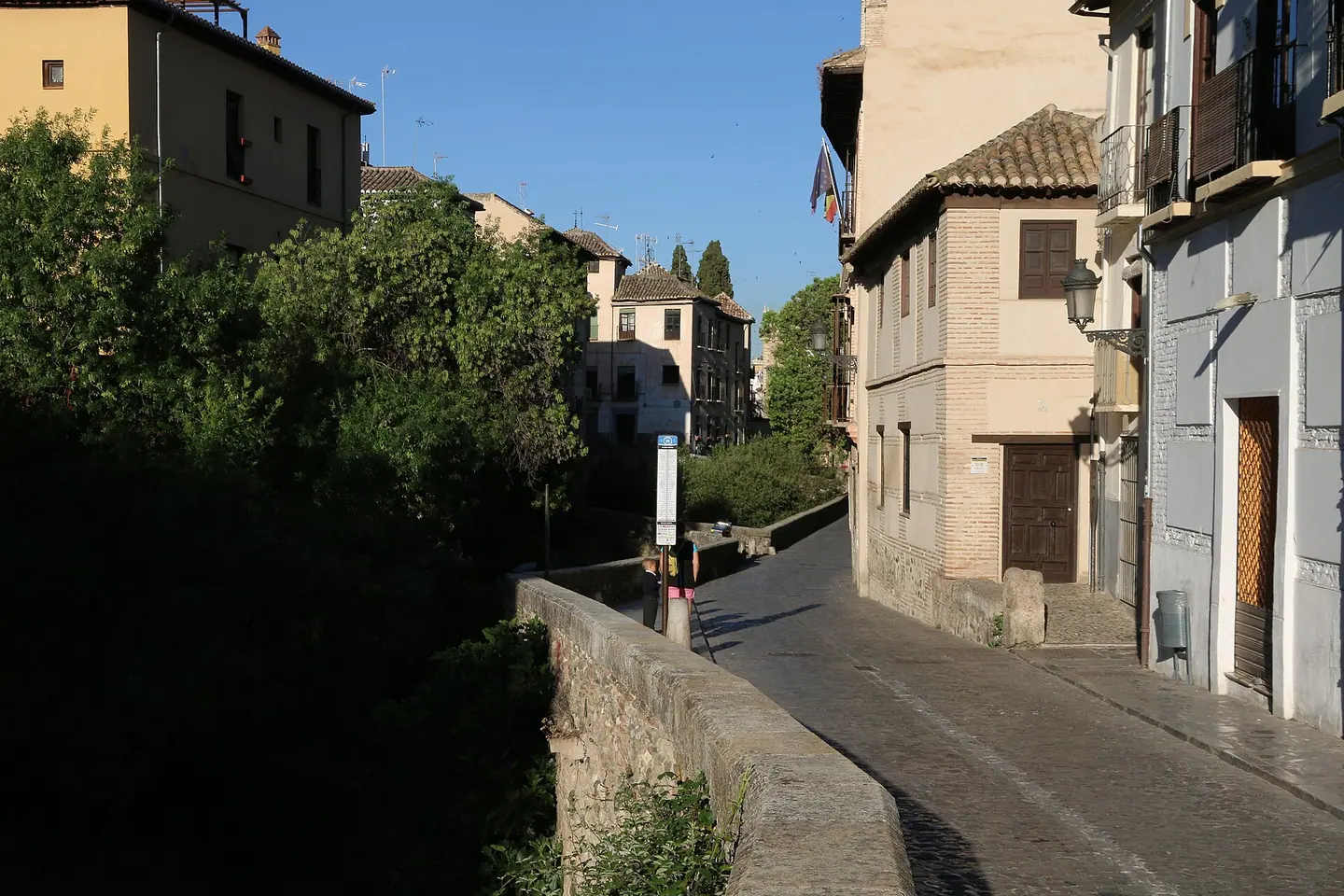
El Realejo, Carmen de los Mártires, Cartuja Monastery & Federico García Lorca Sites
Explore the old Sephardic quarter of El Realejo, the gardens of Carmen de los Mártires, the Baroque sacristy of the Cartuja Monastery and Huerta de San Vicente.
Campo del Príncipe
Created in the late fifteenth century over former Muslim cemeteries, this broad open space hosted royal celebrations and markets. In the centre stands the revered alabaster and jasper Cristo de los Favores monument, erected in 1640. Shaded terraces and traditional tapas bars frame the perimeter, making it the primary social focus of the district.
Cristo de los Favores
Financed by the local residents of the Realejo district in 1640, this solemn open-air monument features a white alabaster cross set on a high jasper pedestal. The sculpture forms the central devotional image during Good Friday processions when thousands gather in absolute silence. It remains one of the city's most emblematic outdoor religious shrines.
Iglesia de Santo Domingo
Founded by the Catholic Monarchs in 1492 as part of the Santa Cruz la Real convent, the church combines late Gothic vaulting with early Renaissance decoration. The portico features stone arches carved with royal heraldry, while inside, ornate Baroque retables fill the side chapels. Look for the elaborate Camarín de Nuestra Señora del Rosario, a lavishly gilded Baroque chamber.
Cuarto Real de Santo Domingo
Pre-dating the Alhambra palaces, this former royal reception hall features sophisticated plasterwork, horseshoe arches and original ceramic tilework. It was built within the fortified estate of the Almanxarra by the early Nasrid sultans before being gifted to the Dominicans after the conquest. Modern landscaped gardens surround the conserved tower, displaying historical irrigation channels.
Casa de los Tiros
Taking its name from the artillery muskets protruding between its stone battlements, this fortified mansion belonged to the Granada Venegas family. The interior preserves the famous Cuadra Dorada, a reception room with a polychrome coffered ceiling depicting Spanish historical figures and kings. Today, the palace exhibits historic local prints, textiles, ceramics and nineteenth-century romantic memorabilia.
Palacio de los Condes de Gabia
Rebuilt in the late eighteenth century around an earlier Renaissance courtyard, this elegant palatial residence features a sober stone doorway with heraldic crests. The central courtyard preserves Tuscan marble columns and a classic Andalusian tile fountain. It now serves as the provincial cultural centre, hosting temporary exhibitions of modern art and photography.
Museo Sefardí de Granada
Located in the heart of the former Jewish quarter, this modest museum preserves the history and intellectual contributions of the Sephardic community prior to 1492. Visitors can inspect religious artifacts, historical manuscripts, culinary traditions and maps tracing medieval synagogues. The curators recount the life of influential figures like Samuel ibn Naghrillah and Judah Halevi.
Convento de Santa Cruz la Real
Established immediately after the fall of Granada, this sprawling monastery complex long held significant intellectual and theological influence. Its Renaissance cloister is distinguished by grand stone archways and decorative painted ceilings. The building now forms part of the Santa Cruz university hall of residence, maintaining centuries of scholarly tradition.
Casa de las Tres Caras
Situated along the sloping streets of El Realejo, this historic home derives its popular name from the three carved human faces adorning its stone lintel. Local folklore connects the carvings to diverse legends, ranging from inquisitorial surveillance to symbolic guardian spirits. The building illustrates the traditional domestic architecture of the neighbourhood, with whitewashed plaster and iron-grilled windows.
Iglesia de San Cecilio
Erected over the remains of an ancient mosque on the hillside above Campo del Príncipe, this church honours the first-century bishop San Cecilio. The exterior features a delicate Plateresque portal carved by Diego de Siloé, incorporating classical pilasters and relief medallions. The Mudéjar wooden ceiling was meticulously restored following a major fire in 1969.
Torres Bermejas
This defensive fortification stands on the Mauror hill, pre-dating the neighbouring Alhambra by several centuries. The red-tinted conglomerate masonry includes three massive towers and an interior cistern, connected to the city walls by stone curtains. Although closed to casual interior tours, its ramparts offer imposing views over the old Jewish district below.
Carmen de los Mártires
Constructed on the site of Christian captive dungeons and a former Carmelite convent where San Juan de la Cruz wrote, this grand villa includes French, English and Nasrid-style gardens. Travellers can wander around a central ornamental lake with a romantic islet, shaded avenues of cedars, and parterres filled with free-roaming peacocks. The estate provides exceptional views over the Vega plain.
Palacio de los Córdova
Originally built near the Plaza de las Descalzas in the 1530s, this noble residence was carefully dismantled and reconstructed in the 1960s at the base of the Alhambra. It exhibits a blend of Renaissance stonework and Mudéjar wooden ceilings within an idyllic park of cypress alleys and water channels. The interior houses rare municipal manuscripts and royal decrees.
Granada Charterhouse
Begun in the early sixteenth century, this monastery represents one of Spain's grandest expressions of high Baroque and Churrigueresque architecture. The sacristy, designed by Francisco Hurtado Izquierdo, is adorned with polychrome marbles, stucco reliefs, mirrors and marquetry chests by Friar José Manuel Vázquez. In the main church, look for the monumental tabernacle and expansive paintings by Juan Sánchez Cotán.
Placeta de la Puerta del Sol
Perched on the upper slopes of El Realejo, this small stone-paved square centres on a covered seventeenth-century public lavadero. Supported by Tuscan columns, the historic washing place allowed local women to wash laundry with water piped from the acequia system. The terrace offers broad panoramas across the tiled roofs of the lower city.
Huerta de San Vicente
Federico García Lorca spent his summers here between 1926 and 1936, writing masterpieces like Blood Wedding and Yerma. The country house preserves original furniture, including the poet's desk and piano, accompanied by personal drawings and paintings by contemporaries like Salvador Dalí. Surrounding the residence is the sprawling Federico García Lorca Park, filled with rose gardens and fountains.
Centro Federico García Lorca
Situated on Plaza de la Romanilla, this modern architectural complex preserves the complete archives and personal effects of the poet. The centre features an exhibition gallery, a specialist theatre and a suspended steel archive vault safeguarding original manuscripts. Regular cultural events celebrate poetry, drama, avant-garde music and modern Andalusian literature.
Fuente de las Batallas
Installed in the mid-twentieth century along the Carrera de la Virgen, this circular fountain serves as a well-known civic landmark and gathering point. Surrounded by leafy plane trees and historical kiosks, it marks the boundary between the historic city centre and modern nineteenth-century expansions. The plaza hosts open-air book fairs, craft markets and celebratory sports parades.
Basilica de las Angustias
Dedicated to Nuestra Señora de las Angustias, this church presents a monumental Baroque facade framed by twin slate-capped towers. The opulent interior features decorative marbles, carved wooden saints by Pedro Cornejo, and an extraordinary Camarín housing the revered seventeenth-century statue of the Virgin. The basilica stands at the religious core of autumn civic devotions.
Puerta de las Granadas
Commissioned by Emperor Charles V and built by architect Pedro Machuca in 1536, this Mannerist gate stands atop the Cuesta de Gomérez. Three stone pomegranates crown the pediment above the imperial coat of arms, giving the arch its popular name. Passing through the portal leads travellers from the urban Realejo slope directly into the forested paths of the Alhambra.
Planning Viewpoints and Steep Lanes in Granada
Pair this route with the practical neighbourhood breakdowns, climate charts and transport advice in our Granada travel overview, alongside additional mapped city walks.