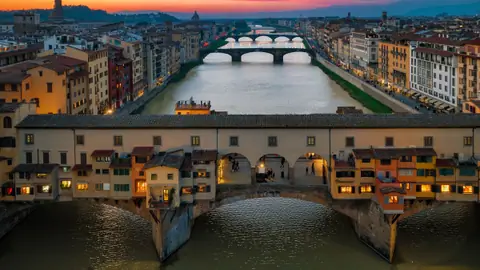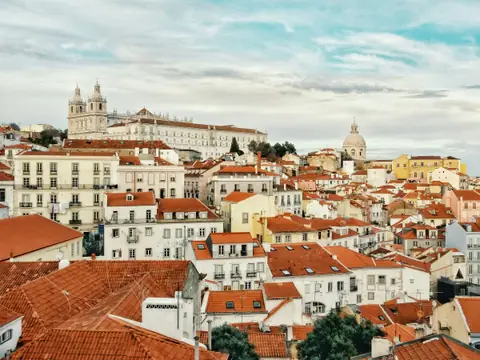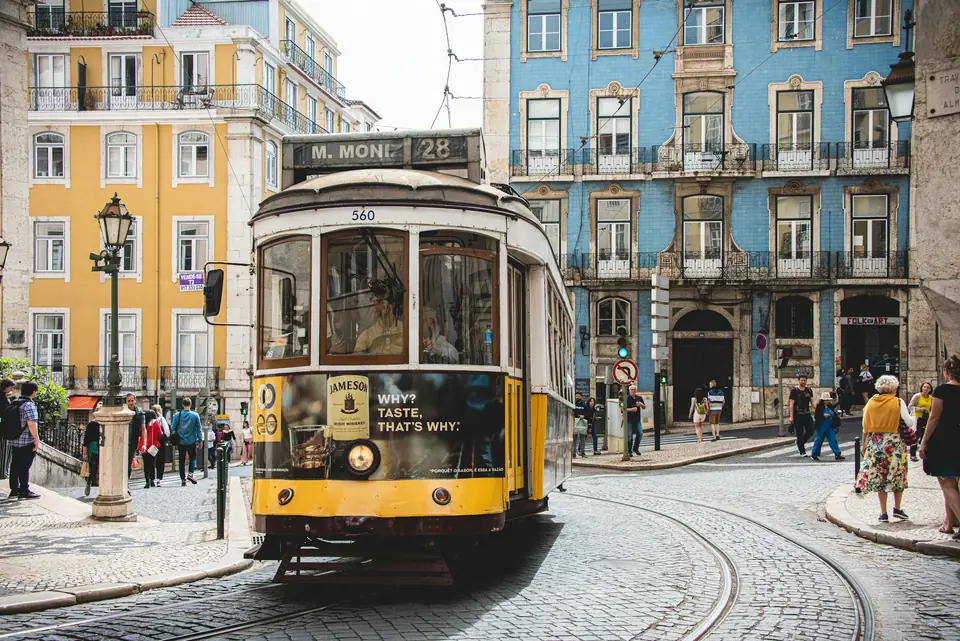
Photo by Paulo Evangelista on Unsplash
Portugal Travel Guide: Regions, Routes and Practical Tips
How to plan a first trip to Portugal: which regions to combine, how to move between them by train or car, and the rules and closures that changed in 2025 and 2026.
Portugal's mainland is about 560 km from north to south, and the fast train from Lisbon to Porto takes under three hours. In that space you get two very different cities, a river valley lined with vineyard terraces, a plain of cork oaks and whitewashed towns, and a southern coast of ochre cliffs. Most first visits combine two or three of these. This guide is about choosing which, and getting between them without wasting days.
Portugal in brief
Short answer: for a first trip, pair Lisbon with Porto by train. Add the Douro Valley if you like wine and landscapes, or the Algarve if you want beaches. Madeira and the Azores are islands out in the Atlantic and deserve a trip of their own.
Portugal suits people who like walking and eating well. It is harder on bad knees: Lisbon and Porto are built on steep hills, paved in calçada, small limestone cobbles that turn slippery in the rain.
The regions at a glance
- Lisbon and around. The capital climbs over hills above the Tagus estuary: the tiled lanes of Alfama, the grid of the Baixa, the monuments of Belém. Start with our Lisbon travel guide, and keep an evening for a fado night. Sintra and the beaches of Cascais are under an hour away by train.
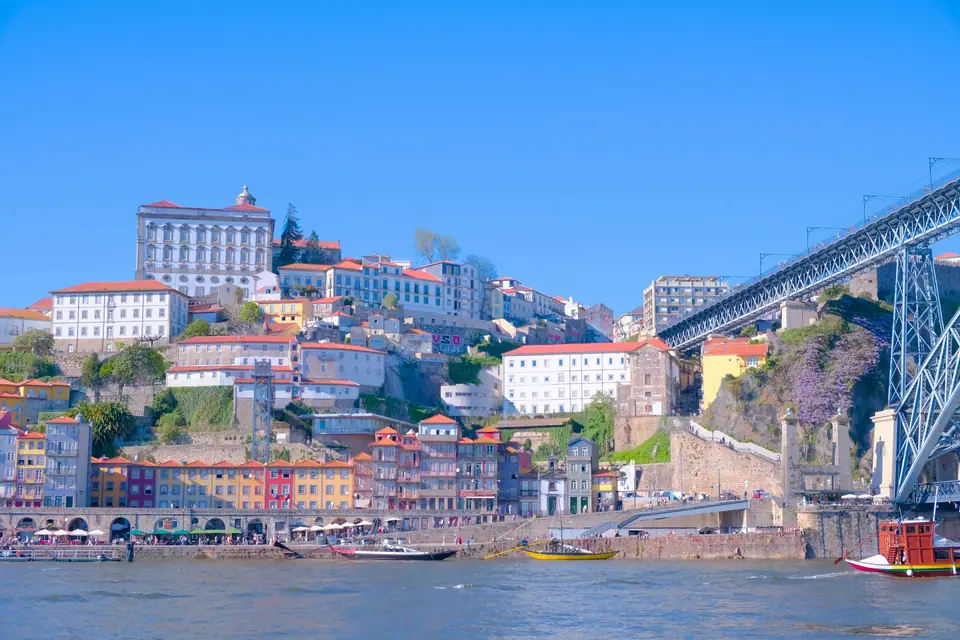
- Porto and the north. Granite and tiles stacked above the Douro river, with the port wine lodges across the water in Vila Nova de Gaia. Braga and Guimarães are short train rides away.
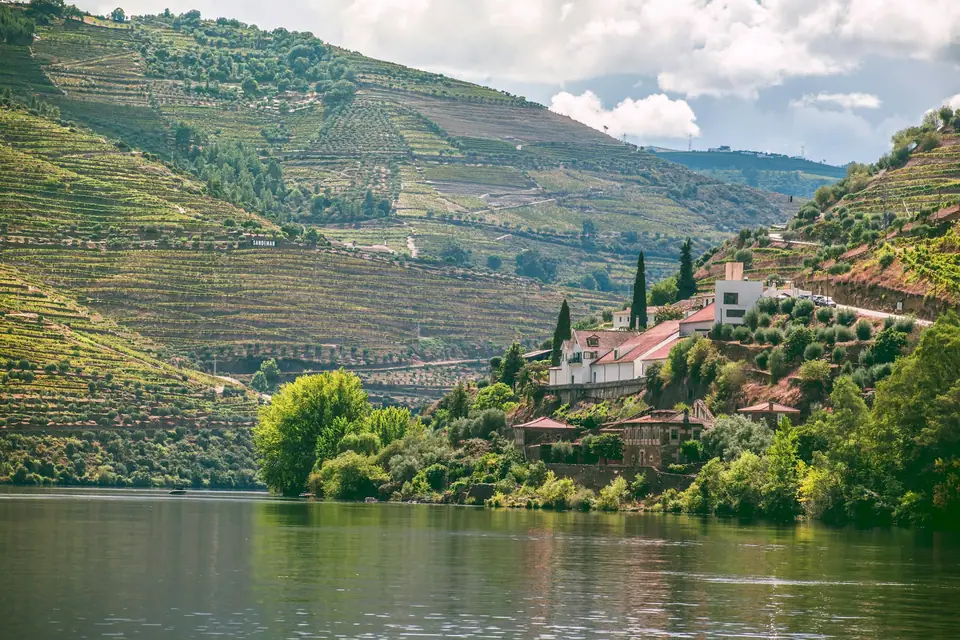
- The Douro Valley. Upstream from Porto, the river winds between terraces of vines where port has been made for centuries. Pinhão and Régua are the usual bases for wine estates, called quintas.
- Central Portugal. Coimbra and its old university sit halfway between Lisbon and Porto. Near the coast are the walled village of Óbidos and Nazaré, famous for its giant winter waves.
- The Alentejo. Wheat fields, olive groves and cork oaks. Évora has a Roman temple and a chapel lined with human bones.
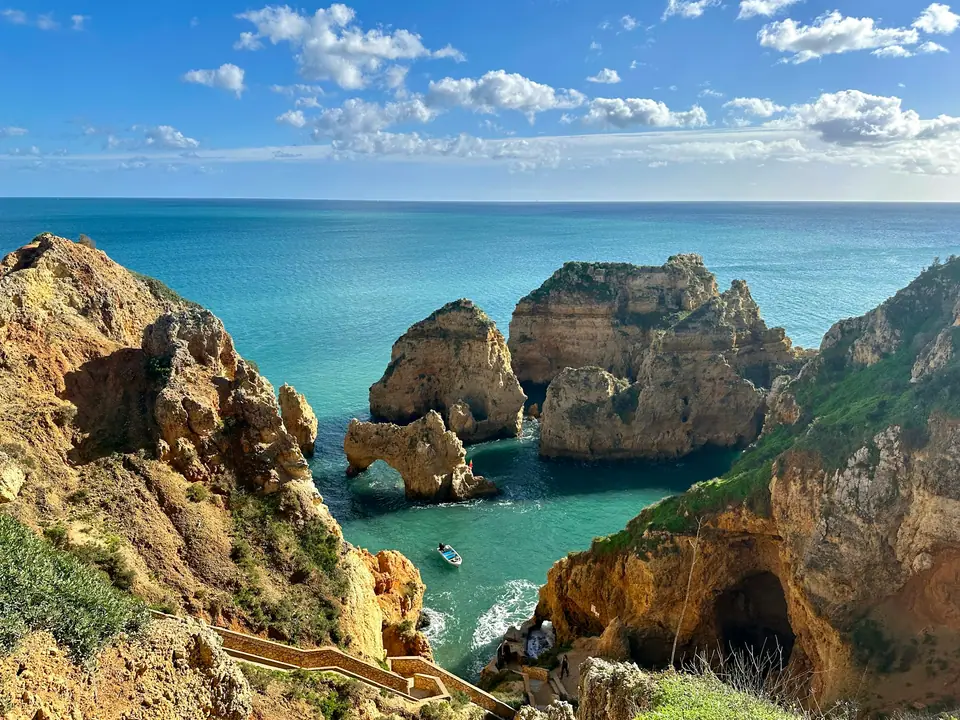
- The Algarve. Sea caves and rock arches around Lagos in the west, sandy islands and lagoons near Tavira in the east.
- Madeira and the Azores. Madeira is known for hiking along its levadas, old irrigation channels. The Azores are nine volcanic islands with crater lakes and whale watching.
Three routes: 7, 10 and 14 days
Book flights into one city and out of another. Porto and Lisbon both have direct international flights, and Faro serves the Algarve.
7 days: Lisbon and Porto
- Porto, 3 nights.
- Train south to Lisbon, 4 nights, with a day trip to Sintra. Our 3-day Lisbon itinerary fills the first three days. Fly home from Lisbon.
10 days: the north and the capital
- Porto, 3 nights.
- Train up the Douro to Pinhão, 2 nights, for wine estates and river views.
- Back through Porto and on to Coimbra, 1 night.
- Lisbon, 3 nights. Fly home from Lisbon.
14 days: north to south
- Porto, 3 nights, then the train to Lisbon.
- Lisbon, 4 nights, including Sintra.
- Pick up a car and drive to Évora, 2 nights.
- The Algarve, 4 nights, split between Lagos and Tavira if you like. Drop the car and fly home from Faro.
Getting around
Between Lisbon, Coimbra and Porto, take the train. CP, the national railway, runs the faster Alfa Pendular and the slightly slower Intercidades on this line; book on cp.pt, as the Alfa often fills up at weekends. Trains also run from Lisbon to Faro. The Douro line from Porto's São Bento station follows the river for much of the way beyond Régua; sit on the right-hand side heading upstream.
For the Alentejo, the Algarve beaches and the Douro estates, a car helps. Before driving:
- Many motorways have electronic-only tolls, with gantries instead of booths. Rental cars usually come with a transponder; ask for one at the desk. Foreign-registered cars can sign up at easytoll.pt.
- The A22 across the Algarve no longer charges tolls.
- Don't drive in Lisbon or Porto. Streets are steep and narrow and parking is scarce, and private cars are not allowed up to Pena Palace in Sintra.
Lisbon's airport is on the red metro line, and Porto's on metro line E.
When to go
April to June and September to October are the best months: warm, and without the August crowds. July and August are hot inland, where the Alentejo can pass 40°C, and the Algarve is packed. The Atlantic stays cool even in summer.
June is festival month. Lisbon celebrates Santo António on the night of 12 June with grilled sardines and street parties in Alfama, and Porto stays up all night on 23 June for São João. Winter is mild in Lisbon and the Algarve, wet in the north.
Practical questions
What do we need to enter Portugal?
Portugal is in the Schengen area. Visitors from outside the EU are now registered under the EU's Entry/Exit System, with fingerprints and a photo taken at the border, and queues at Lisbon and Faro can be long in summer. Leave extra time before flights to non-Schengen countries. ETIAS, the online travel authorisation for visa-free visitors, has not started yet, and the EU has not confirmed a start date. Check the official EU travel site for your nationality and ignore lookalike sites.
Are Lisbon's old funiculars running?
Most are not. After the Glória funicular derailed on 3 September 2025, killing 16 people, the city's historic lifts were stopped. Glória is expected back in 2029 with new equipment. Bica, Lavra and the Santa Justa lift had no reopening date at the time of writing. The newer Graça funicular reopened in April 2026, and tram 28 still climbs through Alfama. Our Alfama guide covers walking the hills.
Do we need to book Pena Palace?
Palace tickets are sold for a fixed date and entry time, so book ahead on the Parques de Sintra site in busy months. Take the train from Rossio to Sintra, then bus 434 up the hill. Our Sintra day trip guide has the order we'd visit things in.

Can we still swim into Benagil cave?
No. Since August 2024, swimming or paddling into the cave on your own is banned, and so is landing on its beach. You can see it from a licensed boat or guided kayak tour, or look down through the hole in its roof from the clifftop path called the Seven Hanging Valleys trail.
Do the Madeira trails cost anything?
Yes, for non-residents. Many of the island's official trails now charge a small fee, booked online on the regional government's SIMplifica portal. The famous PR1 from Pico do Arieiro to Pico Ruivo reopened in 2026 as a one-way route with timed slots, so arrange a taxi or transfer from the far end.
Anything to know about money?
Cards work almost everywhere, though small cafés may prefer cash; at cash machines, decline the offer to convert into your home currency. Bread and olives put on your table (the couvert) are charged if you eat them. Tipping is modest, around 5 to 10 percent in restaurants. Lisbon, Porto and many towns add a nightly tourist tax at the hotel, often missing from the price shown online. For emergencies, call 112.
Where we would start
For a first trip, we'd fly into Porto and out of Lisbon. Three nights by the Douro, the train south, four nights in the capital with a day in Sintra. It shows both halves of the country's character, needs no car, and leaves the Algarve and the islands for a second visit. Pack shoes with a good grip for the cobbles, and book Pena Palace before you go.