A detailed architectural route across Peter the Great’s Imperial Venice of the North: the Neva embankments, Winter Palace, Fontanka and Moyka canals, and Peterhof.
Peter the Great’s 1703 Island Citadel and Rastrelli’s Baroque Embankments
Founded on 27 May 1703 by Tsar Peter the Great on Hare Island (Zayachy Island) in the marshy delta where the Neva River empties into the Gulf of Finland, Saint Petersburg was conceived as Russia's classical and Baroque Window to Europe. Naming the new capital after his patron saint, Peter the Great and his successors Empress Elizabeth and Catherine the Great invited Italian, French, and Russian master architects, Domenico Trezzini, Bartolomeo Rastrelli, Giacomo Quarenghi, and Carlo Rossi, to line the Neva, Moyka, and Fontanka embankments with pastel-colored granite palaces.
Serving as capital of the Russian Empire from 1712 to 1918 and home to the encyclopaedic State Hermitage collections inside the Winter Palace, the UNESCO-listed historic centre preserves one of the world's largest unified eighteenth- and nineteenth-century urban ensembles.
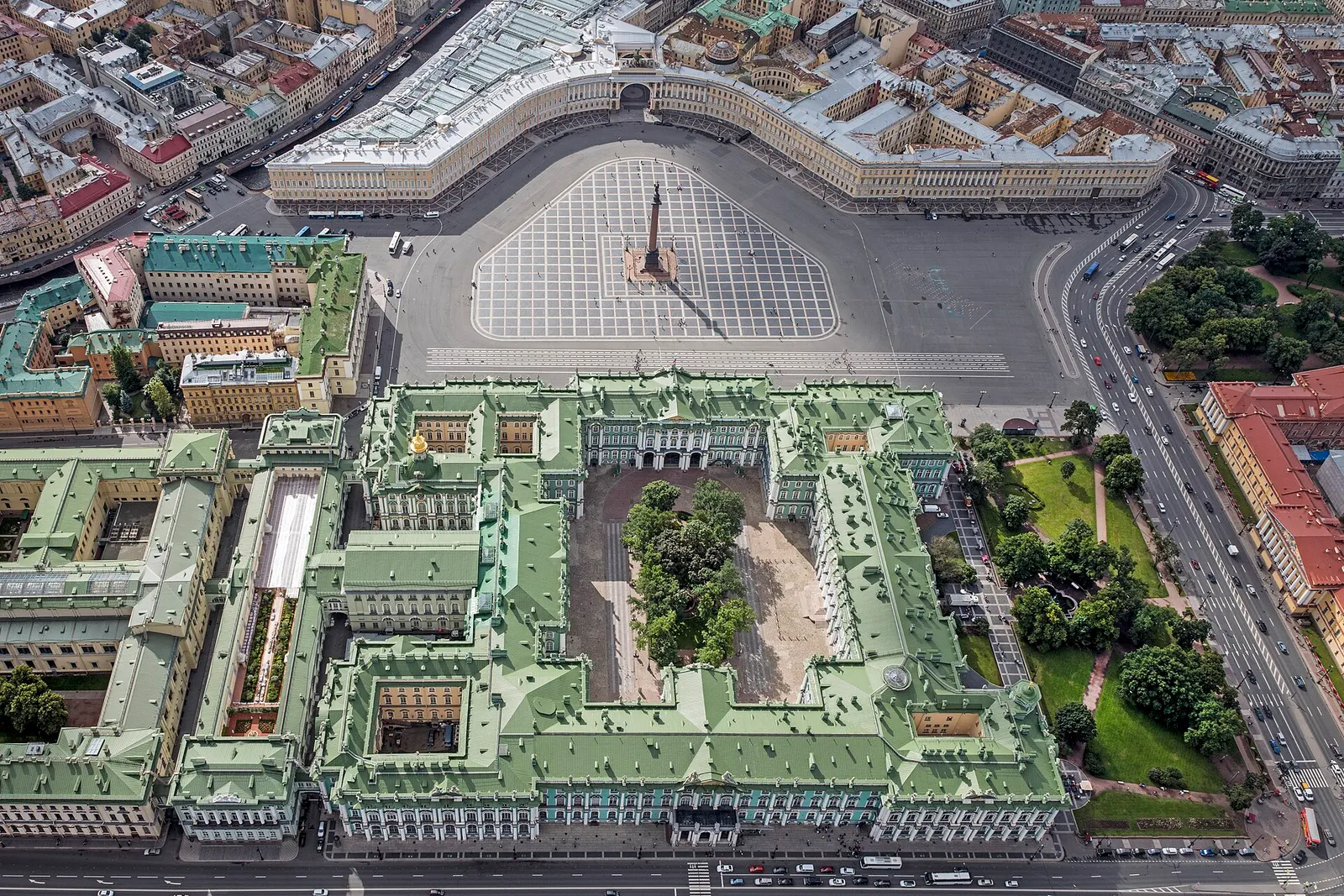
Palace Square, State Hermitage & Admiralty Embankment
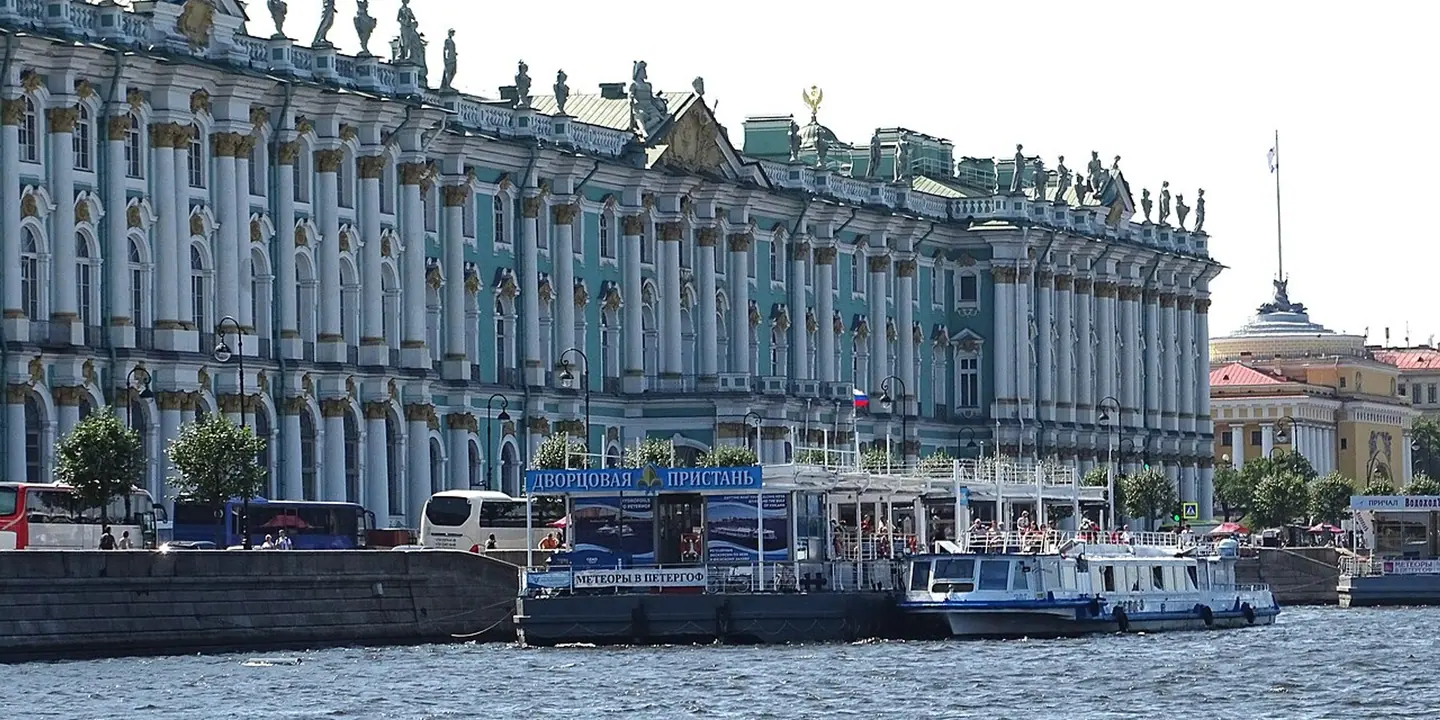
Palace Square Dvortsovaya Ploshchad, Alexander Column, Winter Palace State Hermitage Museum, General Staff Building Arch, New Hermitage Atlantes Portico, Admiralty Spire, Bronze Horseman, and St Isaac’s Cathedral Colonnade
Palace Square
Designed as the ceremonial heart of the Russian Empire, this vast plaza links the Winter Palace with the sweeping curve of the General Staff Building. We recommend observing how Carlo Rossi harmonised disparate architectural styles across the open expanse. The site witnessed crucial moments of modern history, including the 1905 Bloody Sunday procession and the 1917 October Revolution.
Alexander Column
Erected in 1834 to honour Emperor Alexander I, this monumental pillar was designed by French architect Auguste de Montferrand. Carved from a single piece of Finnish red granite, the shaft stands securely on its pedestal supported solely by its enormous weight and precise gravity calculations. An angel bearing a cross surmounts the capital, personifying peace across Europe.
Winter Palace
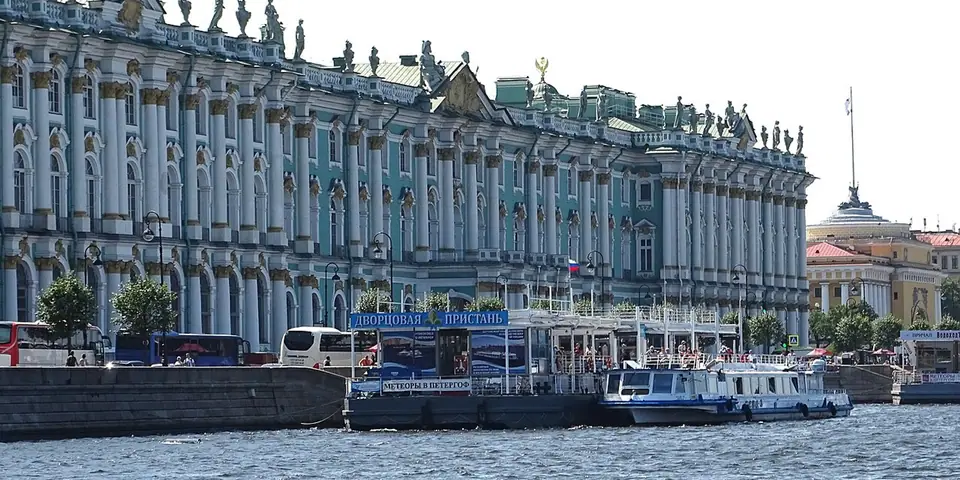
Conceived by Italian architect Bartolomeo Rastrelli between 1754 and 1762, this monumental palace served as the principal winter home of the Romanov tsars. The facade features turquoise walls, gilded capitals, and hundreds of roofline statues that face both Palace Square and the Neva River. Today it accommodates the sprawling art and antiquity collections of the State Hermitage Museum.
General Staff Building
Constructed between 1819 and 1829 to designs by Carlo Rossi, this enormous crescent-shaped complex originally housed imperial ministries alongside the military high command. The central triumphal arch features a bronze chariot driven by the goddess of Victory, commemorating the defeat of Napoleonic forces. Its eastern wing has been converted into modern exhibition galleries for nineteenth and twentieth-century European paintings.
Small Hermitage
Built between 1764 and 1775 by architects Jean-Baptiste Vallin de la Mothe and Yury Velten, this pavilion provided Catherine II with a private retreat adjacent to the formal court. The structure houses the famed Hanging Garden, an elevated courtyard built over vaulted stables. Inside, visitors can view James Cox's mechanical Peacock Clock, which still operates during weekly demonstrations.
Old Hermitage
Erected by Yury Velten between 1771 and 1787, this restrained neoclassical building was specifically commissioned to house Catherine the Great's rapidly expanding acquisition of European paintings. Facing the Palace Embankment, its severe facade contrasts deliberately with Rastrelli's opulent Winter Palace. The interior contains celebrated halls dedicated to Italian Renaissance masters, including original works by Leonardo da Vinci and Titian.
Hermitage Theatre
Designed by Giacomo Quarenghi and constructed in the 1780s, this classical theatre rests on the foundation of Peter the Great's former residence. An arched covered bridge spans the Winter Canal, connecting the auditorium directly to the main Hermitage complex. The semicircular auditorium features marble columns, classical statues of Apollo and the muses, and exemplary acoustics tailored for private royal performances.
New Hermitage
Commissioned by Nicholas I and designed by Bavarian architect Leo von Klenze, this mid-nineteenth-century building opened Russia's imperial collections to the general public. Ten colossal granite Atlantes, sculpted by Alexander Terebenev, support the entry portico along Millionnaya Street. The interior features skylit halls designed to display classical Greek and Roman antiquities, European sculpture, and extensive coin cabinets.
Winter Canal
Excavated in the early eighteenth century, this short canal runs between the Grand Hermitage and the Hermitage Theatre, terminating at the Neva River. Granite embankments and graceful stone bridges frame dramatic vistas of classical facade walls descending directly into the water. The atmospheric passage was made famous in Pyotr Tchaikovsky's opera The Queen of Spades as the scene of Liza's despair.
Hermitage Bridge
Spanning the mouth of the Winter Canal where it meets the Neva, this stone arch bridge was built between 1763 and 1766 to replace an earlier timber drawbridge. It is among the oldest stone bridges in Saint Petersburg, paved in granite to complement the quayside. The structure affords an uninterrupted view along the Palace Embankment and through the covered archway of the Hermitage Theatre.
Palace Embankment
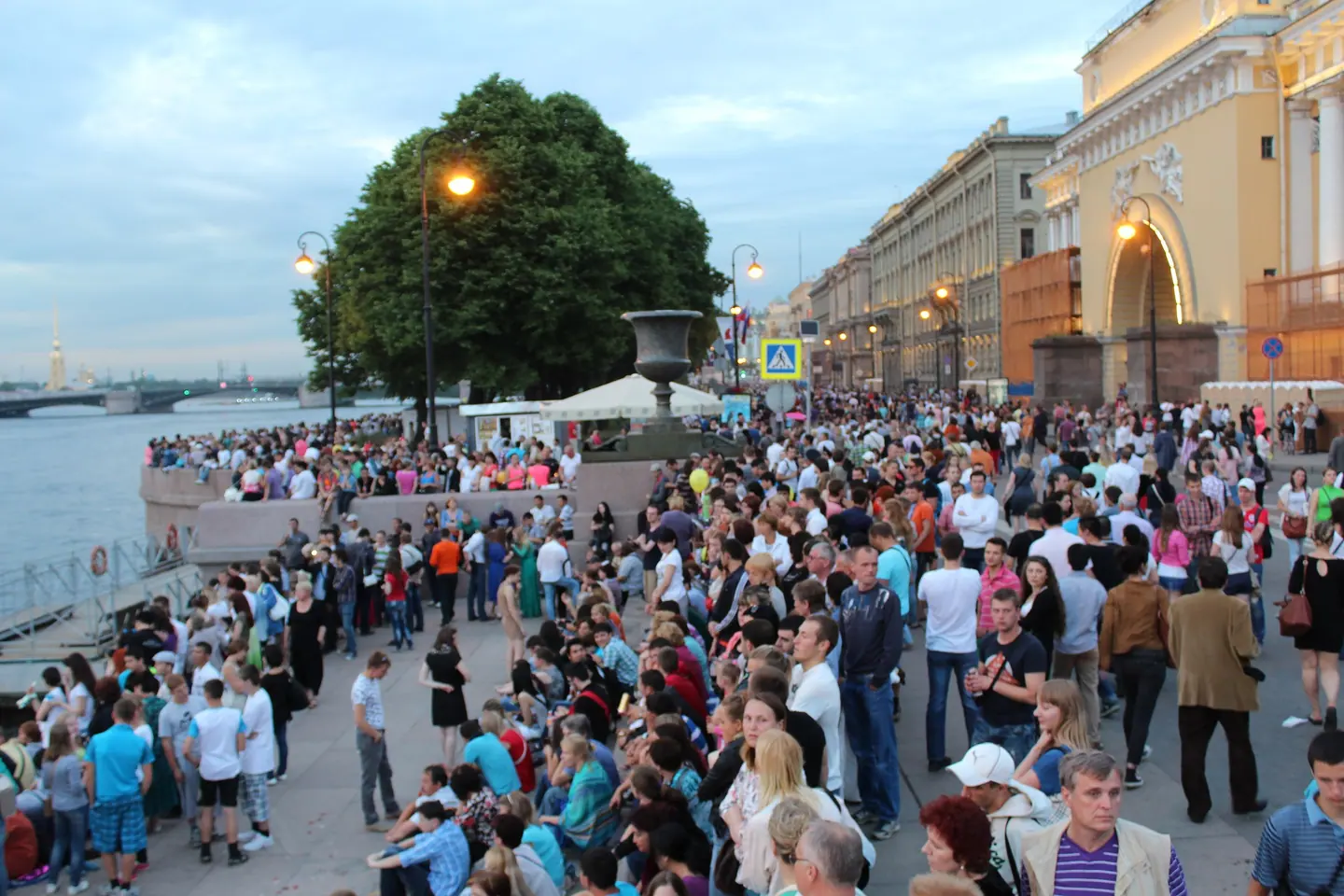
Constructed in solid pink Karelian granite during the reign of Catherine the Great, this riverside street carries traffic past the Hermitage museum buildings. It replaced muddy riverbanks with formal mooring steps, decorative iron railings, and substantial breakwaters. Walking along this pavement provides uninterrupted panoramas across the broad Neva towards the Peter and Paul Fortress and Vasilyevsky Island.
Palace Bridge
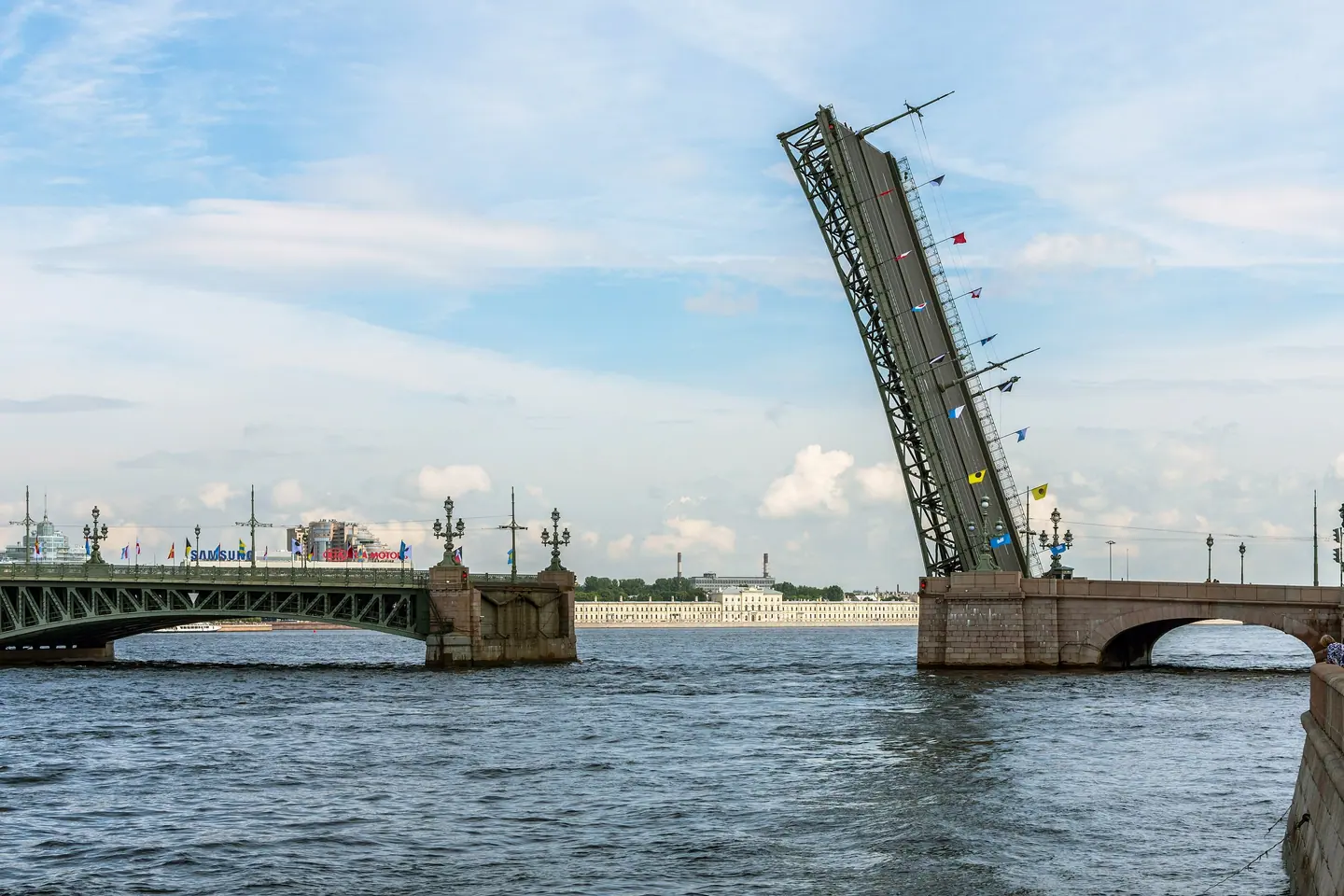
Connecting Palace Square with the Strelka of Vasilyevsky Island, this heavy five-span steel bridge opened to transit in 1916. Its central double-leaf drawbridge span lifts during nocturnal navigation periods in summer, creating one of the city's most familiar night vistas. The structure showcases classical balustrades and decorative lamp posts designed to maintain visual harmony with neighbouring imperial landmarks.
Admiralty Embankment
Constructed in the 1870s after the old naval slipways were decommissioned, this granite embankment links Palace Bridge to Senate Square. The riverside promenade is adorned with bronze statues, including the Peter the Great Shipbuilder monument presented by the Netherlands. It offers an open pedestrian pathway beside the Neva, flanked by late-imperial residential blocks and naval administration buildings.
Saint Petersburg Admiralty
Rebuilt by Andreyan Zakharov between 1806 and 1823, this immense Russian Empire style building served as the administrative centre of the Russian Navy. The focal point is a gilded spire rising above the central gate tower, topped by a miniature three-masted ship weathervane. The spire anchors Saint Petersburg's radial street plan, functioning as the visual terminal for Nevsky Prospekt and Voznesensky Prospekt.
Alexander Garden
Laid out in the 1870s on the former military glacis surrounding the Admiralty fortress, this park was named in honour of Tsar Alexander II. The grounds feature shaded lime avenues, seasonal flowerbeds, and a large central fountain designed to synchronise water jets with music. Monuments to prominent cultural figures, including poets Vasily Zhukovsky and Mikhail Lermontov, line the gravel walking paths.
Senate Square
Bordered by the Admiralty, the Senate and Synod buildings, and Saint Isaac's Cathedral, this river-facing plaza was the site of the 1825 Decembrist revolt. Carlo Rossi unified the western edge of the square by designing the connected yellow neoclassical facades of the Senate and Synod. The open space leads naturally towards the waterfront, focusing the eye on the equestrian statue of Peter the Great.
Bronze Horseman
Commissioned by Catherine the Great and sculpted by French artist Etienne Maurice Falconet, this monument was unveiled in 1782. The statue depicts Peter the Great on horseback, gesturing toward the Neva while trampling a serpent of treason. The rider sits atop the colossal Thunder Stone, a single block of granite hauled from the Gulf of Finland to serve as an organic pedestal.
Senate and Synod Building
Erected between 1829 and 1834 by Carlo Rossi, these twin yellow buildings accommodated the highest civil court and governing church body of the Russian Empire. The two wings are joined across Galernaya Street by an ornate triumphal arch topped with allegorical figures representing Justice and Piety. Today, the complex houses the Constitutional Court of Russia and the Boris Yeltsin Presidential Library.
Saint Isaac's Cathedral
Constructed over forty years from 1818 to 1858 under Auguste de Montferrand, this cathedral was the empire's principal place of worship. The building is supported by dozens of monolithic red granite columns, each quarried and raised using elaborate timber scaffolding. The lavish interior contains malachite and lapis lazuli columns, mosaic icons, and relief sculptures illustrating biblical history.
Saint Isaac's Cathedral Colonnade
Positioned at the base of the cathedral's primary drum, this circular walkway sits forty-three metres above street level. Reached via an internal spiral staircase, it provides a 360-degree viewpoint over the Neva, the Admiralty spire, Palace Square, and the southern canals. Visitors can inspect the copper cladding, stone balustrades, and colossal angel sculptures that surround the drum at close range.
Nevsky Prospekt, Spilled Blood & Arts Square
Kazan Cathedral Colonnade, Singer House Bookshop, Church of the Savior on Spilled Blood, Mikhailovsky Palace Russian Museum, Mikhailovsky Theatre, Field of Mars, Summer Garden of Peter the Great, Anichkov Bridge Horse Tamers, and Fabergé Museum Shuvalov Palace
Kazan Cathedral
Modelled loosely on St Peter's Basilica in Rome, this Empire-style cathedral features an expansive semi-circular screen of ninety-six Corinthian columns fronting Nevsky Prospekt. Completed in 1811 by architect Andrey Voronikhin, the building became a national monument to the victory over Napoleon. Inside, travellers can view the tomb of Field Marshal Mikhail Kutuzov and venerate the copy of the sacred icon of Our Lady of Kazan.
Singer House
Erected between 1902 and 1904 for the Singer Sewing Machine Company, this celebrated Art Nouveau structure now houses the city's largest bookshop, Dom Knigi. Architect Pavel Syusor introduced an innovative metal skeleton frame that permitted large display windows without exceeding Imperial height restrictions. Look closely at the granite facade for finely sculpted bronze Valkyries, floral flourishes and the translucent lantern globe towering over the roofline.
Church of the Savior on Spilled Blood
Constructed along the Griboyedov Canal, this ornate church marks the exact spot where Emperor Alexander II was assassinated in 1881. Designed by Alfred Parland in the medieval Russian style, it stands in deliberate contrast to the surrounding Neoclassical architecture. The interior is famous for holding over seven thousand square metres of shimmering mosaics, which completely cover the soaring vaults, pillars and central canopy over the preserved cobblestones.
Mikhailovsky Palace
Designed by Carlo Rossi between 1819 and 1825 for Grand Duke Mikhail Pavlovich, this sprawling palace serves as the principal branch of the State Russian Museum. The refined Corinthian portico overlooks Arts Square, complemented by manicured grounds that extend towards the Mikhailovsky Garden. Within, the grand white marble staircase and the preserved Rossi Hall demonstrate the height of Russian Empire interior decoration alongside centuries of masterworks.
Mikhailovsky Theatre
Founded in 1833 by order of Emperor Nicholas I, this venue forms an integral part of the uniform architectural ensemble created by Carlo Rossi. While the exterior preserves Rossi's restrained Neoclassical facade, the interior was sumptuously reimagined by Albert Cavos with silver mirrors, crimson velvet and ornate gilded mouldings. The stage has hosted premieres by Tchaikovsky, Shostakovich and generations of classical dancers.
Field of Mars
Originally an amusement meadow and military training ground named after Mars, the Roman god of war, this vast space was transformed into a memorial park in the early twentieth century. At its centre stands the Monument to the Fighters of the Revolution, surrounded by the Soviet Union's first eternal flame. Broad gravel pathways and mature lilac hedges offer tranquil open-sky views across to the engineers' castle and neighbouring palaces.
Summer Garden
Established in 1704 as the Dutch-style private retreat of Peter the Great, the Summer Garden is the oldest park in the city. Symmetrical allées are lined with clipped linden hedges, reconstructed fountains and dozens of authentic eighteenth-century Italian marble allegorical statues. Along its southern edge, visitors can admire the delicate wrought-iron grille designed by Yuri Felten, celebrated for its balanced geometric proportions.
Summer Palace of Peter the Great
Built between 1710 and 1714 by Domenico Trezzini, this modest two-storey masonry house served as the Emperor's summer residence during the construction of the new capital. The simple yellow walls feature twenty-nine terracotta bas-reliefs by Andreas Schlüter, illustrating episodes from Aesop's fables and mythological naval scenes. Inside, the original tiled Dutch stoves, timber panelled studies and naval compasses illustrate the monarch's utilitarian domestic life.
Anichkov Bridge
Spanning the Fontanka River along Nevsky Prospekt, this three-span stone bridge is among the most celebrated crossings in the city. It is famed for the dramatic group of four bronze sculptures, 'The Horse Tamers', cast by Peter Clodt between 1841 and 1850. Each pedestal reveals a progressive stage in taming a wild stallion, while the iron balustrades display classical cast sea nymphs and seahorses.
Fabergé Museum
Housed within the restored Neoclassical halls of the Shuvalov Palace on the Fontanka embankment, this museum holds the world's largest collection of Carl Fabergé masterworks. The centrepiece of the Blue Room displays nine Imperial Easter Eggs created for tsars Alexander III and Nicholas II. Travellers can also admire gold presentation snuffboxes, enamelled silverware, and historic portraits once collected by the Russian aristocracy.
Arts Square
Engineered as an integrated cultural hub, this elegant square links together some of the city's finest artistic establishments, including the Grand Philharmonic Hall, Mikhailovsky Palace and several theatres. The surrounding facades feature harmonious classical columns, cornices and yellow ochre stucco. At the centre of the grassy garden stands a celebrated bronze monument to the poet Alexander Pushkin, created by Mikhail Anikushin in 1957.
Saint Petersburg Philharmonic
Originally constructed in 1839 by Paul Jacot as the Noble Assembly, this grand Neoclassical building has long been the epicentre of the city's musical life. Its Grand Hall, lined with fluted white Corinthian columns and crystal chandeliers, is famous for exceptional acoustics. The venue achieved international renown in August 1942, when it hosted the defiant local premiere of Shostakovich's Seventh Symphony during the wartime siege.
Great Gostiny Dvor
Constructed between 1761 and 1785 to designs by Jean-Baptiste Vallin de la Mothe, this immense commercial arcade occupies an entire city block on Nevsky Prospekt. The building features continuous two-tier arcades that sheltered merchants and shoppers from harsh Russian winters. Today, visitors can walk the outdoor perimeter galleries, which house diverse shopping boutiques while maintaining one of Europe's earliest indoor shopping department structures.
Saint Catherine's Catholic Church
Constructed between 1763 and 1783 by Pietro Antonio Trezzini and Jean-Baptiste Vallin de la Mothe, this basilica is one of the oldest Roman Catholic churches in Russia. Its facade is distinguished by an arched pediment topped by statues of the four Evangelists and angels supporting a cross. The interior contains the burial vault of Stanisław August Poniatowski, the final king of the Polish-Lithuanian Commonwealth.
Saint Peter and Saint Paul Lutheran Church
Commonly known as Petrikirche, this grand church was designed by Alexander Brullov and consecrated in 1838 to serve the capital's substantial German Lutheran community. The stone facade features high round arches, a sculpted figure of the Apostle Peter and two prominent square towers flanking the main entrance. Following decades of repurposed secular use in the twentieth century, the interior now hosts services, classical recitals and historical exhibitions.
Stroganov Palace
Standing where Nevsky Prospekt intersects the Moika River, this historic pink-and-white palace was built between 1753 and 1754 for Baron Sergei Stroganov. It is an exceptional surviving residential example of Russian Baroque, displaying pediments adorned with the Stroganov coat of arms and sculpted lions guarding the carriage gate. Managed by the Russian Museum, the restored state rooms include a splendid ballroom and mineral cabinet.
Mikhailovsky Castle
Designed by Vincenzo Brenna and Vasily Bazhenov, this enigmatic fortress was built around 1800 for Emperor Paul I, who feared court conspiracies and assassination. Surrounded originally by defensive moats and drawbridges, each of the four facades exhibits a completely distinct architectural treatment, ranging from French Neoclassicism to heavy Italian Baroque. Today, travellers can walk through the central octagonal courtyard and tour the State Russian Museum exhibitions inside.
Anichkov Palace
Begun in 1741 by Mikhail Zemtsov and completed by Bartolomeo Rastrelli for Empress Elizabeth, this imposing residence was repeatedly remodelled for Imperial favourites and Romanov heirs. Its restrained Neoclassical exterior, redesigned by Ivan Starov, faces extensive private grounds that buffer the estate from urban traffic. The complex long served as a private residence for future tsars, including Alexander III, and now functions as a youth education centre.
Eliseev Emporium
Erected between 1902 and 1903 by Gavriil Baranovsky, this lavish Art Nouveau commercial hall was built for the merchant Eliseev Brothers. The exterior features a massive stained-glass arch and colossal bronze allegorical statues personifying Commerce, Industry, Science and Arts. Inside, travellers can examine crystal chandeliers, gilded vegetal motifs and gourmet food counters, while the upper floor continues to house the Akimov Comedy Theatre.
Bank Bridge
Constructed in 1826 to designs by engineer Wilhelm von Traitteur, this pedestrian suspension footbridge crosses the narrow Griboyedov Canal directly outside the former State Assignation Bank. It is best known for its four mythical cast-iron griffins, sculpted by Pavel Sokolov, whose golden wings cleverly disguise the structural cable anchors. The bridge offers splendid framing for photography looking towards the grand colonnade of neighbouring Kazan Cathedral.
Peter and Paul Fortress, Vasilievsky Island & Petrogradskaya
Peter and Paul Fortress, Peter and Paul Cathedral Imperial Tombs, Cabin of Peter the Great, Cruiser Aurora, Spit of Vasilievsky Island Rostral Columns, Kunstkamera, Twelve Collegia Building, Menshikov Palace, and Saint Petersburg Mosque Turquoise Dome
Peter and Paul Fortress
Peter the Great established this defensive citadel on Hare Island to protect his new Baltic territory from Swedish naval forces. The fortress contains thick granite bastions, the Grand Ducal Burial Vault, and an 18th-century prison that once held prominent political dissidents. Visitors can walk the elevated Neva curtain wall for sweeping views across the river toward the Winter Palace.
Peter and Paul Cathedral
Designed by Swiss-Italian architect Domenico Trezzini, this Petrine Baroque cathedral was consecrated in 1733 and features a gilded spire rising 122 metres. It serves as the final resting place of Russian monarchs from Peter the Great to Nicholas II. The interior features a carved gilded iconostasis and marble sarcophagi arranged across the ceremonial nave.
Grand Ducal Burial Vault
Constructed between 1896 and 1908 by David Grimm and Antony Tomishko, this neo-Baroque hall was commissioned to house the growing Romanov family burials. Connected to the main cathedral by a covered passage, it contains sixty marble vaults decorated with bronze wreaths. Visitors can inspect the stained-glass window portraying the Resurrection, designed specifically for the central apse.
Trubetskoy Bastion Prison
Rebuilt in the 1870s inside the southwest corner of the fortress, this dedicated isolation facility held hundreds of high-profile political prisoners, including Leon Trotsky and Maxim Gorky. The two-storey building preserve original cell doors, peepholes, and acoustic isolation corridors designed to prevent prisoners from tapping messages. Walking the quiet corridors reveals the austere conditions under the tsarist penal regime.
Boathouse of Peter the Great
Architect Alexander Vist constructed this small pavilion in 1761 to shelter the English sailing dinghy that Peter the Great used as a youth. Known as the Grandfather of the Russian Navy, the original vessel was later moved to the Central Naval Museum, leaving a replica on site. The rooftop features a terracotta allegory of navigation looking toward the Neva.
Cabin of Peter the Great
Soldiers erected this modest wooden dwelling in three days during May 1703 so Peter the Great could oversee the construction of his new maritime capital. Catherine the Great later ordered a red-brick pavilion to be built entirely around the timber log house to shield it from harsh Baltic weather. Inside the shelter, visitors can view the Tsar's personal study and furniture.
Cruiser Aurora
Launched in 1900, this veteran imperial cruiser survived the Battle of Tsushima before its crew fired the blank forecastle shot that signalled the Bolshevik assault in October 1917. Moored permanently on the Petrogradskaya embankment, the ship now operates as a branch of the Central Naval Museum. Visitors can explore the gun decks, engine rooms, and the restored officers' wardroom.
Saint Petersburg Mosque
Modelled closely on the Gur-e-Amir mausoleum in Samarkand, this grand mosque was built between 1910 and 1913 by architect Nikolai Vasilyev to serve the empire's Muslim community. The exterior is clad in grey granite and turquoise ceramic tiles that form intricate geometric calligraphy around the portal. The interior features enormous prayer halls lit by large brass chandeliers and adorned with Qur'anic inscriptions.
Spit of Vasilievsky Island
Architect Thomas de Thomon redesigned this river point between 1805 and 1810, carving a semicircular granite pier with massive launch ramps into the Neva. The square is anchored by two forty-metre terracotta-coloured Rostral Columns studded with bronze ship prows and seated river allegories. Today it serves as a central vantage point for surveying the Winter Palace and Peter and Paul Fortress.
Old Saint Petersburg Stock Exchange
Thomas de Thomon completed this monumental neoclassical trading hall in 1816, drawing inspiration from the Greek temple of Hera at Paestum. The facade is defined by forty-four Doric columns and an expansive pediment sculpture depicting Neptune flanked by maritime commerce figures. Although closed for ongoing restoration, the building remains one of the city's foremost examples of early nineteenth-century imperial architecture.
Kunstkamera
Founded in 1714, this Petrine Baroque building with an astronomical tower was the first purpose-built museum in Russia. Peter the Great created it to overcome superstitions, assembling anatomical specimens preserved in alcohol alongside cultural artefacts gathered across Siberia and the Pacific. The museum now houses the Peter the Great Museum of Anthropology and Ethnography, displaying extensive global ethnographic collections.
Twelve Collegia Building
Commissioned by Peter the Great to house his twelve government ministries, this 400-metre-long Baroque structure was designed by Domenico Trezzini and completed in 1742. Trezzini joined twelve identical three-storey pavilions into a continuous red-and-white facade, reflecting the administrative order of the modernising state. Today it serves as the administrative centre of Saint Petersburg State University and contains extensive academic libraries.
Menshikov Palace
Constructed between 1710 and 1727 by Giovanni Maria Fontana and Gottfried Schädel, this waterfront residence belonged to Prince Alexander Menshikov, Peter the Great's close confidant. The palace showcased early Russian Baroque domestic opulence, often hosting state banquets before the Tsar's own residences were completed. Several interior rooms retain their original Dutch Delft tiles, carved walnut panelling, and authentic eighteenth-century furnishings.
Imperial Academy of Arts
Designed by Jean-Baptiste Vallin de la Mothe and Alexander Kokorinov between 1764 and 1788, this sprawling neoclassical complex trained Russia's finest painters and sculptors. The facade faces the river with an elegant colonnade, while the interior is arranged around a monumental circular courtyard. The academy museum displays plaster casts, classical anatomical drawings, and masterworks by Ilya Repin and Karl Bryullov.
Sphinxes on the University Embankment
Carved from pink Aswan granite over three thousand years ago during the reign of Pharaoh Amenhotep III, these sphinxes originally guarded his mortuary temple in Thebes. The Russian Empire purchased them during the Greek War of Independence and installed them along the Neva embankment in 1834. Hieroglyphic inscriptions naming Amenhotep III remain visible along their carved pedestals and broad bases.
Saint Andrew's Cathedral
Built between 1764 and 1780 to designs by Alexander Vist, this pastel-pink cathedral honours Saint Andrew the First-Called, the patron saint of the Russian navy. The exterior combines late Baroque ornamentation with classical proportions, topped by five domes and a two-tiered bell tower. Inside, visitors can view a rare three-tiered iconostasis carved from linden wood and completely gilded in pure gold leaf.
Smolensky Cemetery
Established along the Smolenka River in 1738, this historic cemetery contains the graves of generations of university professors, naval officers, and writers. Its spiritual heart is the green-domed chapel of Blessed Xenia of Saint Petersburg, one of Russia's most venerated saints, whose tomb attracts continuous pilgrims. The surrounding woodland path contains weathered stone crosses, neoclassical sarcophagi, and the church of the Smolensk Icon.
Museum of Political History of Russia
Housed in the Art Nouveau mansion built in 1906 for the ballerina Mathilda Kschessinska, this building was seized by the Bolsheviks following the February Revolution. Vladimir Lenin delivered speeches from its wrought-iron balcony and directed party operations from its ground-floor drawing rooms. Today the museum documents Russian political movements across the nineteenth and twentieth centuries through authentic diaries, posters, and party documents.
Saint Petersburg Botanical Garden
Peter the Great established this garden on Apothecary Island in 1714 to cultivate medicinal herbs for the army and navy. Over the nineteenth century it expanded into an international botanical institution with a chain of twenty-six interconnected Victorian iron-and-glass greenhouses. Today travellers can walk along palm routes, inspect rare tropical orchids, and admire giant Victoria amazonica water lilies in heated pools.
Ioannovsky Convent
Founded in 1900 by the influential spiritual figure Saint John of Kronstadt, this convent was built by architect Nikolai Nikonov using rich neo-Byzantine brickwork. The upper cathedral of the Twelve Apostles features painted vaults and a distinct five-domed silhouette rising beside the Karpovka River. The crypt church beneath houses the white marble tomb of Saint John, attracting worshippers from across the region.
Moyka & Griboyedov Canals, Mariinsky Theatre & New Holland
Yusupov Palace on the Moyka, St Nicholas Naval Cathedral, Mariinsky Theatre, New Holland Island Brick Warehouses, Bank Bridge Griffins, Lion Bridge, Dostoevsky Museum Quarter, and Alexander Nevsky Lavra Tikhvin Cemetery
Yusupov Palace on the Moyka
Standing along the Moyka River, this yellow neoclassical residence was the primary city seat of the wealthy Yusupov family. Jean-Baptiste Vallin de la Mothe and later architects shaped its grand ballrooms, private rococo theatre, and basement chambers. Travellers explore opulent art collections and the vaulted ground-floor dining room where conspirators poisoned Grigori Rasputin in December 1916.
Mariinsky Theatre
Inaugurated in 1860, this sea-green auditorium designed by Alberto Cavos remains the historic home of Russian ballet and opera. The lavish interior features a six-tiered U-shaped hall lined with gilded plasterwork, velvet drapes, and a colossal crystal chandelier. Premieres of masterworks by Tchaikovsky and Mussorgsky were staged here before royal and aristocratic patrons.
St Nicholas Naval Cathedral
Built between 1753 and 1762 by architect Savva Chevakinsky, this bright blue cathedral represents Russian Elizabethan Baroque at its most refined. Dedicated to Saint Nicholas, the patron saint of sailors, it served the admiralty quarter and contains memorial plaques for lost naval personnel. We admire its freestanding four-tier bell tower standing across the canal embankment.
New Holland Island Brick Warehouses
Created by Peter the Great as a timber storage depot, this triangular island is surrounded by the Moyka and Kryukov canals. Vallin de la Mothe designed the monumental brick storehouses and the austere classical archway rising above the internal basin. The revitalised public complex features manicured lawns, art pavilions, and a converted naval prison nicknamed the Bottle.
Bank Bridge Griffins
Engineered by Wilhelm von Traitteur in 1826, this narrow footbridge spans the Griboyedov Canal near the former State Assignation Bank. Four cast-iron griffins sculpted by Pavel Sokolov conceal the suspension cable anchors inside their hollow bodies. Their gilded wings, ornate lanterns, and cast railings make this one of the city's most recognisable canal crossings.
Lion Bridge
Another graceful pedestrian suspension bridge engineered by Wilhelm von Traitteur, this span across the Griboyedov Canal was completed in 1826. Two pairs of powerful cast-iron lions, also designed by Pavel Sokolov, stand at either abutment, clamping the iron chain cables in their jaws. Its openwork lattice railings and modest scale complement the quiet residential embankments.
Dostoevsky Museum Quarter
Fyodor Dostoevsky rented a second-floor flat in this corner tenement on Kuznechny Lane twice, notably during the final years before his death in 1881. It was here that he completed The Brothers Karamazov. The museum preserves his preserved study, clock stopped at the hour of his passing, family photographs, and an extensive archival library.
Tikhvin Cemetery at Alexander Nevsky Lavra
Established in 1823 within the grounds of the Alexander Nevsky Lavra, this quiet burial ground serves as an open-air sculpture museum of nineteenth-century creative titans. Visitors walk among the elaborate carved tombstones of Pyotr Ilyich Tchaikovsky, Modest Mussorgsky, Fyodor Dostoevsky, and Nikolai Rimsky-Korsakov. The wooded paths provide reflective historical insights into Russia's golden age of arts.
Kryukov Canal and Seven Bridges Viewpoint
Engineered in the 1780s to connect the Moyka and Fontanka rivers, the Kryukov Canal bisects the Kolomna theatre district. At the Krasnoflotsky Bridge intersection near St Nicholas Naval Cathedral, pedestrians can look in various directions to count seven bridges across the meeting waterways. Strolling these granite embankments reveals classic vistas of golden spires reflecting in the dark canal water.
Pikalyov Bridge
Spanning the Griboyedov Canal where it meets the Kryukov Canal, this stone-and-granite bridge was completed in the 1780s. It retains its authentic eighteenth-century appearance, complete with classic cast-iron railings and round granite obelisks topped by brass globes. The bridge serves as the pivotal vantage point for observing neighbouring waterways and cathedral bell towers.
Kolomna Market Square and Pokrovsky Square
Known historically as Pokrovsky Square before being renamed after Ivan Turgenev, this leafy public square formed the civic heart of the old Kolomna quarter. Alexander Pushkin celebrated the neighbourhood in his poem The Bronze Horseman and resided briefly nearby. Though its original Church of the Intercession was demolished, the green square retains the peaceful charm of old residential Petersburg.
Potseluev Bridge
Constructed in 1816 to designs by William Heste, the Bridge of Kisses carries traffic and pedestrians across the Moyka River. Its distinctive name derives from the eighteenth-century merchant Nikita Potseluev, who operated a popular tavern nearby. The crossing features curved cast-iron arches, decorative granite obelisks with lanterns, and panoramas toward Saint Isaac's Cathedral dome.
Rimsky-Korsakov Apartment Museum
Located on Zagorodny Prospekt, this museum preserves the spacious apartment where composer Nikolai Rimsky-Korsakov lived from 1893 until 1908. Here he composed eleven of his fifteen operas, including The Golden Cockerel. The preserved drawing room still displays his Becker grand piano, music manuscripts, and personal instruments where colleagues like Sergei Rachmaninoff and Igor Stravinsky gathered.
Sennaya Square
Laid out in the 1730s as a historic hay and cattle market, Sennaya Square evolved into the commercial heart of central Saint Petersburg. Dostoevsky used its crowded lanes, drinking dens, and tenements as the primary backdrop for Rodion Raskolnikov's troubled wanderings in Crime and Punishment. A restored guardhouse building remains on site as an architectural marker of its tsarist past.
Blue Bridge
Measuring almost one hundred metres across, this cast-iron structure spanning the Moyka River is celebrated as the widest bridge in the city. William Heste designed the initial crossing, which Auguste de Montferrand expanded to integrate seamlessly with the cobbles of Saint Isaac's Square. Look for the granite flood obelisk on the embankment showing high-water levels from historic inundations.
Trinity Cathedral of the Izmaylovsky Regiment
Vasily Stasov designed this late neoclassical cathedral between 1828 and 1835 for the elite Imperial Izmaylovsky Guards Regiment. Its monumental white porticoes support five immense wooden-framed domes painted bright blue and spangled with gilded stars. Outside stands the Monument to Glory, an imposing victory column constructed from six tiers of captured Ottoman cannon barrels.
Alexander Nevsky Lavra Holy Trinity Cathedral
Founded by Peter the Great in 1710, this monastery complex was elevated to the highest spiritual rank of Lavra in 1797. The central Holy Trinity Cathedral, designed by Ivan Starov, features early neoclassical façades and a soaring coffered dome. Inside, visitors encounter the silver shrine that long held the earthly remains of Prince Alexander Nevsky.
Matveev Bridge
Carrying embankment traffic across the Kryukov Canal right opposite New Holland, this bridge dates to the late eighteenth century. Originally a wooden bascule crossing, it was later rebuilt in stone and iron while maintaining classic railings with gilded rosette details. It provides a picturesque viewpoint of the massive red-brick warehouses and arched entrance of New Holland.
Raskolnikov's House
At the corner of Grazhdanskaya and Stolyarny streets stands the four-storey apartment block widely identified as the garret home of Rodion Raskolnikov. Dostoevsky based his topography on exact step counts, placing his brooding student in a tiny attic room under the roof. A high-relief bronze and granite sculpture on the exterior honours the literary character and his creator.
Red Bridge over the Moyka
Spanning the Moyka River along the historic axis of Gorokhovaya Street, this cast-iron structure was completed in 1814 by engineer William Heste. It is the sole surviving cast-iron segment bridge from Heste's standard series across the river that retains its original appearance. Its historic scarlet paintwork and decorative obelisks contrast vividly with the surrounding pastel-hued imperial architecture.
Imperial Summer Palaces: Peterhof, Tsarskoye Selo & Kronstadt
Peterhof Grand Cascade and Samson Fountain, Monplaisir Villa on the Gulf, Catherine Palace at Tsarskoye Selo (Pushkin) & Amber Room, Cameron Gallery, Pavlovsk Palace Park, Oranienbaum Chinese Palace, and Kronstadt Naval Cathedral
Grand Cascade and Samson Fountain
Peter the Great designed this monumental water stairway to celebrate Russian maritime access to the Baltic Sea. Sixty-four gravity-fed fountains and over two hundred gilded bronze figures lead down towards the sea canal. The central sculpture depicts Samson tearing open the jaws of a lion, commemorating the Russian victory over Sweden at Poltava.
Monplaisir Palace
Standing directly upon the shore of the Gulf of Finland, this Dutch Baroque villa served as Peter the Great's favourite coastal residence. The interior features the tsar's collection of Dutch maritime paintings alongside Chinese lacquered panels. Visitors can observe the formal gardens and terrace views across the waters towards Kronstadt.
Grand Peterhof Palace
Bartolomeo Rastrelli transformed Peter the Great's original modest residence into an expansive imperial palace under Empress Elizabeth. The gilded ballroom and ornate state rooms reflect the height of Russian Rococo design. The south facade opens onto the Upper Garden, while the northern frontage overlooks the cascade.
Marly Palace
Inspired by Louis XIV's hunting lodge at Marly-le-Roi, this two-storey pavilion anchors the western section of Peterhof's lower park. Peter the Great used the building for quiet contemplation and entertaining intimate circles of guests. The adjoining ponds were historically stocked with carp that responded to the ringing of bells.
Hermitage Pavilion at Peterhof
Built during the reign of Peter the Great, this compact pavilion allowed the court to dine without the presence of servants. A complex pulley system hoisted food and plates directly to the second-floor banqueting room from the ground-floor kitchens. Moated by a wide canal, it required a drawbridge for access.
Catherine Palace
Architect Bartolomeo Rastrelli designed the current palace for Empress Elizabeth, who named it in honour of her mother, Catherine I. The sky-blue facade stretches nearly one kilometre, decorated with gilded atlantes and pilasters. The ceremonial Golden Enfilade showcases the absolute power and artistic patronage of the Romanov dynasty.
Amber Room
Originally presented to Peter the Great by the King of Prussia, the amber panels vanished during the Second World War. Skilled craftsmen spent over two decades reconstructing the chamber using historical photographs and archival documentation. The room features thousands of kilograms of amber carved into reliefs, monograms, and gemstone mosaics.
Cameron Gallery
Scottish architect Charles Cameron designed this neoclassical gallery for Catherine the Great in the 1780s. Elevated on a rustic stone base, the upper floor features slender Ionic columns framing views of the park. A collection of bronze busts depicting ancient philosophers and statesmen lines the elevated promenade.
Agate Rooms and Cold Bath
Part of the Cameron complex, this elegant building accommodated the private bathing suites and study of Catherine the Great. The upper pavilion contains walls lined with Ural jasper, porphyry, and Russian agate polished to high sheen. The lower level preserved classical plunge baths modelled after ancient Roman thermae.
Great Pond and Chesme Column
The Great Pond forms the central feature of Catherine Park's English landscape section. Antonio Rinaldi erected the Chesme Column in the water to celebrate Russia's naval victory against the Ottoman fleet in 1770. The pink and grey marble monument rises twenty-five metres and displays sculpted bronze prows of captured ships.
Alexander Palace
Giacomo Quarenghi designed this restrained neoclassical palace for the future Emperor Alexander I at the end of the eighteenth century. It served as the primary residence of Nicholas II and his family until their arrest and exile in 1917. Restored private apartments present intimate glimpses into the twilight years of imperial Russia.
Pavlovsk Palace
Constructed by Charles Cameron and Vincenzo Brenna for Grand Duke Paul and his wife Maria Feodorovna, the palace combines neoclassical balance with domestic scale. The central block features an Italianate cupola flanked by curving colonnades. The interiors house refined collections of European decorative arts, classical antiquities, and royal tapestries.
Pavlovsk Great Park
Covering roughly six hundred hectares, this park represents one of the largest planned landscape gardens in Europe. Designer Pietro Gonzaga shaped the terrain using carefully placed groves, meadows, and river bends to create romantic pastoral vistas. Classical pavilions such as the Temple of Friendship dot the wooded pathways.
Temple of Friendship at Pavlovsk
Charles Cameron designed this graceful rotunda in 1782 inside a loop of the Slavyanka River. Encircled by sixteen fluted Doric columns, it was intended as a tribute of gratitude from Grand Duke Paul to Catherine the Great. The stucco interior contains classical plaster reliefs praising civic virtue and friendship.
Chinese Palace at Oranienbaum
Antonio Rinaldi designed this pleasure pavilion for Catherine the Great within the private garden at Oranienbaum. Unlike suburban palaces closer to the front lines, it survived the Second World War with its eighteenth-century interiors intact. The famous Glass Beaded Salon displays hand-embroidered panels stitched with French bugle beads and silk.
Grand Menshikov Palace at Oranienbaum
Built between 1710 and 1727 for Prince Alexander Menshikov, this imposing palace predates many of the royal residences in the region. The central palace features terraced gardens descending towards a canal that connected directly to the Gulf of Finland. Long curving wings end in distinct church and culinary pavilions.
Kronstadt Naval Cathedral
Architect Vasily Kosyakov completed this colossal cathedral in 1913, using the proportions of Hagia Sophia in Istanbul as inspiration. The central dome rises over seventy metres, designed to serve as a landmark for mariners entering the naval base. Black marble tablets in the nave record the names of fallen Russian naval officers and sailors.
Anchor Square
Serving as the civic centre of Kronstadt, this vast square takes its name from the historic anchors once stored on the site. It features an unusual cast-iron roadway surface and monuments commemorating key figures of naval history, including Admiral Stepan Makarov. The space played a central role during the revolutionary movements of 1917 and 1921.
Fort Alexander I
Constructed on an artificial island between 1838 and 1845, this oval stone fortress guarded the southern shipping channel to Saint Petersburg. The structure features three tiers of casemates built from solid granite blocks to withstand artillery fire. At the end of the nineteenth century, it was converted into an isolated research laboratory studying the plague.
Kronstadt Sea Canal and Petrovsky Dock
Begun under Peter the Great and finished decades later, this hydraulic complex allowed swift draining and repair of major naval warships. Ships entered the docks directly from the gulf, after which water gravity-drained into an adjacent reservoir basin. The engineering works remain an integral part of Kronstadt's historic dockyard infrastructure.
Bridges, Canal Quays and Gulf Palaces Around Saint Petersburg
Pair this route with the practical neighbourhood breakdowns, climate charts and transport advice in our Saint Petersburg travel overview, alongside additional mapped city walks.