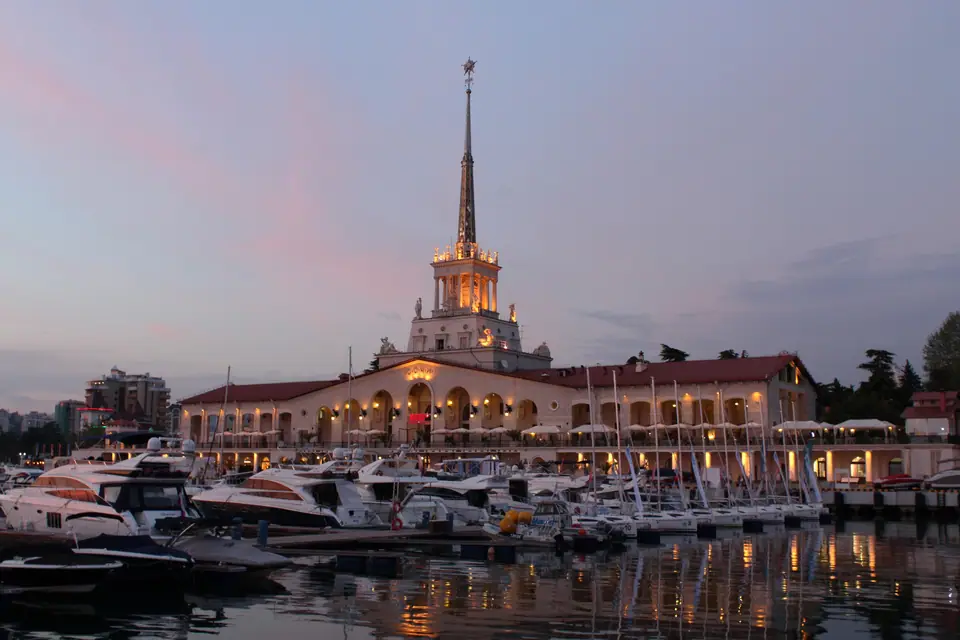
Sochi
Stretching for 145 kilometres along the Black Sea coast beneath the Western Caucasus Mountains, Sochi unites 19th-century botanical parks, Stalinist sanatoriums, Sirius Olympic arenas, and the alpine peaks of Krasnaya Polyana.
Quick decisions
How many days?
3 to 4 days: one day for the Sochi Marine Terminal and Sochi Arboretum, one day for Mount Akhun and the Olympic Park in Sirius, and one to two days for Rosa Khutor and Akhshtyr Gorge.
Where should I stay?
Tsentralny District: walkable harbour, historic parks, and museums. Sirius (Imeretinskaya Bay): flat coastal cycling paths and Olympic arenas. Esto-Sadok and Rosa Khutor: alpine hiking and skiing.
Do I need a car?
No for the main corridor. Electric Lastochka commuter trains link Central Sochi Station, Matsesta, Khosta, Adler, Sochi Airport, the Olympic Park in Sirius, and Rosa Khutor without traffic delays on Kurortny Prospekt.
Best for
Subtropical parks & architecture: 1889 Arboretum and 1930s Stalinist sanatoriums. Canyons & mountains: Yew-Boxwood Grove and 2,320 m Roza Peak.
Before you go
Pack closed-toe shoes with reliable grip for the wet limestone trails of Agura Gorge, the Khosta Yew-Boxwood Grove, and Vorontsovo Caves, plus a windproof layer for the 2,320-metre summit of Roza Peak even in summer.
Getting around
Ride electric Lastochka suburban trains between Central Sochi, Adler, Sirius, and Krasnaya Polyana, and use municipal buses along Kurortny Prospekt and the nearly 900-metre cable car inside the Sochi Arboretum.
Continue your trip
Direct flights from Sochi International Airport (AER) and long-distance trains on the North Caucasus Railway connect Sochi with Moscow, Saint Petersburg, and Kazan.
Overview
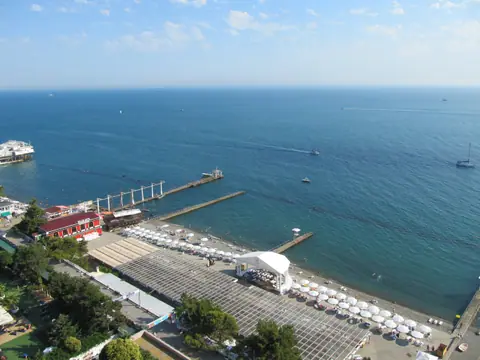
Sochi occupies a geographical setting unlike any other major city in Russia: a 145-kilometre coastal ribbon along the eastern shore of the Black Sea, sheltered from northern continental air masses by the towering wall of the Western Caucasus Mountains. Located at the same latitude as Nice, the coastal strip lies within a humid subtropical zone (Köppen classification Cfa) where palm-lined promenades, magnolia alleys, and hillside tea plantations overlook pebble beaches, while 40 kilometres inland up the Mzymta River valley the peaks of the Aibga Ridge rise above 2,300 metres.
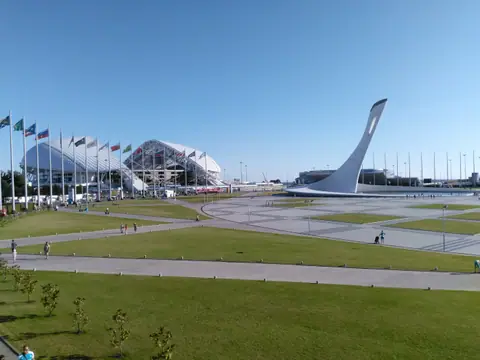
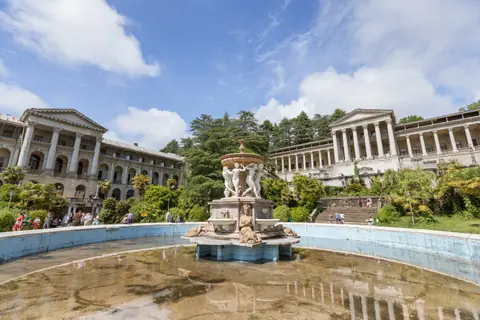
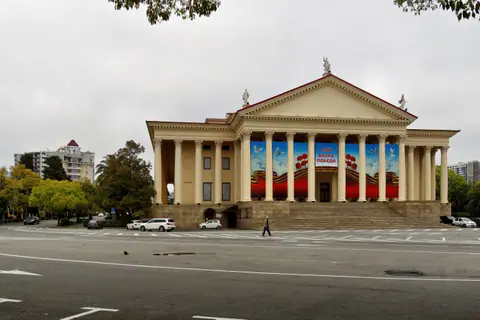
Administratively divided into four elongated city districts (Lazarevsky, Tsentralny, Khostinsky, and Adlersky) plus the adjacent federal territory of Sirius in the Imereti Lowlands, Greater Sochi covers 3,502 square kilometres (with a built-up urban area of 176.77 square kilometres and a municipal population of 466,078). In historic central Sochi and Khostinsky District, late-imperial estates such as the 1889 Sochi Arboretum and the 1898 Riviera Park sit alongside monumental 1930s to 1950s Soviet neoclassical landmarks, including the 71-metre spire of the Marine Terminal, the 88-column Winter Theatre, and the hillside pavilions of the Ordzhonikidze Sanatorium. Further south, the coastal cluster built for the 2014 Winter Olympics in Sirius centres on Fisht Olympic Stadium, while the mountain cluster around Esto-Sadok and Krasnaya Polyana provides year-round cable car access to high alpine ridges and waterfalls.
Getting there
Sochi International Airport (AER) sits in the Adler District roughly 28 kilometres southeast of central Sochi and 40 kilometres west of the Krasnaya Polyana mountain resorts. A dedicated railway terminal at the airport connects directly to Adler Railway Station, Central Sochi Railway Station, and the mountain terminus at Rosa Khutor via electric Lastochka trains, while municipal municipal buses (check current route numbers) link the airport with both central Kurortny Prospekt and the Mzymta Valley. Long-distance trains on the North Caucasus Railway follow the Black Sea shoreline through Lazarevskoye, Loo, Dagomys, Central Sochi, Khosta, and Adler before terminating at Adler, with some continuing to Imeretinsky Kurort in Sirius.
Where to stay
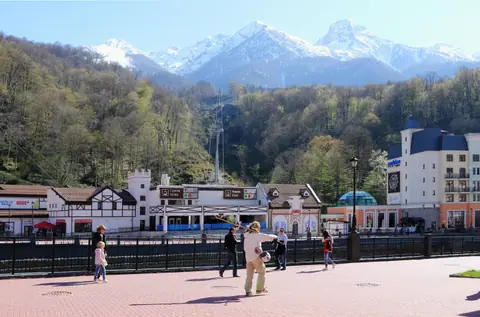
Travellers wanting historic parks, museums, and walkable harbour dining stay in Tsentralny District near the Sea Port, Primorskaya Promenade, and the Svetlana microdistrict beside the Winter Theatre. Travellers prioritising wide pebble beaches without coastal railway tracks and flat seaside cycling paths choose the resort hotels of Sirius (Imeretinskaya Bay), while winter skiers and summer ridge hikers base themselves in the Mzymta Gorge at Esto-Sadok and Rosa Khutor (560 to 1,170 metres).
Things to do
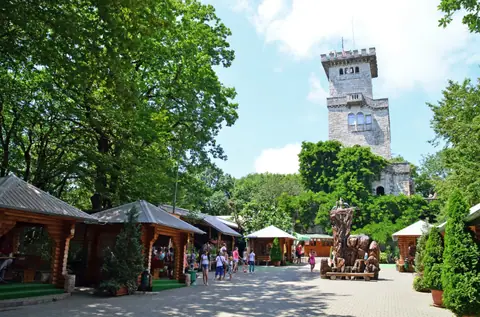
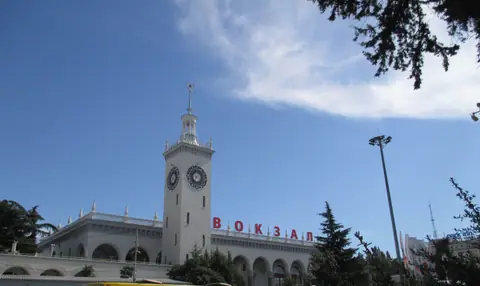
Walk from Alexey Dushkin's 1952 Sochi Railway Station down palm-lined Navaginskaya Street to the 1955 Sochi Marine Terminal, the 1890 Sochi Lighthouse, and the 1891 Cathedral of the Archangel Michael. Follow Kurortny Prospekt past the 1936 Sochi Art Museum and 1937 Winter Theatre to ride the nearly 900-metre cable car above the Sochi Arboretum. In Khostinsky District, tour Stalin's 1937 Green Dacha, hike Agura Gorge to Eagle Rocks and the 1936 Mount Akhun Tower, and explore the relict Khosta Yew-Boxwood Grove and Vorontsovo Caves before riding the Lastochka train to Fisht Stadium in Sirius and the 2,320-metre gondola at Rosa Khutor.
Food and drink
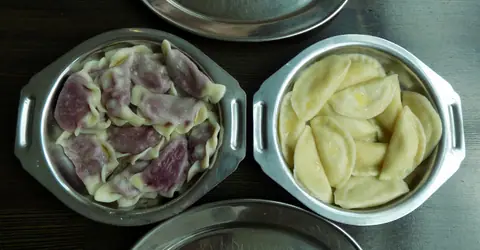
Local dining in Sochi blends Kuban Cossack comfort dishes from Krasnodar Krai with Caucasian mountain baking and Black Sea seafood. Order pan-fried Black Sea red mullet (barabulka) and steamed mussels along the harbour, metal skillets of sour-cherry or potato vareniki and folded blinchiki with farmstead smetana in Krasnaya Polyana, smoked Adyghe cheese and boat-shaped Adjarian khachapuri, and pots of Dagomys or Matsesta tea served with green walnut, white fig, feijoa, and young pine-cone preserves.
Culture
Designated as Russia's premier subtropical health resort in the 1930s and host city of the XXII Olympic Winter Games in February 2014, Sochi pairs a rich architectural heritage of Stalinist Empire sanatoriums and neoclassical theatres with the UNESCO-listed wilderness of the Western Caucasus. Across the city, most of the municipal territory lies within Sochi National Park (founded in 1983) and the adjacent Caucasus State Nature Biosphere Reserve (founded in 1924), protecting ancient Tertiary boxwood and yew forests alongside Paleolithic cave sites such as Akhshtyrskaya Cave.
Weather by month
Sochi is warmest in August, with average highs around 29°C, and coldest in February, when nights drop to about 4°C. December is the wettest month, with rain on about 20 days. For mild weather with fewer rainy days, aim for May, June, September and October.
| Month | Low | Range | High | Rain | Rainy days |
|---|---|---|---|---|---|
| Jan | 4°C | 10°C | 177 mm | 19 d | |
| Feb | 4°C | 10°C | 134 mm | 18 d | |
| Mar | 6°C | 13°C | 133 mm | 18 d | |
| Apr | 9°C | 17°C | 109 mm | 18 d | |
| May | 13°C | 21°C | 107 mm | 16 d | |
| Jun | 17°C | 25°C | 95 mm | 14 d | |
| Jul | 20°C | 28°C | 120 mm | 11 d | |
| Aug | 21°C | 29°C | 106 mm | 10 d | |
| Sep | 17°C | 25°C | 140 mm | 13 d | |
| Oct | 13°C | 21°C | 177 mm | 15 d | |
| Nov | 9°C | 16°C | 175 mm | 17 d | |
| Dec | 6°C | 12°C | 178 mm | 20 d |
Averages of daily values from 2015 to 2024. Rainy days are days with at least 1 mm of rain. Source: Open-Meteo · Compare destinations by month.
Sochi on the map
Every place we cover in Sochi. Tap a category or pin to explore.
In-depth Sochi guides
Browse the guides grouped by topic: sights, neighbourhoods, food, transport, day trips and trip planning.
Sights, Landmarks & Parks
Key monuments, viewpoints, museums and nature trails.
- Things to Do in Sochi: Sea Port, Arboretum, Olympic Park and Mountain ResortsA curated overview of Sochi's architectural landmarks, subtropical parks, Olympic arenas, and Western Caucasus mountain excursions.
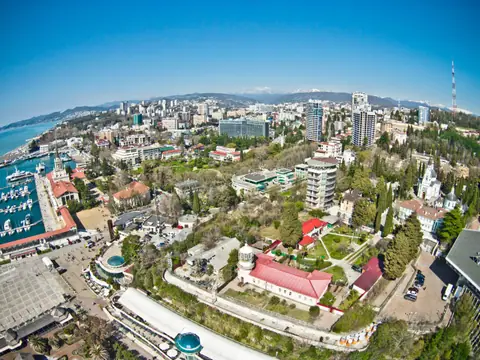
- Sochi Sea Port and Primorskaya Promenade: Marine Terminal Spire, Lighthouse and Archangel Michael CathedralAn architectural walking guide to central Sochi's harbour complex, historic lighthouse plateau, and seafront embankments.
- Sochi Arboretum and Riviera Park: Subtropical Terraces, Rotunda and Magnolia AlleysHow to explore the Italianate terraces, cast-iron sculptures, and rare subtropical flora of the Sochi Arboretum and Riviera Park.
- Olympic Park and Sirius Waterfront: Fisht Stadium, Olympic Cauldron and Coastal ArenasExploring the 2014 Winter Olympic coastal cluster, Fisht Stadium, and the Black Sea promenade of the Sirius federal territory.
- Mount Akhun Observation Tower, Agura Waterfalls and Eagle RocksA hiking and viewpoint guide to the Akhun karst massif, the 1936 limestone observation tower, Agura Gorge, and Eagle Rocks.
- Stalin Dacha, Matsesta Spa Rotunda and Ordzhonikidze Sanatorium ArchitectureInside the 1930s reconstruction of the Sochi-Matsesta health resort, from Stalin's hillside residence to neoclassical sanatorium palaces.
- Winter Theatre, Sochi Art Museum and Kurortny Prospekt ArchitectureArchitecture, collections, and surrounding botanical gardens of the Winter Theatre and the Dmitry Zhilinsky Sochi Art Museum.
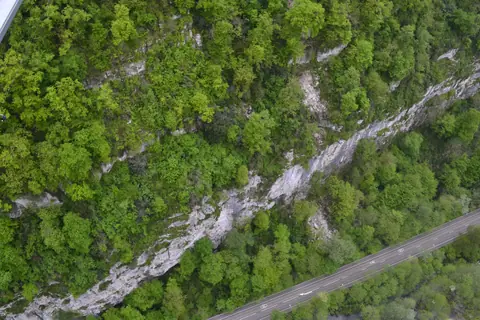
- Skypark Sochi, Akhshtyr Gorge and Psakho River CanyonHow to visit the limestone canyons of the Adler hinterland: Skypark's Skybridge, Akhshtyrskaya Cave, and the Wet and Dry canyons of the Psakho River.
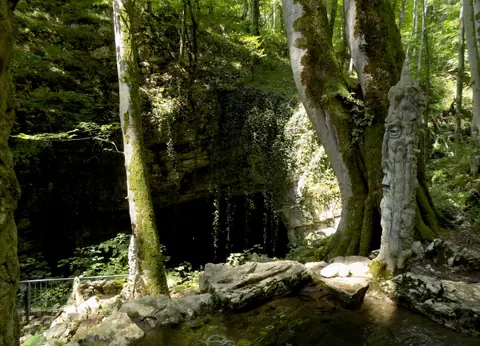
- Vorontsovo Caves, Khosta Yew-Boxwood Grove and 33 WaterfallsA nature guide to Greater Sochi's Tertiary relict forests, underground limestone labyrinths, and the Shakhe Valley cascades.
- Sochi 3-Day Itinerary: Historic Harbour, Subtropical Parks, Olympic Coast and Rosa KhutorA balanced three-day route linking central Sochi's subtropical parks and Stalinist landmarks with the Sirius coastal cluster and the high peaks of Rosa Khutor.
Neighbourhoods & Where to Stay
Districts, historic quarters and the best bases for your stay.
- Sochi: Black Sea Riviera, Subtropical Parks and Caucasus MountainsHow Greater Sochi is organised along its 145-kilometre Black Sea coastline and how to combine its subtropical parks, Soviet sanatoriums, and Caucasus peaks.
- Krasnaya Polyana and Rosa Khutor: Mzymta River Valley, Town Hall Clock Tower and Aibga SlopesHow to visit Sochi's mountain cluster along the Mzymta River, including Rosa Khutor, Krasnaya Polyana Resort (Gorki Gorod), and Roza Peak.
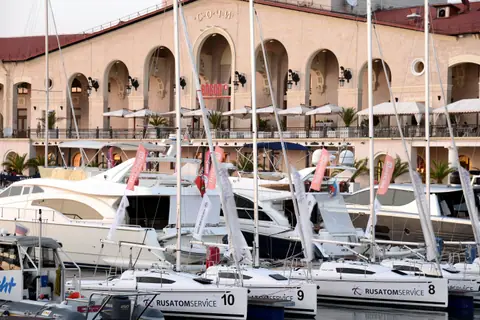
- Where to Stay in Sochi: Central Harbour, Adler Olympic Coast and Mountain Resorts ComparedHow to choose between Central Sochi, the Sirius coastal plain, and the Krasnaya Polyana alpine resorts, or split your stay between sea and mountains.
Food & Drink
Local dishes, markets, cafés and dining districts.
Getting Around & Arrival
Airport transfers, public transit, passes and driving rules.
Need your embassy or consulate in Russia? See embassies and consulates in Russia.
Reviews
Log in to write a review.
No reviews yet.