Quick Field Data
- UNESCO Inscription: Cultural World Heritage Site (Ref. 678), inscribed in 1993 under Criterion (iv).
- Scale & Footprint: 315.47 hectares spanning the outer Citadel (2 by 2 km), the inner Imperial City (2.5 km perimeter wall), and upstream royal tombs and ritual complexes along the Perfume River.
- Access & Ticketing: Ticketed entry governs the Imperial City and individual imperial tombs, with multi-site combination passes sold at main gates; outer Citadel streets and riverside pavilions remain publicly accessible.
- Arrival Logistics: Phu Bai International Airport (HUI) sits 14 km from the city; Da Nang International Airport (DAD) offers a larger regional air hub 80 km to the south.
Geomancy, River Screen, and Nguyen Dynasty Statecraft
When Nguyen Phuoc Anh unified Viet Nam from the Red River Delta to the Mekong Delta in June 1802, he proclaimed himself Emperor Gia Long. Passing over Hanoi, he established his imperial capital at Phu Xuan, modern Hue. The choice reflected dynastic loyalty and political caution. Hue had functioned as the seat of the Nguyen Lords in Dang Trong for generations. Duke Nguyen Phuc Lan and Nguyen Phuc Tan constructed an early palace in Kim Long district from 1635 to 1687 on the left side of the later Citadel. Nguyen Phuc Thai and Nguyen Phuc Khoat later moved the court to Phu Xuan between 1687 and 1712 and again from 1739 to 1774. Tay Son Emperor Quang Trung likewise chose Hue as his royal capital in 1789. Establishing the court in Hanoi risked lingering opposition among northern populations loyal to the former Le dynasty, even though Hue came with grave strategic flaws.
As early as 1822, British ambassador John Crawfurd observed that Hue's narrow coastal plain could barely feed itself and relied on rice, troops, and minted coin shipped from the distant Mekong and Red River deltas. He warned that hostile gunboats blockading the nearby Thuan An estuary could isolate the capital, a weakness France later proved in 1883. Earlier, during Tay Son offensives against Quy Nhon, loss of southern grain routes had plunged Phu Xuan into severe food shortages. Yet for Gia Long and his court geomancers, the symbolic alignment of mountain and river outweighed logistical vulnerability.
Geomancers surveyed the north bank of the Perfume (Huong) River, absorbing lands across Phu Xuan, Van Xuan, Dien Phai, An Van, An Hoa, An My, An Bao, The Lai, and sections of the Bach Yen and Kim Long rivers. Across the water rises Mount Ngu Binh, over 100 metres high with a balanced flat summit known as the Royal Screen, shielding the front approach against malevolent forces. Flanking sand islands in the river channel, Con Hen on the left and Con Da Vien on the right, embody two of the Four Symbols: Azure Dragon (Thanh Long) and White Tiger (Bach Ho). Within this frame, palace walls and altars align cosmologically with the Five Cardinal Points, Five Elements, and Five Colours.
Whereas Beijing's Forbidden City faces true south across concentric symmetrical rings, Hue's Citadel turns southeast toward the Perfume River and shifts the imperial palace enclosure toward the southeastern riverbank rather than dead centre. That orientation linked royal authority straight to river ceremonies, boat landings, and the natural screen of Mount Ngu Binh.
Concentric Walls, Vauban Ramparts, and Upstream Tombs
Surveyed in 1803, construction of the outer Citadel (Kinh Thanh) ran from 1805 until completion in 1832 under Emperor Minh Mang, representing the largest public works project of early modern Viet Nam. Tens of thousands of workers excavated moats, cut connecting waterways, and raised earthworks later clad in brick and stone, creating zigzag Vauban-style bastions designed with assistance from French engineers in Gia Long's service. Measuring nearly 10 km in circumference around a 2 by 2 km square, the ramparts rise 6.6 metres high and 21 metres thick, armed with artillery batteries, cannons, and ammunition depots, while sluice gates channelled Perfume River water through the encircling moat. Coastal and river defences included Tran Binh Dai at the northeastern corner and the coastal fort of Tran Hai Thanh.
Strict social hierarchy governed access inside Kinh Thanh. Only the imperial family resided permanently behind the inner fortifications, while court ladies, eunuchs, and palace guards performed internal service; officials and imperial academy students entered during working hours and departed before nightfall. During French colonial rule, protectorate offices occupied the northern sector inside the fortress, making colonial administrators the only foreign residents within the perimeter.
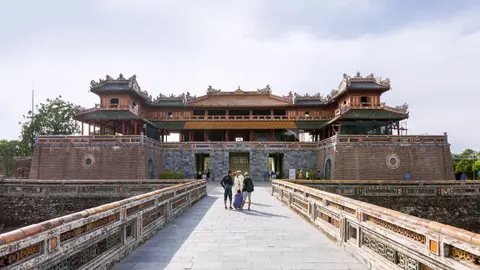
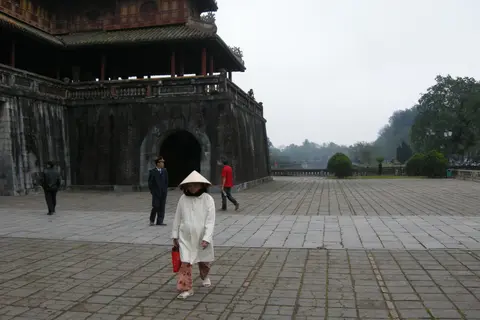
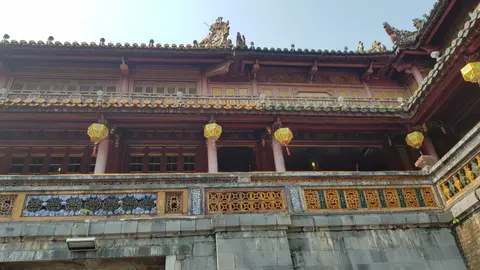
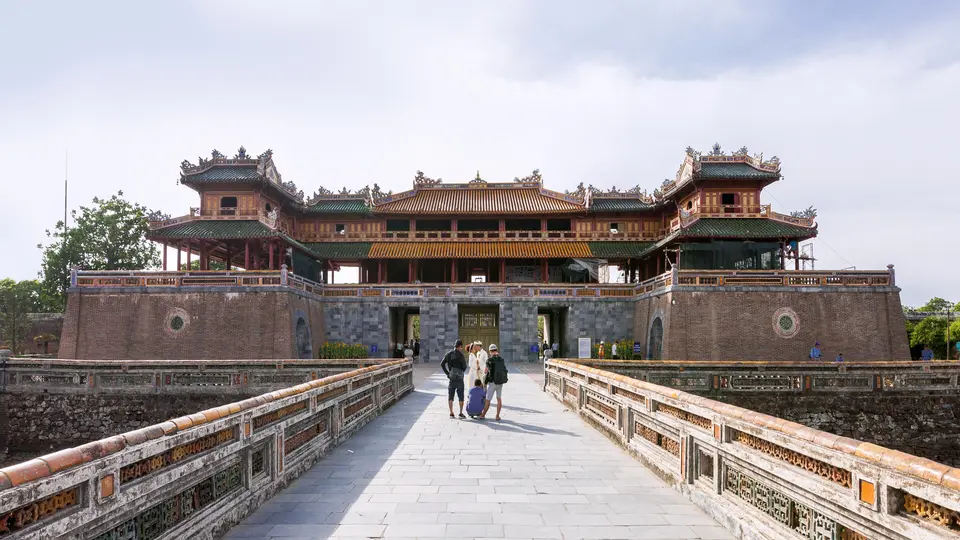
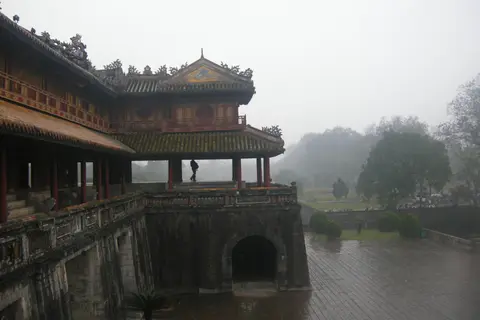
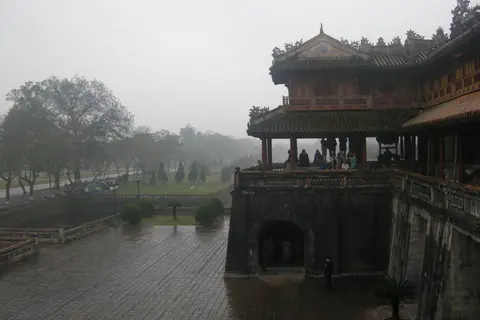
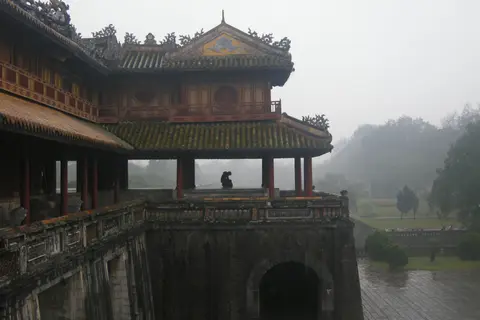
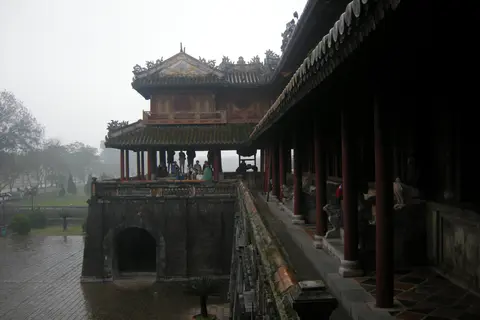
Inside the Citadel sits the second fortified ring, the Imperial City (Hoang Thanh, also called Dai Noi), begun in 1804 and enlarged in 1833 to a 2.5 km brick perimeter wall and inner moat. Entered from the south through the Meridian Gate (Ngo Mon), Hoang Thanh housed state audience halls, royal gardens, ministerial offices, and Dien Tho Palace. Opposite the gate stand the Flag Tower and two-storey Phu Van Pavilion, built in 1819 to post royal edicts and examination lists. Minh Mang also used the pavilion in 1829 for elephant-and-tiger combats and a three-day birthday banquet in 1830. At the innermost core stood the Forbidden Purple City (Tu Cam Thanh), restricted solely to the emperor and his household.
Beyond the walled urban square, the Complex of Hue Monuments extends across ritual and funerary sites rooted in dynasty liturgy. Outlying sites include the Temple of Literature (Van Mieu), the Nam Giao Esplanade of Sacrifice to Heaven and Earth, the Ho Quyen royal arena, and the Temple of the Roaring Elephant (Den Voi Re). Around 5 km from the Citadel on Ha Khe hill rises Thien Mu Temple. Lord Nguyen Hoang built it in 1601 after a local prophecy concerning a celestial lady, an adaptation of the older Cham goddess Po Nagar. Expanded in 1665 by Nguyen Phuc Tan, the monastery grew further in 1714 under Lord Nguyen Phuc Chu. Additions included triple gates, Ngoc Hoang and Thap Dien Diem Vuong shrines, dharma preaching halls, meditation quarters, Avalokitesvara and Medicine Buddha sanctuaries, and sutra towers. Nguyen Phuc Chu had earlier invited Qing-era Chinese Caodong Zen master Shi Da Shan in 1695, instituted annual rainy-season vassana retreats, and imported over one thousand volumes of the Tripitaka canon. Its main hall housed Maitreya flanked by Manjushri and Samantabhadra. Later, during summer 1963, nine Buddhists died on Vesak in Hue amid restrictions on religious flags under President Ngo Dinh Diem's administration. Thien Mu became a major organising centre for hunger strikes and protests before monk Thich Quang Duc rode from Hue to Saigon in his Austin car. Upstream along the Perfume River lie the landscaped mausoleums of seven Nguyen emperors: Gia Long, Minh Mang, Thieu Tri, Tu Duc, Duc Duc, Dong Khanh, and Khai Dinh.
Twentieth-Century Wars, Cyclones, and Flood Mitigation
After French protectorate treaties in the 1880s reduced imperial authority to ceremonial form, the dynasty ended inside the Imperial City on 30 August 1945 with Emperor Bao Dai's abdication ceremony. Abandoned halls quickly suffered termite infestation, neglect, and destructive coastal cyclones, including a severe 1904 storm that damaged Thien Mu before Emperor Thanh Thai authorised repairs in 1907, yet three 20th-century wars inflicted far graver ruin. In February 1947, Viet Minh units seized the Citadel, triggering a six-week French siege and counter-attack that burned the heart of the Imperial Palace.
On 31 January 1968, during the Tet Offensive, heavy forces of the People's Army of Vietnam and Viet Cong occupied Hue. Although U.S. Marines initially held back heavy bombardment to spare religious structures, intensifying house-to-house street combat and anti-aircraft guns positioned on Citadel towers lifted those restrictions. Out of 160 historic buildings across the inner compound, only 10 major monuments remained standing afterward, among them Thai Hoa Temple, Can Thanh Palace, The Mieu, and Hien Lam Cac, with bullet scars still visible on stone walls.
Since UNESCO listing in 1993, the Hue Monuments Conservation Centre under the Thua Thien Hue Provincial People's Committee employs over 700 specialists. They manage research, intangible heritage, traditional mortar and timber craft reproduction, and structural rebuilding under the Cultural Heritage Law (2001, revised 2009) and the Prime Minister's Adjusted Planning Framework (2010 to 2020). To counter severe Perfume River floods, authorities are constructing three upstream dams while restoring the Citadel's historic network of drainage ponds and canals. Urban growth, highway noise, and visual encroachment around the Minh Mang and Khai Dinh mausoleums remain active management priorities, as does regulating visitor flow within carrying capacity.
Citadel Enclosures, River Pagodas, and Upstream Tombs
Because Hue spreads monuments across both the fortified urban core and upstream river hills, visits flow best by dividing the central enclosures from the western temple and valley mausoleums. Along the vertical axis connecting the Flag Tower and Phu Van Pavilion stands Nghênh Lương Pavilion, constructed in 1852 under Emperor Tu Duc and renovated in 1903 and 1918 as the imperial resting hall before Perfume River boat excursions.
| Complex Zone | Key Highlights | Access & Ticket Rule |
|---|---|---|
| Outer Citadel (Kinh Thanh) and River Pavilions | Vauban zigzag ramparts, Flag Tower, Phu Van Pavilion (1819), and Nghênh Lương Pavilion (1852) fronting the river | Public Citadel roads and riverfront lawns open without charge; keep clear of eroding masonry walls |
| Imperial City (Hoang Thanh) and Purple City | Meridian Gate (Ngo Mon), Thai Hoa Palace, The Mieu dynastic shrines, Dien Tho Palace, and reconstructed royal courts | Ticketed entry at Ngo Mon via single-site or multi-monument passes; modest attire expected inside shrines |
| Thien Mu Temple (Celestial Lady Pagoda) | Ha Khe hill temple (1601) 5 km from Citadel, 21 m seven-storey Phuoc Duyen Pagoda (1844), and 3,285 kg bronze bell (1710) | Free access to outer gardens and river steps; observe quiet respect inside active monastic halls |
| Upstream Nguyen Imperial Tombs | Walled mausoleums of Gia Long, Minh Mang, Thieu Tri, Tu Duc, and Khai Dinh along the Perfume River | Individual or bundled heritage tickets required at each tomb gate; confirm valid combinations on the official site |
Confirm current ticketing combinations and active restoration scaffolding on the official Hue Monuments Conservation Centre portal before planning a full-day circuit across the river.
Stone Edicts, Vauban Bastions, and Cast-Bronze Relics in Hue
Three specific physical details across the Citadel and Ha Khe hill illuminate Hue's fusion of European military craft, Vietnamese Buddhism, and Confucian ritual:
- Dismounting steles flanking Phu Van Pavilion: On either side of the two-storey 1819 riverfront pavilion stand twin carved stone steles inscribed with the four Chu Han characters commanding riders to dismount and remove hats before imperial edicts.
- Vauban brick-and-earth bastions and river sluices: Along the 10 km outer Citadel wall, notice how 21-metre-thick earth cores faced in fired brick angle into flanking artillery bastions pierced by sluice gates routing Perfume River water into the moat.
- Thien Mu's 1710 bronze bell and 1844 octagonal tower: Overlooking the Perfume River from Ha Khe hill stand Emperor Thieu Tri's 21-metre, seven-storey brick Phuoc Duyen Pagoda and the 3,285 kg bronze bell. Cast under Lord Nguyen Phuc Chu and once heard 10 km away, the bell stands next to the preserved Austin car driven by monk Thich Quang Duc in 1963.
Dry-Season Timing and Pairing Hue with Hoi An
Because central Viet Nam experiences heavy autumn cyclones and river flooding, walking the Citadel ramparts and crossing to upstream mausoleums runs most smoothly during drier months when unpaved tomb paths stay firm and river views toward Mount Ngu Binh remain clear. Early arrival at the Meridian Gate helps beat midday heat across exposed flagstone courtyards, leaving enough daylight to trace both the inner palaces and the river route upstream to Thien Mu and Minh Mang's walled valley compound. Travellers linking imperial Viet Nam with historic coastal trade can continue 102 km south across the mountains to Hoi An, or compare regional heritage cities across the UNESCO World Heritage Atlas.