Quick Field Data
- UNESCO Inscription: 2023 (Ref. 1671), cultural landscape in Special Region of Yogyakarta, Indonesia; Criteria (ii) and (iii).
- Scale & Footprint: 42.22 hectares spanning the Kraton (Palace) Complex and linked monuments along a six-kilometre north-south urban axis.
- Access & Ticketing: Administered jointly by the Cosmological Axis of Yogyakarta Management Unit and Sultanate Abdi Dalem courtiers under Law No. 11 of 2010; verify Kraton Yogyakarta opening hours, tickets and dress code via official notices.
- Arrival Logistics: Adisutjipto International Airport (JOG) sits eight kilometres east of central Yogyakarta, supplemented by Jenderal Ahmad Yani Airport (SRG, 92 kilometres north) and domestic air links east toward Bali (535 kilometres).
From Mount Merapi to the Indian Ocean Along a Six-Kilometre Axis
Running straight north to south across the heart of central Java, the Cosmological Axis of Yogyakarta translates centuries-old Javanese philosophy into physical street geometry. Founded in 1755 by Sultan Mangkubumi (reigning as Hamengkubuwono I) immediately after the Treaty of Giyanti recognised the Sultanate of Yogyakarta under the Dutch East India Company, the six-kilometre axis covers 42.22 hectares of linked royal monuments. Its linear sightline aligns precisely between Mount Merapi to the north, revered as the dwelling of guardian spirits, and the Indian Ocean to the south, home to the Queen of the Southern Sea.
Anchored squarely at the centre sits the Kraton Ngayogyakarta Hadiningrat, deliberately raised between two rivers inside a former banyan forest naturally shielded from seasonal floods. Flanking avenues connecting northern Tugu Yogyakarta monument and southern Krapyak Hunting House are planted with tamarind and Spanish cherry trees. Every architectural interval embodies foundational Javanese philosophical teachings, including Sangkan Paraning Dumadi (the origin and destination of life), Hamemayu Hayuning Bawana (ideal harmonious life) and Manunggaling Kawula Gusti (union between humanity and the Creator).
Buildings, court customs and urban alignments express deep cultural cross-pollination pre-dating 1755. Over centuries of Mataram royal courts, Javanese society absorbed Hindu-Buddhist ideas of a miniature universe rooted on Java before the 1st century CE with indigenous animism and ancestor veneration. Sufi Islamic devotion from India or the Middle East and European architectural features arrived later, merging into daily offerings, royal coronations, funerals and Islamic feast days along the six-kilometre spine.
Joglo Pavilions of Kraton Yogyakarta and Javanese Court Ritual
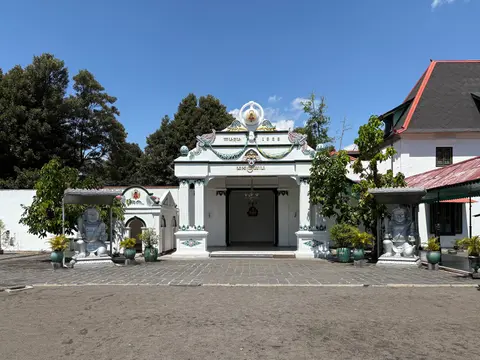
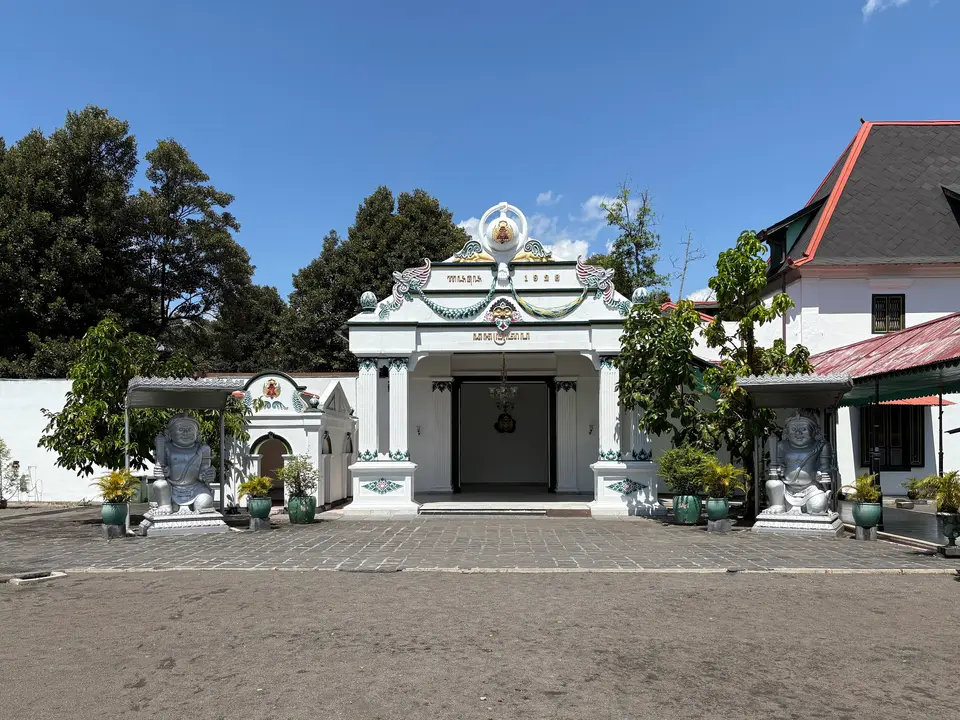
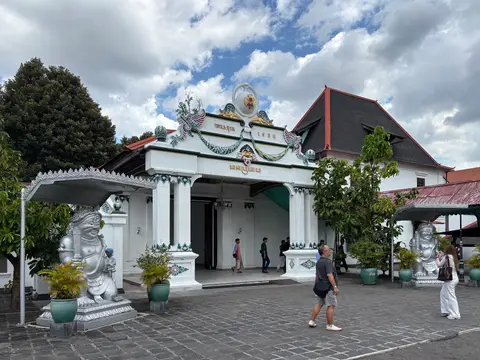
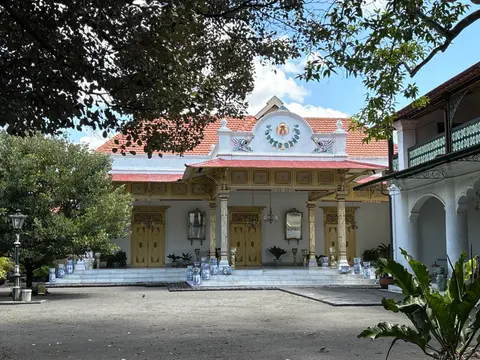
Stepping inside Kraton Yogyakarta reveals calm sandy courtyards carpeted deliberately with fine sand hauled north from Java's southern beach. Sultan Hamengkubuwono I acted personally as chief architect during construction in 1755 to 1756 (Javanese year AJ 1682), earning admiration from Dutch scholars Theodoor Gautier Thomas Pigeaud and Lucien Adam as a worthy architectural successor to Surakarta's Pakubuwono II. Courtyard gates known as regol follow the semar tinandu form with thick carved teak doors screened visually by Renteng or Baturono walls placed behind or ahead of openings.
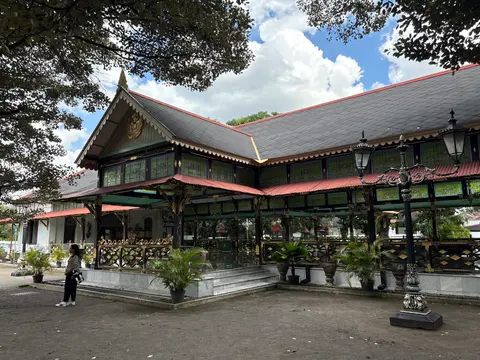
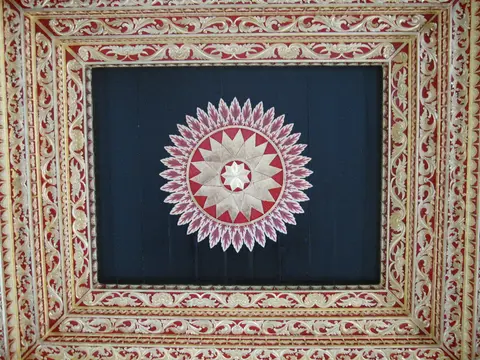
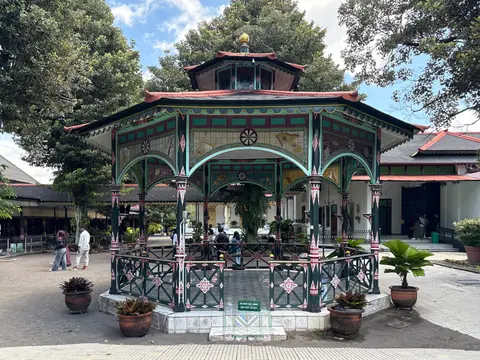
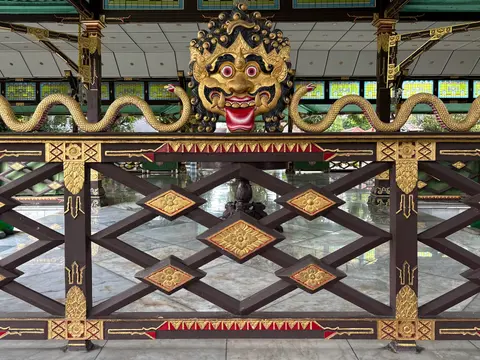
Open timber joglo pavilions define the inner courtyard hierarchy through exact proportions and colour coding. Trapezoidal joglo roofs covered in red or grey shingles, clay tiles or zinc rest upon four central soko guru columns surrounded by outer timber pillars. Painted dark green or black with yellow, light green, red or gold highlights, columns sit atop black stone Ompak pedestals carved with gold ornament. Whitewashed courtyard walls surround raised marble or patterned-tile floors, while top-ranking sultan halls display dense flora, fauna and mixed Portuguese, Dutch and Chinese motifs around square Selo Gilang throne stones. By contrast, lower-rank auxiliary structures maintain low floor levels and carry minimal or zero decorative carving.
War and severe earthquakes repeatedly tested palace masonry across two centuries. On 20 June 1812, Sir Stamford Raffles commanded 1,200 British and Irish troops in an assault that seized the walled royal city in one day, sacking and burning palace halls before British authority later returned Java to the Dutch. Destructive earthquakes in 1867 (and 1876) as well as 2006 caused further damage, leaving most surviving Kraton buildings dating from Sultan Hamengkubuwono VIII's extensive 1921 to 1939 reconstruction, guarded today by ceremonial Yogyakarta Kraton Guards (Prajurit Keraton) and royal Abdi Dalem courtiers.
Taman Sari Water Castle, Earthquakes, and Modern Heritage Laws
Two kilometres south inside the Kraton grounds stands Taman Sari Water Castle, built between 1758 (AJ 1684) and roughly 1765 as a royal garden, workshop, meditation precinct and defensive refuge. Combining Javanese words taman (garden) and sari (beautiful flowers), Dutch visitors called it a waterkasteel because shutting its watergates submerged the grounds in water, leaving tall pavilions rising clear. Regent of Madiun Raden Rangga Prawirasentika originally funded brick production in exchange for tax relief. Finding costs too high, he resigned and Prince Natakusuma (later Sri Pakualam II) replaced him. Project leader Tumenggung Mangundipura twice visited Batavia to study European masonry, creating roughly 59 structures and 18 water gardens around earlier Pacethokan Spring baths before the 1812 British attack, 1825 to 1830 Java War and 1867 earthquake drained its pools.
Today, Taman Sari splits across four distinct sectors whose origins invite rich scholarly discussion. The Serat Rerenggan manuscript recounts Demang Tegis (Demang Portegis), a stranded Portuguese shipbuilder whom villagers suspected of being a forest spirit before Hamengkubuwono II ordered him to build a fortress and granted him the demang title. Portuguese architectural experts examined Taman Sari in 2001, yet historian P. J. Veth noted Javanese-Dutch hybrid character and Sorbonne scholar Hélène Njoto-Feillard argued in 2003 that Javanese creators built the complex without European involvement. Only the central Umbul Binangun bathing complex was fully restored in the early 1970s. Entered via eastern and western octagonal courtyards, it sits between eastern Gedhong Gapura Panggung (bearing four staircases and two remaining nagas) and western Gedhong Gapura Hageng, whose east face stays visible while settlements block its west side.
On Gedhong Gapura Hageng, a carved Javanese sengkalan memet chronogram records the completion year visually in stone relief. The phrase Lajering Kembang Sinesep Peksi (birds gathering flower nectar) encodes the Javanese year 1691 (around 1765 AD): lajering (core) equals 1, kembang (flower) equals 9, sinesep (drink) equals 6 and peksi (bird) equals 1. Carved foliage and birds siphoning nectar frame this inscription cleanly above the gateway. West of the bathing pools, dense Kampung Taman houses cover the drained Segaran artificial lakebed and vanished southern Garjitawati Pool after post-1867 abandonment. Even so, visitors walk down the 1761 underwater tunnel past Tajug ventilation shafts, ruined Kenongo Island (named for cananga trees around Gedhong Kenongo) and Cemethi Island (also called Panembung Island or Sumur Gumantung hanging well) to reach circular Sumur Gumuling mosque. Inside that sunken mosque, four stone staircases converge on an elevated central platform leading upward by one flight above an ablution pool and mihrab niche before Taman Sari extends east toward Magangan.
Modern heritage law works together with traditional Sultanate stewardship across the 42.22-hectare urban corridor. Chaired by the Sultan of Ngayogyakarta Hadiningrat (also Governor of the Special Region of Yogyakarta), the Joint Secretariat oversees the Cosmological Axis Management Unit and traditional Tata Rakiting Wewangunan governance carried out by Abdi Dalem units (Tata Rakiting Paprentahan). Statutory protection rests on Indonesia's Law No. 11 of 2010 and Ministerial Decree No. 117 of 2018. Provincial Spatial Regulation No. 5 of 2019 restricts building heights against high-rise hotels along the Northern Axis, supported by a 2022 Heritage Impact Assessment bylaw. A voluntary relocation scheme eases informal settlements along outer Kraton walls while managers guard against non-traditional repair materials seen in the 1920s Art Deco concrete rebuild of Beringharjo Market.
Access Zones Along Yogyakarta's Historic Cosmological Corridor
Organising Kraton Yogyakarta maps from north to south traces the ritual sequence connecting Mount Merapi sightlines toward the southern sea. Check official Kraton Yogyakarta tickets and seasonal courtyard access notices before entering active royal precincts.
| Complex Zone | Key Highlights | Access & Ticket Rule |
|---|---|---|
| Northern Axis and Tugu Yogyakarta | Tugu Yogyakarta northern monument, ceremonial approach and Art Deco 1920s Beringharjo Market along the urban axis. | Open public street and market plazas; follow pedestrian crossings along busy central avenues. |
| Kraton Ngayogyakarta Hadiningrat | Sandy courtyards, semar tinandu gates, Bangsal Manis joglo halls, Prajurit guards and court heirloom museum. | Single main visitor ticket gate; verify Kraton Yogyakarta opening hours and modest dress code rules at the entrance. |
| Taman Sari Water Castle | Restored Umbul Binangun bathing pools, Gedhong Gapura Panggung, 1761 underground tunnel and Sumur Gumuling mosque. | Separate visitor admission desk inside Kampung Taman south of the Kraton; local alley signs mark walking paths. |
| Southern Corridor to Krapyak Hunting House | Tree-lined ceremonial avenue flanked by tamarind and Spanish cherry trees ending at Krapyak Hunting House. | Public road corridor leading south from the Kraton walls; inspect the historic structure from surrounding lanes. |
Three Architectural and Symbolic Details Inside the Kraton
- Southern Coast Sand Across Palace Courtyards: Notice fine coastal sand spread deliberately beneath trees inside the Kraton grounds, connecting royal floors ritually with Java's southern Indian Ocean coastline.
- Nagas and Javanese Chronogram at Taman Sari Gates: Inspect Gedhong Gapura Panggung's two surviving naga carvings and Gedhong Gapura Hageng's carved bird-and-flower chronogram encoding the Javanese construction year 1691 (1765 AD).
- Converging Staircases Inside Sumur Gumuling: Descend through the drained 1761 Segaran tunnel into the circular underground mosque where four stone staircases meet atop an elevated platform above an ablution pool.
Kraton Yogyakarta Hours, Dress Code, and Cultural Performances
Visitors searching for Kraton Yogyakarta opening hours or Kraton Yogyakarta dance times should confirm active weekly schedules directly with official palace visitor desks, because royal court ceremonies periodically alter public courtyard access. Morning visits generally deliver cooler shaded walking across bright sand courtyards and coincide with scheduled traditional arts presentations. When operating, palace cultural programmes present live bronze gamelan music, classical Javanese dance, macapat sung poetry and wayang shadow puppetry inside royal pavilions.
Observing Kraton Yogyakarta dress code standards demonstrates courtesy inside a working palace and administrative seat. Wear tidy garments covering shoulders and knees, maintain quiet respect around Abdi Dalem courtiers on duty and check whether Kraton Yogyakarta English museum pamphlets or official guides are available at the entry gate. Beyond physical pavilions, royal courtiers maintain Javanese literature, customary law (paugeran), life-cycle rites and ancestral festivals throughout the year. Pairing morning Kraton galleries with a midday walk through Taman Sari and a later stop at Tugu Yogyakarta covers the heart of the urban axis smoothly on foot or via local transport.
Taking time to observe daily street life along the six-kilometre boulevard connects royal history directly with contemporary Yogyakarta. Markets, shaded tamarind groves, courtyard gates and royal heritage zones sit tightly interwoven inside a living provincial capital where palace staff and ordinary citizens share the same ceremonial avenues. Inside the Kraton museum galleries, royal heirlooms and court attire explain how Sultan Hamengkubuwono I shaped Javanese governance after 1755 while Abdi Dalem courtiers sustained musical and theatrical customs across centuries. Planning half a day to one full day along the axis allows comfortable exploration without rushing between museum halls, shaded water gardens and busy residential alleys.
Arriving by air is straightforward through Adisutjipto International Airport (JOG), situated eight kilometres east of central Yogyakarta, while Jenderal Ahmad Yani Airport (SRG) sits 92 kilometres north across Central Java. Domestic Indonesian flights link Yogyakarta eastward to Bali (535 kilometres away), pairing Central Java's royal court heritage cleanly with coastal island stays. Discover further Asian palaces and urban heritage corridors inside our UNESCO World Heritage Atlas.