Quick Field Data
- UNESCO Inscription: Cultural site inscribed in 1991 (Ref. 642) under criteria (i) and (iv).
- Scale & Footprint: 77 hectares protected under a 1992 Indonesian Presidential Decree straddling Yogyakarta and Central Java, spanning 508 stone temples across the 240-structure Hindu Loro Jonggrang compound and the northern Buddhist shrines of Sewu, Lumbung, Bubrah, and Asu.
- Access & Ticketing: Managed within Prambanan Archaeological Park by PT Taman Wisata Candi Borobudur, Prambanan, dan Ratu Boko with regional preservation offices of Yogyakarta and Central Java. Main park admission covers outdoor access across both Prambanan and Sewu courtyards. Visitors should check official site notices before visiting, as several interior temple chambers remain restricted following the 2006 earthquake.
- Arrival Logistics: Adisutjipto International Airport (JOG, 8 kilometres west near Yogyakarta) is the closest gateway, backed by Jenderal Ahmad Yani Airport (SRG, 88 kilometres north in Semarang); our nearest live Indonesian destination guide covers Bali, 522 kilometres east across Java and Bali Sea air links.
Mataram Patronage, the Opak River Diversion, and the 856 CE Dedication
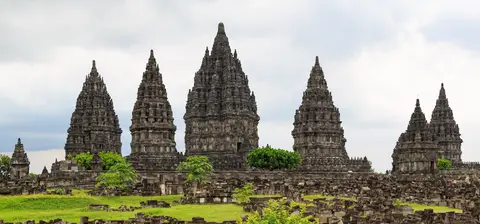
Positioned 17 kilometres northeast of Yogyakarta on the border between the Yogyakarta Special Region and Central Java, Prambanan Temple Compounds represent Indonesia's grandest monument of classical Hindu architecture. Across Southeast Asia, the complex ranks second in size only to Angkor Wat. Initiated in the mid-ninth century by Sanjaya king Rakai Pikatan (confirmed by a short red-painted script reading pikatan on a Shiva temple balustrade finial), the sanctuary was inaugurated on 12 November 856 CE by his successor King Lokapala. This foundation marked a decisive shift in royal Mataram patronage from Mahayana Buddhism toward Shaivite Hinduism. Historians following the dual-dynasty interpretation see Prambanan as the Sanjaya response to the Buddhist Sailendra monuments of Borobudur and Sewu. Successive Mataram monarchs including Balitung Maha Sambu, Daksa, and Tulodong expanded the sanctuary as the primary royal temple of the state, housing hundreds of resident brahmins and disciples near the royal court on the Prambanan Plain.
Constructing a 240-temple complex beside an active volcanic landscape required bold civil engineering recorded directly in King Lokapala's 856 CE Shivagrha inscription. Originally named Shiva-grha (House of Shiva) or Shiva-laya (Domain of Shiva), the sanctuary sat dangerously close to a curving channel of the Opak River that threatened to funnel lahar mudflows from Mount Merapi, rising roughly 25 kilometres to the north. Royal engineers cut a straight north-south diversion channel along the western outer perimeter wall and backfilled the abandoned eastern riverbed to level fresh ground for hundreds of outer shrine terraces. Centuries later, after the Mataram Sultanate divided in 1755, the Opak River and Prambanan ruins demarcated the boundary between Yogyakarta and Surakarta sultanates, surviving today as the border between Yogyakarta and Central Java.
After roughly 80 years of active expansion, the Central Javanese capital shifted to East Java in the 930s under Mpu Sindok, who founded the Isyana dynasty. Whether triggered by power struggles or by the devastating 1006 eruption of Mount Merapi, royal patronage ceased, and a major sixteenth-century earthquake collapsed the towering shrines. Local communities lost historical memory of the Mataram kings and wove the scattered stones into the Rara Jonggrang folktale of cursed stone princesses and Bandung Bondowoso's demon builders. External awareness began in 1733 when Dutch East India Company employee Cornelis Antonie Lons visited while escorting commissioner Julius Frederick Coyett to Kartasura. In 1803, Dutch Governor Nicolaus Engelhard stopped here between visits to Pakubuwana IV and Hamengkubuwana II. Engelhard subsequently assigned Klaten engineer H.C. Cornelius in 1805 to clear vegetation and draft the first measured drawings.
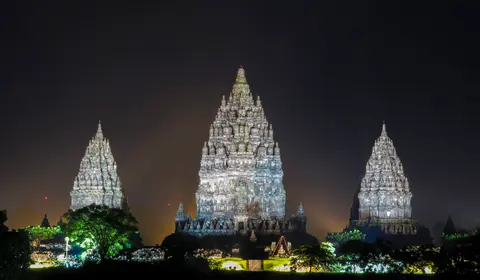
Trimurti Symmetry and the 508 Shrines Across Prambanan and Sewu
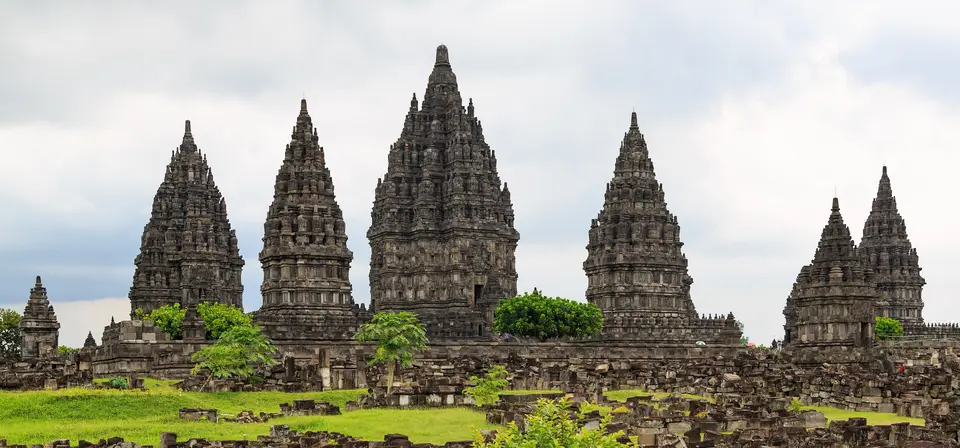
Spanning 508 stone structures overall, the inscribed UNESCO landscape pairs two distinct sacred ensembles inside one contiguous parkland north of the Yogyakarta-Solo highway. At the southern end rises Prambanan proper (Loro Jonggrang), organised across three concentric walled precincts whose original design held 240 shrines. Inside the innermost sacred courtyard stand eight principal temples flanked by eight smaller shrines. Three tall Trimurti temples honour Shiva in the centre (soaring 47 metres high), Vishnu on the north, and Brahma on the south. Facing them stand three opposite Vahana shrines housing their sacred animal mounts: Nandi the bull, Garuda, and Hamsa. Two Apit flank temples seal the northern and southern ends of the inner passage. Four small Kelir boundary shrines stand on the four cardinal axes immediately outside the main inner gates, matched by four Patok shrines marking the courtyard corners in strict Hindu cosmological alignment.
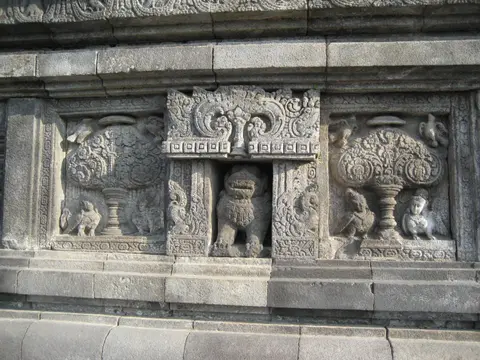
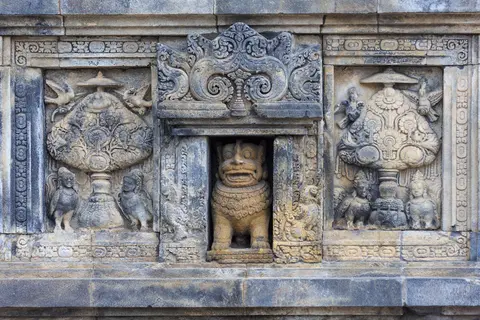
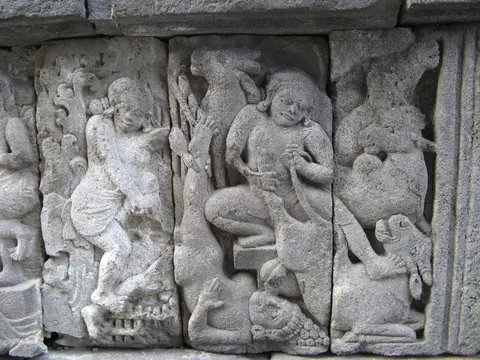
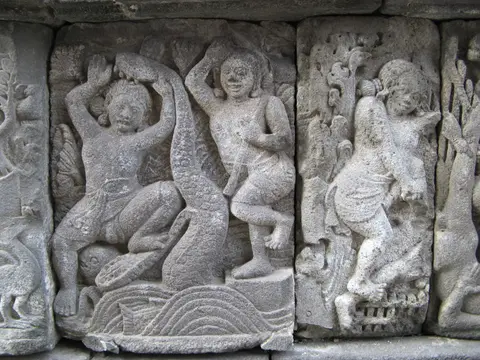
Surrounding that elevated inner square, four stepped concentric terraces once supported 224 outer Pervara (ancillary) temples arranged in exact rows of 44, 52, 60, and 68 shrines from innermost to outermost ring. Carved balustrade galleries running around the elevated Shiva, Brahma, and Vishnu temples unfold narrative stone reliefs recounting the Indonesian Ramayana epic and legends of Krishna and Balarama, sculpted cleanly along circumambulation walkways. Archaeologists have suggested that the tall central Shiva image inside the Shiva garbhagriha may even have been modelled after deified King Balitung following his death.
Walking northward across the archaeological park connects this Hindu state sanctuary directly with Sewu, Indonesia's largest Buddhist temple complex dating back to the 8th-century Sailendra dynasty, linked by the intermediate Buddhist shrines of Lumbung, Bubrah, and Asu (Gana temple). Guarded by four pairs of monumental stone Dwarapala statues, Sewu's shared park presence beside Loro Jonggrang supplies enduring physical evidence of religious coexistence and architectural cross-pollination between Buddhist and Shaivite courts on the Prambanan Plain.
Earthquake Collapse, Anastylosis Rebuilding, and Living Hindu Rites
Following British surveys under Colin Mackenzie for Thomas Stamford Raffles in 1811, decades of loss left villagers hauling foundation blocks away, Dutch residents removing sculptures as garden ornaments, and 1880s excavations worsening looting. Colonial archaeologists initiated restoration in 1918 and launched methodical anastylosis rebuilding in 1930. Because anastylosis requires reassembling collapsed shrines primarily from surviving interlocking stone blocks, Indonesian heritage policy demands at least 75 percent original masonry before rebuilding. Work progressed slowly through the 1930s economic crisis, the Pacific War (1942 to 1945), and the Indonesian National Revolution (1945 to 1949), when drawings and photographs were damaged or lost.
Resumed in 1949, restoration reached a milestone in 1953 when President Sukarno inaugurated the rebuilt 47-metre Shiva temple. Subsequent decades completed Brahma (1978 to 1987), Vishnu (1982 to 1991), and the Vahana shrines (1991 to 1993), culminating in a joint 1993 inauguration by President Suharto with Sewu's central temple. Reconstructing each outer Pervara shrine takes roughly 8 to 12 months. By February 2023, only six of the original 224 outer shrines had been completely rebuilt: four eastern (including row two number 35 finished in December 2017), one southern, and one northern. Two date from the 1930s and four were completed in 2015, 2017, 2019, and 2021, meaning full outer reconstruction would span at least 200 years.
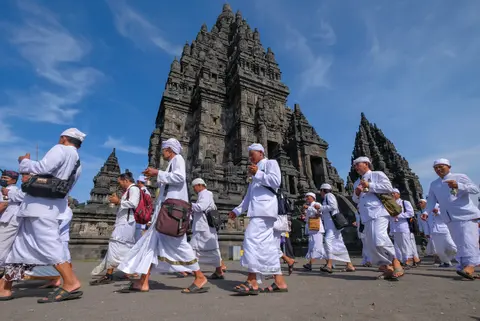
Natural hazards and spatial zoning continue to shape stewardship under Indonesia's 1998 National Cultural Property status, 2007 Action Plan, and 2010 national heritage legislation. After the 27 May 2006 Yogyakarta earthquake scattered carved stones across courtyards, Nandi temple reconstruction finished on 6 January 2009 while 2008 traffic reached 856,029 Indonesian and 114,951 foreign visitors. Seismographs and crack gauges continuously monitor Shiva Temple under 2010 and 2011 technical assessments while inner cellas stay largely closed for safety. Ashfall from Mount Kelud (200 kilometres east) closed the park briefly on 14 February 2014 after its 13 February eruption, though Prambanan escaped the 2010 Merapi ash plume. In 2012, BP3 Central Java proposed a 30-square-kilometre sanctuary zone uniting Prambanan, Ratu Boko, Kalasan, Sari, and Plaosan free of high-rise towers. Meanwhile, living Hindu worship has surged back through Galungan, Tawur Kesanga, Nyepi, and the 9 to 12 November 2019 Abhiseka consecration (1,163 years after 856 CE). Annual Siwaratri celebrations open the Prambanan Shiva Festival from 17 January to Maha Shivaratri on 15 February 2026. Events include Tari Siwa Grha dance symbolising Nataraja's cosmic Tandava at Garuda Field, midnight-to-dawn puja chanting, 1,008 Shiva mantras, dharma seminars, and concluding Tilem Kepitu prayers on the seventh new moon night. Framed since the 1960s by full-moon Ramayana ballet performances west of the Opak River, active ceremony, conservation across the 77-hectare compound, and 2007 and 2008 zoning laws safeguard Prambanan's volcanic-stone skyline following the 2006 earthquake.
Prambanan Archaeological Park Zones and Entry Access
Operations divide between Zone 1 core conservation offices and Zone 2 park management, established in 1992 when the government relocated nearby markets. Surrounding rice paddies and village edges became a unified archaeological park stretching north from the Yogyakarta-Solo main road past Lumbung and Bubrah to Sewu. Touring moves cleanly from south to north on foot or by shuttle.
| Complex Zone | Key Highlights | Access & Ticket Rule |
|---|---|---|
| Central Trimurti & Vahana Courtyard | 47-metre Shiva temple, Brahma and Vishnu shrines, Nandi, Garuda, and Hamsa sanctuaries | Included in main park ticket; exterior circumambulation open while many inner chambers remain closed |
| Outer Pervara Terraces | Concentric rows of 224 ancillary shrine foundations and six reconstructed Pervara temples | Open parkland walk framing the central square; ongoing archaeological work cordoned off |
| Lumbung, Bubrah & Sewu Precinct | 8th-century Sailendra Buddhist shrines and monumental Dwarapala guardian statues north of Prambanan | Included on the same park grounds north of the main Hindu courtyard |
| Opak Riverfront & Trimurti Stages | Diverted 9th-century riverbed axis plus open-air and indoor Ramayana ballet stages | Evening Ramayana performances require separate event tickets outside daytime entry |
Three Relief and Masonry Details to Inspect at Prambanan
Examining individual volcanic stone blocks along the raised inner walkways reveals both medieval construction signatures and modern conservation discipline.
- Ramayana and Krishna Narrative Balustrades: Walking clockwise around the raised walkways of Shiva, Brahma, and Vishnu temples lets visitors trace sequential volcanic-stone panels, moving from the Ramayana across Shiva and Brahma to Krishna overcoming Kamsa and Kaliya along the Vishnu gallery.
- Anastylosis Stone Bonding Without Heavy Mortar: Along newly rebuilt Pervara shrines such as the eastern row towers completed between 2015 and 2021, look closely at crisp interlocking volcanic stone joints. Uncarved filler blocks show exactly where missing pieces fall below the 75-percent original masonry rule.
- Diverted Opak Riverbank Alignment: Stepping to the western rim of the outer compound near the Ramayana amphitheatre highlights how straight the Opak River channel runs past the western wall, still fulfilling King Lokapala's 856 CE hydraulic redirection against Mount Merapi lahars.
Volcanic Seasons, Full-Moon Ramayana Staging, and Pairing with Bali
Central Java experiences clear dry-season mornings from late spring through autumn when volcanic haze lifts off Mount Merapi to the north, while heavy afternoon tropical showers and monsoon clouds build between late November and March. Late afternoon light deepens relief shadows across the tall grey shikara towers just before full-moon evening stagings of the Ramayana ballet begin west of the Opak River.
With Adisutjipto International Airport (JOG) sitting just 8 kilometres west of the temples, travellers connecting Java's Hindu and Buddhist plains onward to coastal Indonesian Hindu traditions can extend their route to our Bali destination guide 522 kilometres east. Additional sacred stone sanctuaries and archaeological parks across Asia await inside the UNESCO World Heritage Atlas.