


























Quick Field Data
- UNESCO Inscription: 1982 · Criteria (ii), (iii), (vi) · Added to the Danger List in 2017.
- Scale & Footprint: Extensive Greek and Roman ridge city at 600 metres elevation in the Jebel Akhdar uplands, surrounded by a 20 km2 rock-cut necropolis and linked to its ancient port of Apollonia 16 km (10 miles) north
- Access & Ticketing: Managed by the Libyan Department of Antiquities adjacent to the modern town of Shahhat; check current regional travel advisories before planning a visit
- Arrival Logistics: Located on a ridge of the Jabal al Akhdar immediately north of Shahhat and east of Bayda in Cyrenaica, northeastern Libya
Theran Colonisation, the Silphium Monopoly as well as the Jebel Akhdar Ridge
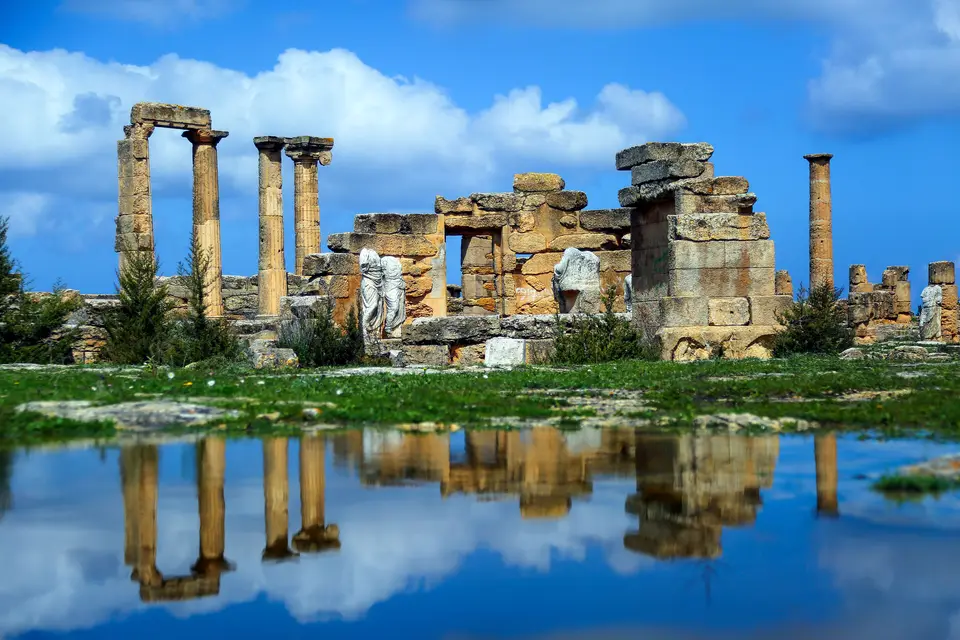
Perched at an elevation of about 600 metres above sea level on a fertile limestone ridge of the Jebel Akhdar (Jabal al Akhdar) uplands between the ravines of the Wadi Bil Ghadir to the south and the Wadi Bu Turqiyah to the north, immediately adjacent to present-day Shahhat and east of Bayda in northeastern Libya at coordinates 32.8250 N and 21.8583 E, the Archaeological Site of Cyrene (also anglicised as Kyrene) was the premier Greek metropolis of North Africa. Doric columns look across green highland valleys to the Mediterranean here. Recognised on the UNESCO World Heritage List at the 6th session in 1982 under Criteria (ii), (iii) alongside (vi) and added to the List of World Heritage in Danger in 2017, the city gave its name to the surrounding region of Cyrenaica and led the classical federation of five regional cities known as the Pentapolis alongside its Mediterranean port of Apollonia (modern Marsa Sousa) 16 kilometres (10 miles) to the north, Euesperides (later Berenice, modern Benghazi), Taucheira (Tocra) as well as Barca.
Inhabited in its cliff caves since the Palaeolithic era and visited in the Bronze Age by Minoans and Mycenaeans, the city was linked in Greek myth (recounted by Pindar in the fifth century BC) to the Thessalian huntress Cyrene and the god Apollo beside the sacred spring of Cyra, though Janko and other scholars also note links to an indigenous Libu or Garamantian name or the asphodil plant. According to Herodotus's Histories and a fourth-century BC inscription, Greek colonists from Thera (modern Santorini, alongside settlers from Sparta, Crete, Samos, and Rhodes) sailed to Libya on the counsel of the Oracle of Delphi under Battus, settling first at Aziris east of Derna before founding Cyrene in 631 BC.
Ruled by the Battiad dynasty descended from Battus, Cyrene grew rich from breeding horses (celebrated when Arcesilaus IV won the Pythian chariot race in 462 BC and the Olympic crown in 460 BC, alongside Olympic victories by Cratisthenes, Hippon in 280 BC as well as Idaeus in 275 BC), grain exports (sending 800,000 medimni or 40,000,000 litres of grain to Greece in the late 320s BC) alongside exporting silphium, a prized medicinal herb depicted on Cyrenian coins that vanished from over-harvesting in the first century AD. After Battus II defeated Egyptian pharaoh Apries and Libyan king Adicran at the Battle of Irasa around 570 BC, and Demonax of Mantinea reformed the constitution under Battus III, fifth-century BC Cyrene established republican governance, built its own Delphi sanctuary treasury between 350 and 325 BC, and fixed its Carthaginian border at the Altars of the Phileni.
During the fourth and third centuries BC, Cyrene flourished as a major intellectual hub of the Greek world: Socrates's disciple Aristippus (c. 435 to 356 BC) and his daughter Arete founded the Cyrenaic school of philosophy here, followed by the mathematician Theodorus, the polymath Eratosthenes (276 to 194 BC, chief librarian at Alexandria and the first scholar to calculate the circumference of the Earth), the poet Callimachus (310/305 to 240 BC), the skeptic philosopher Carneades, Lacydes, Eugammon, Philostephanus, Ptolemais, and Theaetetus. Brought under Ptolemaic rule by general Ophellas in 321 BC, governed by King Magas (whose daughter Berenice wed Ptolemy III in 246 BC), and later ruled by Ptolemy VIII and his son Ptolemy Apion, Cyrene passed by Apion's will to the Roman Republic in 96 BC, receiving a constitution from Lucullus in 87 BC after Aretaphila deposed the tyrant Nicocrates, its first Roman governor in 74 BC, and union with Crete between 67 and 30 BC.
The Street of Battus, the Sanctuary of Apollo, and the Octastyle Temple of Zeus
Home to a large Hellenistic Jewish community (celebrated by the historian Jason of Cyrene around 100 BC in the five-volume source of 2 Maccabees, by Simon of Cyrene who carried the cross of Jesus, and in Coptic tradition as the birthplace of Saint Mark), Cyrene was devastated in AD 115 during the Diaspora Revolt before Marcius Turbo suppressed the uprising and Emperor Hadrian repopulated and rebuilt the city from 118 to 119 AD, admitting it to the Panhellenion. Despite damaging earthquakes in 262 AD (after which prefect Tenagino Probus defeated the Marmaritae in 269 and Emperor Claudius Gothicus refortified the city as Claudiopolis before Diocletian placed it in Libya Superior) and on 21 July 365 AD, Cyrene remained an active Christian centre under bishops Theodorus, Philo, Rufus (at Ephesus in 449), and Leontius, and the philosopher-bishop Synesius (c. 373 to 414 AD) until the Arab conquest in 642 to 643 AD, when the ruins became known locally as Grennah.
Architecturally, the city unfolds across three parallel zones. Along the western ridge crest from the Acropolis (site of the Royal Palace) runs the 1-kilometre Street of Battus (Skyrota), passing the central Agora (flanked by Eastern and Western Stoas and the Temple of Apollo Archegetes), the 2nd-century AD palatial House of Jason Magnus, the Stoa of Hermes and Heracles, the vast Roman Caesareum (originally Ptolemy VIII's gymnasium), two theatres, and the caravanserai. Below the northern cliff face, where the sacred Springs of Apollo and Cyra gush onto a triangular terrace above the Wadi Bu Turqiyah, lies the Sanctuary of Apollo, containing the 7th-century BC Temple of Apollo, the Greek Theatre converted into a Roman amphitheatre, and the Baths of Trajan, linked southeast along Valley Street past the Aqua Augusta and the Baths of Paris toward the Central Quarter and Market Theatre (where an October 2023 flood exposed a Roman water canal).
On the northeastern ridge inside the walls stands the colossal Doric octastyle peripteral Temple of Zeus, built around 500 to 480 BC atop a three-stepped crepidoma measuring 68.3 metres long by 30.4 metres wide (eight front and rear columns by seventeen flank columns around a two-storey, three-aisled cella), matching the scale of the Parthenon in Athens and the Temple of Zeus at Olympia; wrecked in the 115 AD revolt, partially rebuilt in 172 to 175 AD with a colossal cult statue under Commodus in 185 to 192 AD, and toppled again in 365 AD, it stands near the hippodrome and the 5th- or 6th-century East Church. Outside the southern wall across the Wadi Bil Ghadir rises the three-terraced Sanctuary of Demeter and Persephone, while a 20-square-kilometre Necropolis of rock-cut tombs, temple-tombs, and sarcophagi containing veiled Goddess of Death busts stretches north toward Apollonia.
Mapped in 1821 to 1822 by Frederick and Richard Beechey, excavated in 1860 and 1861 by E. A. Porcher and Robert Murdoch Smith (who sent the Apollo of Cyrene to the British Museum), investigated in 1909 by Israel Zangwill's ITO and in 1910 by Richard Norton (whose epigrapher Herbert de Cou is buried on site), and excavated on a grand scale after Italian soldiers found the headless marble Venus of Cyrene in 1913 (returned from Rome to Libya in 2008) and under antiquities controller Richard Goodchild (1955 to 1966) and Sandro Stucchi, Cyrene yielded 76 intact 2nd-century AD Roman statues to University of Urbino archaeologists in 2005 (buried for 1,630 years under a temple wall felled in 375 AD) and underwent conservation by the Global Heritage Fund and the Second University of Naples from 2006.
Walking the Agora, the Sanctuary of Apollo, and the Temple of Zeus
Set on the green uplands above Shahhat, the vast ruin field of Cyrene divides naturally into three walking sectors: the upper Street of Battus and Agora ridge, the lower cliff-side terrace of the Sanctuary of Apollo, and the northeastern hill of the Temple of Zeus and northern Necropolis.
- Upper Ridge from the Agora to the House of Jason Magnus: Begin on the central ridge inside the walled Caesareum and the adjacent Stoa of Hermes and Heracles, then walk west along the paved 1-kilometre Street of Battus (Skyrota) into the open square of the Greek and Roman Agora. Inspect the circular monument of Battus, the Temple of Apollo Archegetes, and across the street, the marble peristyle courts and mosaics of the 2nd-century AD House of Jason Magnus.
- Descending to the Fountain of Apollo and the Greek Theatre: Follow the ancient stepped road down the northern cliff face to the fresh water of the Fountain of Apollo and Spring of Cyra, then walk onto the triangular plateau of the Sanctuary of Apollo to examine the Doric columns of the 7th-century BC Temple of Apollo, the vaulted chambers of the Baths of Trajan, and the Greek Theatre clinging to the western edge of the escarpment looking out toward the Mediterranean Sea.
- The 68.3-Metre Temple of Zeus and the Northern Rock-Cut Necropolis: Drive or walk across the valley to the northeastern ridge to stand among the massive fallen and re-erected Doric drums of the 68.3-by-30.4-metre Temple of Zeus alongside the hippodrome and East Church, then follow the road north toward the port of Apollonia (Marsa Sousa, 16 km away) to view the terraced rock-cut facades of the Necropolis of Cyrene. Check current Libyan travel advisories before planning, and explore the classical Mediterranean in our UNESCO World Heritage Atlas.
