


























Quick Field Data
- UNESCO Inscription: 1988
- Scale & Footprint: A 1,393.8-hectare archaeological sanctuary with a 3,386.4-hectare buffer zone spread across two terraces in the regional unit of Argolis in the Peloponnese, Greece
- Access & Ticketing: Open-air archaeological park and on-site Archaeological Museum of Epidaurus with unified admission covering the theatre, temple foundations, and Kynortion hill; check the official site
- Arrival Logistics: Situated in a valley of the Regional unit of Argolis in the Peloponnese and reached by road or ferry excursions from Athens
From the Hilltop Shrine of Apollo Maleatas to the Classical Cradle of Medicine
Situated in a small valley of the Regional unit of Argolis in the Peloponnese, Greece, across a core area of 1,393.8 hectares surrounded by a 3,386.4-hectare buffer zone, the Sanctuary of Asklepios at Epidaurus functioned as the foremost therapeutic centre of the Greco-Roman world, rivalling major Greek cult centres such as Zeus at Olympia and the oracle of Apollo at Delphi. Ceremonial healing rituals began on the upper slopes of Kynortion hill (Mount Myrtion) in the 2nd millennium BCE, where a shrine to Apollo Maleatas was established by the 8th century BCE. According to the 2nd-century AD geographer Pausanias (Description of Greece 2.26-28), Coronis, daughter of King Phlegyas, gave birth to Apollo's son Asclepius (Asklepios) at Epidaurus and left the newborn infant on Mount Myrtion, where a goat nursed him, a scene later stamped onto 2nd-century AD Epidauran coinage. By the 6th century BC at the latest, the official city-state cult of Asklepios had developed in the lower valley, and during the 4th and 3rd centuries BC an ambitious building programme transformed the two terraces into the earliest organised sanatorium of antiquity, providing direct evidence of how healing practices evolved from religious incubation rituals into scientific medicine. In the 3rd century BC, the poet Isyllus instituted a festival procession to Kynortion hill with an inscribed sacred hymn celebrating Asclepius' birthday, while Cicero later recounted how Dionysius I, of Syracuse removed the golden beard from the statue of Aesculapius, and Aelian recorded tales of miraculous cures and wormwood remedies.
Military and political upheavals repeatedly tested the sanctuary during the Hellenistic and Roman eras. In 146 BC during the Achaean War, the Achaians turned the sanctuary into a fortified stronghold before the Roman general Lucius Mummius defeated them, destroyed Corinth in 146 BC, and left 2 dedications at Epidaurus. In 87 BC the Roman general Sulla looted the sanctuary, in 74 BC the Roman commander Marcus Antonius Creticus stationed a military garrison in the town that provoked grain shortages, and before 67 BC pirates plundered the valley, leaving the guest house, gymnasium, water supply system, and Sanctuary of Apollo Maleatas damaged until a wealthy benefactor, Euanthes son of Eunomus, funded restorations honoured by at least 6 monuments. In the 1st century AD, the wealthy Statilius and Claudius-Cornelius families held the chief priesthoods and funded the Apolloneia Asclapieia Caesarea Games.
A major imperial revival followed the visit of Emperor Hadrian in 124 AD. Influenced by the Pergamene Asclepieium at Pergamum, Hadrian reformed the lifetime priesthood into an annual office selected by allotment, reorganised the Asclepieia Games, introduced cults to Zeus Olympius, Zeus Panhellenius, and Telesphorus, and was honoured as Zeus Asclepius Soter while Epidaurians inaugurated a new calendar era dated from 124 AD. In the 160s and 170s AD, the Roman senator Sextus Julius Major Antoninus Pythodorus from Nysa in Asia Minor (recorded by Pausanias 2.27.6-7 and identified on stamped rooftiles) built the north-east baths of Asclepius, a shrine dedicated to Hygieia alongside Egyptian Asclepius and Egyptian Apollo, the Library of Rufus, and a compact odeon inside the gymnasium for sacred theatre, restored the Stoa of Cotys, the guest house, and the sanctuary of the Epidotae (the helping gods Machaon, Podalirius, Heracles, Tyche, Agathos Daimon, Nemesis, and Artemis Enodia, together with Artemis Lysaea, Hypnos, Oneiros, Pan, and Leto), and rebuilt the Sanctuary of Apollo Maleatas with a propylon, nymphaeum, and subterranean cistern called the Skanà. After the Goths raided the sanctuary in AD 395 and Christian Emperors closed pagan temples in the 4th century AD, Epidaurus remained known into the middle of the 5th century as a Christian healing centre. Modern excavations began on 28 March (15 March old style) 1881 under Panagiotis Kavvadias for the Archaeological Society of Athens, joined by Valerios Stais in 1886 and 1887 and illustrated by Wilhelm Dörpfeld (whose restrained drawings Charles Chipiez contrasted in 1896 with the lavish 1895 reconstructions of Alphonse Defrasse), continuing until 1927 and a final season in June and July 1928 before John Papadimitriou conducted further excavations between 1948 and 1951.
The Acoustic Theatre, the White Marble Tholos, and the Enkoimeterion
Set into the hillside northwest of the sacred grove, the Theatre of Epidaurus dates from the 4th century BC and is celebrated for its architectural proportions and exemplary acoustics. Uncovered by Panagiotis Kavvadias in 1881, the limestone auditorium looks across the valley towards the sacred grove, which was enclosed by boundary stones within which no birth or death was permitted and all sacrificial offerings had to be consumed, a custom Pausanias compared to Delos and Titane. Inside the main sanctuary stood the Doric Temple of Asclepius, excavated in 1882: a peripteral structure of 6 by 11 columns measuring roughly 80 feet in length, built in nearly 5 years by the architect Theodotus according to the building accounts of Inscriptiones Graecae IV 2 no. 102. Its pedimental sculptures and figural acroteria are displayed in the National Archaeological Museum at Athens alongside fragments in the on-site museum. Within the cella, built directly over a water cistern to preserve the ivory without water or olive oil, stood the cult statue of gold and ivory crafted by the Parian artist Thrasymedes, son of Arignotos, half the size of Zeus Olympios at Athens, showing the god seated with his staff, a hand above the serpent, a dog at his side, and Argive hero reliefs on his throne.
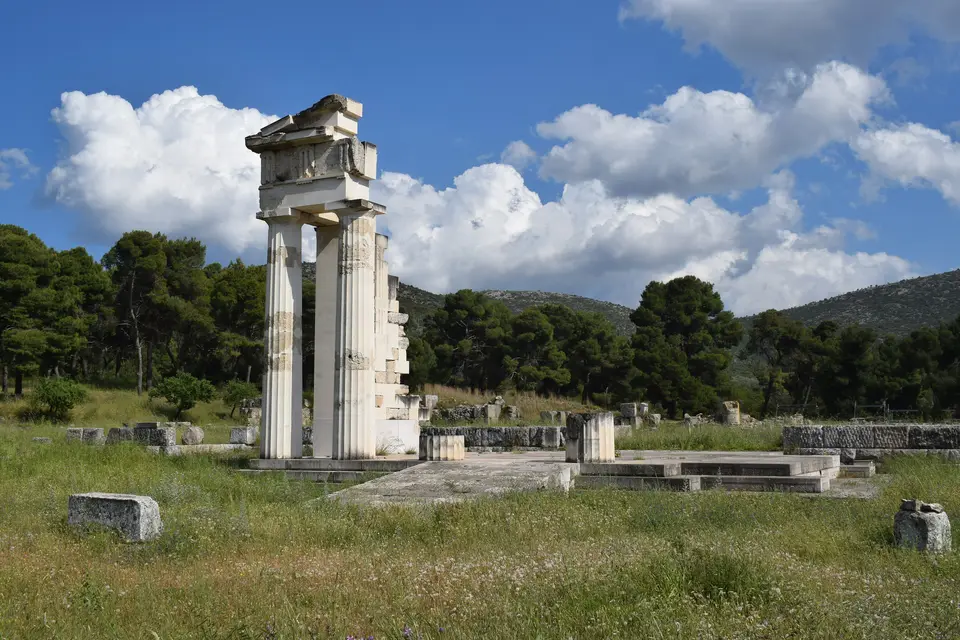
Immediately west of the temple stood the circular white marble Tholos (Round House), excavated in 1882, where harmless yellowish sacred serpents associated with Asklepios were kept, and to the north stretched the Enkoimeterion, or abaton, uncovered in 1883 and partially reconstructed along its western stoa in 1884. Here suppliants slept overnight awaiting healing visions from the god. Nearby stood the inscribed miracle stelae (two uncovered in 1881 and a third published by Kavvadias in 1903 and 1918), written in the Doric dialect of the 4th and 3rd centuries BCE and recording the names, illnesses, and cures of at least 20 patients, alongside an ancient slab cited by Pausanias recording how Hippolytos dedicated 20 horses after being raised from the dead before departing for the Arikians in Italy.
Completing the coherent therapeutic assembly across the lower terrace and Kynortion hill are the 1884 excavations at the Temple of Artemis and at the Great Propylaia, images of Epione and a sanctuary of Aphrodite and Themis, the Stoa of Cotys, the guest house, the gymnasium converted in Roman times to house a brick odeon (published by Kavvadias in 1900), thermal baths, and the stadium (discovered by 1893) linked by a vaulted entrance tunnel to an athletes' changing room or apodyterion excavated in 1902 and interpreted by Stephen Miller in 1992, plus a northern athletes' preparation building found in 1928.
Walking the Sacred Grove, Stadium Tunnel, and Kynortion Hill
A visit to Epidaurus guided by the UNESCO World Heritage Atlas should begin early in the morning at the 4th-century BC Theatre of Epidaurus before tour buses arrive from Athens and the Peloponnesian coast. After testing the acoustics from the circular orchestra floor and upper limestone seating tiers, visitors should pass through the Archaeological Museum of Epidaurus, which preserves architectural members from the Temple of Asclepius and the finely carved ceiling coffers of the Tholos, before entering the pine-shaded sacred grove.
Inside the grove, walkers can trace the ritual journey of ancient patients from the northern Great Propylaia past the foundations of Theodotus's Doric Temple of Asclepius, the concentric foundation rings of the white marble Tholos, and the restored colonnade of the Enkoimeterion (abaton), then continue south to the Roman odeon, the guest house, and the sunken stadium with its vaulted athletes' tunnel. Those with extra time should follow the path up Kynortion hill to inspect the older bronze-age and classical terraces of the Sanctuary of Apollo Maleatas and Pythodorus's subterranean cistern, the Skanà. The sanctuary grounds are expansive.
- Starting at the Theatre and Museum: Walk up to the Theatre of Epidaurus at opening time for quiet acoustic views, then study the reconstructed entablatures and healing inscriptions inside the site museum before exploring the stone foundations in the grove.
- Following the patient incubation route: Stand beside the reconstructed western stoa of the abaton (Enkoimeterion) and the circular foundations of the Tholos to visualise how pilgrims slept near the temple awaiting curative dreams.
- Exploring beyond the central temple: Include the stadium entrance tunnel excavated in 1902 and the upper hill sanctuary of Apollo Maleatas on Mount Kynortion to appreciate the full 1,393.8-hectare scale of the sanctuary.
