


























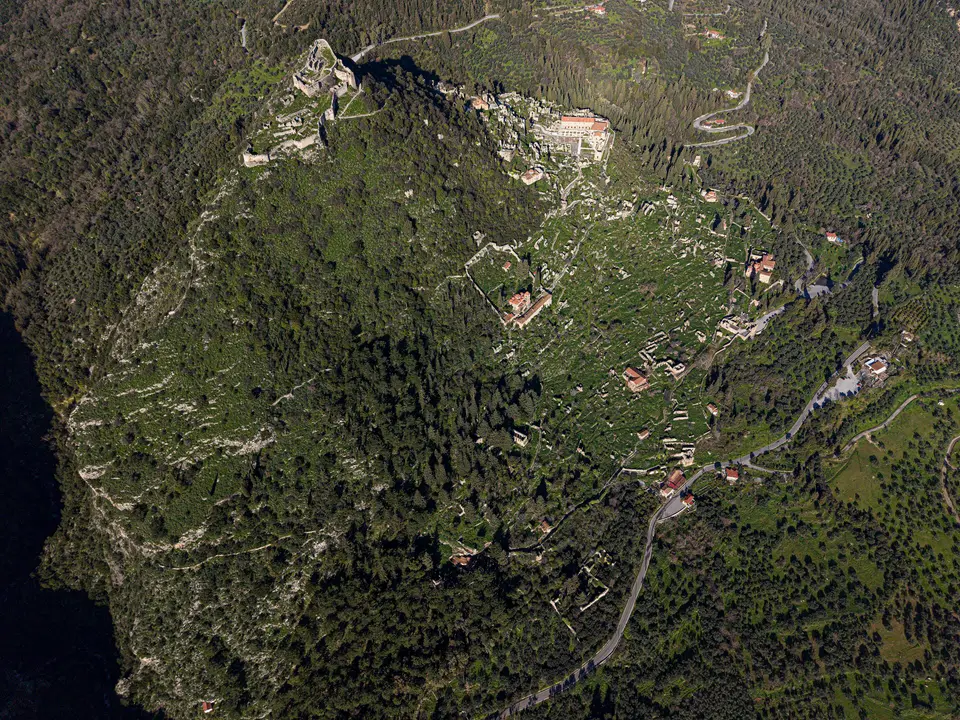
Quick Field Data
- UNESCO Inscription: 1989 (Cultural heritage property in Laconia, Peloponnese, Greece, preserving the fortified medieval princely seat of the Byzantine Despotate of the Morea)
- Scale & Footprint: 54.43 hectares of walled citadel, Upper Town, and Lower Town terraces, surrounded by a 1,202.52-hectare buffer zone on a 620-metre conical hill at the foot of Mount Taygetos
- Access & Ticketing: Managed by the Greek cultural heritage authorities in Laconia; check the official site for combined admission passes covering the Lower Town, Upper Town, castle, and museum
- Arrival Logistics: Located 8 kilometres west of modern Sparta in the Peloponnese; two separate roadside entrances serve the Lower Gate and the Upper Gate beside the fortress summit
Frankish Fortress Origins and the Capital of the Despotate of the Morea
Rising on a steep, conical foothill of Mount Taygetos overlooking the olive and citrus groves of the river valley in Laconia, the Archaeological Site of Mystras preserves the finest surviving urban ensemble of the late Byzantine Palaeologan Renaissance. Throughout Greece, the UNESCO World Heritage Atlas in 1989 across 54.43 hectares just 8 kilometres west of ancient Sparta, the fortified hillside city was founded in 1249 after the Fourth Crusade, when Prince William II of Villehardouin, who governed the Frankish Principality of Achaea, constructed a commanding summit fortress on the 620-metre ridge known as Myzithras to control the plain of Laconia and Lacedaemon and the mountain passes of Taygetos.
Frankish rule proved brief. Following the Battle of Pelagonia in 1259, troops of the Nicaean Empire captured William II of Villehardouin, and in 1262 the prince surrendered the castles of Mystras, Monemvasia, and Grand Magne as ransom to Emperor Michael VIII Palaiologos, who had recaptured Constantinople the previous year. Seeking protection beneath the newly garrisoned Byzantine battlements rather than remaining on the exposed valley floor around Lacedaemon, inhabitants migrated uphill onto the rocky northern and eastern slopes beneath the castle. New defensive walls enclosed first an Upper Town, or fortified quarter, and subsequently a sprawling Lower Town enclosed by outer defensive walls.
From 1262 the city functioned as the seat of the Byzantine military governor of the Peloponnese, and in 1348 Emperor John VI Kantakouzenos elevated Mystras to the capital of the autonomous Despotate of the Morea, appointing his son Manuel Kantakouzenos as its first Despot. In 1383 control passed to the imperial Palaiologos dynasty under Theodore I, followed by succession of princely brothers including Constantine XI Palaiologos, who was crowned the final Byzantine Emperor inside the church of Agios Demetrios at Mystras shortly before the fall of the empire before departing to defend Constantinople. Even as Ottoman armies encroached across the Balkans, 14th- and 15th-century Mystras flourished as an intellectual and artistic hub where the neoplatonic philosopher Gemistos Plethon taught scholars including humanist scholars who later carried classical Greek manuscripts to Italian cities such as Florence. Surrendered to Sultan Mehmed II in 1460, briefly captured by the Venetians during the Venetian campaign between 1687 and 1715 when silk manufacturing brought renewed prosperity to a population of tens of thousands of inhabitants, and burned during the Orlov uprising in 1770 against the Ottomans and again by Egyptian troops under Ibrahim during the War of Independence in 1825, the medieval town was finally abandoned after King Otto founded modern Sparta, Sparti, on the plain in 1834. Silence returned to the hillside. Across the surrounding foothills of Mount Taygetos and Mount Parnon, where Slavic Melingoi and local Tsakones inhabited the mountain villages and the Frankish rulers after the Fourth Crusade of 1205 had contested control with the Nicaeans at Prinitsa and Makryplagi, Mystras had stood for more than two centuries as the political heart of the Peloponnese. Princesses from Italian and Western families, including Theodora Tocco and Cleofe Malatesta, married into the Despotate court, strengthening cultural links between Byzantine Laconia and Renaissance Florence before the Ottoman Sanjak of Mezistre was established in 1460.
Palaeologan Ecclesiastical Architecture, Fresco Cycles, and the Despots' Palace
Because Mystras was never built over in modern times, its terraced cobblestone streets, vaulted gates, aristocratic mansions, and churches reveal a complete late medieval urban hierarchy descending from the summit acropolis. At the crest of the hill stands the Frankish Castle built in 1249 and reinforced under Byzantine and Ottoman rule, featuring double curtain walls, rectangular and circular watchtowers, vaulted cisterns, and a central keep commanding sweeping views across Laconia and the snow-capped peaks of Taygetos. Directly below the castle on the only broad terrace of the Upper Town rises the Palace of the Despots, a monumental two-winged residential and administrative complex constructed in four phases between the late thirteenth and early 15th centuries. Its oldest eastern wing incorporates Gothic pointed arches reflecting Western influences under the Kantakouzenos rulers, while the four-storey northern wing built by the Palaiologos rulers contains a vast monumental rectangular ceremonial throne room heated by eight fireplaces and lit by lancet windows above an arched loggia.
Across the Upper Town and Lower Town, the religious architecture of Mystras displays a distinctive hybrid building type pioneered around 1290 by the monastic founders at the Hodegetria Church, known as the Hodigitria-Afendiko, inside the Brontochion Monastery. This "Mystras mixed type" merges a three-aisled basilica on the ground floor with a five-domed cross-in-square church on the upper gallery level, wrapped by porticoes and a tall bell tower. The oldest church on the site, the Cathedral of Agios Demetrios founded in 1292 by the local metropolitan bishop and rebuilt on its upper storey in the early 15th century, retains a carved marble floor plaque depicting the double-headed eagle of the Palaiologos dynasty alongside an inscription recording the 1292 foundation and an adjacent two-storey metropolitan palace now housing the Archaeological Museum of Mystras.
Inside the churches, vivid wall paintings trace the evolution of Palaeologan fresco art from plastic classicism to refined courtly elegance. At the Monastery of the Peribleptos, tucked into a natural rock cavity at the southeastern corner of the Lower Town in the mid-14th century, intact fresco cycles of the liturgical and biblical cycles glow with subtle pastel blues, ochres, and expressive movement. High in the Upper Town, the Church of the Pantanassa, dedicated in the fifteenth century by the chief minister John Frangopoulos and still inhabited by a community of Orthodox nuns, blends Byzantine masonry with elaborate Gothic exterior arcades and a four-storey campanile, while its interior vaults preserve brilliant fifteenth-century frescoes of the biblical narrative cycles. Nearby stand the late thirteenth-century church of Saints Theodores with its massive octagonal dome, the mid-14th-century court chapel of Agia Sophia built by Manuel Kantakouzenos, the frescoed chapel of Evangelistria, and aristocratic stone residences such as the Laskaris House and the Frangopoulos House.
Walking the Upper and Lower Town Terraces from Top to Bottom
Travellers journeying south from Athens across the Peloponnese via the Peloponnese reach Mystras in the shadow of Mount Taygetos just past Sparta. Because the paved medieval lanes climb steeply across several hundred metres of vertical elevation on sun-baked limestone slopes, the most comfortable strategy is to start at the Upper Gate by the castle and walk downhill toward the Lower Gate, arranging transport or a return walk between the two car parks.
- Summit fortress, Agia Sophia, and the Palace of the Despots: Enter through the Upper Gate to climb first to the 1249 Frankish citadel while morning temperatures remain cool. Descending from the keep, pass the Mavroporta and Nauplia Gate and the court church of Agia Sophia to reach the broad square of the Palace of the Despots, where multi-year restoration work has reconstructed the timber roofs and vaulted chambers of the Kantakouzenos and Palaiologos wings alongside the vaulted stone gate linking the Upper Town and Lower Town.
- Pantanassa Convent and the Peribleptos rock church: Follow the terraced path along the contour of the hillside to the active Monastery of the Pantanassa to examine its sculpted exterior apse, Gothic belfry, and vivid fifteenth-century upper-gallery frescoes. Continue downward past the vaulted stables and living quarters of the Frangopoulos and Laskaris mansions to the quiet southeastern corner of the enclosure, where the dark, cool interior of the Peribleptos Monastery shelters the finest surviving 14th-century paintings on the mountain.
- Brontochion Monastery, Cathedral of Agios Demetrios, and museum: Conclude in the northern and lower quarters of the Lower Town by visiting the octagonal dome of Saints Theodores and the grand Hodigitria-Afendiko church of the Brontochion Monastery, where four imperial chrysobulls painted directly onto the walls of a southwestern funerary chapel record the monastery's landed estates across the Peloponnese. Before exiting the Lower Gate, step into the courtyard of Agios Demetrios to view the double-headed eagle slab and the sculptures, Byzantine silk garments, illuminated manuscripts, and inscriptions displayed in the museum alongside architectural fragments from Saint Nicholas, Saint Christopher, Agia Kyriaki, the Taxiarchs, Aï-Yannakis, and the Krevatas residences.
