


























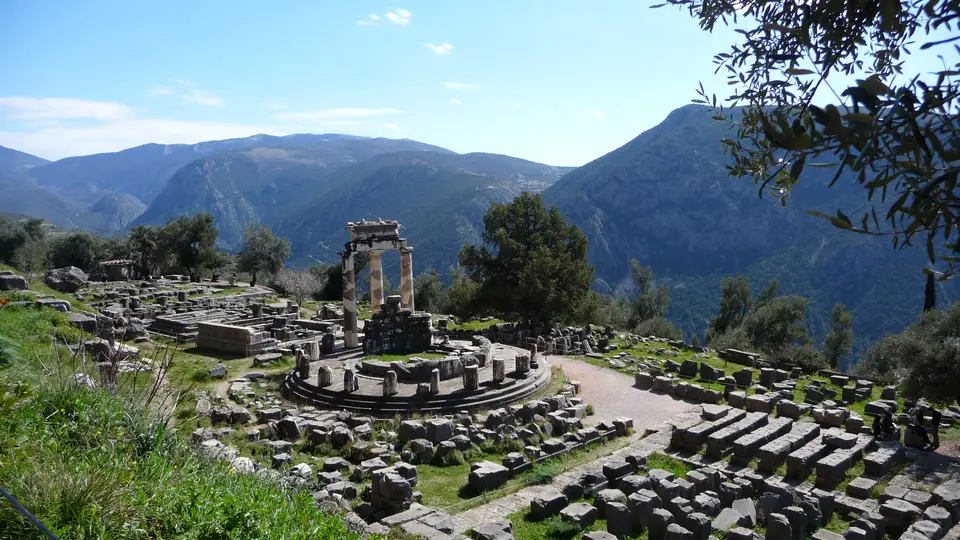
Quick Field Data
- UNESCO Inscription: 1987 (Cultural, Criteria i, ii, iii, iv, vi)
- Scale & Footprint: Mountain terraced sanctuary complex in the Regional unit of Phocis comprising the Sanctuary of Apollo (with the 4th-century BC Doric Temple of Apollo, civic treasuries along the Sacred Way, theatre, and sanctuaries to Gaia, Dionysus, and Neoptolemus), the Castalian Spring, and the Delphi Archaeological Museum
- Access & Ticketing: Fenced archaeological park and onsite museum operated by Greek archaeological authorities; check the official site for combined ticket options and seasonal mountain schedules
- Arrival Logistics: Located at 38.4815°N, 22.4962°E on the southern slopes of Mount Parnassus above the Gulf of Corinth in Central Greece, reachable by road from Athens
The Navel of the World, the Pythia, and the Pan-Hellenic Amphictyonic League
Positioned at 38.4815 degrees north and 22.4962 degrees east on the southern slopes of Mount Parnassus in the Regional unit of Phocis, the Archaeological Site of Delphi overlooks an extensive olive-grooved valley north of the Gulf of Corinth in Central Greece. Framed directly above by two towering rocks of Mount Parnassus known as the Phaidriades ("Shining") Rocks, the site was inhabited as early as the 2nd millennium BC during the Mycenaean era (1500 to 1100 BC), when early cults honoured the earth deity Gaia alongside later sanctuaries to Dionysus and Neoptolemus. Beginning in the 8th century BC and reaching the height of its political and religious influence across Greece in the 6th century BC, Delphi emerged as the supreme Panhellenic sanctuary dedicated to Apollo, the Olympian god of light, knowledge, harmony, archery, music, prophecy, the arts, and healing. In ancient Greek belief, Delphi marked the physical centre of the universe: according to myth, Zeus sent forth two eagles from the eastern and western ends of the earth, and their meeting point at Delphi was marked by the conical stone known as the Omphalos ("navel of the world"), flanked by two golden eagles inside Apollo's sacred temple.
According to the second part of the Homeric Hymn to Apollo, Pythian Apollo established his sanctuary at Delphi after slaying the she-dragon Python beside a nearby stream and leaving her body to rot (triggering Apollo's temporary banishment by Zeus to Thessaly for purification of miasma and the mythological founding of the Pythian Games), before taking the form of a dolphin to intercept a ship of Minoan sailors from Knossos bound for Pylos, guiding them via a divine wind to the port of Crissa to serve as his priests at Delphi. Throughout antiquity, kings, city-states, and private citizens from across the Mediterranean and beyond travelled to the Temple of Apollo (known in Greek as the Apollonion) to consult the Pythia, the priestess and oracle of Apollo, on state matters such as founding colonies and personal questions of marriage, children, and health. Famous historical and mythic consultations recorded by Herodotus and Greek tragedians include King Croesus of Lydia (who dedicated immense treasures before his defeat by the Persians and Xerxes I, alongside the silver bowl and iron stand crafted by Glaucus of Chios and dedicated by his father Alyattes) and Oedipus in Oedipus Rex. Originally selected from young women of Delphi and later restricted to women at least fifty years old who dressed as young maidens after Echecrates the Thessalian violated a priestess, the Pythia functioned for nine warmer months of the year after sacrificial goats, sheep, or bulls were offered on the outer altar. Cleansed with water from the Castalian Spring and holding bay laurel leaves, she descended into the subterranean oracular vault beneath the temple floor and sat upon a tripod over a rock chasm (debated by modern geologists studying hydrocarbon fault gases and by classical historians including Lisa Maurizio and Joseph Fontenrose) while priests interpreted or inscribed her prophecies on bay laurel leaves. During the three winter months, oracular practice paused and ritual focus shifted to the mystery cult of Dionysus (whose mortal remains were said to rest in the temple) and festivals staged by the female Thyiades.
Governance of the wealthy sanctuary rested with the Amphictyonic League council. Contention over Delphi between 595 BC and 290 BC triggered a series of Sacred Wars, including the Second Sacred War between Sparta and the Athenian-backed Phocians, and the Third Sacred War in 357 BC, when Phocian forces refused to pay an Amphictyonic fine for cultivating sacred land and seized the Temple of Apollo, looting an estimated 10,000 talents of treasures to fund a mercenary army. After Alexander the Great conquered Asia, Delphic influence extended as far east as Bactria before the Roman emperor Theodosius I, acting in AD 390, ordered the closure and destruction of pagan temples and the removal of Delphi's statues.
The Sacred Way, the Five Temples of Apollo, and Polygonal Masonry Terraces
Constructed on a mountain terrace sloping from north to south, the central sanctuary of Apollo is supported by monumental terrace walls of interlocking polygonal masonry enclosing stone chambers underneath. Beginning at the Castalian Spring where pilgrims purified themselves before entering, the paved path known as the Sacred Way ascended through the precinct, lined with civic treasuries, stoas, altars, and statues housing the offerings of major Greek states such as Athens, Corinth, Boeotia, and Thebes, alongside the tall column topped around 560 BC by the marble Sphinx of Naxos.
Greek traditions studied by scholars such as Henry J. Middleton and recorded by Pausanias and the Homeric Hymn reference five successive temples built at Delphi: a first hut made of laurel brought from the Vale of Tempe, a second temple sent to the Hyperboreans made either of beeswax and feathers or of ferns by a Delphian named Pteras, a third mythical temple of bronze built by Hephaestus (destroyed by fire or an earth fissure), and a fourth stone temple built by Trophonius and Agamedes that burned down in 548 BC. Following the 548 BC fire, the Amphictyonic League council set a budget of 300 talents (one quarter paid by Delphi and three quarters collected from donations across the known world, including twenty mina from the Greek colonists of Naucratis and 1,000 talents from the Egyptian King Amasis II) to build the fifth temple. Celebrated in Pindar's Pythian odes, Euripides' Ion, and the Histories of Herodotus, the building contract was handled by the exiled Alcmaeonidae family with Spintharus of Corinth (Spintharius) as architect, upgrading the six-by-fifteen-column Doric peristyle facade from limestone to white Parian marble. Functioning by 490 BC, the fifth temple featured pediments begun by Praxias and finished by Androsthenes depicting Apollo, Artemis, and Leto on the east and Dionysus with the Thyiades on the west, while five gilt-bronze-outfitted metopes mirrored Apollo's victory over Python by showing Heracles and Iolaus slaying the Lernaean Hydra, Bellerophon mounted on Pegasus overcoming the Chimera, Zeus striking down the giant Mimas, Athena vanquishing the giant Enceladus, and Dionysus slaying a giant with his thyrsus. Attached to the exterior were Persian shields captured by the Athenians at the Battle of Marathon in 490 BC alongside Gallic shields dedicated after the Gauls were repulsed in 279 BC. After an earthquake in 330 BC, the architects Xenodoros and Agathon reconstructed the visible 4th-century BC Doric temple ruins.
Inside the pronaos porch of the temple were carved three famous precepts attributed to the Seven Sages ("Know Thyself", "Surety Brings Ruin", and "Nothing in Excess") alongside the enigmatic symbol "E". The main cella featured blue-grey limestone floor slabs washed with Castalian Spring water, wall paintings attributed by Pliny the Elder to Aristoclides, statues of Zeus, Apollo, and the Fates, the sacred stone that Rhea gave to Chronos in place of infant Zeus, and Pindar's iron chair, leading to the restricted inner adyton housing the golden statue of Apollo, the Omphalos, sacred armour, a pine-wood fire altar burning bay leaves and barley-meal, and the subterranean oracular vault. Along the exterior polygonal wall below the platform, inscriptions dating from the 3rd century BC to Roman times under Hadrian record Amphictyonic decrees, Pythian Games records, slave emancipations dedicated to Apollo, and a medical tax levied to pay for healing attendance.
French Excavations, the Charioteer of Delphi, and Field Navigation
Modern excavation began in 1891 when French authorities authorised the French School of Athens to excavate the site from 1892 to 1894 under archaeologist Jean Théphille Homelle, uncovering the bronze Charioteer of Delphi (dedicated by Polyzalos of Gela after a Pythian Games victory), the marble "Dancers of Delphi", and the head of the Sphinx of Naxos (unearthed in 1893). A subsequent campaign in 1938 by the French School of Athens under Robert Demangel, Pierre Amandry, and Pierre de La Coste-Messeliére discovered two cavities beneath Apollo's temple containing ivory, bronze, and gold fragments of chryselephantine statues and gold slates depicting animals and mythic figures. Within Greece, the sanctuary was inscribed on the UNESCO World Heritage List in 1987, and Delphi can be visited using our Athens travel guide and located on our interactive world map. Mountain winds sweep across the high terraces.
- Climbing the Sacred Way to the Temple of Apollo: Begin at the Castalian Spring and ascend the switchbacks of the Sacred Way past the civic treasuries of Athens, Corinth, Boeotia, and Thebes and the inscribed polygonal masonry wall to reach the 4th-century BC Doric Temple of Apollo.
- Exploring the sanctuary terraces and ancient theatre: Survey the central sanctuary terrace housing the sanctuaries to Gaia, Dionysus, and Neoptolemus before climbing above the Apollonion to the stone seating of the ancient theatre overlooking the olive valley north of the Gulf of Corinth.
- Inspecting the bronze Charioteer and chryselephantine ivories in the museum: Visit the Delphi Archaeological Museum to examine the bronze Charioteer of Delphi dedicated by Polyzalos of Gela, the Dancers of Delphi, the Sphinx of Naxos, and the gold and ivory chryselephantine fragments uncovered in 1938.
