


























Quick Field Data
- UNESCO Inscription: 1979 (established as an Alberta provincial park on 27 June 1955; named an IUGS Geological Heritage Site in October 2022) · Natural Criteria
- Scale & Footprint: 7,825 hectares encompassing 26 kilometres of undisturbed badlands and riverside cottonwood riparian habitat along the Red Deer River valley
- Access & Ticketing: Managed as a provincial park with a public scenic loop road, self-guided badlands trails, the Dinosaur Provincial Park Visitor Centre, and restricted fossil preserve zones accessible only on ranger-guided tours
- Arrival Logistics: Located in the badlands of southern Alberta, Canada, 48 kilometres northeast of Brooks, 220 kilometres east of Calgary, and 100 kilometres downstream from Drumheller
Campanian River Deltas and Three Geologic Formations
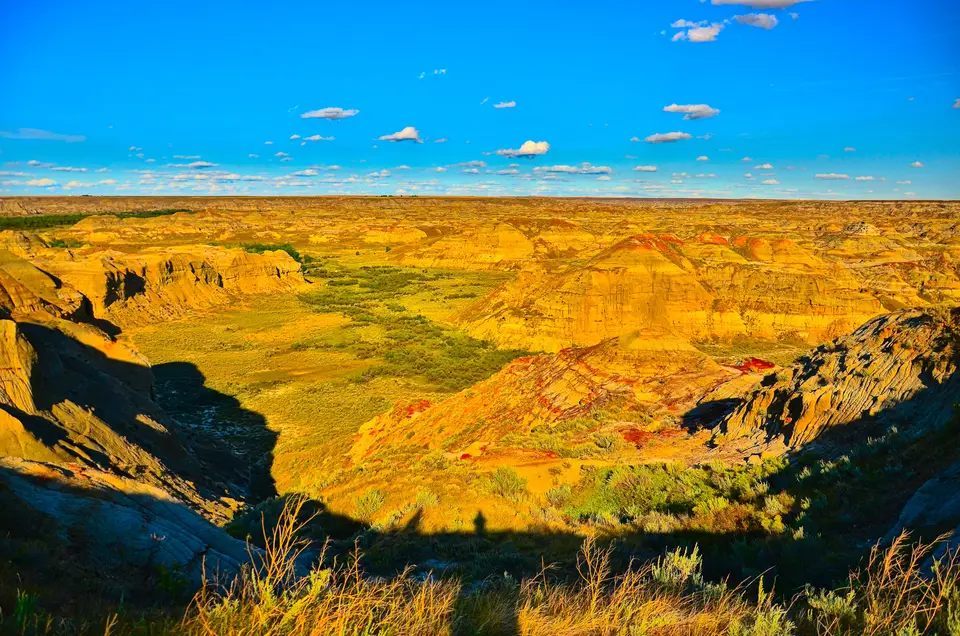
Dinosaur Provincial Park encompasses 7,825 hectares of stark hoodoos and coulees alongside riverside cottonwood groves along a 26-kilometre stretch of the Red Deer River valley in southern Alberta, lying 48 kilometres northeast of Brooks and 220 kilometres east of Calgary. Surrounded by flat prairie grasslands, the valley cuts downward into soft Upper Cretaceous sediments where unimpaired water and wind erosion continually sculptures the badlands and exposes fresh fossil bone each spring. Recognised by UNESCO on 26 October 1979 and selected in October 2022 by the International Union of Geological Sciences (IUGS) among the world's first 100 geological heritage sites, the park preserves three contiguous ecological communities: high prairie grasslands and eroded badlands alongside lush riparian cottonwood corridors.
The sedimentary sequence exposed in the canyon walls accumulated over roughly 1.5 million years in the Late Cretaceous Campanian stage, around 75 to 77 million years ago, when eastward- and southeastward-flowing river systems crossed a warm, subtropical coastal floodplain into the Western Interior Seaway. Stratigraphically, the badlands expose three different geologic formations stacked from bottom to top. Exposed lowest in the canyon floor is the upper horizon of the terrestrial Oldman Formation, representing the oldest sedimentary layer in the valley. Overlying it is the full terrestrial thickness of the Dinosaur Park Formation, deposited from 76.5 down to 74.8 million years ago in meandering river channels and coastal floodplains, which contains the vast majority of the park's articulated dinosaur skeletons. Capping the upper canyon rims is the base of the marine Bearpaw Formation, laid down when the Western Interior Seaway finally flooded the coastal plain. Because these Late Cretaceous beds remain unencumbered by modern construction inside the 7,825-hectare boundary, seasonal rainstorms washing down the steep clay slopes continuously uncover new fossil horizons for comparative and chronological palaeontology across the badland gullies and riverside benches.
Today those ancient subtropical swamp strata support a semi-arid badlands microclimate where two of Canada's northernmost cactus species, prickly pear (Opuntia) and pincushion cactus (Pediocactus), bloom across the sun-baked clay slopes during the second half of June. Along the riverbanks and coulees, 165 bird species including curlews and Canada geese plus nighthawks share the valley with pronghorn, mule deer, cottontail rabbits, chorusing coyotes at dusk, prairie rattlesnakes, bull snakes, and red-sided garter snakes. The stark visual contrast between the flat agricultural prairies above the valley rim, the deeply incised sandstone and mudstone hoodoos of the badlands, and the shady cottonwood groves lining the Red Deer River creates an isolated ecological refuge that has remained largely undisturbed by surrounding development.
Fifty-One Dinosaur Species, Roy Fowler, and Global Museum Collections
No other locality on earth matches the concentration and taxonomic diversity of Late Cretaceous fossils preserved within the Oldman and Dinosaur Park formations. Nearly 500 fossil species spanning microscopic fern spores to large carnivorous dinosaurs, including more than 166 vertebrate taxa and between 35, 44, and 51 to fifty-eight documented species of dinosaurs across 34 genera and 10 families, have been recovered from these 7,825 hectares. Plant macrofossils and rich fossil pollen and spore beds record an ancient canopy of taxodiaceous and cupressaceous conifers, fern fronds, Ginkgo, Cercidiphyllum, sycamore (Platanus), and aquatic Pistia-like plants. Beneath that canopy swam sharks, durophagous rays such as Myledaphus, paddlefish, bowfins, gars, teleost fishes, frogs, salamanders, extinct albanerpetontids, diverse turtles, crocodilians, the fish-eating reptile Champsosaurus, and the large monitor lizard Palaeosaniwa, while mouse- and shrew-sized stagodont marsupials and placentals plus multituberculate mammals scurried below Hesperornithiformes birds and giant pterosaurs related to Quetzalcoatlus.
The dinosaur fauna itself spans every major Late Cretaceous herbivorous and carnivorous guild. Horned ceratopsians include Leptoceratops, Vagaceratops irvinensis, Chasmosaurus russelli, Chasmosaurus belli, Pachyrhinosaurus, Styracosaurus albertensis, Coronosaurus brinkmani, and Centrosaurus apertus. Duck-billed hadrosaurs grazed the floodplains in vast herds, represented by crested and non-crested species including Parasaurolophus walkeri, Prosaurolophus maximus, Lambeosaurus magnicristatus, Lambeosaurus lambei, Gryposaurus incurvimanus, Gryposaurus notabilis, and Corythosaurus casuarius. Armoured ankylosaurs (Euoplocephalus tutus, Panoplosaurus, and Edmontonia), dome-headed pachycephalosaurs (Stegoceras), and swift hypsilophodontids (Orodromeus) shared the riverbanks with ostrich-mimic ornithomimids (Ornithomimus, Struthiomimus, and Rativates), crested caenagnathids (Citipes elegans, Chirostenotes collinsi, and Chirostenotes pergracilis), and paravian theropods (Dromaeosaurus albertensis, Saurornitholestes, Hesperonychus elizabethae, Troodon, and Richardoestesia gilmorei), all hunted by the apex tyrannosaurids Gorgosaurus libratus and Daspletosaurus torosus.
To halt unregulated bone quarrying, the province established Dinosaur Provincial Park on 27 June 1955 during Alberta's 50th Jubilee Year and appointed local farmer and amateur fossil hunter Roy Fowler (1902 to 1975) as its first warden. Over the decades, more than 350 to 500 articulated specimens, including over 150 complete skeletons, have been excavated and exhibited in more than 30 major museums around the globe. Until 1985, every major skeleton discovered in the valley had to be shipped away for scientific analysis and display to institutions such as the Royal Ontario Museum in Toronto, the Canadian Museum of Nature in Ottawa, New York City's American Museum of Natural History, and Chicago's Field Museum of Natural History. That changed in 1985 when the Royal Tyrrell Museum of Palaeontology opened in Midland Provincial Park adjacent to Drumheller, 100 kilometres upstream along the Red Deer River, complemented on-site by the Dinosaur Provincial Park Visitor Centre and the restored early-twentieth-century log cabin of pioneering African-American Alberta cowboy and rancher John Ware.
Navigating the Badlands and Restricted Preserve Zones
Visiting Dinosaur Provincial Park divides between the open public badlands drive along the Red Deer River floor and the strictly protected natural preserve zones, where eroding skeletons lie exposed on the ground and entry is permitted only on guided palaeontological walks. Bones weather out daily. Stepping from the flat agricultural prairie down into the multi-coloured coulees reveals 75 million years of Earth history carved directly by prairie cloudbursts and seasonal snowmelt.
- Entry and Route via the Valley Viewpoint and Visitor Centre: Drive 48 kilometres northeast from Brooks (or 220 kilometres east from Calgary) across flat prairie grasslands to the sudden edge of the Red Deer River valley, where the overlook reveals 26 kilometres of layered hoodoos and coulees. Descend into the canyon to start at the Dinosaur Provincial Park Visitor Centre, inspecting the fossil preparation lab and video theatre alongside articulated skeleton displays before walking over to John Ware's Cabin, opened on select summer days near the riverside cottonwoods.
- Tickets, Interiors and Viewpoints on the Badlands Path and Guided Tours: Follow the public gravel road through the badlands to walk the self-guided interpretive paths that pass through the base of the Oldman Formation into the channel sandstones of the Dinosaur Park Formation (laid down 76.5 to 74.8 million years ago). To enter the restricted fossil preserve zones, where Centrosaurus bonebeds and articulated hadrosaur skeletons remain in situ, reserve a ticketed ranger-led bus or hiking tour well in advance through the visitor centre.
- Timing and Onward Connections to Drumheller: Plan your visit for the second half of June to see northern prickly pear (Opuntia) and pincushion (Pediocactus) cacti in full bloom and hear evening coyote and nighthawk calls, while carrying sun protection and water for hot summer canyon hikes and watching for prairie rattlesnakes, bull snakes, and red-sided garter snakes. Combine your field trip with the Royal Tyrrell Museum 100 kilometres upstream in Drumheller and explore other fossil sites in our UNESCO World Heritage Atlas.
