Quick Field Data
- UNESCO Inscription: Ref. 788 · Cultural Site · Inscribed 1996 · Criteria (i), (ii), (iii), (iv)
- Scale & Footprint: Eight serial monuments covering 1.272 hectares across central Ravenna and the nearby historic port district of Classe, 5 kilometres south of town
- Access & Ticketing: Protected under Italy's Legislative Decree 42/2004 and managed jointly by the Ministry of Culture, Comune di Ravenna, and Opera di Religione; combined timed tickets and separate state monument admissions are booked through official diocesan and museum channels
- Arrival Logistics: 74 kilometres east of Bologna Guglielmo Marconi Airport (BLQ) with direct regional trains; Forlì-Luigi Ridolfi International Airport (FRL) sits 27 kilometres away with limited seasonal routes, while Florence (FLR, 105 kilometres) and Venice Marco Polo (VCE, 122 kilometres) provide further air hubs
Marshland Capital of Emperors, Goths, and Byzantine Exarchs
Now separated from the Adriatic shoreline and linked to the sea only by the Candiano Canal, Ravenna rose in antiquity on pile-founded islands inside a coastal marsh lagoon settled by the Umbri from at least the fifth century BC and later joined by Celtic Senones. Accepted into the Roman Republic in 89 BC, the harbour sheltered Julius Caesar's troops in 49 BC before Octavian established the fleet base of Classis after 31 BC. Emperor Trajan financed a 70-kilometre aqueduct during the early second century AD, yet Ravenna's defining architectural century opened in 401 and 402, when Western Roman Emperor Honorius shifted the imperial court here from Mediolanum.
Surrounded by protective marshes yet open via Classis to imperial shipping from Constantinople, Ravenna swelled into a city of 50,000 inhabitants where Romulus Augustulus was deposed in 476. Odoacer ruled Italy for 13 years until Ostrogothic King Theodoric, dispatched by Eastern Emperor Zeno in 489, trapped him inside Ravenna through a four-year siege and captured the city in 493. Theodoric established an Ostrogothic capital that tolerated parallel religious and legal communities. Arian Christian Goths worshipped in their own cathedral and baptistery beside Nicene Latin citizens governed under Roman law, and in 519 Theodoric ordered the town to rebuild burned synagogues at public expense. After Theodoric died in 526, his grandson Athalaric governed under Amalasuintha's regency until internal dynastic upheaval invited intervention. Byzantine general Belisarius then conquered Ravenna in 540 under Emperor Justinian's campaign to reclaim Italy. Completed in 554, the reconquest established Ravenna as seat of the Byzantine Exarchate of Ravenna and inspired early geographic compilations such as the Ravenna Cosmography. Ravenna's archbishop gained brief ecclesiastical autocephaly from Rome in 666, before Lombard King Aistulf seized the Exarchate in 751 and Frankish ruler Pepin forced him to surrender it to the Papacy in 756.
Eight surviving monuments from the fifth and sixth centuries trace every chapter of this rapid political succession. Five structures stand within compact walkable streets of the historic centre, two occupy adjacent former imperial or royal quarters, and the eighth rises 5 kilometres south across flat reclaimed plains where the Roman fleet once anchored.
Galla Placidia, Baptisteries, and Early Nicene and Arian Art
Built between 425 and 450 during Galla Placidia's regency for her young son Emperor Valentinian III, the cruciform brick chapel known as the Mausoleum of Galla Placidia originally opened off the narthex of the imperial palace church of Santa Croce. Despite thirteenth-century local tradition pointing to three marble sarcophagi inside (whose largest tomb accidentally burned in 1577 when curious children inserted a taper), Galla Placidia actually died in Rome in 450 and lies buried there. Because Adriatic coastline subsidence and groundwater rose steadily over the centuries, the chapel's fifth-century floor was raised five feet above its original level, leaving its squat brick exterior deceptive compared to the incandescent interior.
Light filtered through modern alabaster windows reveals wall, lunette, and vault surfaces encased entirely in glass tesserae. Over the north doorway, a beardless Good Shepherd clothed in imperial purple and gold clasps a cross-staff rather than a wooden crook, marking the transition from classical naturalism toward Late Antique abstraction. Above, a dark blue dome studded with concentric golden stars surrounds a central gold cross and the four winged Evangelist symbols. Below, the western lunette depicts stags approaching spring waters, while the southern lunette shows a haloed saint carrying a cross between a flaming gridiron and an open cabinet housing the four Gospels.
Two surviving baptisteries illustrate Ravenna's doctrinal division under Ostrogothic rule. Erected for the Orthodox Nicene community, the Neonian Baptistery remains the most complete Early Christian baptistery in Europe. Its interior holds inlaid marble dadoes, stucco prophets, and concentric cupola mosaics showing Christ's baptism surrounded by marching Apostles. Across town, Theodoric built the octagonal Arian Baptistery beside today's Santo Spirito cathedral. Its dome mosaic mirrors the Orthodox composition while weaving subtle iconographic differences reflecting Arian theology. Theodoric also founded his palace basilica, later rededicated as Sant'Apollinare Nuovo, lining its nave walls above colonnades with rhythmic processions of saints and glimpses of his lost palace. Outside the city walls, he commissioned his circular Mausoleum out of massive interlocking Istrian stone blocks, the sole surviving tomb of a migration-period Germanic ruler.
San Vitale, Hollow Terracotta Vaults, and Imperial Panels
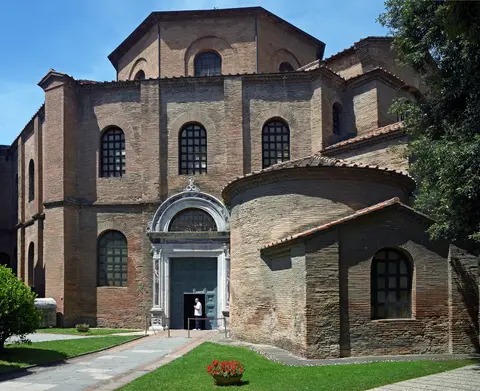
Only one orthodox Nicene commission dates from Theodoric's lifetime, the intimate Cappella Arcivescovile inside the Archbishop's Palace. By contrast, Ravenna's crowning Justinianic achievement began under Bishop Ecclesius in 526 and reached consecration under Bishop Maximian in 547. Local banker Julius Argentarius financed the work at a recorded cost equivalent to 16.38 kilograms of gold, suggesting eastern Byzantine origins rooted in public benefaction traditions. The Basilica of San Vitale follows a double-shelled octagon echoing Constantinople's Church of Saints Sergios and Bacchos, and some scholars link its plan to lost audience halls of the Byzantine Imperial Palace. Its masonry merges Roman arched portals and stepped staircase towers with Byzantine narrow brickwork, polygonal apse geometry, and early exterior flying buttresses. Builders formed the western vault from interlocking hollow terracotta tubes rather than heavy brick, marking the earliest recorded structural use of clay tube vault forms. Meanwhile, the ambulatory and upper gallery, the matrimoneum possibly reserved for married women, received vaults only in the Middle Ages.
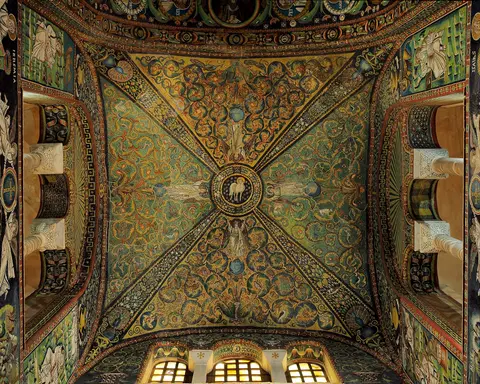
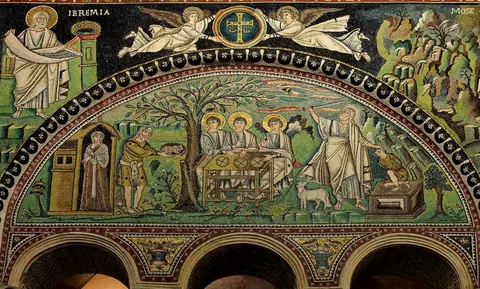
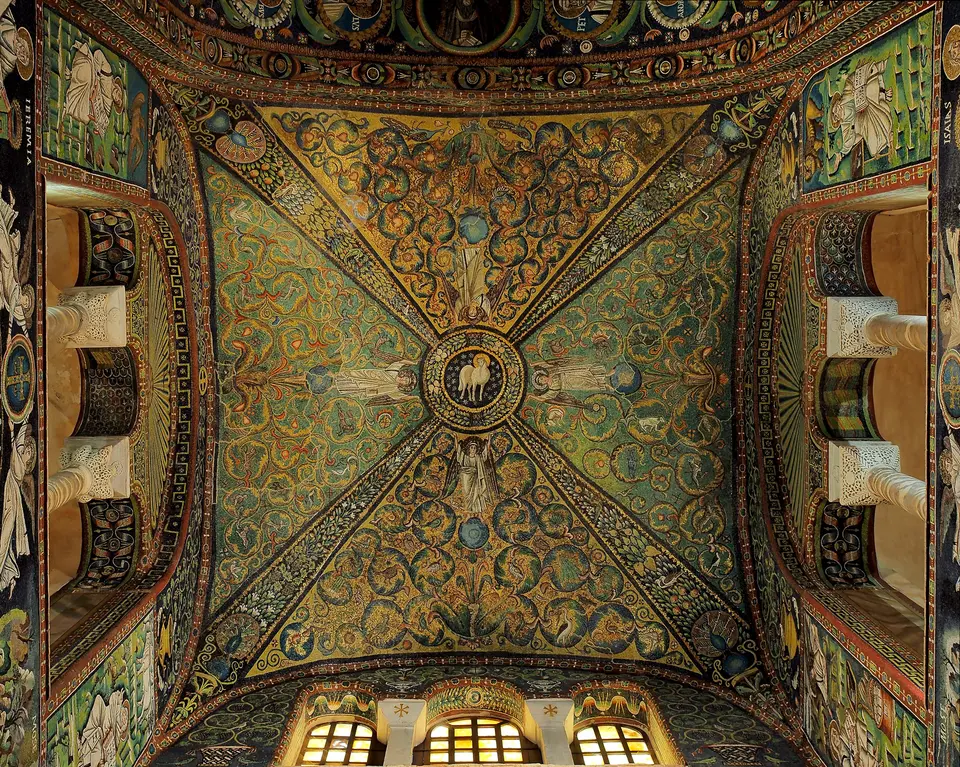
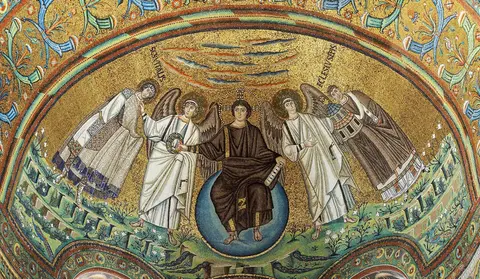
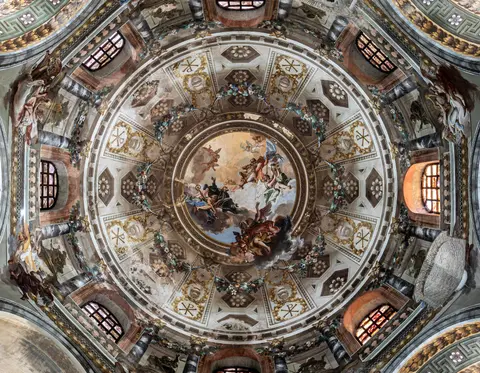
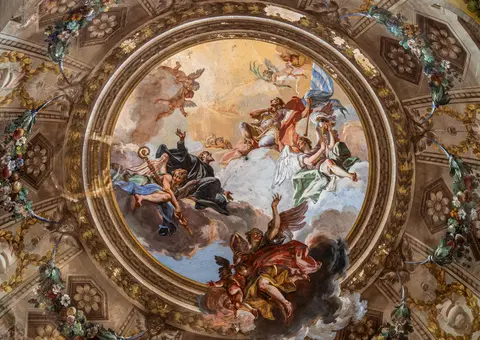
Inside the presbytery, Baroque dome frescoes painted between 1778 and 1782 by Serafino Barozzi, Ubaldo Gandolfi, and Jacopo Guarana frame sixth-century mosaics in the vivid Hellenistic-Roman jewelled style, completed before Gothic rule ended. Lunettes above the triforia depict biblical offerings including the Hospitality of Abraham (Genesis 18:1 to 16), the Sacrifice of Isaac, Abel and Cain, Moses at the Burning Bush, Jeremiah, Isaiah, and the Twelve Tribes of Israel. Angels holding cross medallions crown these scenes, flanked by white-robed Evangelists beneath fierce symbolic beasts. Overhead, four angels support a garlanded crown encircling the Lamb of God amidst birds, stars, flowers, and peacocks. Flanking prothesis and diaconicon chapels and 15 triumphal arch medallions portray Christ, the Twelve Apostles, and Saints Gervasius and Protasius. On the flanking arches, Jerusalem and Bethlehem symbolise the Jewish and Gentile branches of humanity. Across the apse conch, Christ seated upon a blue cosmic globe hands a martyr's crown to Saint Vitalis opposite Bishop Ecclesius presenting a scale model of the church.
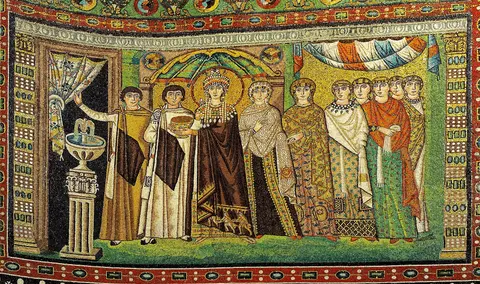
Two famous mosaic panels face each other at the base of the apse walls, completed by 547 as imperial propaganda after Belisarius reclaimed Italy. On the left, the haloed Byzantine ruler clad in Tyrian purple stands centred between armed palatinae guards, generals Belisarius and Narses, and clergy led by Bishop Maximian. Maximian's inscription was adjusted when he succeeded Bishop Victor, and overlapping feet trace a deliberate V-shaped hierarchy unifying church and state. Opposite him, Empress Theodora holds a golden Eucharistic vessel before a fountain, cupola, and hung canopy. She is accompanied by court women, traditionally identified as Belisarius's wife Antonina and daughter Ioannina, and eunuchs dressed in richly patterned silks suggestive of Sassanian Persian imports.
Sant'Apollinare in Classe and Ravenna's Shifting Coastline
Five kilometres southeast beside the ancient harbour district of Classe stands the monumental Basilica of Sant'Apollinare in Classe. Julius Argentarius sponsored this church during the intense 540 to 600 episcopal building drive that also yielded partially surviving churches such as San Michele in Africisco. Framed by an imposing cylindrical brick bell tower and broad sunlit aisles, the basilica centres on an extraordinary green meadow apse mosaic showing Saint Apollinaris beneath a jewelled transfiguration cross. Although silting shifted the sea miles eastward, all eight monuments retain intact spatial integrity despite turbulent medieval centuries. Ravenna passed through Traversari rule (1218 to 1240) and Da Polenta lordship from 1275, which sheltered exiled Florentine poet Dante. Venetian rule followed from 1441 to 1509 until the Battle of Agnadello during the War of the League of Cambrai, giving way to papal governance. Today the Ministry of Culture, Comune di Ravenna, Opera di Religione, and the School of Restoration monitor subsidence, pollution, and tourist condensation damp under Legislative Decree 42/2004 and the 1964 Venice Charter. Together they pass mosaic craft knowledge from primary schools through the Fine Art Academy.
Access Rules Across Ravenna's Eight Inscribed Monuments
Because ownership splits between the Archdiocese of Ravenna-Cervia and Italy's Ministry of Culture, travellers navigate two separate ticketing systems to visit all eight sites cleanly.
| Complex Zone | Key Highlights | Access & Ticket Rule |
|---|---|---|
| Diocesan Complex (San Vitale & Galla Placidia) | Double-shelled octagonal basilica, imperial mosaic panels, and starry blue cruciform chapel vaults | Single combined diocesan pass covers both monuments; Mausoleum of Galla Placidia requires a strict timed reservation slot |
| Neonian Baptistery, Sant'Apollinare Nuovo & Archiepiscopal Chapel | Orthodox baptismal cupola stuccoes, Ostrogothic palatine nave processions, and private bishop's oratory | Included on the same diocesan combined ticket; modest church dress and calm indoor noise levels apply |
| State Monuments (Arian Baptistery & Mausoleum of Theodoric) | Ostrogothic baptistery dome mosaic and monumental monolithic Istrian-stone royal tomb outside town | Managed separately by Italy's Ministry of Culture; verify current ticket rules and local holidays online before setting out |
| Basilica of Sant'Apollinare in Classe | Monumental sixth-century maritime basilica, cylindrical brick campanile, and green meadow apse mosaic | State-administered monument 5 kilometres south of town reached easily by regional train or local bus |
Tessera Angles, Tube Vaulting, and Theodora's Silk Drapery
Moving close beneath the apse walls and ambulatory piers inside San Vitale and Galla Placidia reveals three physical techniques behind Ravenna's sixth-century luminosity.
- Angled Glass Tesserae Against Alabaster Light: Look along curved surfaces in the Mausoleum of Galla Placidia and San Vitale's presbytery. Mosaicists tilted individual coloured and gold-leaf glass tesserae at subtle angles inside wet mortar so shifting daylight bounces off fractured facets rather than reflecting flatly like painted plaster.
- Lightweight Interlocking Terracotta Tube Vaulting: Stand beneath San Vitale's central octagonal cupola and study its light masonry piers. Rather than casting heavy Roman brick domes that demanded massive buttressing walls, builders inserted hollow fired clay tubes end-to-end in concentric rings, creating an early structural forerunner of hollow clay tile vaulting.
- Imperial Purple and Patterned Sassanian Silk Motifs: Inspect the lower hem of Empress Theodora's purple cloak in the right-hand apse panel. Artisans rendered imported Persian-style patterned silk borders and pearl-strung imperial diadems in tiny varied stone and glass cubes, turning diplomatic court dress into permanent architectural portraiture.
Book timed morning entry slots for Galla Placidia so damp winter condensation or peak afternoon queues do not interrupt quiet viewing. Then connect Ravenna directly by regional rail to our Bologna city guide or explore additional Early Christian ensembles across the UNESCO World Heritage Atlas.