


























Quick Field Data
- UNESCO Inscription: 1979 · Criteria (ii), (iii)
- Scale & Footprint: Eight-component serial site anchored by the 70,000 square metres Fasil Ghebbi royal enclosure and its 900-metre curtain wall
- Access & Ticketing: Unified entry ticket covers the main walled Fasil Ghebbi palace compound, while outlying Gondar components such as the Bath of Fasilides and Debre Berhan Selassie have separate gates
- Arrival Logistics: Located in the city of Gondar in the Amhara Region of northern Ethiopia, north of Lake Tana
From Roving Imperial Camps to the Basalt Ramparts of Gondar
Between the thirteenth and seventeenth centuries, Ethiopian emperors governed their highland territories without a permanent capital city, travelling from province to province in tented royal camps referred to in Amharic as a katama or makkababya, the term used in the Royal Chronicle of Baeda Maryam. In 1636, Emperor Fasilides ended this mobile tradition by establishing Gondar as a permanent capital in the highlands north of Lake Tana, within what is today the North Gondar Administrative Zone of the Amhara National Regional State. At the core of the city, Fasilides ordered the construction of a fortified royal compound called Fasil Ghebbi, taking its name from the Amharic word ghebbi meaning an enclosure or compound. Until 1864, when the seat of Ethiopian government moved elsewhere, successive rulers expanded this walled citadel with castles, churches, libraries, and banqueting halls.
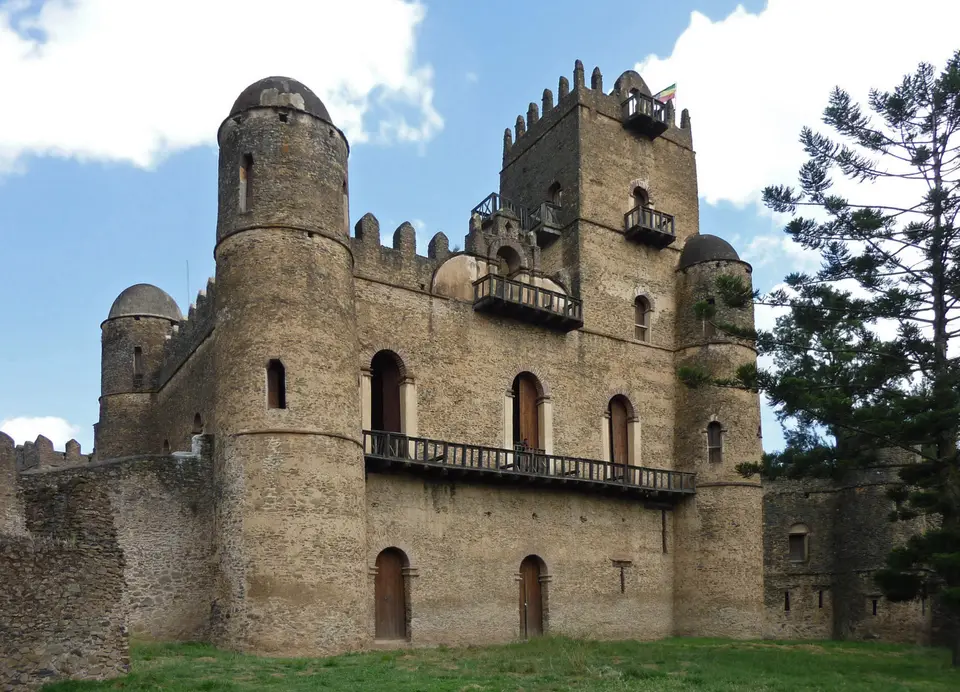
The main Fasil Ghebbi palace enclosure covers approximately 70,000 square metres on a ridge above Gondar and is surrounded by a curtain wall 900 metres long, pierced by twelve entrances and originally linked to neighbouring quarters by three stone bridges. Builders raised the fortress-like palaces from dark brown basalt stone set in lime mortar, framing the doorways, arched windows, and cornices with local wine-coloured tuff. When the Yemeni ambassador Hassan ibn Ahmad al-Haymi visited the young court in 1648, he recorded that the master builder behind the castle of Fasilides was an Indian architect named Abdal Kerim, a craftsman who had earlier built the royal residence of Emperor Susenyos I, at Danqaz. According to the Royal Chronicles, the later structures of Emperor Yohannes I, and Emperor Iyasu I, were designed by an Ethiopian architect named Walda Giyorgis, while the masonry, carpentry, and metalwork were carried out by local Beta Israel craftsmen of the Kayla clan.
Inscribed by UNESCO in 1979, Fasil Ghebbi and the Gondar Region form an eight-component serial site that extends well beyond the central palace walls. The first component encompasses the Fasil Ghebbi compound itself, with its six major building complexes and some twenty palaces and royal structures. The remaining seven components lie in and around Gondar and the Lake Tana basin: the Monastery and Church of Debre Berhan Selassie, the Bath of Fasilides by the Qaha River to the northwest, Kiddush Yohannes, the Monastery and Church of Qusquam (where Empress Mentewab built her residence in Kuskam), the Thermal Area alongside Sosinios (called Maryam Ghemb locally), the Monastery and Church of Gorgora, and the Palace of Guzara. Together these eight sites reflect the synthesis of Ethiopian highland masonry with Arab, Hindu, and Portuguese architectural elements later modified through Baroque forms introduced to Gondar by Jesuit missionaries.
This structural combination of dark basalt walls, wine-coloured volcanic tuff arches, and lime-mortar vaulting gave the Gondarine court a permanent stone architecture capable of enduring heavy seasonal highland rains while projecting imperial authority across northern Ethiopia.
Castles of the Gondarine Emperors and the Twelve Gates
Inside the 900-metre perimeter wall of Fasil Ghebbi, the royal edifices trace a clear chronological progression from south to north across the 70,000 square metres enclosure. Anchor of the southern court is the Castle of Emperor Fasilides, constructed around 1645 as a towering two-storey stone keep with four round corner towers capped by domes and loomed over by battlemented walls that resemble medieval Europe transposed to the Ethiopian highlands. Immediately north stands the saddle-vaulted Castle of Emperor Iyasu I, along with two smaller structures commissioned by Yohannes I, namely the Library of Tzadich Yohannes and the Chancellery of Tzadich Yohannes. When the Armenian envoy Khoja Murad visited the imperial compound in 1696, the palaces housed a vast royal household with at least 80 royal children living inside the walls.
In the northern half of the enclosure, eighteenth-century rulers constructed expansive ceremonial halls and private residences. Here stands Dawit's Hall (the Castle of Emperor David or Dawit III), located adjacent to the Banqueting Hall of the Emperor Bekaffa (Bakaffa), the royal stables, and the church of Asasame Qeddus Mikael. As scholar Stuart Munro-Hay noted, the popular nickname House of Song for Dawit's Hall arose when the Amharic term zofan bet, signifying the House of the Divan or Throne, was misread as zafan bet; the substantial one-storey hall features a round tower at its southeast corner and arched windows along a single long chamber that lacked a roof by 2002. Nearby rises the Palace of Mentuab (Empress Mentewab), alongside two other compound churches: Elfign Giyorgis and Gemjabet Mariyam. Around the perimeter, the twelve historic gates open counter-clockwise starting at Fit Ber (also called Jan Tekle Ber) facing the southern marketplace of Adababay, where imperial proclamations were read. Continuing around the curtain wall, visitors pass Wember Ber for the judges and Tazkaro Ber for funeral commemorations (where a stone bridge collapsed during fighting under Iyasu II), followed by Azaj Tequre Ber (formerly connected via a stone bridge to Adababay Tekle Haymanot church) and Adenager Ber for the court spinners (which crossed by bridge to Qeddus Rafael church in the weavers' quarter). Further along the circuit stand Qwali Ber serving the queen's attendants beside Elfign Giyorgis church, Imbilta Ber for the royal musicians, Elfign Ber leading to the private apartments, Balderas Ber for the cavalry commander, Ras Ber (or Qwarenyoch Ber), Ergeb Ber (or Kechin Ashawa Ber), Inqoye Ber honouring Princess Inqoye (the mother of Mentewab), and finally Gimjabet Mariyam Ber opening onto the churchyard of Gimjabet Mariyam.
Although many fragile timber pavilions and kiosks observed in ruined traces by Thomas Pakenham in the late 1950s did not survive eighteenth- and nineteenth-century conflicts, the heavy brown basalt walls and wine-coloured tuff arches endured. Renovations carried out during the late 1930s by Italian occupiers, post-independence conservation campaigns, and major restoration works in 2025 stabilised the castles and curtain walls. Beyond the city to the northwest beside the Qaha River, the two-storey stone pavilion of the Bath of Fasilides still stands inside its rectangular water basin, while the hillside complex of Empress Mentewab at Qusquam and the painted church of Debre Berhan Selassie preserve the broader ceremonial setting of Gondar.
Walking the Royal Enclosure and Outlying Gondar Monuments
Today the crenellated basalt walls of Fasil Ghebbi rise at the heart of modern Gondar, bordered on the south by the city park occupying the old proclamation ground of Adababay. Stone pathways wind through quiet lawns inside the 900-metre curtain wall, linking the intact keep of Fasilides with the roofless halls of the northern court. The volcanic masonry feels cool and massive. Because the UNESCO serial site spans eight distinct components across the city and surrounding hills, visitors should pair a walk through the main royal compound with excursions to the outlying baths and monasteries.
- Entry and Route Through the Main Compound: Enter the Fasil Ghebbi enclosure near the southern gate of Fit Ber and begin at the Castle of Emperor Fasilides, climbing the stone stairs to inspect the four round corner towers and the wine-coloured tuff window arches overlooking Adababay. Walk north past the Library and Chancellery of Tzadich Yohannes and the vaulted Castle of Emperor Iyasu I, into the northern court, where the Banqueting Hall of the Emperor Bekaffa, the long roofless chamber of Dawit's Hall, and the Palace of Mentuab frame the upper lawn.
- Tickets, Interiors, and Viewpoints Around Gondar: Your main admission ticket covers the entire 70,000 square metres royal compound, allowing you to trace the twelve perimeter gates from Wember Ber and Tazkaro Ber to Adenager Ber and Gimjabet Mariyam Ber. After completing the central enclosure, take a local transport ride northwest to the Qaha River to purchase separate entry for the two-storey pavilion of the Bath of Fasilides, then continue east to inspect the interior murals of Debre Berhan Selassie and the hillside ruins of Qusquam.
- Timing and Onward Connections: Explore the open stone courtyards of Fasil Ghebbi and the hillside ruins of Qusquam during the cooler morning hours, reserving the shaded trees around the Bath of Fasilides and the interior of Debre Berhan Selassie for midday. From Gondar, overland routes continue south to the lakeside monastery of Gorgora and the Palace of Guzara above Lake Tana, and you can discover other historic sites across Ethiopia in our UNESCO World Heritage Atlas.
