


























Quick Field Data
- UNESCO Inscription: 1980 · Criteria (i), (iv)
- Scale & Footprint: Extensive archaeological zone at 2,131 metres (6,991 ft) elevation at the base of the Adwa mountains within the Tigray Region's Central Zone, surrounded by La'ilay Maychew woreda
- Access & Ticketing: Combined archaeological tickets cover the Northern Stelae Park, royal underground tombs, Dungur palace, and the Ezana Stone; the Chapel of the Tablet is strictly closed to all visitors
- Arrival Logistics: Located in the Tigray Plateau of northern Ethiopia, served by Emperor Yohannes IV Airport 5.5 km (3.4 miles) east of the town centre and regional highland roads south of Asmara
Granite Stelae Engineering and the Crossroads of the Red Sea World
Situated at 2,131 metres (or 6,991 feet) above sea level near the foot of the Adwa mountains on the Tigray Plateau of northern Ethiopia, the ancient city of Aksum (also spelled Axum; Tigrinya: ኣኽሱም; Amharic: አክሱም; Ge'ez: አኵስም) marks the political and spiritual heart of the Aksumite Empire. Monolithic granite towers over this highland plain. Entered onto the UNESCO World Heritage List in 1980 under Criteria (i) and (iv), the ruins date from the 1st to the 13th century AD and reflect the era between the 1st and 8th centuries AD when the Kingdom of Aksum stood at the commercial crossroads of Africa and Arabia alongside the Greco-Roman world as the dominant regional power between Persia and the Eastern Roman Empire. Controlling the ivory trade from Sudan alongside inland routes across northeastern Africa, Aksumite fleets commanded Red Sea maritime commerce through the port of Adulis.
Archaeological excavations around the Anqar Baahti rock-shelters as well as Gobadra (Gobo Dara) reveal Stone Age activity around the plain, while R. Fattovich's excavations on the flat-topped mountain (amba) of Beta Giyorgis above the town document pre-Aksumite settlement from the 7th to the 4th centuries BC. By the 1st century AD, the Periplus of the Erythraean Sea described Aksum as a metropolis sustained by wheat farming and abundant livestock alongside metalworking, glassware, pottery, ivory carving, and a large rock-cut water reservoir now called May Sum (traditionally known as the Queen of Sheba's Bath) below the hill of May Oho.
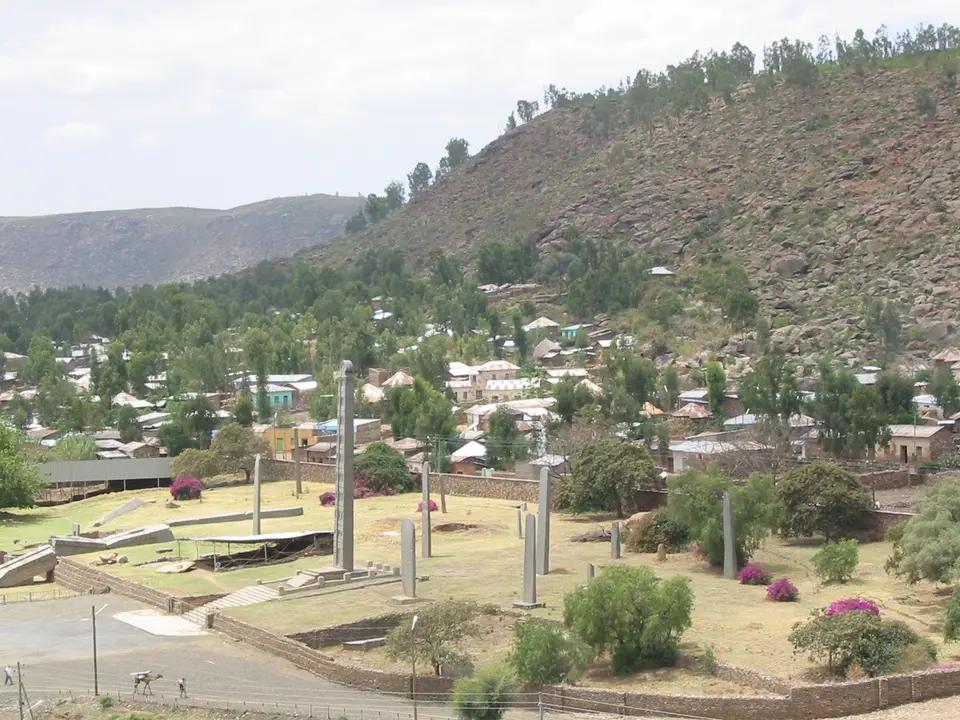
Across the town survive the monolithic granite stelae (obelisks) carved during the 3rd and 4th centuries AD to mark the underground royal tombs of the pre-Christian Aksumite elite. Quarried in the hills several kilometres away and dragged to the Northern Stelae Park, these monuments evolved from rough boulders and plain dressed granite shafts into towering multi-storey architectural representations. The carvings reproduce classic Aksumite building technique in solid granite: alternating courses of stone and recessed bays alongside false doors and windows, as well as projecting square corner beams and round bosses known as monkey-heads, originally topped by cast metal discs affixed to their faces.
Three giant monoliths dominate the Northern Stelae Park. The Great Stele, the largest monolithic obelisk humans ever attempted to erect, measures 33 metres (108 ft) in length and lies broken on the ground where it fell, probably during the process of erection, crushing the tomb complex beneath it. Nearby stands the 24-metre (79 ft) Obelisk of Axum, carved to represent a nine-storey Aksumite tower, which Italian occupying forces seized in October 1935 and broke into five pieces in 1937 to ship to Rome during the Second Italo-Ethiopian War; following a 1947 United Nations agreement, Italy returned the segments in April 2005 and covered the transfer expenses, and UNESCO reinstalled and unveiled the monument on 4 September 2008. Standing beside it at the entrance to the park is the 24-metre (over 23 m) King Ezana's Stele, accompanied by three further carved stelae measuring 18.2 m (60 ft) and 15.8 m (52 ft) alongside 15.3 m (50 ft) high, while the Gudit Stelae field to the west contains 4th-century tombs.
From King Ezana's Conversion to the Ark of the Covenant and Imperial Coronations
Before adopting Christianity in the 4th century, Aksumite kings erected rows of monumental granite thrones inscribed in Sabaean and Ge'ez alongside Ancient Greek to celebrate military victories and honour pre-Christian deities including Mahram and Astar alongside Baher and Madr. Preserved in its own shelter, the trilingual Ezana Stone, often compared to the Rosetta Stone, records the campaigns of King Ezana alongside inscriptions attributed to Ousanas and Kaleb together with his son Wazeba, including Ezana's dedication of a throne at Sado. When the merchant Cosmas Indicopleustes visited during the early 6th century's second decade, he described the four-towered royal palace adorned with bronze unicorn statues, an architectural tradition visible today in the 4th-century Ta'akha Maryam palace and the 6th-century Dungur palace ruins (popularly called the Queen of Sheba's Palace) with their dressed granite corner blocks, stepped walls, and monumental staircases.
Following King Ezana's conversion to Christianity in the 4th century, Coptic monks memorialised at hilltop monasteries such as Abba Pentalewon and Abba Liqanos translated the Bible and the Book of Enoch into the Ge'ez language in the 5th and 6th centuries. After Arab conquests severed Red Sea contact with the Byzantine Empire and ecological deforestation strained local agriculture, an inscription by Hasani Dano'el records the subjugation of the Aksumite king in the 9th century, and political power shifted south before the city was sacked by Gudit in the 10th century.
Under the medieval Solomonic Dynasty, Aksum revived as the sacred coronation capital of the Ethiopian Empire, governed by the ecclesiastical Nebure Id. Nebure Id Yishaq of Aksum compiled the Kebra Nagast (referring to the city as Dabra Makadda), recounting how the biblical Ark of the Covenant and the Tablets of Stone were brought to Aksum, alongside land charters preserved in the Book of Axum. Restored by Dawit I, reigning in 1406, and used for the 1436 coronation of Emperor Zara Yaqob (where monarchs cut a symbolic cord held by the daughters of Aksum and were anointed on the ancient stone thrones as King of Zion), the five-aisled, seven-chapel Cathedral of Our Lady Mary of Zion was described in detail by Portuguese missionary Francisco Alvares in the 1520s before Adal leader Ahmad ibn Ibrahim al-Ghazi sacked and burned the city in 1535 (after Lebna Dengel dispersed 1,705 golden objects for safekeeping).
Rebuilt by Emperor Sarsa Dengel in 1580, burned during an Oromo raid in 1611 after the 1608 coronation of Susenyos I, and visited by Fernao Guerreiro, Pedro Páez, and Manoel Barradas, the present battlements of the Old Cathedral of Our Lady Mary of Zion were built by Emperor Fasilides in 1655 to 1665 (celebrated by his daughter Princess Yodit) and hosted the coronations of Iyasu I, crowned in 1693, and Emperor Yohannes IV on 12 January 1872. Later described by travellers Charles-Jacques Poncet in 1700, James Bruce (who noted 600 houses and credited Ptolemy III Euergetes), Wolde Selassie in 1794, Samuel Gobat, Wube Haile Maryam, James Theodore and Mabel Bent in February 1893, Augustus B. Wylde in 1897, and German archaeologist Enno Littmann in 1906, the precinct was expanded in 1955 when Emperor Haile Selassie built the neo-Byzantine New Cathedral of St. Mary of Zion (visited by Queen Elizabeth II) and Empress Menen Asfaw funded the Chapel of the Tablet, where a single guardian monk watches over the venerated Ark of the Covenant.
Navigating the Northern Stelae Field, Royal Tombs, and Maryam Tsion
Set in a walkable highland basin at 2,131 metres, Aksum's monuments fall into three geographic clusters: the central stelae park and cathedral precinct in town, the hillside royal tombs of King Kaleb to the northeast, and the Dungur palace and Gobadra quarry to the west.
- Northern Stelae Park, King Bazen's Tomb, and the Ezana Stone: Begin at the Northern Stelae Park to examine the 33-metre fallen Great Stele, the reinstalled 24-metre Obelisk of Axum, the standing 24-metre King Ezana's Stele, and the subterranean masonry chambers of the royal underground tombs built with dressed granite blocks and brick arches, along with the museum housing Aksumite coins and pottery. Walk east along the foot of May Oho hill past the May Sum reservoir (Queen of Sheba's Bath) to view the megalithic King Bazen's Tomb and the trilingual Ezana Stone pavilion.
- Our Lady Mary of Zion precinct and the Chapel of the Tablet: Directly across from the stelae field, enter the walled compound of Our Lady Mary of Zion to view the ancient Aksumite stone coronation thrones in the outer courtyard and the 1955 domed New Cathedral (open to both men and women), as well as the exterior of the fenced Chapel of the Tablet. Male visitors may also enter the 1665 Old Cathedral built by Emperor Fasilides and inspect the adjacent ecclesiastical museum.
- Dungur Palace, Gobadra Lioness, and regional highland logistics: Follow the western road out of town past the 4th-century Gudit Stelae field to walk the multi-room granite foundations and stepped staircases of the 6th-century Dungur Palace, then hike 2 km (1.2 miles) further west into the granite boulder hills of Gobadra to see unfinished stelae in the ancient quarry and the rock carving known as the Lioness of Gobedra. Check regional travel conditions in Tigray before planning, and pair your route with our UNESCO World Heritage Atlas and our Asmara highland guide to the north.
