


























Quick Field Data
- UNESCO Inscription: 1978 (placed on the List of World Heritage in Danger in 1996 and removed in 2017 after species recovery) · Natural Criteria (vii), (x)
- Scale & Footprint: Encompasses the highest serrated ridges of the Simien Massif up to 4,430-metre Buahit Pass and Ras Dashan, bounded by a 35-kilometre northern cliff wall dropping 1,500 metres
- Access & Ticketing: Administered from park headquarters in Debarq under the National Reserve Act; all trekkers and vehicles must register at Debarq and travel with accredited park scouts and local guides
- Arrival Logistics: Situated within Ethiopia's Amhara Region across the North Gondar Zone, 120 kilometres north of Gondar along the mountain road linking Debarq to Buahit Pass and Mekane Berhan
Paleogene Flood Basalts and the Mayshasha Catchment
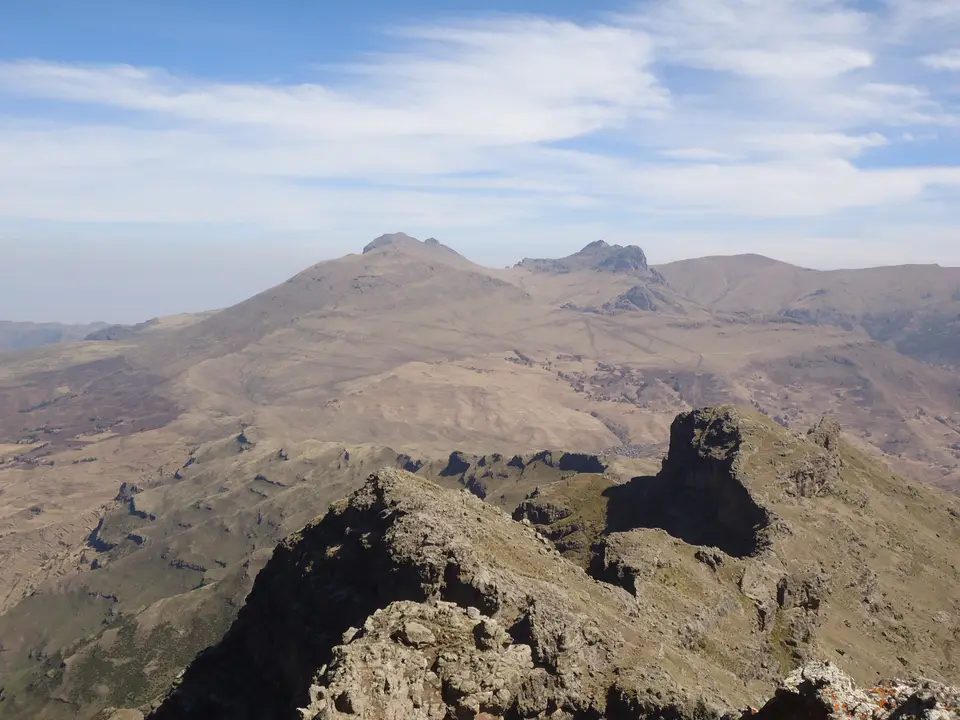
Simien National Park occupies the western flank of the Simien Massif within Ethiopia's Amhara Region across the North Gondar Zone, situated 120 kilometres north of Gondar (in historic Begemder province). The massif began forming roughly 30 million years ago during the Paleogene period, when voluminous volcanic flood basalts erupted across the northern Ethiopian plateau to build an immense shield volcano that includes Ras Dashan, the highest summit in Ethiopia. Over subsequent millions of years, heavy rainfall and fluvial incision carved the undulating basaltic tableland into a labyrinth of serrated peaks, deep canyons, and sheer northern escarpments that drop 1,500 metres vertically and stretch for 35 kilometres above the rugged canyon-like lowlands, a topographic relief frequently compared to the Grand Canyon in the USA.
Because the underlying Simien rock consists of heavily perforated basalt, the high plateau acts as a natural sponge and catchment basin for the northern highlands. Fed by two distinct annual rainy seasons, surface runoff and basalt springs converge into the Mayshasha River, which bisects the national park from north to south and sustains lush riparian corridors through the dry months. This dramatic 1,500-metre vertical drop organizes the park's flora into three sharp altitudinal vegetation belts across the Eastern Afromontane biodiversity hotspot and the Afroalpine Centre of Plant Diversity.
Between 1,900 and 3,000 metres, the montane forest belt shelters East African juniper (Juniperus procera) and African olive (Olea africana) alongside African redwood (Hagenia abyssinica), fig (Ficus), and waterberry (Syzygium guineense), above an understorey of cocona (Solanum sessilistellatum), Abyssinian rose (Rosa abyssinica), yellow primrose or cowslip (Primula verticillata), and stinging nettle (Urtica). Rising from 2,700 to 3,700 metres is the ericaceous or subafroalpine belt, once cloaked between 3,000 and 3,800 metres by dense forests of St. John's wort (Hypericum) that have nearly vanished, and today dominated by moss- and lichen-draped tree heath (Erica arborea). Above 3,700 metres up to 5,433 metres stretches the open afroalpine grassland and moorland belt, punctuated by towering giant lobelia (Lobelia rhynchopetalum), everlastings (Helichrysum), lady's mantle (Alchemilla), and cushions of Grimmiaceae moss.
Walia Ibex Precipices and Ethiopian Wolf Moorlands
These isolated sky-island habitats support 21 large mammal species, led by four flagship mammals endemic to the Ethiopian Highlands. Clinging to the 1,500-metre northern cliff ledges is the endangered Walia ibex (Capra walie), an endemic wild mountain goat restricted to the Simien Mountains and found nowhere else on earth. Across the open afroalpine tussock grasslands and heathlands roam massive troops of the grazing Gelada baboon (Theropithecus gelada) and the endangered Ethiopian wolf (also known as the Simien fox, Canis simensis), the rarest canid species in the world, while the northern montane woodland slopes shelter Menelik's bushbuck (Tragelaphus scriptus meneliki). They share the ridges and gorges with the Anubis baboon and Hamadryas baboon, black-and-white colobus monkey, golden jackal, spotted hyena, leopard, caracal, serval, wild cat, rock hyrax, common duiker, and cliff-dwelling klipspringer.
Small-mammal and avian endemism is equally pronounced across the plateau. A 2015 scientific expedition recorded 11 rodent species and two shrew species across the massif, all endemic to the Ethiopian Plateau and seven observed only in the Simien Mountains, including the Abyssinian grass rat (Arvicanthis abyssinicus) and Bailey's shrew (Crocidura baileyi), alongside a possible new shrew species in the genus Crocidura. Overhead, the park forms a core Important Bird Area within the Central Ethiopian Highlands Endemic Bird Area, supporting up to 400 bird species across the wider mountain ecoregion and more than 50 core cliff species. Among the raptors riding the canyon thermals are the bearded vulture (lammergeier, soaring on a 3-metre wingspan), Rüppell's vulture, Verreaux's eagle, tawny eagle, augur buzzard, lanner falcon, Eurasian kestrel, and thick-billed raven, while the woodlands hold the Abyssinian woodpecker, black-winged lovebird, and Ethiopian black-headed oriole.
Despite its rugged terrain, farmers and pastoralists have lived and farmed across the Simien highlands for at least 2,000 years, with agricultural clearing beginning on gentle highland valley slopes before expanding onto steep basalt precipices. Protected in Ethiopia as a national park in 1969 through the fieldwork of warden Clive Nicol (who chronicled his experiences in his 1971 book From the Roof of Africa) and inscribed among the first UNESCO World Heritage Sites in 1978, the reserve soon faced severe ecological stress from expanding arable land, wood cutting, livestock overgrazing, and an unpaved road graded directly from Debarq through park villages over the 4,430-metre Buahit Pass to Mekane Berhan (10 kilometres beyond the park boundary). Serious declines in the Walia ibex and Ethiopian wolf populations led to Simien National Park being placed on the List of World Heritage in Danger in 1996. Over the next two decades, park boundary revisions and expansions, livestock management, environmental education, and voluntary community resettlement programmes (though debated by critics as green colonialism replacing traditional practices with an eco-tourism economy) stabilised the flagship mammal populations, allowing UNESCO to remove the park from the Danger List in 2017. Adequate financial support for local livelihood alternatives and cooperative management with highland villages remains essential to prevent overgrazing and maintain the ecological integrity of the Afroalpine grasslands and montane forests.
Trekking the Northern Escarpment from Debarq to Buahit Pass
Exploring Simien National Park follows the dramatic edge of the 35-kilometre northern cliff wall, where high-altitude footpaths and the unpaved mountain road trace the rim from Debarq toward the 4,430-metre Buahit Pass and Ras Dashan. The cliffs drop sheer. Walking across these open sky-island ridges allows trekkers to experience the rapid shift from shady juniper and redwood valleys up into the windswept giant lobelia moorlands above the clouds.
- Entry and Route from Gondar and Debarq: Drive 120 kilometres north from Gondar to the administrative headquarters in Debarq to pay entry fees, pick up your mandatory armed park scout, and enter the western ridge of the massif. Begin your acclimatisation walk in the montane and subafroalpine zone between 1,900 and 3,700 metres, where lichen-draped tree heath (Erica arborea), East African juniper (Juniperus procera), African olive (Olea africana), and African redwood (Hagenia abyssinica) frame your first views down into the eroded basalt gorges and the valley of the Mayshasha River.
- Tickets, Interiors and Viewpoints along the Northern Cliff Wall: Follow the rim trails eastward across the Mayshasha River catchment toward the 1,500-metre vertical precipices of the northern escarpment, scanning the basalt ledges for Walia ibex and klipspringers while watching troops of Gelada baboons dig for roots among giant lobelias (Lobelia rhynchopetalum) and yellow primroses (Primula verticillata). Continue ascending into the afroalpine zone above 3,700 metres toward the 4,430-metre Buahit Pass and Ras Dashan to search the open moorlands for the Ethiopian wolf (Canis simensis) and 3-metre-wingspan bearded vultures riding the cliff thermals alongside Rüppell's vultures and Verreaux's eagles.
- Timing and Onward Connections across the Amhara Highlands: Schedule your Simien trek between October and May after the two rainy seasons subside, when clear skies expose the canyon lowlands and freezing night temperatures replace summer downpours, and coordinate camp logistics in Debarq to support local village guides and mule handlers along the unpaved mountain corridor toward Mekane Berhan. From Debarq or Mekane Berhan, link your highland expedition with Gondar and other East African mountain sanctuaries in our UNESCO World Heritage Atlas.
