


























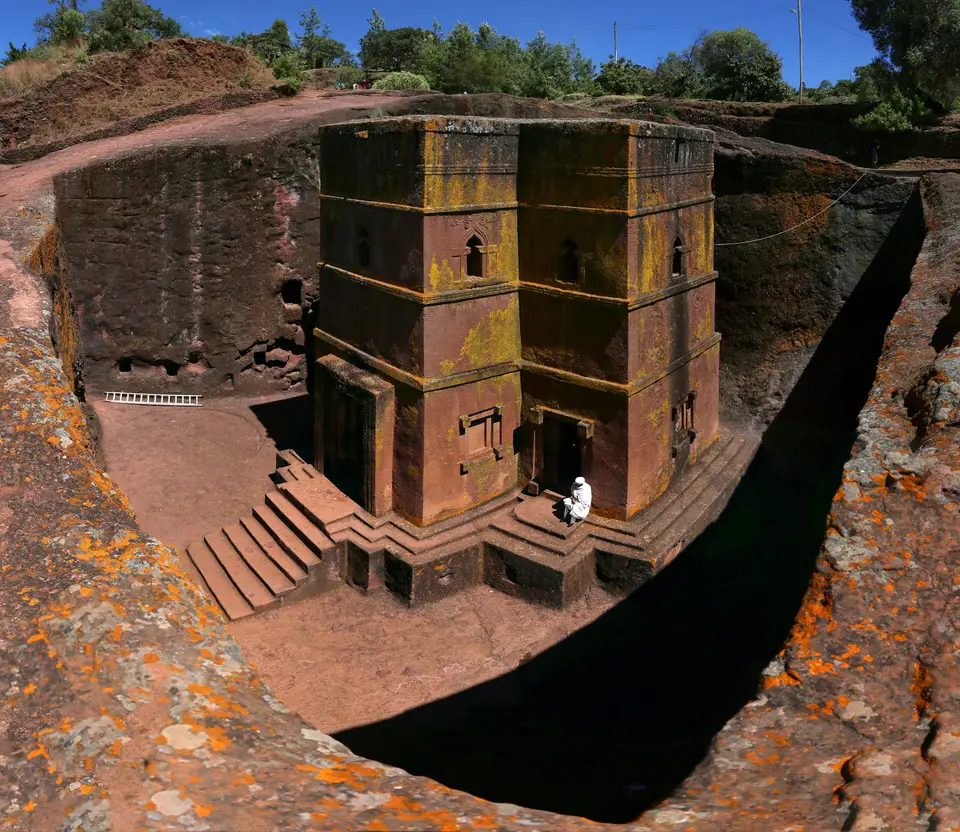
Quick Field Data
- UNESCO Inscription: 1978 · Criteria (i), (ii), (iii)
- Scale & Footprint: 11 medieval rock-hewn monolithic and semi-monolithic churches linked by deep basalt trenches and drainage ditches with subterranean tunnels at 2,480 metres (8,140 ft) in the Amhara Region
- Access & Ticketing: Multi-day site passes are purchased at the central ticket office in Lalibela town; shoes must be removed before stepping onto the carpets of every church interior
- Arrival Logistics: Situated at 2,480 metres in the western Ethiopian Highlands in the Amhara Region, surrounded by the traditional two-storey stone Lasta Tukuls of Lalibela town
Subtractive Basalt Engineering, Top-Down Excavation, and the New Jerusalem Layout
High in the western Ethiopian Highlands set around 2,480 metres (or 8,140 ft) above sea level, the 11 medieval Rock-Hewn Churches of Lalibela are not built upward from quarried stone blocks; instead, they were carved downward by subtraction directly into the living red scoriaceous basalt of the mountain slope. Living rock becomes sacred architecture here. Commissioned during the late 12th and early 13th centuries under King Gebre Meskel Lalibela (reigned ca. 1181 to 1221 AD) of the Agew Zagwe (Zagwa) dynasty, which had founded the highland town traditionally known as Roha in 1137 AD following the decline of the Aksum Empire, the sanctuary was conceived to recreate the holy city of Jerusalem as a symbolic 'New Jerusalem' once 12th-century Muslim conquests blocked Christian pilgrimage routes to the historic Holy Land.
To transform the volcanic hillside of Roha into this New Jerusalem, royal craftsmen organised the archaeological site around a rock-cut watercourse named the river Jordan. Five churches were excavated on the northern bank of the rock-cut river Jordan, five churches were carved south of the river, and the eleventh church, Biete Giorgis (Biete Ghiorgis, House of St. George), was chiselled into an independent pit to the west, with deep perimeter trenches and ceremonial passages alongside a system of tunnels connecting the churches within each group. Even the surrounding topography of Lalibela was given biblical names matching the sacred geography of Jerusalem, turning a walk through the rock-cut trenches into a physical pilgrimage across the Holy Land.
The subtractive engineering process required extraordinary three-dimensional precision because space was created entirely by removing rock from top to bottom. Using only basic hand tools of hammers and chisels, workers first traced the perimeter footprint on the bare scoriaceous basalt and excavated deep vertical trenches surrounding the monolithic and semi-monolithic blocks. Once the exterior roofs and string courses together with mouldings and doors alongside windows were shaped from the top downward, masons chiselled into the interior blocks to hollow out the columns and arches as well as aisles and various floors from the ceiling down to the ground level. Because rock removed by a chisel could never be replaced, every interior pillar and window lattice had to be planned in advance before excavation began at the roof level.
Out of the 11 rock-hewn churches, 4 are strictly free-standing (monolithic), completely detached from the surrounding mountain on all four sides, while 7 share a structural rock face with the surrounding basalt mountain from which they were hewn. To protect these sunken volcanic courtyards from highland rains, the builders completed the gigantic excavation through a deep network of drainage ditches alongside rock trenches and ceremonial passages, several of which open into hermit caves and catacombs cut into the surrounding trench walls.
Three Construction Phases and the Eleven Churches Across the River Jordan
While local tradition holds that King Gebre Meskel Lalibela received a vision in which Christ guided him through Jerusalem prior to his accession to the throne and that it took 24 years to build all 11 rock-hewn churches, archaeological evidence indicates that the structures evolved into their current form across three construction phases, altering and incorporating preexisting rock features into a unified Christian pilgrimage sanctuary. This multi-phase sequence explains why fortified defensive trenches and courtly rock halls sit side by side with basilican churches modelled on earlier Aksumite timber-and-stone construction.
North of the river Jordan lies the five-church northern cluster, anchored by Biete Medhane Alem (Biete Medhani Alem). With its five aisles and monumental exterior colonnade standing inside a deep rock trench, Biete Medhane Alem is widely regarded as the world's largest monolithic church. Connected by rock-cut passages is the central courtyard of Biete Maryam (Bet Mariam), famed for its colourful mural paintings of geometrical designs and biblical scenes, flanked by Biete Meskel and Biete Denagel. Completing the northern group is Biete Golgotha Mikael (Bet Golgotha), whose interior walls preserve carved human figures in bas-relief.
South of the river Jordan, the five-church southern cluster includes Biete Amanuel and Biete Qeddus Mercoreus (Biete Mercoreos) alongside Biete Lehem together with Biete Abba Libanos and Biete Gabriel-Rufael (Biete Gabriel Rafael). While most of the eleven monuments likely functioned as Christian churches from their initial excavation, architectural historians note that both Biete Gabriel Rafael and Biete Mercoreos may originally have functioned as royal residences before being adapted for liturgy. Across both clusters, horizontal mouldings and string courses divide the larger structural rock shapes into smaller sections, giving each church a distinct architectural profile while echoing the stepped stone courses and projecting window frames of classical Ethiopian highland architecture.
Standing independently to the west of the northern and southern clusters, yet connected to the others by a system of deep rock-cut trenches, is the eleventh church, Biete Giorgis (Biete Ghiorgis, House of St. George). Carved downward into a deep square pit of red scoriaceous basalt, Biete Giorgis features a cruciform plan shaped like a Greek cross rising from its sunken courtyard floor. Recognised among the initial 1978 UNESCO World Heritage properties, the churches face complex modern conservation challenges: in 2008, with funding from the EU, 4 massive temporary shelters were erected to cover five of the churches, though their heavy weight now poses structural risks that Ethiopia's ARCCH (Authority for Research, Conservation of Cultural Heritage) has sought to address, alongside restoration projects funded by the American Embassy at Bet Gabriel-Rafael and Bet Golgotha-Mikael in coordination with the local church committee.
Navigating the Trenches, Tunnels, and Pilgrim Ceremonies Today
Far from being a silent ruin, Lalibela remains a living high place of the Ethiopian Orthodox Christian Church and a focus of pilgrimage for Coptic and Ethiopian Orthodox Christians since the 12th century, set beside a traditional village of circular two-storey houses built from red volcanic stone in the traditional circular style called Lasta Tukuls. Used daily for worship and prayer and serving as a home to clergy, the trenches and courtyards fill with white-robed worshippers during major religious festivals such as Timkat and Genna, when chanting and ceremonial drums echo off the vertical basalt walls.
- Northern cluster entry from Biete Medhane Alem to Bet Golgotha: Purchase your entry pass at the main ticket gate and descend into the northern trench system at Biete Medhane Alem to walk around its freestanding monolithic exterior and through its five-aisled interior. Follow the connecting rock trenches into the courtyard of Biete Maryam (Bet Mariam) to inspect its colourful paintings of geometric designs and biblical scenes alongside Biete Meskel and Biete Denagel, before entering Biete Golgotha Mikael (Bet Golgotha) to view the human figures carved in bas-relief.
- Subterranean tunnels of the Southern cluster and Biete Giorgis: Cross the rock-cut river Jordan to enter the southern church group at Biete Gabriel-Rufael, then bring a small pocket torch to walk through the dark rock-hewn tunnel system linking Biete Amanuel and Biete Qeddus Mercoreus with Biete Lehem and the cliff-backed facade of Biete Abba Libanos. Conclude your circuit at the independent western pit of Biete Giorgis, admiring its cruciform roof from the upper cliff rim before descending through the access trench to its courtyard floor.
- Highland altitude, festival timing, and liturgical etiquette: Plan your visit during the dry highland season, which includes the pilgrimage celebrations of Genna and Timkat, and allow two full days to explore the 11 churches at an altitude of 2,480 metres (8,140 ft). Wear easily removable shoes and bring clean socks, as footwear must be left outside every church door, and walk respectfully around clergy and pilgrims at prayer. Compare Lalibela with the world's other earliest inscribed monuments in our UNESCO World Heritage Atlas.
