


























Quick Field Data
- UNESCO Inscription: 1980 · Criteria (ix), (x) · Included on the Danger List from 1984 to 1992 and since 1996
- Scale & Footprint: 512,736 hectares (roughly 4,900 to 5,200 km2) surrounded by a 544,943-hectare buffer zone across three adjacent hunting domains within the 1,470,000-hectare Garamba Complex
- Access & Ticketing: Managed by African Parks in partnership with Congolese conservation agency ICCN (Institut Congolais, Conservation de la Nature) since 2005; entry and ranger-escorted safaris require advance authorisation
- Arrival Logistics: Situated in Haut-Uélé Province in northeastern Democratic Republic of the Congo along the South Sudan border, reached by charter flight to Nagero station
Biogeographical Transition, Fire-Maintained Savannahs, and Gallery Forests
Positioned in Haut-Uélé Province in the northeastern corner of the Democratic Republic of the Congo against the international frontier with South Sudan, Garamba National Park encompasses 512,736 hectares at the heart of the 1,470,000-hectare Garamba Complex. Surrounded by a formally designated buffer zone of 544,943 hectares extending up to 20 km into the three contiguous hunting domains of Gangala-na-Bodio and Azande alongside Mondo-Missa, the reserve protects one of Central Africa's last continuous forest-savannah mosaic landscapes. Two great biomes meet here. Lying directly across the ecological transition zone between the moist Guineo-Congolian equatorial forest belt to the south and the drier Guinean-Sudanese (Sudanian) savannah to the north, the park unites species from both biogeographical regions.
Unlike the closed-canopy rainforests of the central Congo Basin, approximately 30% of Garamba consists of vast, undulating open grasslands forming the sole extensive open savannahs across the northern part of the Democratic Republic of the Congo. Driven by seasonal flooding, herbivory, and natural bushfires, the savannah grasses grow up to 3 metres (10 ft) tall during the wet season before drying and burning back to nourish fresh shoots across low-density acacia plains. Intersecting these open grasslands is a dense hydrological network of permanent rivers, seasonal marshes, papyrus wetlands, semi-deciduous woodlands, and ribbon-like gallery forests that trace the watercourses across the plateau.
This habitat mosaic supports more than 150 mammal species (with 138 formally recorded in park surveys), 459 bird species (including 286 core savannah and wetland species recognized by BirdLife International as an Important Bird Area), 83 reptile species, and 43 amphibian species. Along the rivers and papyrus marshes, massive pods of Common Hippopotamuses share waterholes with African buffaloes and giant forest hogs alongside various antelope, while secretarybirds stride across the open plains and pangolins or primates together with leopards inhabit the gallery forests. Recognised since 2005 as a Lion Conservation Unit together with the Domaine Chasse Bili Uere, the park's savannahs and woodlands sustain prides of lions alongside hyenas.
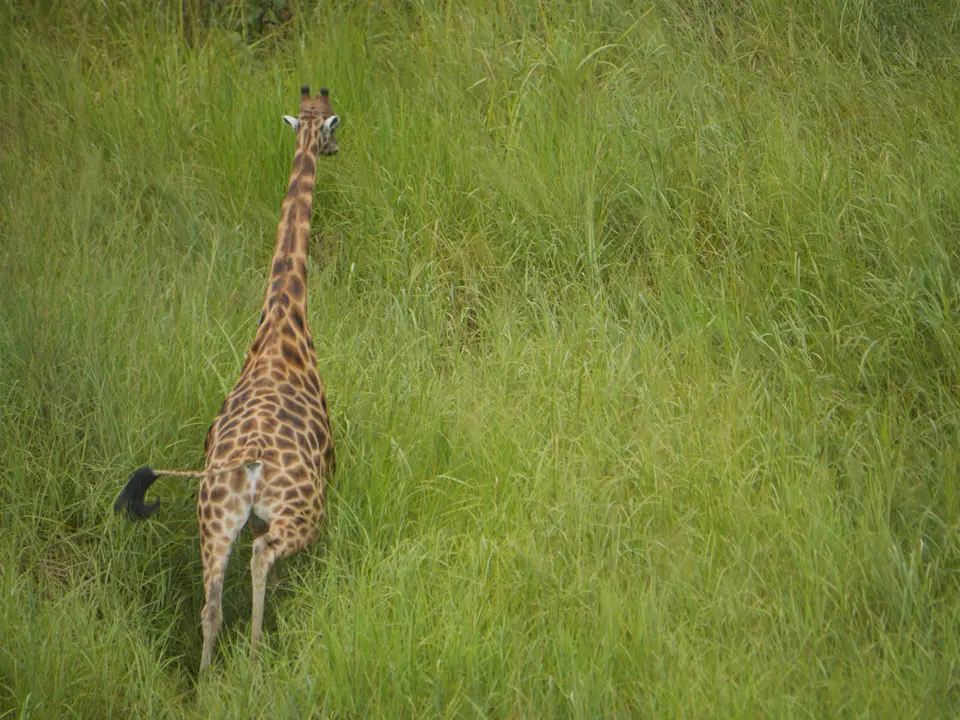
Two flagship megafauna populations define Garamba's global scientific importance. First, the park protects the Democratic Republic of the Congo's only surviving population of giraffes, belonging to the rare Kordofan subspecies, which browse the scattered savannah acacias. Second, Garamba's elephants represent a unique natural hybrid between the larger African bush elephant of the savannahs and the smaller African forest elephant of the Guineo-Congolian basin, demonstrating the evolutionary overlap of the two biomes in their physical stature and behaviour.
From 1938 Establishment to Anti-Poaching Warfare and Rhino Reintroduction
Established in 1938 as one of Africa's oldest national parks, Garamba was inscribed on the UNESCO World Heritage List in 1980 under Criteria (ix) and (x) for its intact savannah-forest dynamics and its role as the last wild refuge of the northern white rhinoceros alongside African elephants and hippopotamuses as well as Kordofan giraffes. By the mid-1980s, however, commercial poaching reduced the northern white rhinoceros population to just 15 individuals, prompting UNESCO to place Garamba on the UNESCO Danger List from 1984 to 1992. International conservation support from the Frankfurt Zoological Society, the World Wildlife Fund, the International Union for Conservation of Nature, and the International Rhino Foundation helped recover rhino numbers to between 20 and 25 animals in 2003 and 2004 and allowed the park's brief removal from the Danger List in 1992.
Regional armed conflict soon reversed those gains. Between 1991 and 1993, some 50,000 Sudanese refugees displaced during fighting involving the Sudan People's Liberation Army in the Second Sudanese Civil War settled along the park's perimeter, triggering a surge in armed bushmeat and ivory poaching. Between 1993 and 1995, park rangers fought 121 armed engagements with poachers and recovered more than 900 weapons between 1991 and 1996, supported by patrol vehicles funded in 1994 and ranger salaries funded in 1995 by the International Rhino Foundation. In February 1996, after poachers killed two northern white rhinos (a male named Bawesi and a pregnant female named Juliet), UNESCO returned Garamba to the UNESCO Danger List, where it has remained since 1996. Following Operation Thunderbolt in 1997 during the First Congo War, Ugandan insurgent groups including WNBF and UNRF (II) retreated into the park, and in the 2000s Joseph Kony's Lord's Resistance Army used the remote bush as a sanctuary, attacking the Nagero station in 2009 and claiming at least eight lives, among them two park rangers, while wounding 13 others.
Between 2007 and 2017, armed elephant poachers and militia groups killed at least 21 park rangers and Congolese soldiers defending the reserve, including 13 personnel killed between January 2015 and April 2017 whose sacrifice was chronicled by photojournalist Kate Brooks in The Last Animals and director Kathryn Bigelow in the 2017 documentary The Protectors: Walk in the Rangers' Shoes, honoured by the Tribeca Film Festival with the Disruptor Award in April 2017. Under this pressure, the northern white rhinoceros vanished from the wild, while Garamba's elephant population (which had numbered around 20,000 in the 1960s and 1970s) fell from 2,800 in 2011 to fewer than 2,000 by 2017 after poachers killed 22 elephants in 2012, 68 in two months in 2014, and 98 in 2015.
Since 2005, a co-management partnership between African Parks and Congolese agency ICCN (Institut Congolais, Conservation de la Nature), backed by the European Union and the United States Fish and Wildlife Service alongside the United States Agency for International Development, the Wildcat Foundation, and the World Bank, has overhauled law enforcement and aerial surveillance alongside community relations with pastoralist groups such as the Huda and Wodaabe (Mbororo). As a direct result, elephant poaching plunged from 98 killed in 2015 to just three in 2022, Kordofan giraffe numbers (which had peaked at 300 in 1976 and 356 in 1993 before dropping to 86 in 2003 and 2007 and a low of 38 in 2016) rebounded to 71 in 2022 and over 80 by 2024, and in 2023 conservationists moved 16 white rhinoceroses from a South African private game reserve into Garamba to restore the ecological role of mega-grazers across the savannah.
Field Access at Nagero Headquarters and Conservation Operations
Because Garamba lies in a remote frontier zone of Haut-Uélé Province along the South Sudan border and remains an active conservation security zone, independent overland travel is impossible. All visits must be arranged well in advance through African Parks and ICCN, centering on the fortified park headquarters and riverine station at Nagero along the southern boundary next to the Gangala-na-Bodio Hunting Reserve.
- Charter arrival and Nagero headquarters orientation: Coordinate your entry directly with African Parks to fly by charter aircraft into Nagero station on the southern edge of the park. Upon arrival at Nagero, visitors receive a comprehensive security and ecological briefing from ICCN and African Parks management, inspecting the operations centre where rangers and troops from the Congolese Armed Forces in the Democratic Republic of the Congo coordinate aerial monitoring and patrol teams across the 512,736-hectare core park and the surrounding 544,943-hectare hunting-domain buffer zone.
- Ranger-escorted savannah drives and hippo river overlooks: Accompanied by armed ICCN rangers, explore the southern savannah plains and gallery forest tracks radiating from Nagero to observe herds of hybrid African bush and forest elephants and African buffaloes alongside antelope, as well as the park's rebounding population of over 80 Kordofan giraffes browsing acacia crowns. Along the river bends and papyrus marshes, elevated viewing points look down onto dense pods of hippopotamuses, while guided walks near the perimeter highlight the 16 white rhinoceroses reintroduced from South Africa in 2023.
- Dry-season grass height and global atlas context: Plan any authorised field visit during the dry season between January and March after controlled and natural bushfires have cleared the 3-metre-tall wet-season savannah grasses, concentrating elephants and giraffes together with lions along the permanent river channels and making ground tracks passable. Review current regional travel advisories before planning, and use our UNESCO World Heritage Atlas to explore Central Africa's other endangered rainforest and savannah reserves.
