


























Quick Field Data
- UNESCO Inscription: 1987, extended in 2004 (Cultural, Criteria i, ii, iii, iv; ID 250bis).
- Scale & Footprint: 21.88-hectare serial designation (with a 16.715 ha buffer zone) in Tamil Nadu comprising three royal Chola temple complexes: the Brihadisvara Temple at Thanjavur (1003 to 1010 CE), the Brihadisvara Temple at Gangaikondacholapuram (completed 1035 CE), and the Airavatesvara Temple at Darasuram (completed 1166 CE).
- Access & Ticketing: Active Hindu living temples with daily, weekly, and annual rituals based on ancient Agamic texts; check the official site for dress codes, footwear rules, and sanctum worship schedules.
- Arrival Logistics: Located at 10.9795°N, 79.3126°E in Tamil Nadu roughly 340 km (210 mi) southwest of Chennai, with Darasuram situated about 40 km (25 mi) northeast of Thanjavur near Kumbakonam and Gangaikondacholapuram about 70 km (43 mi) northeast of Thanjavur.
Four and a Half Centuries of Chola Imperial Patronage and Living Agamic Worship
Spread across the state of Tamil Nadu in southern India roughly 340 kilometres (210 mi) southwest of Chennai at 10.9795 degrees north and 79.3126 degrees east, the Great Living Chola Temples encompass three royal Hindu sanctuaries constructed during the 11th and 12th centuries CE by monarchs of the Chola Empire, whose territory extended across southern India and into neighbouring islands. Having established a powerful monarchy in the 9th century CE at Thanjavur and in its surroundings, the Chola rulers governed for four and a half centuries, combining military conquest and efficient administration with cultural assimilation and the promotion of architecture, stone sculpture, painting, and bronze casting. Unlike ruined monuments whose liturgical life ended centuries ago, all three imperial shrines, comprising the Brihadisvara Temple at Thanjavur (recognised in 1987) and the Brihadisvara Temple at Gangaikondacholapuram (Gangaikonda Cholapuram or Gangaikondacholisvaram) and the Airavatesvara Temple at Darasuram (added in the 2004 extension under ID 250bis), remain active living temples where daily, weekly, and annual worship and rituals established over a thousand years ago on the basis of older Agamic texts continue as an inseparable part of community life.
The architectural sequence begins at Thanjavur, where the Chola king Rajaraja I, who reigned from 985 to 1012 CE, inaugurated the construction of the Brihadisvara Temple (known in royal inscriptions as Dakshina Meru) in his 19th regal year (1003 to 1004 CE) and consecrated the monument with his own hands in his 25th regal year (1009 to 1010 CE). One generation later, his successor Rajendra Chola I, who founded a new royal capital at Gangaikondacholapuram about 70 kilometres (43 mi) northeast of Thanjavur, finished building a second monumental Brihadisvara Temple there in 1035 CE. In the mid-12th century, King Rajaraja II constructed the third sanctuary, the Airavatesvara Temple at Darasuram on the outskirts of Kumbakonam (about 40 kilometres or 25 mi northeast of Thanjavur), beginning the complex around c. 1150 CE and completing it in 1166 CE.
Across all three monuments, investigated by art and architectural historians including S. R. Balasubrahmanyam (in his 1975 study of Middle Chola temples and 1979 study of Later Chola temples), P. V. Jagadisa Ayyar (1993), George Michell (1988), Krishna Chaitanya (1987), and Richard Davis (1997), the Chola emperors expressed royal Chola ideology and Tamil civilisation in the architectural conception of the Dravidan temple form. While each sanctuary is dedicated primarily to Lord Shiva, the complexes also reverentially display traditions of Vaishnavism and Shaktism alongside syncretic Hindu iconography and the devotional legends associated with the sixty-three Shaivism saints of the Tamil Bhakti movement known as the Nayanars.
Dravidan Vimana Engineering from Thanjavur to Gangaikondacholapuram and Darasuram
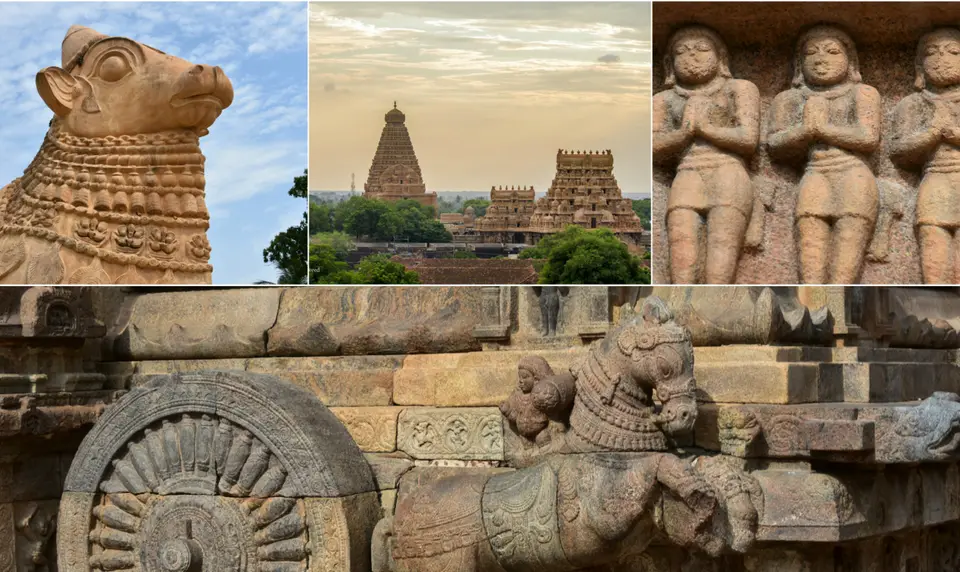
Together, the three complexes demonstrate the progressive development of high and late Chola Dravidan architecture across two centuries, fulfilling four World Heritage criteria: representing an artistic achievement in the pure Dravidan temple form (Criterion i), establishing at Thanjavur the first great Chola temple example followed by the architectural evolution witnessed in the two later sanctuaries (Criterion ii), bearing testimony to the architecture of the Chola Empire and Tamil civilisation in Southern India (Criterion iii), and embodying Chola royal ideology in stone and bronze (Criterion iv). At Thanjavur, the Brihadisvara Temple was built out of granite between 1003 and 1010 AD around a moat, enclosed within fortified walls added after the 16th century. Entered through monumental gopura gateways leading into a vast colonnaded prakara (corridor), the sanctum houses one of the largest Shiva lingas in India beneath a straight-edged granite vimanam (vimana) sanctum tower that rises as one of the tallest towers in South India. Although damaged in its history with some early artwork now missing and later mandapam halls added in subsequent centuries, the temple preserves royal inscriptions, frescoes, and stone sculptures related predominantly to Shaivism as well as Vaishnavism and Shaktism, and is famed as the location that commissioned the 11th-century brass Nataraja depicting Shiva as the lord of dance. Within the courtyard stand subsidiary shrines honouring Nandi, Amman, Ganesha, Subrahmanyar, Sabhapati, Varahi, Dakshinamurti, and Chandesrvarar.
At Gangaikondacholapuram (Gangaikonda Cholapuram), completed in 1035 AD under Rajendra Chola I, the architects adapted the Thanjavur model on a square plan while modifying the geometry of the sanctum tower. Rising 53 metres high, the curvilinear vimana of Gangaikondacholisvaram introduces recessed corners and an upward-curving silhouette that contrasts with the rectilinear granite pyramid at Thanjavur. This softer, gracefully contoured profile demonstrates the stylistic transition from the severe monumental geometry of the reign of King Rajaraja (Rajaraja I) to the fluid sculptural expression of the new imperial capital founded by Rajendra Chola I. In addition to the main shrine with its Shiva linga, axial Nandi, famed bronze sculptures, and smaller shrines and gopura (some of which were damaged or restored over subsequent centuries), the temple walls display carved stone statues of Vishnu, Durga, Surya, Harihara, and Ardhanishvara within their exterior niches.
At Darasuram near Kumbakonam, one among a cluster of eighteen medieval large Hindu temples in the Kumbakonam area and named after Indra's white elephant Airavata, King Rajaraja II created a stone complex topped by a 24-metre vimana and a stone image of Shiva. Although inscriptions indicate that the Airavatesvara Temple was originally much larger and possessed seven courtyards when completed in 1166 CE, only one courtyard survives today alongside the ruined gopuram while the main temple and associated shrines stand within the walled enclosure. Its celebrated front hall, the Rajagambhira Thirumandapam ("Royal Courtyard"), is fashioned as a stone chariot structure drawn by horses with long granite steps and carved pillars depicting major Vedic and Puranic deities including Indra, Agni, Varuna, Brahma, Vayu, Surya, Vishnu, Durga, Saraswati, Sri Devi (Lakshmi), Saptamtrikas, Ganga, Yamuna, Ganesha, Subrahmanya, Kama, and Rati, together with the narrative relief panels recounting the devotional legends of the sixty-three Nayanars. Today the Darasuram sanctuary draws Hindu pilgrims and worshippers throughout the year, uniting twelfth-century Chola courtly artistry, literature, and theatre with living Agamic ritual.
Circuit Logistics across Tamil Nadu
Covering 21.88 hectares (with a 16.715-hectare buffer zone) and inscribed on the UNESCO World Heritage List in 1987 and 2004, the three Chola temples form a compact circuit between Thanjavur, Kumbakonam, and Gangaikondacholapuram in Tamil Nadu and continue to draw large crowds of Hindu pilgrims and visitors throughout the year. Because visitors walk barefoot across the sun-warmed granite courtyards to witness daily, weekly, and annual Agamic worship, early morning or late afternoon visits provide the most comfortable conditions for studying the exterior sculptures, frescoes, and inscriptions. You can map the three temple complexes across southern India on our interactive world map. Barefoot pilgrims circle the granite shrines daily.
- Studying the granite vimana and shrines at Thanjavur: Walk through the gopura and colonnaded prakara of the Brihadisvara Temple at Thanjavur (Dakshina Meru) to examine the straight-sided granite vimanam tower, the royal inscriptions of Rajaraja I, and the courtyard shrines of Nandi, Amman, Ganesha, Subrahmanyar, Sabhapati, Varahi, Dakshinamurti, and Chandesrvarar.
- Comparing the 53-metre curvilinear tower at Gangaikondacholapuram: Travel 70 kilometres (43 mi) northeast of Thanjavur to the 1035 AD capital of Rajendra Chola I, comparing its 53-metre upward-curving vimana, recessed corners, bronze sculptures, and statues of Vishnu, Durga, Surya, Harihara, and Ardhanishvara with the severe tower at Thanjavur.
- Inspecting the stone chariot hall at Darasuram: Visit the Airavatesvara Temple on the outskirts of Kumbakonam (40 kilometres or 25 mi northeast of Thanjavur) to examine the 24-metre vimana, the horse-drawn stone chariot of the Rajagambhira Thirumandapam, and the carvings of the sixty-three Nayanars and Vedic and Puranic deities.
