


























Quick Field Data
- UNESCO Inscription: 1984, designated for pioneering South Indian rock-cut and structural temple architecture created under the Pallava dynasty.
- Scale & Footprint: Comprises roughly 40 sacred Hindu monuments carved into a charnockite granite ridge and coastal headland in Chengalpattu district, Tamil Nadu.
- Access & Ticketing: Administered across three main ticketed monument clusters (the Shore Temple, the Pancha Rathas, and the central granite hillock); check the official site for combined ticket rules.
- Arrival Logistics: Situated on the Bay of Bengal coast approximately 60 kilometres south of Chennai along the East Coast Road, sandwiched between the sea and a coastal lagoon.
Set along a wind-swept granite headland and sandy shoreline on the Coromandel Coast of Tamil Nadu, the Group of Monuments at Mahabalipuram (historically known as Mamallapuram) forms an extraordinary open-air workshop of early South Indian sacred art. Throughout India, the UNESCO World Heritage Atlas in 1984, the sanctuary comprises roughly 40 Hindu monuments sculpted during the seventh and eighth centuries AD under the patronage of the Pallava kings of Kanchipuram. Rather than building solely with quarried blocks, Pallava master sculptors carved cave temples (mandapas), freestanding monolithic chariots (rathas), and immense narrative bas-reliefs directly out of living charnockite gneiss and granite boulders, before transitioning to early structural stone masonry at the water's edge. Granite boulders crown the coastal ridge.
Pallava Maritime Patronage and the Evolution of South Indian Stone Art
Long before the Pallava rulers transformed the granite ridge into a royal sacred landscape, the coastal port was known to classical geographers and early Tamil poets as a thriving harbour for maritime trade across the Bay of Bengal and Southeast Asia. First-century AD navigation accounts such as the Periplus of the Erythraean Sea and Ptolemy's second-century geographical treatise refer to busy ports along this coast, while early Tamil literature describes merchant ships arriving with horses and northern goods. Roman coins of the fourth century AD alongside Chinese celadon and local Pallava coinage unearthed around the lagoon confirm sustained commercial links with both the Mediterranean world and East Asia.
The artistic transformation of the port began under the Pallava monarch Mahendravarman (Mahendravarman I, reigned 600 to 630 AD), a royal poet and patron who pioneered rock-cut cave architecture across Tamil Nadu, and reached full flower under his son Narasimhavarman (Narasimhavarman I, reigned 630 to 668 AD). Celebrated by the royal title Mamalla (the Great Wrestler), Narasimhavarman lent his name to Mamallapuram and expanded the port's sculptural programme during the mid-seventh century. Construction continued under his royal successors and culminated under Narasimhavarman II (known as Rajasimha, reigned 690 to 728 AD), who shifted architectural practice from excavating natural rock cliffs to erecting freestanding structural stone temples.
Across the four distinct monument categories preserved at Mahabalipuram, namely rock-cut cave mandapas, monolithic rathas, giant open-air narrative reliefs, and structural temples, visitors can trace the complete formal vocabulary of southern Hindu temple architecture taking shape in stone. Elements originally built in perishable timber and brick alongside stucco, such as barrel-vaulted sala roofs, horseshoe-shaped gable windows (kudus), octagonal shikharas, and seated lion-base pillars, were translated here into enduring granite. These seventh- and eighth-century architectural prototypes subsequently inspired the monumental medieval temples of South India as well as Hindu sanctuary design across Southeast Asia.
Pancha Rathas, the Descent of the Ganges, and the Shore Temple
At the southern end of the sandy coastal strip stands the Pancha Rathas (Five Chariots) ensemble, carved during the seventh century from a single southward-sloping granite outcrop. Named by later local tradition after the five Pandava brothers and their wife Draupadi from the Mahabharata epic, each monolith tests a different architectural floor plan and roof superstructure. The small square Draupadi Ratha imitates a curved thatch-roofed village hut dedicated to the goddess Durga; the Arjuna Ratha beside it introduces a two-tiered pyramidal vimana with an octagonal dome; the elongated Bhima Ratha rises over a rectangular plan topped by a barrel-vaulted roof; the three-storey Dharmaraja Ratha establishes the classic stepped pyramidal temple tower with dozens of sculpted deity niches; and the apsidal Nakula Sahadeva Ratha demonstrates the curved elephant-backed vault form alongside freestanding monolithic sculptures of an elephant, a lion, and Shiva's Nandi bull.
On the main granite hillock overlooking the town, Pallava sculptors transformed a natural vertical rock cleft measuring 27 metres long and 9 metres high into one of the largest narrative bas-reliefs in the world, known both as the Descent of the Ganges (Bhagiratha's Penance) and Arjuna's Penance. Over a hundred life-sized figures of deities, celestial flying beings, ascetics, hunters, monkeys, and two monumental elephants converge toward the central vertical fissure, where an upper water cistern once released cascades during festivals to simulate the sacred river Ganga descending from the Himalayas through the matted locks of Shiva. Nearby on the same ridge, ten rock-cut cave mandapas preserve masterpieces of seventh-century relief sculpture: the Varaha Cave depicts Vishnu in boar form rescuing the earth goddess from the cosmic ocean, the Krishna Mandapa shelters a pastoral scene of Krishna lifting the mountain to shelter villagers and cattle from Indra's storm, and the Mahishasuramardini Mandapa contrasts Vishnu reclining on the serpent Ananta with eight-armed Durga riding her fierce lion into battle against the buffalo-headed demon Mahishasura.
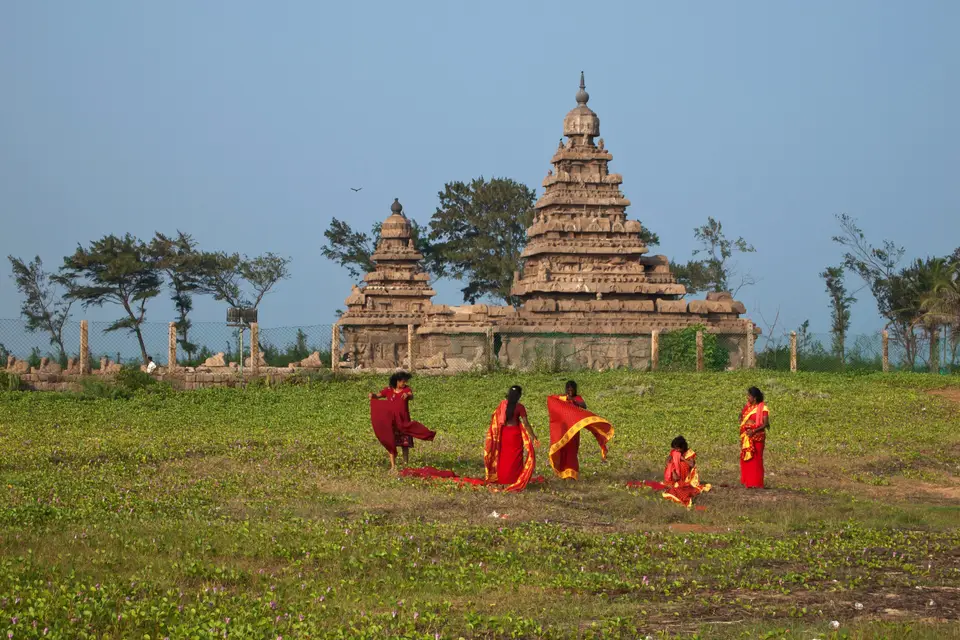
Directly on the sandy foreshore of the Bay of Bengal stands the eighth-century Shore Temple complex built by King Rajasimha. Constructed from dressed granite blocks rather than hollowed out of a boulder, the complex combines two stepped pyramidal towers, the larger five-storey eastern Kshatriyasimhesvara shrine facing the rising sun and a smaller western Rajasimhesvara shrine, linked by an intermediate flat-roofed mandapa where Vishnu reclines on living bedrock as Anantasayana. Surrounded by a perimeter wall topped with rows of seated Nandi bulls and accompanied by a rock-cut lion monolith containing a miniature Durga shrine in its chest, the Shore Temple functioned both as a royal sanctuary and as a maritime landmark known to European sailors as one of the Seven Pagodas.
Coastal Erosion, Tsunami Discoveries, and Touring the Granite Ridge
After the decline of Pallava rule in the ninth century, shifting coastal sands gradually buried the lower monuments until Scottish antiquarian William Chambers published the first European account in 1788. Since the late twentieth century, the Archaeological Survey of India has installed a protective granite boulder breakwater and planted casuarina trees along the beach to shield the Shore Temple from salt-laden winds and pounding monsoon surf. In December 2004, when the Indian Ocean tsunami receded before striking the Coromandel Coast, the sudden withdrawal of water and shifting beach sands uncovered seventh-century granite sculptures of lions and elephants near the Shore Temple alongside a submerged brick-and-stone ancient temple foundation at nearby Saluvankuppam north of the Tiger Cave.
Viewed together across the granite hillock and the sandy Bay of Bengal foreshore, the monuments of Mahabalipuram document the complete transition of early South Indian sacred architecture from excavated rock cliffs to freestanding stone masonry. In the cave mandapas and across the great open-air narrative relief wall, seventh-century sculptors infused hard charnockite stone with fluid movement, depicting divine myths, and naturalistic studies of elephants and deer alongside monkeys and ascetic life. At the southern rathas and the wave-washed Shore Temple, experimental roof forms and pyramidal towers established the enduring structural grammar of Tamil temple building.
Walking the full circuit of Mahabalipuram involves moving between the beachfront sanctuary, the central granite hillock, and the southern Pancha Rathas compound. Planning the walking sequence around the tropical coastal climate helps visitors appreciate the fine relief carvings in optimal shadow and light.
- Start at the Shore Temple and east-facing reliefs at dawn: Early morning sunlight illuminates the seaward facade of the Shore Temple and casts crisp sculptural shadow across the east-facing Descent of the Ganges rock wall before heat builds on the granite.
- Wear footwear that slips off easily: Although outer pathways across the hillock allow shoes, stepping inside sacred sanctums and onto certain monolithic plinths requires removing footwear, and bare granite grows extremely hot by midday.
- Explore the granite ridge beyond Krishna's Butterball: Follow the ridge path past the precariously balanced 250-tonne boulder known as Krishna's Butterball to reach the upper Olakkannesvara Temple, the Dharmaraja Mandapa, and the Trimurti Cave on the quieter northern slope.
