


























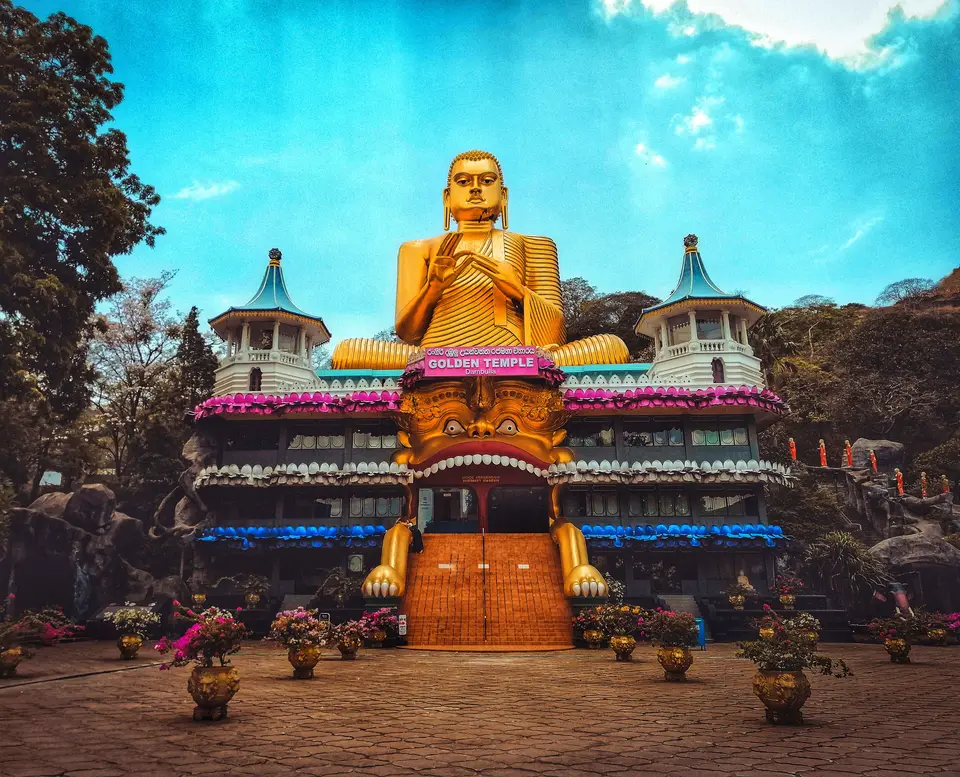
Quick Field Data
- UNESCO Inscription: 1991 (Cultural heritage site in Matale District, Central Province, Sri Lanka)
- Scale & Footprint: Five main cave shrines beneath a 150-to-160-metre overhanging granite rock, containing 2,100 square metres (23,000 square feet) of mural paintings and 153 to 157 statues
- Access & Ticketing: Administered by the Temple Authorities of Dambulla alongside Sri Lankan heritage bodies; check the official site for cave sanctuary admission tickets and modest dress requirements
- Arrival Logistics: Situated 148 kilometres east of Colombo, 72 kilometres north of Kandy, 43 kilometres north of Matale, and 19 kilometres southwest of the rock fortress of Sigiriya
Forest Monks, Exiled Kings, and Twenty-Two Centuries of Living Pilgrimage
Crowning the southern slope of a massive granite inselberg that rises 150 to 160 metres (520 feet) above the surrounding plains of Matale District in Sri Lanka's Central Province, the Rangiri Dambulla Cave Temple, known in Sinhala as Dam̆būlla Raja Maha Vihāraya, in Tamil as Tampuḷḷai Poṟkōvil, and internationally as the Golden Temple of Dambulla, is Sri Lanka's largest and best-preserved historic cave sanctuary. Throughout Sri Lanka, the UNESCO World Heritage Atlas in 1991 and located 148 kilometres (92 miles) east of Colombo, 72 kilometres (45 miles) north of Kandy, and 43 kilometres (27 miles) north of Matale, the site has served as a continuous centre of Buddhist monasticism and pilgrimage for 22 centuries.
Archaeological evidence from the nearby megalithic burial grounds at Ibbankatuwa, where human skeletons dating back roughly 2,700 years have been excavated, demonstrates that prehistoric Sri Lankans inhabited the region centuries before the arrival of Buddhism. Beginning in the 3rd and 2nd centuries BCE, forest-dwelling Buddhist monks occupied the natural caverns among the more than 80 documented rock shelters scattered around Dambulla Rock, carving a continuous horizontal drip ledge along the brow of the overhanging cliff to prevent rainwater from flowing into the interiors.
Royal transformation of the monastic caves into a monumental shrine complex began in the 1st century BCE during the Anuradhapura period (1st century BC to 993 AD), recorded in a 1st-century Brahmi inscription carved above the entrance to the first cave. When King Valagamba of Anuradhapura, also known as Vattagamani Abhaya, was driven from his capital by South Indian invaders, he found refuge inside the Dambulla caves under the protection of the monks for 15 years. Upon reclaiming the throne of Anuradhapura, the grateful monarch converted the natural rock shelters into walled temple sanctuaries. Over the following millennium, successive rulers enriched the complex, culminating in the Polonnaruwa period (1073 to 1250 AD) when King Nissanka Malla (Nissankamalla) gilded the cave interiors and commissioned or regilded some 50 to 70 statues in 1190, earning the sanctuary its title of Rangiri, "Golden Rock". During the 18th century, the rulers of the Kingdom of Kandy, most famously the Buddhist revivalist King Kirti Sri Rajasinha (1747 to 1782), carried out comprehensive restorations, adding new shrine caves and painting the rock ceilings in the distinctive Kandy school style, before arched brick colonnades and gabled white facades were added along the veranda in the 1930s and 1938.
The Five Sanctuaries, Kandy Ceiling Murals, and Polychrome Statuary
Unlike compartmentalised masonry temples, the five principal cave shrines of Dambulla rely on an open, undivided spatial hierarchy where rows of polychrome statues, carved directly from the living gneiss rock or modelled in brick, clay, and stucco, work in concert with 2,100 square metres (23,000 square feet) of tempera wall and ceiling paintings to guide devotees from one ritual focus to the next. Across the five caves stand 157 major sculptural figures, including 153 statues of Gautama Buddha in seated, standing, and reclining postures, three portrait statues of Sri Lankan monarchs alongside four statues of Hindu deities integrated into Sinhala Buddhist devotion, including Vishnu, Ganesha, and Saman.
Entering from the western end of the rock veranda, pilgrims step first into Devaraja lena, the "Cave of the Divine King", whose founding is commemorated by the 1st-century Brahmi inscription above the doorway. Filling almost the entire length of the dark chamber is a 14-to-15-metre monolithic statue of the reclining Buddha hewn directly out of the bedrock and repainted repeatedly down to the 20th century; at the Master's feet stands his devoted disciple Ananda, while near his head rises a shrine to the god Vishnu, revered in local tradition as having used his divine powers to fashion the caves. Next opens the second and grandest sanctuary, Maharaja lena, the "Cave of the Great Kings", which measures roughly 52 metres from east to west, 23 metres from the front wall to the rear rock face, and 7 metres at its highest vault. Inside stand 16 standing and 40 seated Buddha statues, including a rock-cut Buddha on the left attended by painted wooden statues of the Bodhisattvas Maitreya and Avalokiteshvara (Natha), alongside garlanded statues of the gods Saman and Vishnu, wooden and stone likenesses of the royal patrons King Vattagamani Abhaya (Valagamba) and King Nissanka Malla, a central stupa (dagoba), and a stone basin collecting water that drips perennially from a ceiling fissure even during dry months. Following the undulating contours of the bare rock vault overhead stretch 18th-century tempera murals portraying the life of the Buddha from the dream of Queen Mahamaya, the Temptation by the demon Mara, and the First Sermon to pivotal episodes from early Sri Lankan Buddhist history.
Passing into the third sanctuary, the Maha Alut Vihara or "Great New Monastery", visitors encounter a spacious chamber created under the patronage of King Kirti Sri Rajasinha between 1747 and 1782. Here 50 seated and standing Buddha statues and a painted portrait statue of Kirti Sri Rajasinha himself are framed by a ceiling covered in over 1,500 meditative Buddha figures painted in the classic Kandy palette of cinnabar red, yellow ochre, and black. Completing the sequence along the eastern terrace are the smaller fourth cave, the fourth and fifth cave shrines along the eastern veranda, which houses a large reclining Buddha surrounded by Hindu and Buddhist figures. Swallows swoop past the veranda at dusk.
Climbing Dambulla Rock and Viewing the Five Painted Caves
Travellers journeying into Sri Lanka's Cultural Triangle from Colombo or Kandy follow the gentle stepped stone path up the southern flank of Dambulla Rock, where troop monkeys and evening flocks of swallows gather along the cliff ledges and panoramic views open northward across the forested plains toward the 19-kilometre-distant monolith of Sigiriya. Because roughly 80 percent of the surviving paintings belong to the 18th-century Kandy schemes studied by scholar Senake Bandaranayake and stabilised after the initial 1960s cleaning through the 1982 to 1996 joint conservation initiative uniting UNESCO, the Temple Authorities of Dambulla, and the Cultural Triangle Project, followed by a 2003 UNESCO buffer-zone review, visitors remove shoes and hats before stepping onto the hand-cut stone paving of the active monastic veranda.
- The southern rock ascent and Sigiriya horizon viewpoint: Climb the rock-cut stairway up the gentle granite slope during the cooler hours of early morning or late afternoon, pausing on the open bedrock terraces below the 1938 white arched veranda to look out across the Matale plains toward the silhouette of Sigiriya Rock 19 kilometres away. Observe the ancient chiselled drip line running high along the granite brow and the 1st-century BCE Brahmi donor inscriptions carved into the stone lip.
- Devaraja lena and the vast expanse of Maharaja lena: Step inside Cave 1 (Devaraja lena) to examine the gold-painted soles and expressive drapery of the 14-metre rock-hewn reclining Buddha alongside Ananda and Vishnu. Move immediately into Cave 2 (Maharaja lena) to walk the 52-metre-wide sanctuary floor, inspecting the wooden statues of King Valagamba and King Nissanka Malla, the Maitreya and Avalokiteshvara bodhisattvas, the sacred dripping water vessel, and the sweeping 18th-century narrative ceiling composition of Mara's assault and early Sinhalese chronicles.
- Maha Alut Vihara (Cave 3), the fourth and fifth caves, and the lower museum: Spend time inside Cave 3 studying the statue of King Kirti Sri Rajasinha and the geometric textile-like ceiling patterns of 1,500 painted Buddhas characteristic of the 18th-century Kandy school, which retained excellent preservation across Vihara 2 and Vihara 3 during the 1982 to 1996 conservation survey. After viewing the compact interiors of the fourth and fifth caves, descend to the base of the hill to visit the modern museum and visitor facilities constructed outside the historical sanctuary zone.
