


























Quick Field Data
- UNESCO Inscription: 1982 (Cultural Criteria ii, iii, iv)
- Scale & Footprint: 180-metre granite column rising above terraced royal precincts together with hydraulic gardens in Matale District
- Access & Ticketing: Managed by the Central Cultural Government authorities of Sri Lanka; check the official site before travel for current foreign visitor pass categories and museum entry rules
- Arrival Logistics: Situated in the northern Matale District near Dambulla inside the Central Province, northeast of Colombo
Magma Core and the Fifth-Century Court of King Kashyapa
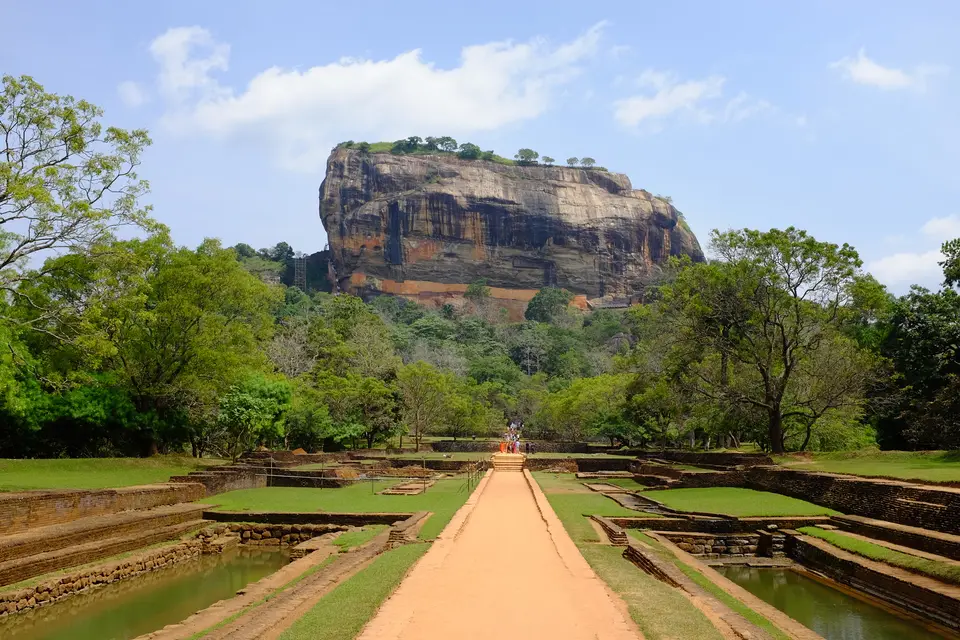
Rising abruptly above the dry-zone scrub forest of Sri Lanka inside the northern Matale District close to the town of Dambulla, the Ancient City of Sigiriya occupies the summit and surrounding plains of an eroded volcanic magma plug that towers 180 metres above the surrounding forest canopy. Listed in the UNESCO World Heritage Atlas in 1982 under cultural criteria ii, iii, and iv, this rocky inselberg, known locally as the Lion Rock, preserves the complete urban layout of a short-lived fifth-century capital constructed by King Kashyapa I, who reigned from 477 to 495 CE. Travellers arriving from Colombo to the southwest encounter a fortified royal complex where sub-surface hydraulic engineering, natural boulder architecture, classical Sri Lankan wall painting, and a sheer palace citadel remain clearly legible across both the western plains and the upper rock plateau. The cliff dominates the flat horizon.
Long before Kashyapa selected the inselberg for his royal seat, the surrounding rock shelters functioned as an ascetic woodland retreat. Archaeological excavations conducted across the site demonstrated that the natural caverns at the base of the cliff were inhabited in prehistoric times around 3,000 years ago and adapted into a Buddhist monastic refuge from the 3rd century BCE onwards. Numerous cave shelters along the western and northern slopes feature drip-ledges chiselled above their overhangs to divert rainwater, accompanied by donor inscriptions carved from the 3rd century BCE through the 1st century CE recording pious gifts of rock cells to the monastic sangha. Following the dynastic conflict recorded in the ancient chronicle, Kashyapa, born to King Dhatusena and a consort of non-royal rank, seized the throne in 477 CE, while the rightful heir Moggallana fled to southern India to raise an army. Anticipating his half-brother's return, Kashyapa relocated the royal capital from Anuradhapura to the defensible heights of Sigiriya. When Moggallana finally marched north in 495 CE, Kashyapa descended to the plains on his battle elephant; when his mount detoured around a marsh, his troops mistook the manoeuvre for retreat and scattered. Kashyapa took his own life on the field, and Moggallana returned the seat of government to Anuradhapura, handing Sigiriya back to the Buddhist monastic community, which occupied the site until the 13th and 14th centuries.
Hydraulic Geometry, Boulder Precincts, and the Western Water Gardens
Approaching the rock from the western moat reveals one of the oldest surviving landscaped garden complexes in Asia, organised symmetrically along an east-west axis and enclosed by earthen ramparts together with wide water-filled moats. Rather than treating the fortifications, pleasure gardens, as well as palace buildings as separate zones, fifth-century planners integrated them into a single geometric composition that steps progressively upward from the outer plain to the foot of the granite cliff. In 1831, a British officer from the 78th Highlanders, Major Jonathan Forbes, encountered the bush-covered summit while riding on horseback across the plains, sparking antiquarian interest that led archaeologist H. C. P. Bell to begin scientific clearing in the 1890s. The western precinct is divided into four distinct yet interlocking landscape forms:
- The Symmetrical Water Gardens: Divided into three principal walled enclosures along the western approach, these gardens contain rectangular bathing pools, islands linked by stone causeways, plus sunken limestone fountains fed by underground terracotta conduits connected to the man-made Sigiriya tank to the south. Because the southern reservoir sits at a higher elevation than the garden courts, gravity pressure still forces water through the perforated limestone fountain plates during the rainy season without mechanical pumps.
- The Miniature Water Garden: Located in the first section of the western precinct, this detailed court combines shallow angled pools, pebbled water channels, alongside brick pavilion foundations where courtiers could rest above circulating water channels during the dry heat of the central plains.
- The Asymmetric Boulder Gardens: Where the flat western plain meets the rising talus slope of the rock, the orthogonal geometry gives way to an organic maze of winding brick pathways, rock-cut staircases, as well as timber-framed pavilions anchored directly into huge natural gneiss boulders via carved post-holes and brick retaining walls.
- The Terraced Slopes: Rising above the boulder zone, brick-faced rubble retaining walls create stepped artificial terraces that carry the ceremonial stairway towards the northern cliff face while stabilizing the steep soil slopes against monsoon erosion.
Frescoes of the Western Cliff, the Mirror Wall, and the Lion Gate
Midway up the sheer western face of the rock, a spiral staircase leads into a sheltered concavity 140 metres long and 40 metres wide where the plaster originally carried a vast painted gallery of up to 500 female figures rising from banks of clouds. Today 22 paintings survive inside this protected pocket, together with further fragments in nearby caves, depicting richly jewelled women holding lotus blossoms and trays of flowers. While local folk tradition identifies them as Kashyapa's royal consorts or ladies-in-waiting proceeding toward a shrine, art historians including Senake Bandaranayake have interpreted them either as celestial nymphs scattering blossoms over the world below or as personifications of lightning and rain clouds tied to royal fertility symbolism. After vandals damaged several figures in October 1967, Italian restorer Luciano Maranzi arrived in 1968 to clean and consolidate the surviving pigments. Painted in rich reds, yellows, and greens over a smoothed lime plaster base mixed with rice husks and clay, the figures display delicate line shading that shares stylistic kinship with the contemporary paintings at Ajanta in India while retaining a distinct local court idiom.
Directly below the fresco overhang runs the Mirror Wall, a brick masonry gallery coated in a highly polished white lime plaster mixed with egg white, beeswax, together with wild honey that still gleams after 1,500 years. Between the 6th and the 14th centuries, visitors from across the island climbed to inspect the abandoned palace and scratched 685 poetic verses onto this plaster surface. Known collectively as the Sigiri Graffiti and deciphered by archaeologist Senerath Paranavitana, who also authored a celebrated 1972 study of the site, these short Sinhala poems record the astonishment of medieval travellers, soldiers, monks, alongside women who addressed the painted ladies directly in verse, providing an invaluable philological record of the evolution of the Sinhala language between the 8th, 9th, and 10th centuries. Following the gallery around the northern shoulder of the rock brings climbers to the Lion Platform, a broad brick and limestone terrace from which the entire rock takes its name. Here, a colossal brick and plaster lion once crouched against the cliff; visitors entered its open jaws and climbed through its throat to reach the summit. Only the two massive clawed forepaws and the stepped brick masonry between them survive today, flanking the modern iron staircases that scale the final vertical groove.
The Summit Palace and Practical Climbing Logistics
Covering roughly 3 hectares across the top of the rock, the summit plateau preserves the stepped brick foundations of Kashyapa's upper palace, laid out across undulating rock levels on the northern half while terraced gardens and cisterns occupy the lower southern half. At the eastern edge, where the cliff drops sheer toward the jungle and distant mountain ranges, sits a rock-cut royal throne carved directly into the living gneiss facing east. In Sri Lanka, the centre of plateau, a large rectangular rock-hewn pond collected monsoon rainwater to supply the upper court, supplemented by stone drainage channels etched across the bedrock.
Climbing from the outer moat to the summit requires steady footing along with careful heat management. Visitors should plan their route with the following practical considerations in mind:
- Entry and Route: Most travellers reach the site by road from Dambulla, or via private vehicle and intercity bus connections from Kandy and Colombo. The main ticket office and archaeological museum stand near the western outer moat, where visitors begin the walk through the Water Gardens before ascending through the Boulder Gardens.
- Tickets and Viewpoints: All foreign visitor tickets are issued at the official counter near the museum; check the official site for current rates before arrival. For an unobstructed panoramic view of Sigiriya Rock in its entirety, many hikers combine their morning climb of the citadel with an afternoon ascent of Pidurangala Rock, an adjacent monastic outcrop located immediately to the north.
- Timing and Onward Connections: Begin the climb as early in the morning as access permits to avoid intense midday solar radiation on the exposed iron stairs above the Lion Platform. Carry sufficient drinking water, wear gripped walking shoes suitable for polished limestone and metal rungs, and heed ranger warnings regarding wild honeybee colonies nesting beneath the cliff overhangs by keeping voices low as you pass the Lion Platform.
