Quick Field Data
- UNESCO Inscription: 2000 · Criteria (i), (ii), (iii)
- Scale & Footprint: 331 hectares encompassing 2,345 caves and niches, over 60 pagodas, 2,500 to 2,800 steles and nearly 110,000 Buddhist statues along a 1-kilometre Yi River gorge
- Access & Ticketing: Managed by the Longmen Grottoes Research Academy under strict visitor carrying-capacity limits; main visitor flow enters from the northern end of West Hill and crosses eastward
- Arrival Logistics: 12 kilometres south of Luoyang and 31 kilometres from Luoyang Beijiao Airport (LYA), with broader international connections via Zhengzhou Xinzheng International Airport (CGO) at 127 kilometres
Northern Wei and Tang Carving Campaigns Along the Yi River
Twelve kilometres south of Luoyang in Henan Province, the north-flowing Yi River, a tributary of the Luo River, cuts between two steep limestone ridges: Longmenshan on the west bank and Xiangshan on the east. Because those twin cliffs rise like traditional Chinese gate towers guarding the southern approach to Luoyang, ancient texts named the narrows Yique (Gate of the Yi River) before the later title Longmen (Dragon's Gate) took hold. Longmen ranks as one of China's three supreme Buddhist cave sanctuaries, alongside the Yungang Caves near Datong in Shanxi Province and the Mogao Caves near Dunhuang in Gansu Province. The sanctuary packs 2,345 caves and niches into just 1 kilometre of river gorge. These limestone chambers shelter roughly 100,000 to 110,000 Buddhist statues, many originally painted, ranging from miniature figures 25 millimetres (1 inch) tall to a 17-metre (57-foot) Vairocana Buddha. The gorge also preserves more than 60 pagodas and 2,500 to 2,800 inscribed tablets known as the Forest of Ancient Stelae.
Excavation and carving proceeded across four distinct historical campaigns from 493 to 1127, anchored to Luoyang's prestige as an imperial capital across 13 Chinese dynasties. Emperor Xiaowen inaugurated the first phase around 493 when he transferred the Northern Wei dynasty capital south from Datong to Luoyang, drawing patronage from emperors, nobles, generals and religious societies. More than 30 percent of surviving caves date from this era and embody the slender Central China Style. Regional strife disrupted work during a slower second phase between 524 and 626 across the Sui (581 to 618) and early Tang transitions. Buddhism then expanded dramatically in the third phase from 626 to 755 under Tang Emperor Gaozong and Empress Wu Zetian. This era generated 60 percent of all Longmen caves in the fuller, court-influenced Great Tang Style while adding open-air monastic temples now mostly reduced to ruins. A final declining phase continued through the late Tang and Northern Song (accounting for less than 10 percent of the total) before wars between the Jin and Yuan dynasties ended cave excavation.
Although Ming (1368 to 1644) and Qing (1644 to 1912) literati revived admiration for Longmen's epigraphy, twentieth-century upheaval inflicted heavy damage. After the fall of the Qing dynasty, Western collectors and souvenir hunters removed major stone reliefs during the early twentieth century. Two murals or procession panels now sit in the Metropolitan Museum of Art in New York and the Nelson-Atkins Museum of Art in Kansas City, Missouri. Japanese forces looted statues during the Second Sino-Japanese War, unrest struck again in the 1940s, and the Cultural Revolution saw many statue heads broken off. Legal preservation began under Article 22 of the 1949 constitution, with the Longmen Relics Care Agency opening in 1953 and a Conservation Office completing a site inventory in 1954. The State Council declared Longmen a protected national monument in 1961 and a state scenic zone in 1982. Later, the Luoyang governing body became the Longmen Grottoes Research Institute in 1990 and the Longmen Grottoes Research Academy in 2002. Today the Ministry of Culture management agency works with the Research Academy under Luoyang City regulations. Together they analyse cliff deterioration, run environmental monitoring, enforce tourist carrying-capacity caps and keep both West Hill and East Hill faithful to their historic condition.
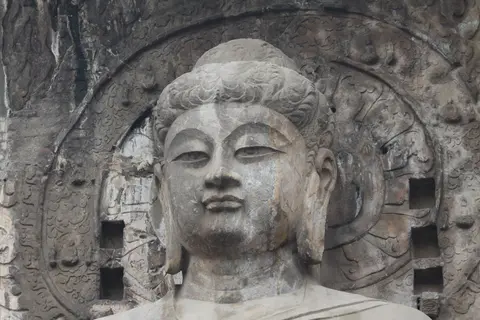
Guyangdong, Three Binyang Caves and the Medical Inscriptions
Pedestrian terraces along the West Hill (Longmenshan) enter from the northern gate and follow caves numbered sequentially north to south across fifty large and medium grottoes plus hundreds of smaller votive niches. Moving down this limestone gallery illustrates step by step how imported Central Asian Buddhist conventions merged with Chinese sculptural theory and brush calligraphy.
In the central-southern section of the West Hill floor sits Guyangdong (Old Sun Cave, also known as Shiku Temple), Longmen's oldest and largest Northern Wei cave, with initial carving dated as early as 478 and formal imperial patronage around 493 under Emperor Xiaowen. Cut on a horseshoe ground plan, Guyangdong centres on three monumental images: a central Sakyamuni Buddha flanked by Bodhisattvas carved with narrow, ascetic Northern Wei proportions and rhythmic layered robes. Across the northern and southern walls, donors packed two horizontal tiers of votive niches containing roughly 600 to 800 finely cut Northern Wei calligraphic inscriptions, recording artists' names, carving dates and donor prayers, making Guyangdong China's richest single cave archive of Northern Wei square-brush epigraphy.
Near the northern floor of the West Hill stand the Three Binyang Caves (North, Middle and South Binyang), excavated by Emperor Xuanwu to commemorate his father Emperor Xiaowen and his mother. Carved in the earlier Datong idiom between 500 and 523 (begun 505), Middle Binyang Cave took a 24-year effort traditionally said to involve 800,000 workers. Its rear wall displays five monumental Northern Wei statues showing a central Sakyamuni Buddha flanked by four Bodhisattvas. Side-wall Buddha triads symbolising Buddhas of the past, present and future sit beneath a carved lotus ceiling canopy. Large bas-reliefs depicting imperial worship processions of Emperor Xiaowen and Empress Dowager Wenzhao once flanked the entrance before being chiselled away in the mid-1930s. Nearby West Hill caves chart ongoing stylistic shifts, opening with horseshoe-shaped Lianhua-dong (520s), Weizi-dong (522) and well-preserved Huangfugong / Shiku-si (completed 527). Later caves continue through Zhaifu-dong (circa 636), Huijian-dong (630s), Fahua-dong (650s) and Tang-era Wanfo-si (670s to 680s). In Yaofangdong (Medical Prescriptions Cave), begun around 570 and carved continuously across 150 years, donors engraved 140 medical inscriptions detailing treatments for diverse illnesses.
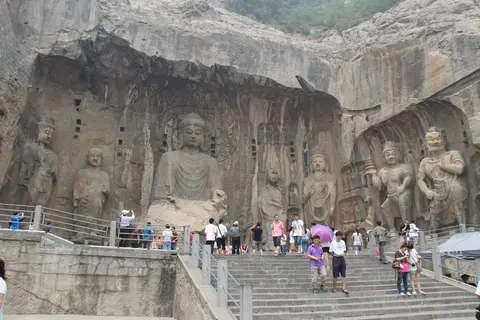
Fengxiansi Colossal Vairocana and East Hill Monastic Caves
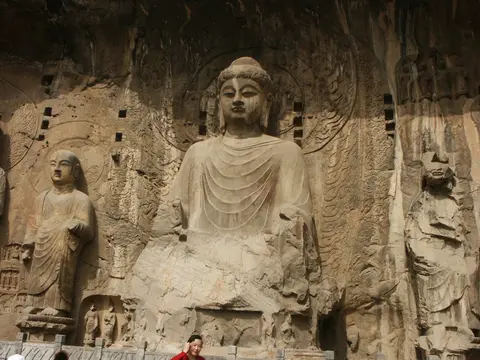
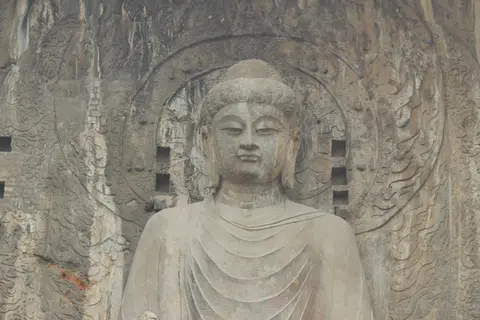
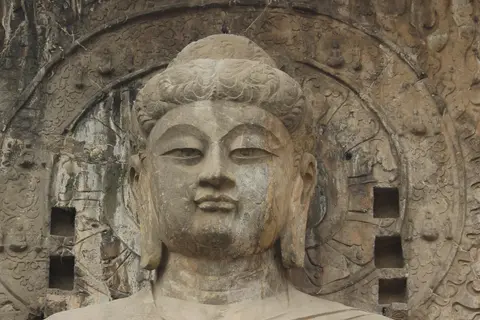
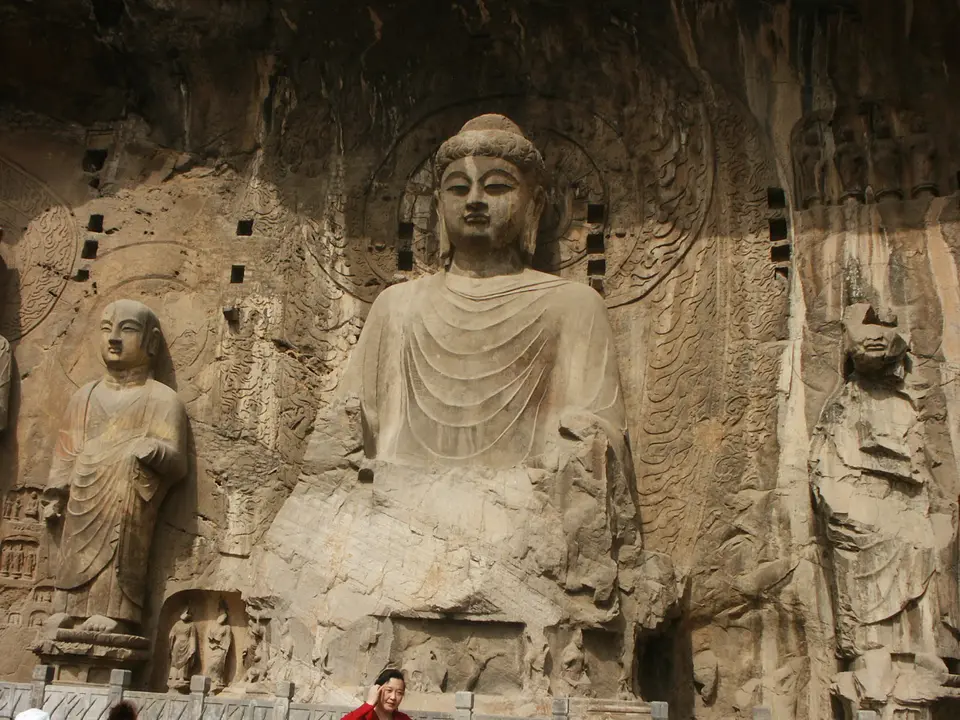
At the southern end of the West Hill terrace stands Longmen's supreme Tang masterwork, Fengxian-si Cave, open to sky and river light rather than confined inside a dim cavern. Carving ran from 672 to 675 under Emperor Gaozong and Empress Wu Zetian. Originally fronted by wooden temple halls long perished, the vast open limestone bay frames nine monumental Tang sculptures. Towering over the ensemble is the 17-metre seated Vairocana Buddha, whose tranquil gaze and rounded imperial features later tradition associated with Wu Zetian's sponsorship. Flowing draperies fold calmly across crossed legs beside attendant disciples, serene bodhisattvas, heavenly kings and muscular guardians carved cleanly against the sheer rock face. Recent scholarly analysis of Longmen's Buddha statues, bodhisattvas and flying apsaras demonstrates how Tang workshops integrated Central Asian artistic conventions with indigenous Chinese aesthetic dynamics. Buddhist carving thus shifted from stiff imported silhouettes into poised royal realism imitated across regional Chinese cave temples and neighbouring Asian kingdoms.
Crossing the southern pedestrian bridge to the east bank brings visitors beneath the cliffs of Xiangshan (East Hill). Whereas West Hill blends Northern Wei, Sui and Tang campaigns, every cliff carving on East Hill dates exclusively from the Tang dynasty, led by Jinan-dong, Ganjing-si and Leigutai-dong (all begun in 684). Smaller caves across Xiangshan once housed residential quarters for large communities of Tang monks near scenic open-air temple terraces. Monastic complexes thus spread across both banks of the narrow valley rather than remaining confined to imperial memorial shrines on the western rock face. Today, modern riverfront walkways along the eastern cliff give unobstructed frontal panoramas back across the Yi River toward the colossal statues of Fengxiansi. Travellers can read the full spatial alignment of the river sanctuary from cliff top to waterline, framed by the intact river-and-cliff setting that has surrounded Longmen since the late fifth century.
Longmen Cliffside Precincts and Entry Logistics
Understanding the directional one-way flow from north to south along West Hill and back north across the Yi River avoids exhausting climbs along the 1-kilometre gorge while surveying both riverbanks without backtracking. Raised walkways link lower river terraces to higher cliff ledges through flights of stone steps, so comfortable walking shoes and steady footing make navigating consecutive grotto thresholds far easier during busy holiday periods.
| Complex Zone | Key Highlights | Access & Ticket Rule |
|---|---|---|
| Northern West Hill Caves | Three Binyang Caves (500 to 523), lotus ceiling canopy, Yaofangdong's 140 medical steles and Qianxisi entrance terrace | Ticketed main gate entry from the northern trailhead; caves are sealed at thresholds behind protective barriers |
| Central & Southern West Hill | Guyangdong's 600 to 800 inscriptions, Lianhua-dong, Wanfo-si and the 17-metre Vairocana Buddha of Fengxiansi (675) | Staircase walkways link raised terraces; capacity limits regulate dense weekend viewing platforms beneath Fengxiansi |
| Xiangshan (East Hill) & Leigutai | Tang-only caves (684), Jinan-dong, Ganjing-si, monastic terraces and cross-river panoramic viewpoints facing Fengxiansi | Included on combined complex pass after crossing the southern river bridge; steep hillside stairs link east-bank shrines |
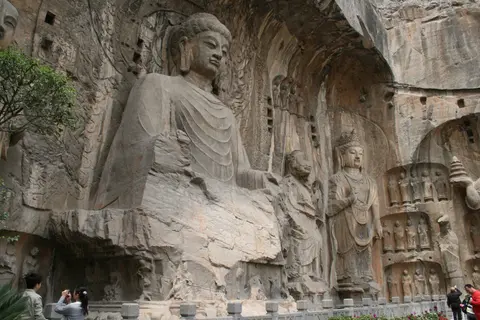
Three Stone-Carving Details to Trace at Longmen Grottoes
First, compare the facial proportions and drapery folds in Middle Binyang Cave (completed 523) with those inside Fengxiansi (675). Within a century and a half along the same limestone gorge, tall, ascetic Northern Wei figures wrapped in rhythmic waterfall robes give way to the High Tang court style. Wide shoulders, serene naturalism and relaxed royal bearing clearly trace the transition from Central China Style to Great Tang Style.
Second, scan the lower and upper registers along the north and south walls inside Guyangdong for square rectangular steles framing small Buddhas. These 600 to 800 Northern Wei tablets mark one of China's greatest surviving stone galleries of Wei-style square-brush calligraphy, recording exact dedication dates and names of royal and common donors who financed individual votive niches.
Third, look closely at the stone walls flanking the entrance threshold of Yaofangdong, carved over 150 years beginning in 570. Beside Buddhist niches, Tang and Northern Qi donors cut 140 medical recipes directly into permanent limestone so travellers and monks could consult remedies for eye conditions, fevers and joint pain inside the cliff sanctuary.
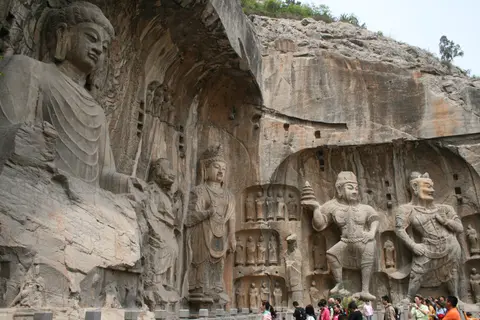
Seasonal Viewing Light and Rail Connections via Luoyang
Because West Hill faces east across the Yi River, morning sunlight illuminates the deep niches of Guyangdong, Binyang and Fengxiansi directly, whereas afternoon glare softens into warmer evening tones best viewed from the East Hill terrace across the water. Spring and autumn offer comfortable temperatures for climbing the cliff staircases; summer heat reflects sharply off bare limestone while winter winds sweep north down the valley. Allow half a day to trace the numbered West Hill grottoes from north to south, cross the Yi River bridge and return along Xiangshan's east-bank viewpoints before heading back into modern Luoyang.
Reaching Longmen is straightforward from Luoyang, 12 kilometres north, served by Luoyang Beijiao Airport (LYA) 31 kilometres away and Zhengzhou Xinzheng International Airport (CGO) 127 kilometres east. Domestic flights into Luoyang and wider international or regional connections via Zhengzhou both feed local urban transit south to the Yique river narrows, making Longmen easy to reach as a half-day architectural focus without complex mountain transfers. Pair Longmen with China's wider cave-temple and imperial heritage through our UNESCO World Heritage Atlas, or link northward on China's high-speed rail trunk to our Beijing guide, 698 kilometres northeast.