


























Quick Field Data
- UNESCO Inscription: 1980 · Criteria (iv), (vi).
- Scale & Footprint: 15.095 hectares core (66-hectare cultural monument within a 250-square-kilometre Late Classic kingdom) at 600 to 700 metres elevation in the Copán River valley, western Honduras
- Access & Ticketing: Protected as a national cultural monument since 1982; entry tickets cover the Main Group (Great Plaza alongside the Hieroglyphic Stairway as well as the Ballcourt and Acropolis) and the Sepulturas Group connected by a sacbe causeway, with separate access to the archaeological tunnels and the Copán Sculpture Museum
- Arrival Logistics: Located in the municipality of Copán Ruinas in the Copán Department of western Honduras near the border with Guatemala, 1.6 kilometres (1 mile) east of the modern town of Copán Ruinas
Dynastic Foundation from Tikal and the Stratigraphy of the Acropolis
Set within a fertile mountain basin along the Copán River at elevations between 600 and 700 metres (1,970 to 2,300 feet) above sea level in western Honduras near the border with Guatemala, the Maya Site of Copán (known in ancient Mayan inscriptions as Oxwitik, meaning the Three Witiks) was the foremost political alongside civil and scientific capital on the southeastern periphery of Mesoamerica. Inhabited across two millennia from the Early Preclassic era (with stone architecture from the 9th century BC and texts citing 321 BC alongside AD 159 and AD 376 under Foliated Ajaw) until its 9th-century AD political collapse, the city controlled jadeite and obsidian trade along the Motagua River valley. First described to King Philip II of Spain in 1576 by Diego García de Palacio and explored in the 19th century by Juan Galindo alongside John Lloyd Stephens, Frederick Catherwood, Alfred Maudslay, and Harvard University, Copán entered the World Heritage List in 1980 under criteria (iv) and (vi). Carvings record four centuries of kings.
Classic Copán's golden age between AD 300 and 900 began with a geopolitical intervention in AD 426. As recorded on Altar Q and verified by tunnel excavations beneath the Acropolis, a warrior lord named K'uk' Mo' Ajaw (mentioned 20 years earlier in an AD 406 text from Tikal and sponsored by Tikal's 16th ruler, Siyaj Chan K'awiil II) arrived in AD 426, assumed the dynastic title K'inich Yax K'uk' Mo' alongside the title ochk'in kaloomte (Lord of the West, previously borne by the Teotihuacan general Siyaj K'ak'), installed a subordinate ruler at Quiriguá, and founded a royal dynasty of 16 kings that ruled for four centuries. Legitimising his rule by marrying a local noblewoman of Copán, K'inich Yax K'uk' Mo' initiated masonry construction over Preclassic earth-and-cobble platforms before dying between AD 435 and 437. In 1995, archaeologists Robert Sharer and David Sedat excavated his vaulted crypt beneath the Hunal phase of Temple 16, built in the Teotihuacan talud-tablero style and containing the skeleton of the foreign-born founder alongside jade offerings, while the overlying Yehnal (in Petén Maya style with red masks of K'inich Tajal Wayib') and Margarita platforms (built by his son, Ruler 2 K'inich Popol Hol, with stucco quetzals and macaws alongside the Xukpi stone dated AD 437) held the tomb of his queen, the Lady in Red.
Across the 600-by-300-metre (1,970-by-980-foot) Main Group, successive rulers built overlapping pyramid phases over the royal tombs of the Acropolis (divided into the East Court and West Court). Under K'inich Popol Hol, builders laid out the first Mesoamerican ballcourt adorned with scarlet macaws and placed the carved Motmot Capstone (dated AD 435 and 441, showing the first two kings within a quatrefoil frame) beneath Structure 10L-26, later rebuilt by Ruler 4 Ku Ix (Papagayo phase with Stela 63). Following Ruler 7 B'alam Nehn alongside Ruler 8 Wil Ohl K'inich and Ruler 9, Ruler 10 Moon Jaguar (enthroned in May 553) constructed the Rosalila phase of Temple 16 around AD 571. Discovered intact by archaeologist Ricardo Agurcia inside the pyramid, Rosalila preserves painted stucco reliefs depicting K'inich Yax K'uk' Mo' alongside the sky deity Itzamna, anthropomorphic mountains, and skeletons and crocodiles.
High-Relief Stelae, the AD 738 Quiriguá Disaster, and the 2,200-Glyph Stairway
As valley population expanded under Ruler 11 K'ak' Chan Yopaat (ruling 49 years from AD 578 to 5 February 628 and dedicating Stela 7 in AD 613 and Stela P in AD 623) and Copán's longest-reigning monarch, Ruler 12 Smoke Imix (born AD 612, crowned at age 15 in 628, and ruling 67 years until 15 June 695 at age 79), the kingdom reached an estimated Late Classic population ranging from 18,000 to 25,000 inhabitants across 250 to 476 square kilometres (with 6,000 to 9,000 residents in the 0.6-square-kilometre core at a density of 1,449 structures per square kilometre, 9,000 to 12,000 across 23.4 square kilometres of periphery, and over 6,000 rural structures mapped by LiDAR alongside the 2012 Scribe King burial). In AD 652, Smoke Imix erected Stelae 2 and 3 in the Great Plaza and four valley monuments (Stelae 10 and 12 alongside 13 and 19, plus one at Santa Rita 12 kilometres away), built Structure 2, and constructed the Mascarón and Chorcha phases of Temple 26, where his tomb beneath 11 stone slabs held 44 ceramic vessels alongside 10 paintpots and 12 effigy incense burners.
Ascending the throne in July 695, Ruler 13 Uaxaclajuun Ub'aah K'awiil brought Copán's in-the-round portrait sculpture to its artistic zenith across the Monument Plaza, erecting Stela J in AD 702 (with a woven mat-pattern hieroglyphic puzzle) and Stelae 4 and A and B, C, D, F, and H up to AD 736 (with Stela A in AD 731 ranking Copán and Tikal alongside Calakmul and Palenque). He also sealed Rosalila beneath a new Temple 16 (depositing eccentric flints and a 5-foot shark from the ocean 42 kilometres away), built Structure 10L-22 in AD 715 in the East Court (with Witz mountain-god masks and Chenes regional style doorway sculpture celebrating his first K'atun), constructed the Esmeralda phase of Temple 26 by AD 710 with the first Hieroglyphic Stairway, and dedicated the third version of the Ballcourt (with 16 mosaic macaw sculptures) on 6 January 738.
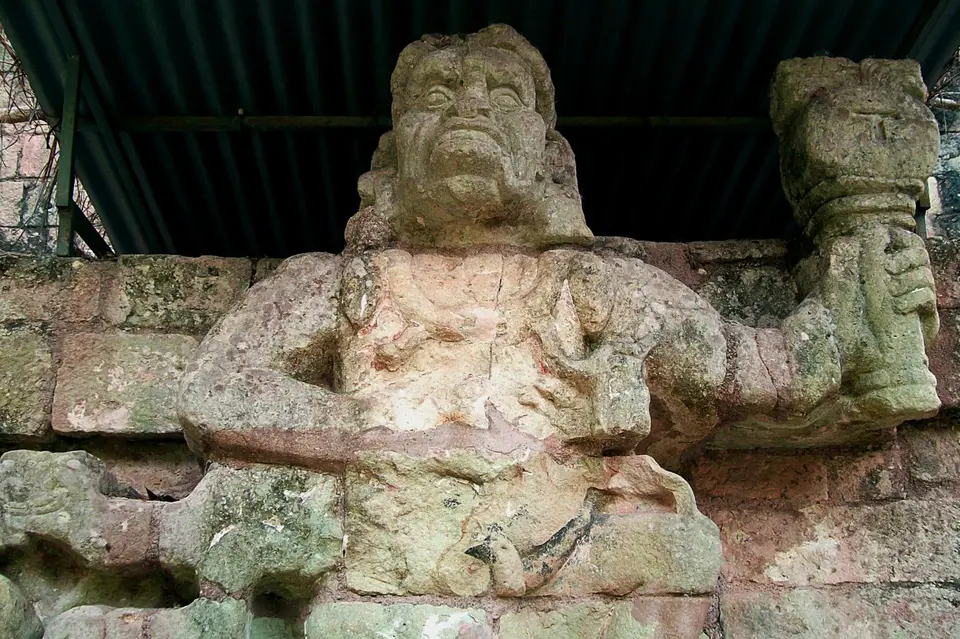
In April 738, catastrophe struck. K'ak' Tiliw Chan Yopaat, installed as a vassal at Quiriguá in AD 724, allied with Tikal's rival Calakmul and declared himself k'ul ajaw in 734 before ambushing Copán's king and decapitating Uaxaclajuun Ub'aah K'awiil six days later at Quiriguá. Deprived of the Motagua River jade route, Copán suffered a 17-year monument hiatus under Ruler 14 K'ak' Joplaj Chan K'awiil (installed 7 June 738, died January 749) before Ruler 15 K'ak' Yipyaj Chan K'awiil rebuilt Structure 10L-26 to install the 10-metre-wide (33-foot), 21-metre-long (69-foot), 62-step Hieroglyphic Stairway in AD 755 (with Stela M at its base in AD 756 and five statues of seated kings placed every 12th step), whose 1,800 to 2,200 glyphs form the longest known Maya inscription, before his burial beneath Temple 11 (marked by Stela N in AD 761).
Ruler 16 Yax Pasaj Chan Yopaat (enthroned in June 763 as the son of a noblewoman from Palenque) completed Temple 11 between AD 769 and 773 (with Pawatun corner sculptures) and the final phase of Temple 16 around AD 776, placing at its base Altar Q, carved around its sides with all 16 dynastic rulers seated on their name glyphs as K'inich Yax K'uk' Mo' hands the royal sceptre to Yax Pasaj. Yet overpopulation and noble competition (seen in the 50 buildings and 7 courtyards of the Sepulturas Group, including the House of the Bakabs) weakened the state; Yax Pasaj's shrine at Structure 10L-18 depicted war dances and Stela 11 recorded the toppling of the Foundation House, while the final claimant, Ukit Took' (enthroned 6 February 822), left Altar L unfinished as the dynasty collapsed between AD 800 and 830. Later, the Copán River eroded the eastern Acropolis, cutting a 37-metre-high (121-foot), 300-metre-long (980-foot) vertical profile before the Carnegie Institution diverted the river in the 1930s and archaeologists consolidated the cut in the 1990s.
Walking the Great Plaza, Hieroglyphic Stairway, and Rosalila Replica
Exploring the 66-hectare cultural monument of Copán allows travellers to read four centuries of Classic Maya art across three interconnected zones: the Great Plaza and Ballcourt alongside the elevated courts and tunnels of the Acropolis and the on-site Sculpture Museum.
Plan your walk through the valley core around the portrait stelae alongside the 62-step stairway and the museum collection.
- Examine the three-dimensional stelae of the Great Plaza and the AD 738 Ballcourt: Enter the northern Monument Plaza to study the deep-relief portrait stelae of Uaxaclajuun Ub'aah K'awiil (including Stelae A, B, and C and D, F, H, and Stela J of AD 702) alongside the AD 652 stelae of Smoke Imix. Walk south into the Court of the Hieroglyphic Stairway through the Ballcourt dedicated on 6 January 738, noting the sloping playing alleys and the 16 scarlet macaw sculptures overhead.
- Inspect the 2,200 glyphs of Structure 10L-26 and Altar Q in the West Court: Stand before Stela M at the foot of Structure 10L-26 to view the 10-metre-wide, 62-step Hieroglyphic Stairway ascending the pyramid behind five seated royal statues. Climb into the West Court and East Court of the Acropolis to see Altar Q at the base of Temple 16, where all 16 kings from K'inich Yax K'uk' Mo' (AD 426) to Yax Pasaj Chan Yopaat (AD 763) are carved, and step up to Structure 10L-22 to view its sculpted Witz doorway.
- Tour the Copán Sculpture Museum and walk the sacbe to Las Sepulturas: Visit the on-site Sculpture Museum to walk inside the life-size replica of the AD 571 Rosalila shrine discovered intact beneath Temple 16 and see the original Altar Q alongside the Motmot Capstone. Afterwards, follow the stone causeway (sacbe) northeast from the Main Group to the Sepulturas Group to explore the 50 elite residential buildings and the carved House of the Bakabs, and compare Copán with Quiriguá and Tikal in our UNESCO World Heritage Atlas.
