


























Quick Field Data
- UNESCO Inscription: 1987 (Cultural, Criteria i, ii, iii, iv; designated as Palenque National Park by Mexico in 1981).
- Scale & Footprint: 1,780-hectare, 9-are, 49-square-metre archaeological site (within the 1,772 ha or 17.72 km² national park) at 150 m elevation containing 1,400 recorded structures across a 2.5 km² explored core, with only about 10% of the total city explored.
- Access & Ticketing: Managed by the National Institute of Anthropology and History (INAH) of Mexico and the national park authority; check the official site for park and archaeological zone entry and site museum schedules.
- Arrival Logistics: Located at 17.4833°N, 92.0500°W adjacent to the modern town of Palenque in Chiapas, lying roughly 130 km (81 mi) to the south of Ciudad del Carmen near the Usumacinta River.
Lakamha, the Classic Maya Dynasty, and the Reign of Pacal the Great
Set at an elevation of 150 metres (490 feet) above sea level where the karst foothills of Chiapas meet the basin of the Usumacinta River in southern Mexico (17.4833 degrees north, 92.0500 degrees west, roughly 130 kilometres or 81 miles to the south of Ciudad del Carmen), the ancient Maya sanctuary and national park of Palenque was known in antiquity as Lakamha ("Big Water" or "Big Waters"), a name studied by David Stuart, Stephen D. Houston, and Rodrigo Liendo-Stuardo in reference to the waterfalls and pools of the Otulum River. Founded during the Late Preclassic period around ca. 226 BC and occupied until ca. AD 799 to 800, the city rose around AD 500 to become a powerful regional capital between AD 500 and 700. Epigraphic research pioneered by Heinrich Berlin, Tatiana Proskouriakoff, Linda Schele, and Peter Mathews from the 1960s onward outlined the earliest complete dynastic sequence reconstructed for a Maya city: beginning with the mythical founder dubbed a Toktan Ajaw on the Temple of the Foliated Cross and the first historical king Kuk Balam (Quetzal Jaguar, whose four-year reign began in 431), followed by the ruler nicknamed "Casper" by archaeologists, his probable sons (the first documented on a tablet found in 1994 alongside his teenage successor), the prestigious ruler who died in 524, followed after a four-year interregnum by a king crowned at Toktán in 529 who governed for 36 years, and his two sons who first adopted the royal title Kinich ("the great sun").
After Queen Yohl Iknal succeeded to the throne in 583, troops from rival Calakmul and its client states invaded and sacked Palenque in 599 and again twelve years later in 611 under her son (who died in 612), when Calakmul's ruler personally led his forces into Palenque. Glyphic panels on the Temple of the Inscriptions record that fundamental religious ceremonies were suspended in 613, lamenting the loss of both the divine lady and the king. Following the un-crowned rule of Janaab Pakal (Pakal I) and his daughter Queen Sak Kuk, who governed for three years starting in 612, the dynasty was re-established when Sak Kuk passed power in 615 to her twelve-year-old son Janaab Pakal, known as Pakal the Great (Pacal the Great). Reigning from 615 to 683 (with his mother remaining an influential force for his first 25 years) and wedding Lady Tzakbu Ajaw (also called Ahpo-Hel), princess of Oktán, in 624, Pakal the Great rebuilt the city, allied with Tikal and Yaxchilan to capture six enemy kings, and remodeled The Palace in 654, 661, and 668. His older son succeeded him in 683 to finish Pakal's tomb and build the Group of the Crosses before his brother took the throne in 702 to enlarge the northern side of The Palace. In 711, rival Toniná sacked Palenque and captured the old king, triggering a 10-year interregnum until a new king was crowned in 722; elite construction ceased sometime after 800, the site was sparsely populated when the Spanish arrived in the 1520s, and a tropical forest of sapodilla, mahogany, and cedar trees gradually overgrew the monuments.
Following de la Nada's early account, modern investigation began in 1773 when Don Ramon de Ordoñez y Aguilar visited the Chiapas ruins and submitted an official account to the Capitan General based in Antigua Guatemala, leading to a 1784 examination and the expedition two years later by architect Antonio Bernasconi and Colonel Antonio del Río, followed by draughtsman Luciano Castañeda in 1807 (published in London in 1822 and 1834). Subsequent researchers included Juan Galindo in 1831 (who recognised that the carved figures depicted local Native Americans rather than Egyptians, Polynesians, or Lost Tribes of Israel), Jean-Frédéric Waldeck from 1832 (published 1866), Patrick Walker and Herbert Caddy from British Honduras and John Lloyd Stephens and Frederick Catherwood in 1840, photographer Désiré Charnay in 1858 and 1881 to 1882, Alfred Maudslay in 1890 to 1891, Frans Blom of Tulane University in 1923, Alberto Ruz Lhuillier from 1949 to 1952 and Jorge Acosta into the 1970s for the National Institute of Anthropology and History (INAH), and Merle Greene Robertson, who launched the Palenque Mesa Redonda conferences in 1973.
The Temple of the Inscriptions, The Palace, and Hydraulic Engineering
Covering 1,780 hectares, 9 ares, and 49 square metres with 1,400 recorded buildings (of which only about 10% across 2.5 square kilometres or 0.97 sq mi were explored by 2005), Palenque is smaller than Tikal, Chichen Itza, or Copán yet exemplifies the refinement, lightness, and harmony of the Palencano style, featuring mansard-like roofs, delicate roof combs, bas-relief carvings, and A-shaped corbel arches. In addition, limestone slabs mined from the Early Paleocene Tenejapa-Lacandón Formation inside the temples preserve marine fossils of modern reef fish (serranids such as Paleoserranus, damselfish such as Chaychanus, and syngnathiforms such as Eekaulostomus) alongside extinct pycnodontids from the recovery after the Cretaceous-Paleogene Chicxulub meteor extinction; the ancient Maya collected these fossils along with Miocene shark teeth and ray spines from the Tulijá Formation.
Begun around 675 as the royal funerary pyramid of Hanab-Pakal, the Temple of the Inscriptions measures 60 metres wide, 42.5 metres deep, and 27.2 metres high, topped by a summit temple (25.5 by 10.5 by 11.4 metres, with largest stones weighing 12 to 15 tons and a total volume of 32,500 cubic metres) housing the second-longest glyphic text in the Maya world (after the Hieroglyphic Stairway at Copan), recording 180 years of history from the 4th through 12th period cycles and rituals for the Palenque Triad deities (GI, GII, and GIII). In 1952, after four years of clearing the interior stairway, Alberto Ruz Lhuillier opened Pakal's tomb (the richest scientifically excavated burial then known in the ancient Americas prior to Sipán in Peru), revealing a carved sarcophagus lid depicting Pakal as the Maya maize god emerging from the underworld, a hand-carved jade mosaic mask and jade suit held with gold wire, stucco wall reliefs, a winter-solstice alignment duct, and a hollow stone psychoduct leading up the stairs. Adjacent Temple XIII yielded the cinnabar-covered Tomb of the Red Queen in 1994.
Across Mexico, the middle of city stands The Palace (97 by 73 metres at its base), built over four centuries around interior courtyards, baths, saunas, and the four-storey Observation Tower. Across the stream rise the step pyramids of the Group of the Crosses (comprising the Temple of the Cross, the Temple of the Foliated Cross, and the Temple of the Sun), whose inner tablets depict the ruler at six years of age (9.10.8.9.3, or 9 Akbal and 6 Xul) and at his accession at age 48 flanking the world tree, alongside the Temple of the Skull, the Temple of the Jaguar (200 metres south), Structure XII (God of Death relief), the Temple of the Count, a ballgame court, and Temple 20. Because Palenque experiences a humid climate averaging 26 °C (79 °F) and receives roughly 2,150 to 2,160 millimetres (85 in) of annual rain, Maya engineers built the subterranean Otulum Aqueduct (over 100 metres long with a 3-metre-high corbel arch vault under the main plaza), a stone bridge, the Picota and Michol Drainage Canals, and the Piedras Bolas Pressurized Conduit, identified in 2010 by researchers Christopher Duffy and Kirk French of Pennsylvania State University as the earliest known pressurised aqueduct in the New World, jetting water 6 metres (20 ft) high. In June 2022, INAH archaeologist Arnoldo González Cruz reported unearthing a nine-inch-tall stucco head dating back 1,300 years and representing the young maize god Hun Hunahpu in a ritual pond deposit.
Rainforest Trails, the Site Museum, and Visitor Logistics
Designated a 17.72-square-kilometre national park in 1981 and inscribed on the UNESCO World Heritage List in 1987, Palenque received 920,470 visitors in 2017. You can locate the Chiapas rainforest sanctuary on our interactive world map. Howler monkeys echo across the plazas.
- Inspecting the Temple of the Inscriptions, Temple XIII, and The Palace: Enter the main clearing to view the pyramid of the Temple of the Inscriptions and adjacent Temple XIII (Tomb of the Red Queen) before exploring the corbel-arched galleries, courtyards, and four-storey Observation Tower of The Palace.
- Climbing the Cross Group and viewing the Otulum Aqueduct: Cross the Otulum River beside the 3-metre-high vaulted stone aqueduct to climb the Temple of the Cross, the Temple of the Foliated Cross, and the Temple of the Sun and examine their carved inner sanctuary reliefs.
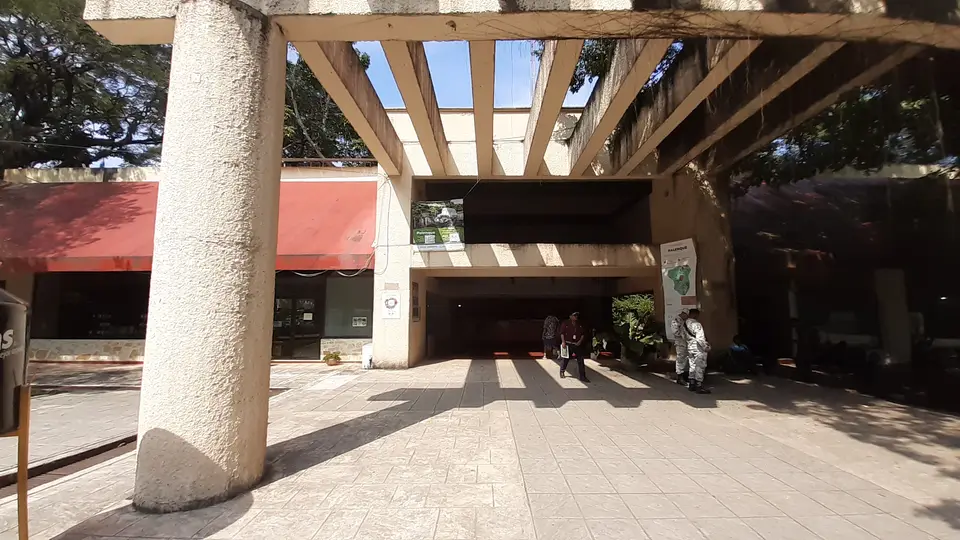
- Exploring the Temple of the Count, ballgame court, and site museum: Walk past the Temple of the Skull, Structure XII, the Temple of the Count, and the Mesoamerican ballgame court before following the Otulum waterfalls trail to the site museum built in the 1970s.
