


























Quick Field Data
- UNESCO Inscription: 1985 (Cultural Criteria i, ii, iv)
- Scale & Footprint: Six pre-Romanesque religious, royal, and hydraulic monuments in and around Oviedo inside the Principality of Asturias (region area 10,605.70 square kilometres)
- Access & Ticketing: Managed by regional heritage and church authorities in Oviedo; check the official site before visiting for guided interior access and seasonal passes
- Arrival Logistics: Located in and around Oviedo, served by Renfe AVE high-speed trains via the Pajares Base Tunnel, ALSA coaches, and Asturias International Airport 40 kilometres away
Asturian Pre-Romanesque Origins in the Cantabrian Stronghold
Cradled between the rugged limestone peaks of the Cantabrian Mountains (Cordillera Cantábrica) to the south and the maritime cliffs of the Cantabrian Sea along the Atlantic Ocean to the north, the Monuments of Oviedo and the Kingdom of the Asturias preserve the architectural heritage of the small Christian kingdom that kept the flame of Christianity alive across the Iberian Peninsula during the 9th century. Listed in the UNESCO World Heritage Atlas in 1985 and mapped on the Atlas, this group of six buildings within and around the historic Asturian capital of Oviedo developed an original pre-Romanesque architectural language that shaped the subsequent evolution of sacred and court architecture across medieval Spain. Cut off from the southern plains by mountains that rise to 2,648 metres (8,688 feet) at the Torrecerredo peak in the Picos de Europa National Park and 2,519 metres (8,262 feet) at the molar-shaped Picu Urriellu (El Naranjo de Bulnes), the early medieval court in Oviedo combined Late Antiquity, Paleo-Byzantine, Visigoth, and classical Roman building traditions into vaulted stone halls and churches. Green hills frame the stone sanctuaries.
Human presence across the territory of Asturias stretches back to Lower Paleolithic and Upper Paleolithic habitation by Homo erectus and Neanderthals, who left cave paintings in the eastern valleys, followed by the Mesolithic Asturiense culture, Bronze Age megaliths and tumuli, and Iron Age Celtic tribes known as the Astures (including the Luggones and the Pesicos), who built fortified hill towns called castros. Although Roman legions under Emperor Augustus subdued the Astures between 29 and 19 BC, the mountain tribes resisted Suebi and Visigoth raids during the 4th and 5th centuries AD and never became part of Islamic Spain after the 8th-century Moorish invasion. Instead, Christian nobles took refuge behind the Cantabrian barrier and established the independent Regnum Asturorum (Kingdom of Asturias) in 722 following the Battle of Covadonga near Cangas de Onís, where Christian forces attributed their surprise victory to the blessing of the Virgin of Covadonga near the mountain lakes (Los Lagos). Before the Asturian monarchy transitioned into the Kingdom of León in the 10th century (later becoming the Comarca of the Asturias of Oviedo in 1230 and the Principality of Asturias in the 14th century, with the royal heir styled Prince or Princess of Asturias since 1388), its 9th-century monarchs Alfonso II and Ramiro I, transformed Oviedo into a royal and ecclesiastical seat equipped with churches, palaces, martyr shrines, and urban waterworks.
Across later centuries, the surrounding Principality of Asturias (which reached a population of 100,000 in the 16th century before doubling with the arrival of American corn, and today counts 1,015,128 residents across 78 municipalities, 8 comarcas, and 857 parishes under the 1981 Statute of Autonomy in force since 30 January 1982) witnessed major historical milestones. In the 18th century, Enlightenment thinker Benito de Feijóo settled inside Oviedo's Benedictine Monastery of San Vicente while reformer Gaspar Melchor de Jovellanos (1744 to 1811) was born in coastal Gijón; on 10 May and 25 May 1808, Oviedo rose up against Napoleon with 18,000 men following the abdication of King Ferdinand VII; and after 1830, coal mines and iron factories in the Nalón and Caudal basins alongside returning wealthy Indianos (migrants to Argentina, Uruguay, Puerto Rico, Cuba, and Mexico who built modernista villas, schools, and libraries) reshaped the province prior to the October 1934 miners' uprising, the Spanish Civil War Battle of El Mazuco, and the 1939 to 1975 period when the region was called the Province of Oviedo.
The Six Inscribed Monuments: Alfonsine and Ramirense Masterpieces
Architectural historians divide the 9th-century monuments of Oviedo into the Alfonsino pre-Romanesque phase under King Alfonso II and the Ramirense Romanesque phase under King Ramiro I, complemented by later Asturian churches such as San Salvador de Valdediós ("Conventín") in Villaviciosa, San Salvador de Priesca, and San Julian de Viñón in Cabranes (as well as Camino de Santiago Romanesque landmarks including San Pedro de Villanueva Monastery outside Cangas de Onís, San Esteban de Aramil in Siero, San Juan de Amandi in Villaviciosa, and Santa María de Junco in Ribadesella). Together, the six inscribed components in and around Oviedo demonstrate how 9th-century builders mastered barrel vaulting, sculpted relief medallions, and hydraulic engineering:
- Santa María del Naranco (Mount Naranco): Erected on the green slopes of Mount Naranco overlooking Oviedo to the north as part of a royal complex built by the early Asturian kings (originally functioning as a royal palace hall under King Ramiro I, before its conversion into a church), Santa María del Naranco draws direct inspiration from Late Antiquity and Paleo-Byzantine architecture. Its two-storey rectangular stone structure features a barrel-vaulted upper hall flanked by open belvedere loggias on its narrow facades, decorated with carved stone medallions, cable mouldings, and column capitals.
- San Miguel de Lillo (Mount Naranco): Standing a short distance upslope from Santa María del Naranco on Mount Naranco, the church of San Miguel de Lillo preserves the western section of its original 9th-century royal basilica. Its carved stone door jambs, latticework window screens, and relief carvings provide a complete sculptural record of Asturian court traditions, including circus scenes inspired by classical consular reliefs.
- Santa Cristina de Lena (Lena Municipality): Situated south of Oviedo in the municipality of Lena along the mountain route toward León, Santa Cristina de Lena stands on a hillside spur above the valley. Distinguished from basilican churches by its compact cruciform interior distribution and raised presbytery screen, the church uses carved stone lattice panels and blind wall arcading to separate the congregation nave from the elevated sanctuary.
- San Julián de los Prados (Santullano, Oviedo): Known locally in Oviedo as Santullano and built during the Alfonsino pre-Romanesque period under King Alfonso II, this spacious three-aisled basilica with a transept and triple-apsed sanctuary preserves an extensive cycle of 9th-century aniconic fresco paintings executed in stucco and pigment across its high interior walls, depicting architectural perspectives, curtains, and geometric friezes rooted in Roman mural traditions.
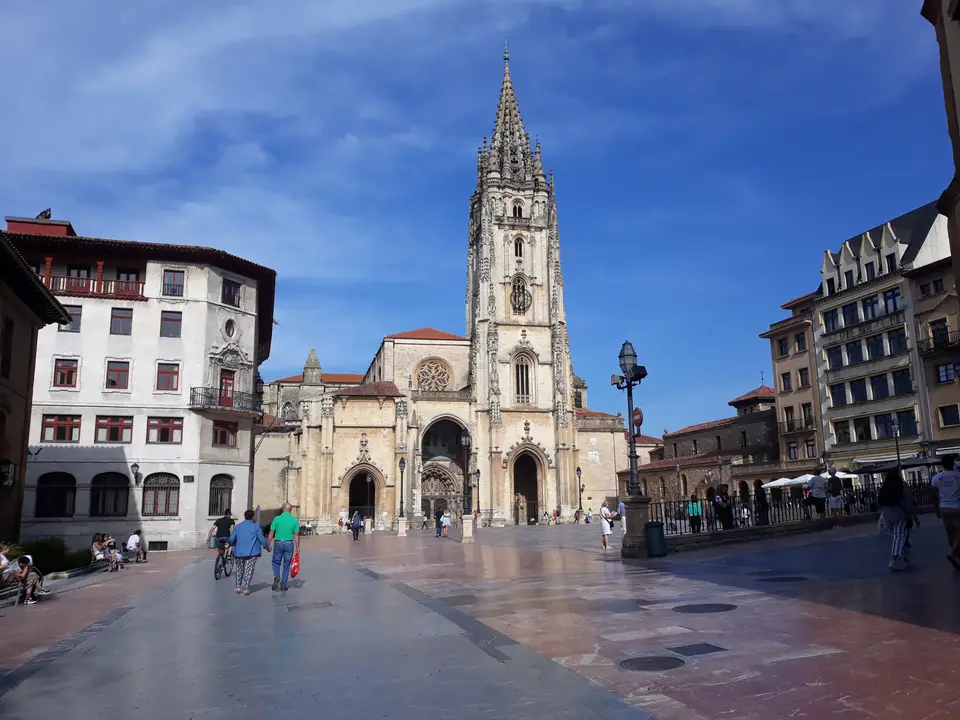
- The Cámara Santa of Oviedo Cathedral: Integrated into the southern flank of the later Gothic Cathedral of San Salvador in central Oviedo, the Cámara Santa is a two-storey 9th-century chapel structured like the funerary structures of classical Rome and Paleo-Christian martyr shrines, combining a barrel-vaulted lower crypt with an upper reliquary sanctuary that houses the sacred crosses and relics of the Asturian monarchy.
- La Foncalada hydraulic fountain (Oviedo): Located in the streets of Oviedo and built during the opening decades of the 9th century under Alfonso II, La Foncalada is a public potable-water fountain house built over a natural spring using classical Roman hydraulic engineering models. Topped by a protective stone gable inscribed with the royal Asturian cross and its Latin inscriptions "Hoc signo tuetur pius" and "Hoc signo vincitur inimicus", it remains an exceptional surviving work of early medieval civil engineering still in working order.
Navigating the Monuments of Oviedo, Mount Naranco, and Lena
Exploring the six World Heritage monuments allows visitors to combine the historic centre of Oviedo (which also features Baroque palaces such as the Palace of Camposagrado and the Velarde Palace housing the Museum of Fine Arts of Asturias, the Auditorio Príncipe Felipe, and Santiago Calatrava's 1999 Palace of Congresses) with the wooded slopes of Mount Naranco and the mountain valley of Lena, while nearby Gijón (4 kilometres from the cruise berths of El Musel port, with its 313-metre Moliner quay, 326-metre 7ª Alignment, and 360-metre Espigón II) and Avilés (home to Oscar Niemeyer's International Cultural Centre, Saint Nicholas of Bari, Capilla de los Alas, Palacio de Balsera, and the 13th-century St. Thomas of Canterbury church) anchor the coastal belt of Green Spain, where winter daytime highs average 12 to 13 degrees Celsius and summer highs average 22 to 23 degrees Celsius:
- Entry and route: Begin inside central Oviedo at the Cámara Santa inside the Cathedral of San Salvador and walk a short distance north to the spring of La Foncalada and east to the basilica of San Julián de los Prados (Santullano). From the city centre, municipal buses or a brisk uphill walk lead 3 kilometres north onto Mount Naranco to visit Santa María del Naranco alongside neighbouring San Miguel de Lillo, while regional commuter trains connect Oviedo southward to the hillside station below Santa Cristina de Lena.
- Tickets and viewpoints: While the exterior fountain basin of La Foncalada is visible from the street at all times, entering Santa María del Naranco, the basilica of San Miguel de Lillo, San Julián de los Prados, and Santa Cristina de Lena as well as the Cámara Santa requires scheduled admission or guided visits; check the official site before travelling to confirm seasonal visiting slots and restoration closures. From the grass terraces outside Santa María del Naranco, visitors enjoy a sweeping view across the roofs of Oviedo toward the central Ubiñas range.
- Timing and onward connections: Oviedo is linked directly to Madrid and Castile and León by Renfe AVE high-speed rail through the Pajares Base Tunnel (opened in November 2023) and by ALSA coaches, while Asturias International Airport lies 40 kilometres (25 miles) away near Avilés. After inspecting the pre-Romanesque churches, travellers can sample traditional fabada asturiana, cachopo, Cabrales cheese, and natural apple cider (sidra) poured from overhead (el escanciado) in Oviedo's cider houses, or drive east along the N634 road past the raised wooden grain silos (hórreos and paneras covering over 100 square metres or 1,076 square feet) of Ceceda village toward Llanes, the Playa del Silencio near Cudillero, and Cangas de Onís.
