


























Quick Field Data
- UNESCO Inscription: 1985 (extended in 2008 to incorporate seventeen additional Cantabrian caves alongside Altamira, forming an ensemble of eighteen decorated caves), inscribed as masterpieces of Upper Palaeolithic human artistic creation.
- Scale & Footprint: The flagship Cave of Altamira measures approximately 270 metres in length (with a 16-hectare buffer zone) inside Mount Vispieres near Santillana del Mar, Cantabria.
- Access & Ticketing: While the original Cave of Altamira remains closed to regular public entry to protect its fragile microclimate, the adjacent National Museum and Research Centre of Altamira displays the full-scale replica cave replica completed in 2001, and several companion caves across Cantabria and northern Spain offer timed guided visits; check the official site for booking rules.
- Arrival Logistics: situated outside Santillana del Mar within the region of Cantabria along the northern coast of Spain.
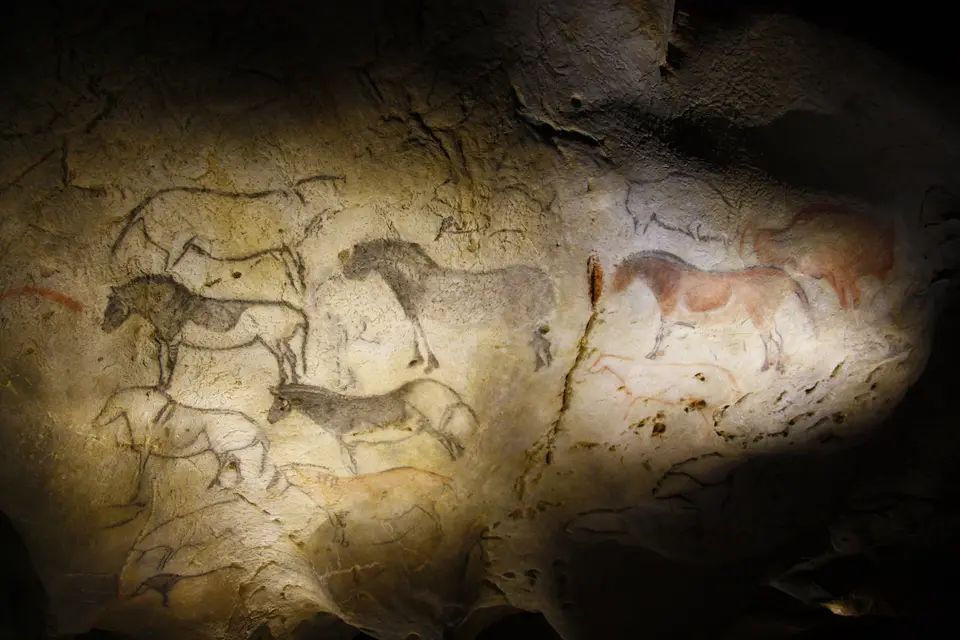
Scattered across the limestone hills and coastal valleys of the Cantabrian Corniche in northern Spain, Altamira and the wider Paleolithic cave art network across northern Spain bring together eighteen subterranean sanctuaries that trace the birth and flowering of human visual art. First inscribed on the UNESCO World Heritage Atlas in 1985 for the celebrated Cave of Altamira (Cueva de Altamira) near Santillana del Mar and expanded in 2008 to encompass seventeen additional decorated caves across Cantabria, northern Spain on the Cantabrian Corniche, the serial property spans the entire Upper Palaeolithic era from roughly 35,000 to 11,000 BC (36,000 to 11,000 BP). Isolated from external weather fluctuations inside deep karst galleries, these cave walls preserve charcoal drawings and mineral ochre paintings alongside negative hand stencils and rock engravings created by early Homo sapiens from the Aurignacian and Solutrean periods to the height of the Magdalenian culture. Polychrome bison charge across the limestone ceiling.
Modesto Cubillas, Marcelino Sanz de Sautuola, and the 1902 Rehabilitation
Formed through karst collapse processes inside the calcareous limestone bedrock of Mount Vispieres near Santillana del Mar, the Cave of Altamira stretches approximately 270 metres in length across a series of twisting chambers whose main passage varies from two to six metres in height. Around 13,000 years ago, a massive natural rockfall sealed the mouth of the cave, locking its Upper Solutrean (dating to 18,500 years ago) together with Lower Magdalenian horizons (dating between 16,590 and 14,000 years ago) archaeological floor deposits and ceiling paintings inside a stable subterranean time capsule. Only in 1868, after a fallen tree disturbed the collapsed rocks, did a local tiler named Modesto Cubillas discover the hidden opening.
Eleven years later, in 1879, Spanish amateur archaeologist Marcelino Sanz de Sautuola was excavating bone and flint tools inside the cave entrance accompanied by his eight-year-old daughter María, who wandered into a low side chamber, looked up at the undulating limestone vault, and cried out that she saw painted oxen on the roof. Together with geologist University of Madrid geologist Juan Vilanova y Piera, Sautuola published a landmark study in 1880 attributing the polychrome paintings to prehistoric Palaeolithic hunters, the very first time anywhere in Europe that a prehistoric origin was proposed for cave art.
Instead of universal acceptance, Sautuola's 1880 publication triggered a bitter twenty-year scientific controversy. Leading French prehistorians headed by prehistorians Émile Cartailhac and Gabriel de Mortillet ridiculed the Spanish findings at the 1880 Prehistorical Congress in Lisbon, arguing that Stone Age humans lacked the intellectual capacity for such sophisticated artistic composition and suspecting forgery because the ceiling showed no smoke soot marks (a puzzle Sautuola solved by demonstrating that Palaeolithic artists burned animal marrow fat in stone lamps, which emits virtually no soot). Only in 1902, fourteen years after Sautuola's death, after comparable Palaeolithic cave paintings were discovered in the Franco-Cantabrian region and studied with Henri Breuil, did Émile Cartailhac publish his famous retraction article, Mea culpa d'un sceptique, in the journal L'Anthropologie, formally vindicating Sautuola and establishing the authenticity of Upper Palaeolithic art. Subsequent excavations at Altamira were conducted between 1902 and 1904 by researcher Hermilio Alcalde del Río, German prehistorian Hugo Obermaier between 1924 and 1925 (when Spain declared the cave a National Monument on 25 April 1924), and Joaquín González Echegaray in 1968.
The Polychrome Ceiling, Uranium-Thorium Dating, and Artistic Technique
Although human domestic occupation at Altamira was restricted to the sunlit cave mouth, where hunters feasted on deer and horses alongside coastal marine life, Palaeolithic artists ventured throughout the full 270-metre length of the dark galleries to paint and engrave. Nowhere is their mastery more evident than in the Gran Sala (Great Hall) on the Techo de los Polícromos (Polychrome Ceiling). Here, Magdalenian artists depicted extinct steppe bison (Bison priscus) arranged across varied postures, standing or bellowing as well as resting on the ground, accompanied by two horses and a large doe and wild boar figures alongside abstract tectonic and claviform (club-shaped) signs.
To create these lifelike images, the artists first engraved outlines into the rock with flint burins, then outlined the animals in black wood charcoal and filled their bodies with red and yellow iron-oxide ochre or hematite pigments diluted with water or applied as dry crayons. By scraping and washing away layers of pigment to create subtle gradations of chiaroscuro shading, and by deliberately positioning the hump and shoulders of each bison over natural convex bosses and fissures protruding from the limestone ceiling, the painters achieved an astonishing three-dimensional sculptural relief.
Whereas early scholars assumed the ceiling had been painted in a single Magdalenian generation, high-precision uranium-thorium dating of thin calcite crusts overlying the pigments, published by researchers in 2008 and 2012 in the journal Science, revealed that artistic activity inside Altamira spanned more than 20,000 years. A large red claviform symbol on the Polychrome Ceiling was dated to roughly 36.16 ka (well within the early Aurignacian period, soon after modern humans arrived in northern Iberia), a red dotted-outline horse was dated to 22.11 ka at the start of the Solutrean alongside negative blown-pigment handprints, and the great polychrome bison were completed during the Magdalenian era around 16,590 to 14,000 years ago.
Microclimate Conservation, the 2001 replica cave, and Visiting the Cantabrian Caves
Taken together, the eighteen decorated caves of the Cantabrian Corniche trace the full arc of Upper Palaeolithic artistic expression across more than twenty thousand years of human history. Inside these dark limestone chambers, protected from external weather variations by rockfalls and narrow karst passages, early Homo sapiens mastered the use of mineral ochre, hematite, charcoal, and stone engraving tools to transform natural rock contours into living animal forms.
During the mid-twentieth century, body heat, and carbon dioxide and water vapour exhaled by hundreds of thousands of annual tourists destabilised Altamira's delicate cave microclimate, prompting closure in 1977 and limited reopening in 1982 before full closure in 2002 after green microbial mould spots appeared near the pigments, a closure reaffirmed by the Spanish Ministry of Culture in December 2010. To allow the public to experience the art without endangering the original rock, artists Manuel Franquelo and Sven Nebel completed a millimetre-accurate, three-dimensional replica cave (the replica cave) inside the adjacent National Museum and Research Centre of Altamira in 2001, using the exact mineral ochre and charcoal pigments of the Magdalenian masters (complementing earlier reproductions in Madrid, the 1964 Deutsches Museum replica in Munich, and a 1993 replica in Japan). Meanwhile, several of the seventeen companion caves across Cantabria, across the Cantabrian Corniche, welcome small booked groups into authentic Palaeolithic chambers.
- Tour the 2001 replica cave and museum exhibits at Santillana del Mar first: Begin at the National Museum and Research Centre of Altamira to see the reconstructed Polychrome Ceiling at eye level, where the original floor height before twentieth-century excavations is recreated so you can observe how natural ceiling bosses give the steppe bison their three-dimensional volume, and original Solutrean and Magdalenian bone tools and stone lamps alongside ochre pigments.
- Book timed entry in advance for open companion caves in Cantabria: While the original Cave of Altamira remains closed for microclimatic conservation, reserve timed guided tickets ahead of your trip for nearby decorated caves in the Cantabrian region.
- Combine the Altamira plateau with a walk through medieval Santillana del Mar: Follow the two-kilometre country lane connecting the Mount Vispieres museum hilltop with the cobbled colegiata town of Santillana del Mar, where Marcelino Sanz de Sautuola set out on his historic 1879 exploration.
