


























Quick Field Data
- UNESCO Inscription: 1985, inscribed as one of the premier pilgrimage centres of Christianity and an intact urban ensemble of Romanesque and Gothic alongside Baroque granite architecture.
- Scale & Footprint: Encompasses the historic walled core (zona monumental) radiating around the Cathedral of Santiago de Compostela and the outlying Santa María de Conxo Monastery, situated at an elevation of 260 to 370 metres within a 220-square-kilometre municipality in Galicia.
- Access & Ticketing: The granite streets and arcaded lanes surrounding the cathedral are open public spaces, while the Pórtico de la Gloria and the cathedral museum alongside the monastic cloisters operate timed ticketing; check the official site in advance.
- Arrival Logistics: Capital of the Autonomous Community of Galicia in the province of A Coruña, served by the Lavacolla airport (12 kilometres away) and high-speed rail connections toward Madrid and Porto.
Set among green granite hills in the province of A Coruña in northwestern Spain, where Atlantic weather systems bring mild temperatures and roughly 1,800 millimetres of annual rainfall, the Old Town of Santiago de Compostela functions as the ultimate goal of the Way of Saint James (Camino de Santiago). For Spain, the UNESCO World Heritage Atlas in 1985, the historic quarter (known in Galician as a zona vella) grew around the revered shrine of Saint James the Greater (Sanctus Iacobus, which evolved into the name Santiago). Together with Rome and Jerusalem, medieval Compostela ranked as one of the three supreme pilgrimage cities of the Christian world, inspiring a vast network of roads and bridges alongside hospitals and churches across Europe and earning Galicia the name Jakobsland (or Gallizaland) in Nordic sagas. Travellers journeying north across the northern Portuguese border from Porto or arriving on foot along the ancient pilgrim routes step into an exceptionally unified city of silver-grey granite plazas and Romanesque portals alongside Baroque facades. Pilgrim shells mark every granite archway.
Pelagius the Hermit, Bishop Theodemir, and the Medieval Shrine
Archaeological excavations beneath the cathedral during the nineteenth and twentieth centuries revealed that the site of Santiago de Compostela was originally a Roman cella memoriae (martyrium) and cemetery by the fourth century AD, which continued in use after the Germanic Suebi settled in Galicia in the early fifth century and after the Visigothic King Leovigild annexed the Suebi kingdom in 585. Modern philologists including Richard A. Fletcher and Joan Coromines alongside Ramón Menéndez Pidal derive the name Compostela from the Latin phrase compositum tella, which denotes an ordered burial ground, while medieval folk etymology linked it poeticially to Campus Stellae (Field of the Star).
According to the twelfth-century Codex Calixtinus and medieval tradition, after the apostle James, son of Zebedee, was martyred in the Holy Land, his disciples transported his body in a stone boat from Jaffa to Iria Flavia in Galicia, overcame the trials set by the pagan Queen Loba at the Pico Sacro mountain, and buried the apostle on Mount Libredon. Around eight hundred years later, between the years 818 and 842 under the rule of King Alfonso II of Asturias, a hermit shepherd named Pelagius observed mysterious lights shining above the forgotten forest tomb and alerted Bishop Theodemir of Iria (who died in 847). Guided by a bright star, Bishop Theodemir identified the relics as those of Saint James the Greater and notified King Alfonso II in Oviedo, who ordered a church built over the tomb, establishing a sacred rallying symbol for the northern Christian kingdoms during their struggle against Islamic rule in Iberia.
First mentioned as a pilgrimage destination by the monk Usuard in 865, the growing sanctuary became the coronation and burial church for the kings of Galicia and León (including Ordoño IV in 958 and Bermudo II in 982 alongside Alfonso VII in 1111 and the tombs of Fernando II and Alfonso IX). After Bishop Sisenand II was killed fighting Viking raiders in 968 after fortifying the shrine, the Andalusian commander Ibn Abi Aamir (al-Mansur) assaulted and burned the town in 997, carrying off the church bells and doors southward while leaving the apostle's tomb untouched. Completely rebuilt in the eleventh century and enclosed within new defensive walls and towers by Bishop Cresconio, Compostela reached its medieval zenith in the twelfth century under its first archbishop, Diego Gelmírez, who elevated the church into a metropolitan see and launched the masterpiece of European Romanesque pilgrimage architecture.
The Cathedral of Saint James, the Pórtico de la Gloria, and the Four Plazas
Around the middle of the Old Town rises the Cathedral of Santiago de Compostela, rebuilt in the eleventh century in the barrel-vaulted Romanesque pilgrimage style with a wide gallery triforium and ambulatory designed to allow thousands of weary pilgrims to circulate around the high altar and crypt reliquary of Saint James without interrupting liturgical services. Just inside the western entrance stands the supreme sculptural masterpiece of the twelfth century: the Pórtico de la Gloria, where a sculpted Romanesque narthex welcomes arriving pilgrims beneath triple stone arches.
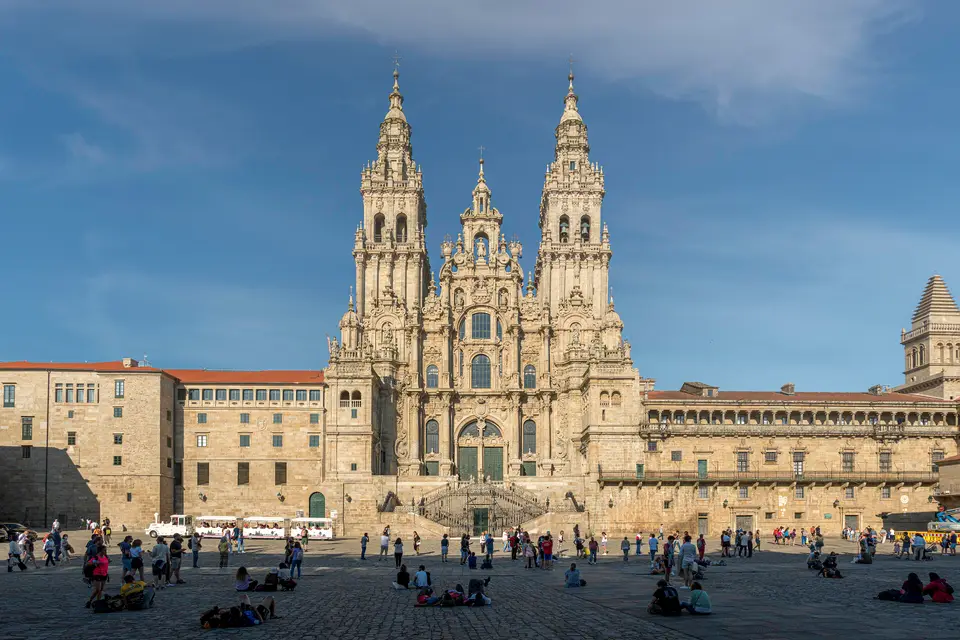
In the seventeenth and eighteenth centuries, wealthy cathedral canons encased the medieval Romanesque stone core inside a magnificent Baroque granite shell that faces four interconnected monumental squares. On the western Praza do Obradoiro soars the twin-towered Baroque Obradoiro facade (depicted on Spanish 1, 2, and 5 cent euro coins), accessed via an ornate double-flight staircase. Framing the Praza do Obradoiro are three landmark civic and royal buildings: on the north side stands the royal hospital of the Hostal dos Reis Católicos, established in 1492 under Isabella of Castile and Ferdinand II of Aragon as a royal hospital and hospice to care for sick pilgrims (now a historic Parador hotel built around four Renaissance and Gothic cloisters); on the west stands the eighteenth-century neoclassical Pazo de Raxoi, which functions as the city hall and seat of the Galician regional presidency; and on the south stands the historic seat of the University of Santiago de Compostela (founded in the early sixteenth century).
Stepping around the southern flank of the cathedral brings visitors into the Praterías square, where the cathedral's surviving Romanesque exterior facade opens onto the plaza. Adjacent squares around the cathedral are framed by the high monastic walls and the sixteenth-century Baroque Abbey of San Martiño Pinario, one of the largest monastic complexes in Spain, while beyond the medieval perimeter stand the twelfth-century Romanesque Colexiata de Santa María do Sar (famous for its outward-leaning nave piers and buttresses), the seventeenth-century Convent of San Francisco, the outlying Santa María de Conxo Monastery, and the nineteenth-century Parque da Alameda, beside contemporary cultural landmarks designed by Alvaro Siza Vieira and Eduardo Chillida at San Domingos de Bonaval.
Walking the Granite Arcades and Visiting the Pórtico de la Gloria
With more than 200,000 to 277,854 registered pilgrims completing the Camino de Santiago on foot, bicycle, or horseback each year, the granite-paved arcaded streets of the historic old town around the cathedral retain the lively hospitality of a living medieval pilgrimage town. Exploring the surrounding squares such as the Praza das Praterías alongside the vast historic monastery of San Martiño Pinario and the royal hospital of the Hostal dos Reis Católicos demonstrates how the entire urban layout was shaped by centuries of European pilgrimage, while walking across the granite paving of the Praza do Obradoiro and through the surrounding arcaded streets of the historic centre allows visitors in Galicia to trace how Romanesque sculpture, Renaissance cloisters, and Baroque facades evolved around the cathedral shrine.
- Reserve a timed restoration ticket for the Pórtico de la Gloria: Because access to the twelfth-century Pórtico de la Gloria narthex and the cathedral rooftop walkways is strictly limited to preserve the delicate polychrome stone, book your timed entry slot online well before arriving in Santiago.
- Trace the four cathedral plazas in a clockwise architectural circuit: Walk from the eighteenth-century Baroque Obradoiro facade around to the northern Abbey of San Martiño Pinario and around the eastern flank into the southern Praterías square to compare the twelfth-century Romanesque silversmiths' portal with the later Baroque towers.
- View the Old Town skyline from Alameda Park: In the late afternoon, walk across the street from the western edge of the zona vella into the Parque da Alameda to view the classic panorama of the cathedral's twin Baroque bell towers rising above the granite rooftops and green hills of Mount Libredon.
