


























Quick Field Data
- UNESCO Inscription: 1988 across the historic university quarter and monumental centre in Castile and León, Spain.
- Scale & Footprint: Municipal territory of 39.56 square kilometres set at an elevation of 802 metres on three hills above the right bank of the Tormes River.
- Access & Ticketing: Historic streets and squares remain open to pedestrians throughout the year; check official cathedral, cloister, and university portals for admission rules.
- Arrival Logistics: Connected by high-speed rail and highways with Madrid (228 kilometres southeast), with Salamanca Airport located 14 kilometres east at Matacán.
Set across three low hills along the right bank of the Tormes River at an elevation of 802 metres (ranging from 763 metres along the river to 911 metres at Los Montalvos), the Old City of Salamanca preserves one of Europe's most cohesive historic university landscapes. Listed in the UNESCO World Heritage Atlas in 1988, the historic core brings together Roman infrastructure, 12th-century Romanesque parish churches, Gothic vaults, Plateresque academic portals, and the grand baroque enclosure of the Plaza Mayor. Attached to the comarca of Campo Charro across the northern portion of the Meseta Central plateau, the city counted 144,458 inhabitants in 2024 as the 46th-largest municipality in Spain. Stone plays a central role here.
Celtic Hillforts, the Roman Bridge, and Medieval Repopulation
Human occupation on these river bluffs began at the start of the 1st millennium BC on the hill of Cerro de San Vicente, where Final Bronze Age ceramics from the Las Cogotas I, culture and 7th-century BC Iron Age remains of the Soto de Medinilla culture were uncovered. During the 4th century BC, settlement shifted to the nearby Teso de las Catedrales (Cerro de San Isidro), framed by the incised channels of the Santo Domingo and San Francisco streams under the Celtic Vaccaei and Vettones tribes. Ancient Greek authors Polybius of Megalopolis and Stephanus called the settlement Helmantike, whereas Livy and Plutarch recorded Hermandica and Ptolemy noted Salmatica or Salmantica. In 220 BC, Carthaginian general Hannibal besieged and captured ancient Helmantica during his Iberian advance; according to Plutarch and Polybius, the defenders initially offered 300 talents of silver before their women concealed weapons to resist the Carthaginian troops.
Following the Second Punic War, Rome annexed Salmantica to the province of Lusitania. Three Roman works shaped the permanent urban layout: the Calzada de la Plata trading road, the primitive Cerca Vieja defensive wall encircling the cathedral hill, and the 1st-century stone Roman Bridge across the Tormes River, whose northern arches survive intact while the southern half was reconstructed during the 17th century following the San Policarpo flood of 1626. In November 2015, excavations beneath a house on Calle Libreros uncovered fragments of a Roman marble togado statue from the ancient forum, now displayed in the Museum of Salamanca.
After Alan and Visigothic rule, when 4th-century walls were reinforced with keeps and bishops attended the Councils of Toledo by 589, Muslim forces under Musa ibn Nusayr captured the town in 712. Clashes such as the campaign of Alfonso I, of Asturias in 754 left the riverbanks largely depopulated until Christian forces won the Battle of Simancas in 939 and King Ramiro II, of León began resettling the Tormes valley, followed by church donations under Ordoño III, of León in 953. Definitive repopulation occurred after Alfonso VI, of León conquered Toledo in 1085 and entrusted his son-in-law Raymond of Burgundy in 1102 with settling Franks, Castilians, Serranos, Mozarabs, Portuguese, Galicians, and Jews under the Fuero de Salamanca. Jerome of Périgord restored the Diocese of Salamanca and initiated construction of the Old Cathedral.
The 1218 University and the 16th-Century School of Salamanca
Academic life defines the identity and architectural geometry of the city. Although cathedral schools operated here by 1134, King Alfonso IX, of León granted the royal charter of studium generale in 1218. King Alfonso X, of Castile issued a royal decree in 1254 establishing the title of University and endowed its chairs between 1252 and 1282, while Pope Alexander IV, ratified universal recognition in 1255, placing Salamanca alongside Paris and Bologna. Proclaiming itself the Mother of Virtues, Sciences, and the Arts, the institution reached its golden age in the 16th century, when the city held roughly 24,000 inhabitants (with 300 in the southern arrabal) and enrolled 6,500 students each year around 1580.
Inside the university cloisters and the Dominican Convento de San Esteban, scholars led by Francisco de Vitoria formed the School of Salamanca. Drawing on scholasticism and Thomism alongside reports from Dominican missionaries Bartolomé de las Casas and Antonio de Montesinos, these thinkers reformulated natural law, economic theory, and ius gentium (the law of nations) to defend the human dignity and property rights of indigenous peoples in the Americas. Crucial milestones of world history unfolded within these halls: Antonio de Nebrija published the first Castilian grammar (Gramática de la lengua castellana) in 1492; Christopher Columbus consulted university cosmographers and astronomer Abraham Zacuto (1452 to 1515) while staying at San Esteban; Hernán Cortés studied here until 1501; Luis Ramírez de Lucena printed the oldest surviving modern chess treatise in 1496; mathematicians prepared the 1515 and 1578 studies for Pope Gregory XIII's calendar reform; and anatomist Andreas Vesalius defended his medical inquiries before an imperial board ordered by Emperor Charles V, in 1551.
- Patio de Escuelas and Hospital del Estudio: Framing the Escuelas Mayores and Escuelas Menores together with the 1413 Hospital del Estudio ( and now the Rectorate, with the final building programme begun in 1533), alongside the 15th-century Gothic and Renaissance house of Doctor Álvarez Abarca (Museum of Salamanca) and the 18th-century Casa-Museo de Unamuno.
- Convento de San Esteban and Convento de las Dueñas: The 16th-century Dominican convent of San Esteban features a triumphal-arch Plateresque façade, the Renaissance Cloister of los Reyes, and a baroque altarpiece by José Benito de Churriguera; nearby, the 1533 Convento de las Dueñas centres on a two-storey irregular pentagonal cloister carved with grotesques and monsters.
- Historic Colleges and Palaces: Including the 16th-century Colegio Mayor de Santiago el Zebedeo (del Arzobispo Fonseca), the 1554 Colegio Trilingüe designed by Rodrigo Gil de Hontañón, the 1719 Colegio de San Ambrosio (now the General Archive of Spain's Civil War), alongside the Palacio de Anaya, the Plateresque Palacio de Monterrey of the House of Alba, the 1546 Palacio de la Salina by Rodrigo Gil de Hontañón, the 1545 Palacio de Rodríguez de Figueroa, the Casa de las Muertes by Juan de Álava, and the late-15th-century Casa de las Conchas decorated with 350 scallop shells of the Order of Santiago.
- Towers and Noble Houses of the War of the Bandos: Fifteenth-century factional strife between the San Benito and Santo Tomé noble bands (pacified by patron saint John of Sahagún) left landmarks such as the Casa de doña María la Brava on the Plaza de los Bandos, the 1470 octagonal Torre del Clavero built for Francisco de Sotomayor, the Torre del Aire, and the Torre de los Anaya.
Twin Cathedrals, La Clerecía, and the Baroque Plaza Mayor
Salamanca preserved both of its cathedrals side by side along the Patio Chico. Begun in the 12th century in Romanesque style, the Old Cathedral stands directly beside the much larger New Cathedral, which was started in the 16th century in Gothic style and completed in the 18th century. When the Lisbon earthquake of 1755 shook the region, it left a visible crack in the bell tower of the New Cathedral and tilted the arches and pillars inside the Romanesque Church of San Martín next to the Plaza del Corrillo. Other notable sanctuaries include the circular Romanesque Church of San Marcos, the 1175 Church of Santo Tomás Cantuariense (dedicated to Saint Thomas Becket shortly after his canonization), the 1512 Convento de la Anunciación (las Úrsulas) with the tomb of Archbishop Fonseca by Diego de Siloé, the Convento de las Agustinas housing José de Ribera's Immaculate Conception, and the baroque La Clerecía (begun in 1617 for the Jesuits with two 50-metre twin towers and now the seat of the Pontifical University founded in 1940 by Pope Pius XII).
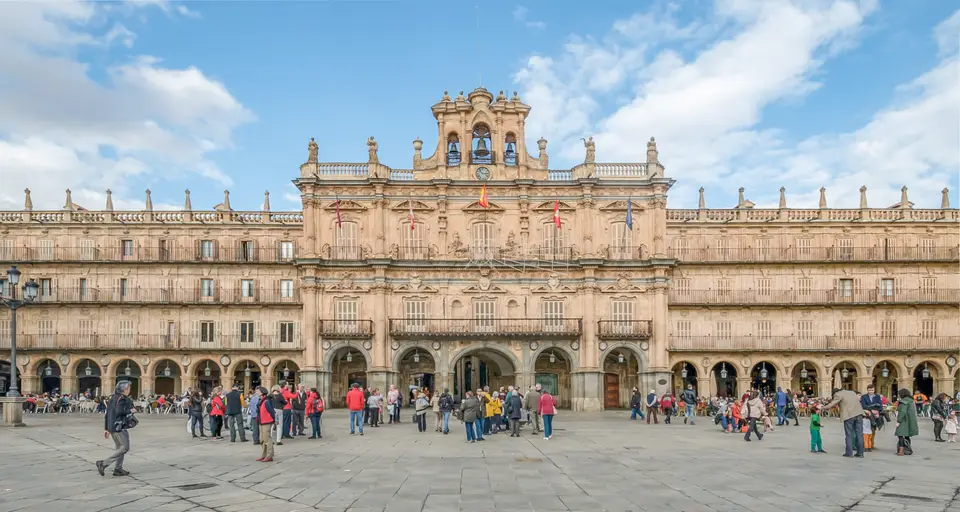
In Spain, the centre of Barrio Viejo lies the baroque Plaza Mayor, built between 1729 and 1755 to designs by Alberto and Nicolás Churriguera. Although French troops under Marshal Soult occupied the city in 1809 and demolished several university colleges in the Caídos quarter before the Anglo-Portuguese victory under Wellington at the Battle of Arapiles in 1812, the historic core recovered and later shared the 2002 European Capital of Culture title with Bruges.
Salamanca Route Planning and Practical Logistics
Walking north from the Roman Bridge and the Huerto de Calixto y Melibea garden (alongside the 1905 iron-and-glass Art Nouveau palace of Casa Lis), visitors pass the twin cathedrals, climb Rúa Mayor past La Clerecía and the Casa de las Conchas, and emerge into the Plaza del Corrillo and Plaza Mayor. You can trace this south-to-north spine on the Atlas.
Trains from Vialia-Estación de Salamanca and La Alamedilla link the city with Madrid, Valladolid, and Ávila, supplemented by the A50, A62, and A66 motorways. Salamanca has a cold steppe climate (BSk) with frosty winters and dry, warm summers; visitors arriving in spring can witness the 24 Holy Week processions involving 18 brotherhoods, 10,000 cofrades, and 50 sculpted pasos, or sample local hornazo meat pie and chanfaina rice.
