


























Quick Field Data
- UNESCO Inscription: 1979 · Criteria (i), (iii), (vi).
- Scale & Footprint: Ten-component serial site covering 374.48 hectares across Aswan Governorate from the First Cataract to Lake Nasser.
- Access & Ticketing: Individual entry tickets govern the Abu Simbel temple complex alongside the boat-accessed island sanctuary of Philae, Kalabsha, and the Aswan quarry and island sites.
- Arrival Logistics: Anchored by the city of Aswan in southern Egypt, with Abu Simbel located 230 kilometres southwest (300 kilometres by road) or reached via Abu Simbel Airport 2 kilometres from the village.
Cataract Geography, Pharaonic Frontier Strategy, and the Ten Serial Zones
Stretching across the Governorate of Aswan from the granite rapids of the First Cataract of the Nile south to the Second Cataract near the border with Sudan, this ten-component UNESCO serial site covers 374.48 hectares of southern Egypt. In antiquity, Aswan sat immediately north of the First Cataract as the strategic southern frontier town of Egypt and the staging base for military campaigns alongside gold-mining expeditions and trade caravans moving upstream into Lower and Upper Nubia. Across the Middle Kingdom and New Kingdom as well as the Ptolemaic and Roman eras, rulers quarried pink granite at Aswan, fortified river islands, and carved colossal state sanctuaries into the Nubian sandstone cliffs to project imperial sovereignty and assimilate local cults into Egyptian state religion.
The ten inscribed component zones divide geographically into two distinct groups of five. The southern group comprises five temple complexes rescued from the rising waters of Lake Nasser behind the Aswan High Dam during the UNESCO International Campaign conducted between 1960 and 1980: the twin rock-cut temples of Abu Simbel alongside the New Kingdom temple of Amada, the ram-sphinx avenue and rock sanctuary of Wadi Sebua, the Roman temple of Kalabsha just south of the High Dam, and the Ptolemaic Sanctuary of Isis at Philae (relocated to the neighbouring Island of Agilkia). The northern group of five components clusters around Aswan itself: the Old and Middle Kingdom Tombs across the river alongside the ruins of the border town of Elephantine, the ancient stone quarries with their unfinished obelisk, the Coptic Monastery of St. Simeon on the West Bank, and the historic Islamic Cemetery.
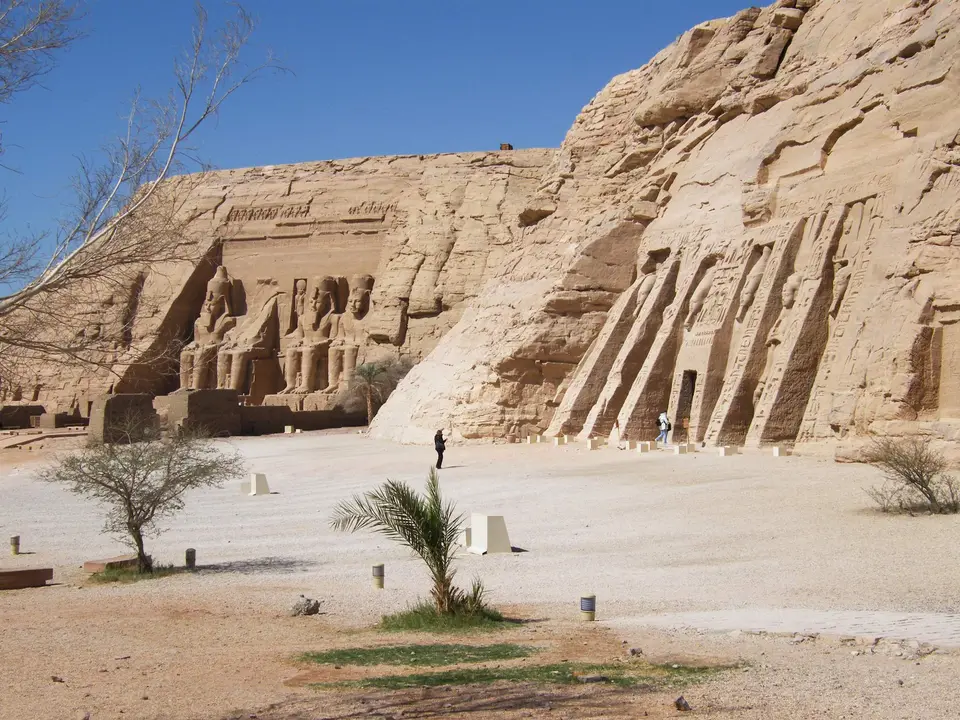
The centerpiece of the southern group stands at Abu Simbel above the western shoreline of Lake Nasser, roughly 230 kilometres southwest of Aswan in a direct line or 300 kilometres by desert highway. Carved directly out of the steep sandstone mountainside over a 20-year period between approximately 1264 BC and 1244 BC (completed around the 24th year of his reign), Pharaoh Ramesses II, of the 19th Dynasty created two rock-cut sanctuaries: the Great Temple dedicated to Amun and Ra-Horakhty together with Ptah and the deified Ramesses himself, and the Small Temple 100 metres to the northeast dedicated to the goddess Hathor and his chief royal consort Queen Nefertari. Ancient Egyptian architects oriented the 63.1-metre subterranean axis of the Great Temple so that twice every year, on 22 October and 22 February, the horizontal rays of the rising sun pierce the outer doorway and hypostyle halls to illuminate the seated statues of Ramesses II, alongside Amun-Ra and Ra-Horakhty in the innermost sanctuary while leaving the underworld god Ptah in perpetual shadow.
Colossi of Ramesses II, Nineteenth-Century Rediscovery, and the 1968 Salvage
The pylon-shaped façade of the Great Temple at Abu Simbel measures 33 metres high and 38 metres wide, dominated by four seated colossal statues of Ramesses II, each rising 20 metres high on his throne wearing the pschent double crown beneath a cornice frieze of twenty-two worshipping baboons. While the head and torso of the second colossus from the south collapsed during an ancient earthquake and still rest at the statue's feet where they fell, smaller sculpted figures stand beside the pharaoh's calves reaching no higher than his knees: Queen Nefertari Meritmut and queen mother Mut-Tuy alongside princes Amun-her-khepeshef and Ramesses B as well as six princesses (Bintanath, Baketmut, Nefertari, Meritamen, Nebettawy, and Isetnofret). Inside the doorway surmounted by a cryptogram niche of Ra-Horakhty holding the user hieroglyph and feather of Maat (spelling User-Maat-Re), the 18-by-16.7-metre hypostyle hall (pronaos) is supported by eight Osirid pillars of the king and carved with sweeping wall reliefs of the Battle of Kadesh along the Orontes river alongside campaigns in Libya and Nubia, leading inward to a four-pillared hall and transverse vestibule before the rock-cut sanctuary. At the Small Temple of Hathor and Nefertari, six standing 10-metre statues in rock recesses portray the queen at equal scale to the king in front of a hall carried by six Hathoric pillars showing Nefertari playing the sacred sistrum.
Buried up to the knees of the colossi by drifting desert sand by the sixth century BC, when Greek and Carian mercenaries under Potasimto and Amasis in the army of King Psamtik II, scratched a famous Greek graffito into the left leg of the southern colossus during a campaign past Elephantine toward Kerkis, the temples vanished from European awareness until Swiss explorer Johann Ludwig Burckhardt spotted the Small Temple and emerging heads of the Great Temple in March 1813. After Giovanni Belzoni, assisted by Henry Salt and Henry William Beechey alongside Charles Leonard Irby together with James Mangles and Giovanni Finati, dug through the sand drift for 22 days to enter the furnace-hot interior on 1 August 1817, William John Bankes returned in 1819 with Alessandro Ricci alongside Linant de Bellefonds and Jean-Nicolas Huyot, whose drawings enabled Jean-François Champollion on 14 September 1822 to decipher the cartouches of Ramesses and Thutmose before leading his 1828 Franco-Tuscan expedition with Ippolito Rosellini. Later visitors included painter David Roberts in 1838 alongside photographers Maxime Du Camp in 1850 and Francis Frith, writer Amelia Edwards (whose painter Andrew McCallum uncovered the Chapel of Thoth on 16 February 1874), British Royal Engineers under Lieutenant James Henry L'Estrange Johnstone who cleared 850 long tons of overhanging rock in 1893, and Alessandro Barsanti, who uncovered the Chapel of Re-Harakhty between 1909 and 1910.
When construction of the Aswan High Dam threatened to submerge Abu Simbel beneath 60 metres of water and dissolve its porous sandstone, UNESCO launched an international salvage campaign in 1959 championed by Egyptian Minister of Culture Tharwat Okasha alongside Christiane Desroches Noblecourt and René Maheu as well as Prince Sadruddin Aga Khan and Kazimierz Michałowski. Adopting the 1963 proposal of Swedish engineering firm Vattenbyggnadsbyrån (VBB) to saw the monuments into blocks, the Joint Venture Abu Simbel consortium led by Hochtief with Impregilo and Atlas alongside Grands Travaux de Marseille, Skanska, and Sentab erected a 370-metre-long, 27-metre-high cofferdam while 34,000 short tons of sand cushioned the facades and 300,000 tons of overlying rock were excavated with pneumatic hammers. Carrara stonecutters (marmisti) injected the stone with epoxy resin and used 6.4-millimetre handsaws to cut the Great Temple into 807 blocks and the Small Temple into 235 blocks (1,036 blocks in total, weighing 7 to 30 tons each), lifting the first block on 21 May 1965 and reassembling the monuments between January 1966 and September 1968 some 208 metres further inland and 65 metres higher inside reinforced concrete domes (a 55-metre span and 19-metre height over the Great Temple) buried under an artificial hill at a cost of 41.7 million.
Traversing the Aswan Islands and the Relocated Lake Nasser Temples
Visiting the ten components of the Nubian Monuments today requires pairing a base on the riverfront of Aswan with an excursion across the desert or by air to the shores of Lake Nasser. At Abu Simbel, visitors walk around the reconstructed mountain curve to confront the 20-metre colossi overlooking the blue expanse of the reservoir, and can also step inside the hidden reinforced concrete dome behind the sanctuary to see the twentieth-century engineering shell that holds the mountain weight off the ancient ceilings. The desert air shimmers above the water. Back in Aswan, river boats shuttle travellers between the granite boulders of the First Cataract to reach the relocated Ptolemaic colonnades of Philae on the Island of Agilkia and the temple terraces of Elephantine.
- Entry and Route at the Twin Temples of Abu Simbel: Arrive at Abu Simbel by early morning highway convoy 300 kilometres southwest from Aswan or via the 2,000-metre runway at Abu Simbel Airport 2 kilometres from the site, and walk the curved lakeside path to the forecourt of the Great Temple of Ramesses II. Inspect the Greek mercenary graffito on the southern colossus alongside the earthquake-fallen torso, the Chapel of Thoth, and the Chapel of Re-Harakhty on the terrace before walking inside through the eight Osirid pillars and Battle of Kadesh reliefs to the four-statue sanctuary, then continue 100 metres northeast into the Small Temple of Hathor and Nefertari.
- Tickets, Interiors, and Viewpoints Across Philae and Aswan: In the Aswan sector, board a motorboat south of the Old Dam to the Island of Agilkia, where the Sanctuary of Isis at Philae was re-erected block by block during the UNESCO campaign up to 1980, and take a separate boat to the southern tip of Elephantine and the Temple of Kalabsha near the High Dam. On the East Bank of Aswan, examine the ancient granite stone quarries where the unfinished obelisk remains attached to the bedrock, and cross to the West Bank to climb to the Old and Middle Kingdom Tombs and the mud-brick desert fortress of the Monastery of St. Simeon.
- Timing and Onward Connections: Schedule Abu Simbel and the West Bank desert climb to the Monastery of St. Simeon for dawn to beat the intense BWh hot-desert heat, and plan months ahead if visiting on 22 February or 22 October when crowds gather at sunrise for the solar alignment 63.1 metres inside the Great Temple. Aswan connects northward by rail and river to Thebes and Cairo, and you can trace all Egyptian sites in our UNESCO World Heritage Atlas.
