


























Quick Field Data
- UNESCO Inscription: 1980 · Criteria (iii), (vi)
- Scale & Footprint: Serial property across two sites in Paphos District, western Cyprus: Kato Paphos (ancient Nea Paphos and the Tombs of the Kings necropolis) and Kouklia village (Palaepaphos and the Sanctuary of Aphrodite)
- Access & Ticketing: Managed by the Cyprus Department of Antiquities; separate modest entry tickets apply at the Kato Paphos Archaeological Park, the Tombs of the Kings as well as the Kouklia sanctuary and museum
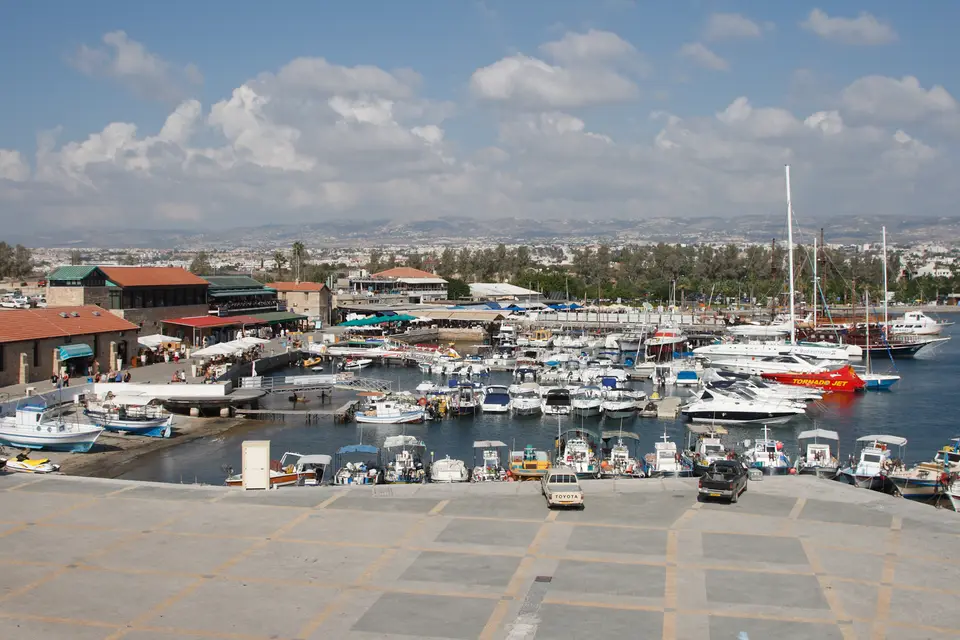
- Arrival Logistics: Kato Paphos sits directly on the harbour promenade of modern Paphos city, with the Tombs of the Kings 2 km north and Kouklia (Palaepaphos) located 16 km southeast along the coastal highway
Two Sacred Cities of Aphrodite and the Hellenistic Grid of Nea Paphos
Stretching along the southwestern coast of Cyprus in the District of Paphos, the UNESCO World Heritage property of Paphos unites three archaeological components across two distinct locations that trace the island's sacred and political history from the Neolithic period through the Byzantine era. Myth and Mediterranean trade meet in mosaic stone here. Inscribed in 1980 under Criteria (iii) and (vi) and managed by the Cyprus Department of Antiquities, the serial listing pairs the inland coastal village of Kouklia, home to Palaepaphos (Old Paphos) and the Sanctuary of Aphrodite, with the coastal harbour town of Kato Paphos (Kato Pafos), which encompasses the Hellenistic-Roman capital of Nea Paphos (New Paphos, catalogued as Aphrodite's Sacred City) alongside the northern rock-cut necropolis called the Tombs of the Kings (Tafoi ton Vasileon in Greek).
Inhabited since the Neolithic era, Palaepaphos at modern Kouklia evolved into the religious and administrative centre of the ancient Cypriot city-kingdom of Paphos and the Mediterranean focal point of the cult of pre-Hellenic fertility deities and the Greek goddess Aphrodite (Roman Venus), whose legendary birthplace lay on the nearby shore. In the 12th century BC, the Myceneans erected a monumental open-air sanctuary and temple to Aphrodite at Palaepaphos, establishing a pilgrimage cult that Homeric poetry made famous across the classical world.
Toward the end of the 4th century BC, Nicocles (Nikokles, who died in 306 BC), the last ruler of the city-kingdom of Paphos, founded Nea Paphos on a coastal promontory to the northwest to provide a sheltered deep-water harbour replacing the silted port of Palaepaphos. After Alexander the Great died in 323 BC and the wars of his successors concluded in 272 BC, Ptolemy the First (Ptolemy Soter, reigned 305 to 282 BC) absorbed Cyprus into the Ptolemaic Kingdom and resettled residents from the razed city of Marion into Nea Paphos. Thriving as a Ptolemaic naval and shipbuilding hub that traded amphorae, coinage, and luxury goods across Egypt, the Levant, the Aegean as well as Asia Minor, Nea Paphos replaced Salamis as the administrative capital of Cyprus in the 2nd century BC and retained that capital status after Rome annexed Cyprus in 58 BC and organised the Roman province in 22 BC, until devastating 4th-century AD earthquakes prompted the return of the capital to Salamis.
Laid out on a regular Hellenistic rectangular street grid modelled in 2020 3D spatial surveys of the Maloutena district, the city centred on a vast 2nd-century BC Agora below the acropolis spanning 150 by 160 metres (2.5 hectares), excavated between 1975 and 1978 by Kyriakos Nicolaou and since 2011 by Jagiellonian University, bordered by an Asclepeion healing shrine, a 2nd-century AD semicircular limestone Odeon with 12 rows of seating for 1,200 spectators alongside a late-4th-century BC theatre on the southern slope of Fabrika Hill excavated by the University of Sydney since 1995.
Mythological Mosaic Pavements and the Peristyle Tombs of the Kings
What makes Kato Paphos world-famous is the ensemble of Roman aristocratic villas uncovered since June 1965 by the Polish Centre of Mediterranean Archaeology at the University of Warsaw (founded by Kazimierz Michałowski alongside Warsaw University of Technology) and the Cyprus Department of Antiquities (expanded by Sophocles Hadjisavvas in 1977). Across four principal residences, the House of Dionysos, the Villa of Theseus, the House of Aion as well as the House of Orpheus, alongside the adjacent Hellenistic House uncovered in 1986 with its mosaic of Armed Aphrodite and the Horae, master mosaicists between the 2nd and 5th centuries AD laid polychrome tesserae pavements that form an illuminated album of Greek mythology.
In the 3rd-century AD House of Dionysos, which spans nearly 2,000 square metres (22,000 sq ft) around a central impluvium atrium, floor mosaics cover a quarter of the residence: hunting scenes line three porticoes, the western gallery depicts Pyramos and Thisbe, Dionysos and Ikarios with the First Wine Drinkers alongside Apollo pursuing Daphne and Poseidon with Amymone, while the tablinum and side rooms portray the Dioskouroi flanking the Triumph of Dionysos, Hippolytos and Phaedra, Ganymede and the Eagle, Narcissus, the Horae, and a colourful peacock. Just to the southwest, the vast Villa of Theseus, measuring 120 metres (390 ft) by 80 metres (260 ft) around a 56-by-56-metre peristyle court and built from the early 3rd to the 5th centuries AD as the Roman governor's palace, preserves the circular labyrinth mosaic of Theseus battling the Minotaur and a late-antique apse panel of the first bath of Achilles.
Immediately east of the Villa of Theseus stands the 4th-century AD House of Aion, excavated in 1982 and 1983, whose triclinium floor preserves one of the finest figurative mosaics of Late Antiquity: framed around Aion (god of eternal time), five mythological panels portray Leda with the Swan and the Birth of Dionysus alongside the beauty contest pitting Cassiopeia against the Nereids, the Triumphant Procession of Dionysus, and the musical contest between Apollo and Marsyas. Nearby, the 3rd-century AD House of Orpheus contains panels of Orpheus and his Lyre surrounded by wild beasts, Hercules and the Lion of Nemea, and an Amazon with her horse, while near the harbour stand the columns of the early 5th-century AD Early Christian Basilica of Panagia Limeniotissa.
Two kilometres north of the harbour walls lies the northern component of Kato Paphos: the monumental Hellenistic and Roman necropolis of Tafoi ton Vasileon (Tombs of the Kings). Named not for royal burials but for the sheer architectural grandeur of its underground rock-cut tombs carved between the 3rd century BC and 3rd century AD for high Ptolemaic officials and aristocrats, these subterranean complexes replicate the houses of the living, with stepped dromoi descending into open sunken peristyle atria ringed by monolithic rock-hewn Doric columns, triglyph-and-metope friezes, and burial loculi.
Walking Kato Paphos, the Tombs of the Kings, and Kouklia
Exploring the full UNESCO property of Paphos takes one full day, starting at the harbourside mosaic pavilions of Kato Paphos in the morning, continuing north along the coastal path to the Tombs of the Kings, and driving 16 kilometres southeast in the afternoon to the Mycenean sanctuary of Aphrodite at Kouklia.
- Kato Paphos Archaeological Park and the four mosaic villas: Enter the harbourside gate of the Kato Paphos Archaeological Park to begin at the sheltered viewing walkways of the House of Dionysos, inspecting its 2,000-square-metre atrium and mythological panels. Walk south to the sprawling 120-by-80-metre Villa of Theseus and the neighbouring House of Aion to compare 3rd-, 4th-, and 5th-century AD mosaic artistry, then cross the 150-by-160-metre Hellenistic Agora to climb the 12 limestone tiers of the 2nd-century AD Odeon and view the early 5th-century Basilica of Panagia Limeniotissa and the Fabrika Hill theatre.
- Subterranean Doric peristyles at the Tombs of the Kings: Follow the coastal promenade 2 km north of Kato Paphos harbour to the open-air sandstone plateau of Tafoi ton Vasileon (Tombs of the Kings). Descend the rock-cut staircases into the sunken peristyle courtyards to see how Hellenistic masons chiselled Doric columns and entablatures directly out of the living coastal bedrock.
- Sanctuary of Aphrodite at Kouklia (Palaepaphos): Drive 16 km southeast along the coast road to the hillside village of Kouklia to walk through the 12th-century BC Mycenean megalithic limestone blocks and Roman reconstruction courts of the Sanctuary of Aphrodite, and visit the adjacent sanctuary museum housing the conical black cult stone (baetyl) of the goddess alongside Cypriot inscriptions and votive offerings. Pair your Cyprus archaeological route with our UNESCO World Heritage Atlas.
