


























Quick Field Data
- UNESCO Inscription: 1985 (extended 2001) · Criteria (ii), (iii), (iv).
- Scale & Footprint: 3.693 ha across 10 serial Byzantine monuments in the Troodos Mountains of central Cyprus.
- Access & Ticketing: Administered in cooperation with local church custodians across the Troodos villages; check the official site for access arrangements.
- Arrival Logistics: Distributed across the mountain villages of Kakopetria, Kalopanagiotis, Nikitari, Lagoudera, Moutoullas, Pedoulas, Pelendri, Galata, Platanistasa, and Palaichori Oreinis.
Steep Wooden Roofs Over Mountain Sanctuaries
Since 1985, the UNESCO World Heritage Atlas in 1985 under Criteria (ii), (iii), and (iv), initially comprising nine churches and extended in 2001 with the addition of a tenth monument in Palaichori Oreinis, the Painted Churches in the Troodos Region protect one of the largest concentrations of Byzantine churches and monasteries in the former Byzantine Empire. Frescoes cover their interior vaults. After the Byzantine Empire annexed Cyprus in 965 AD during the Arab-Byzantine wars, mountain communities across the Troodos range constructed and decorated numerous churches and monasteries over a 500-year period lasting until the sixteenth century. In 2002, an eleventh monument in Kourdali (Spilia), the Church of Panagia Chrysokourdaliotissa, was also submitted on the UNESCO Tentative List as a potential further extension.
Covering a combined area of 3.693 hectares in the Troodos Mountains of central Cyprus, the ten World Heritage monuments display indigenous architectural elements specific to Cyprus and shaped by the island's mountain geography alongside its history and winter climate. Foremost among these features are steep-pitched wooden roofs clad in flat hooked tiles, which in several churches were built as a protective second roof directly over earlier Byzantine masonry domes and vaulted forms. Confined to the Troodos range and of local origin, these timber-tiled roofs give the exteriors a modest rural silhouette that stands in sharp contrast to the refined decoration inside, where walls and vaults preserve metropolitan Byzantine and post-Byzantine painting of the highest artistic quality.
Because the high valleys of the Troodos Mountains experience heavy winter rainfall and snow that would otherwise penetrate exposed masonry domes, the addition of steep wooden pitched roofs with flat hooked tiles proved essential to the long-term survival of the interior murals. Under these protective timber canopies, pigments applied to lime plaster more than eight or nine centuries ago have retained their clarity, offering visitors an unbroken visual survey of Eastern Mediterranean Christian iconography.
Ranging in scale from small village chapels to major monastic complexes such as the Monastery of St. John Lampadistis, the ten churches also contain a wealth of dated dedicatory inscriptions. Because dated medieval fresco inscriptions are an uncommon feature across the Eastern Mediterranean during the Middle Ages, their survival in the Troodos valleys makes this serial monument group uniquely valuable for recording the exact chronology and stylistic evolution of Byzantine wall painting over five centuries.
Eleventh- and Twelfth-Century Comnenian Masterworks
The earliest surviving mural cycles within the Troodos World Heritage Complex date from the eleventh and twelfth centuries, when Cyprus flourished as an island province of the Byzantine Empire. Important examples of eleventh-century iconography survive in two monuments: the eleventh-century monastery church of Agios Nikolaos tis Stegis (St. Nicholas of the Roof) in Kakopetria and the twelfth-century church of Panagia Phorbiotissa (also spelled Phorviotissa, and known as Asinou) in Nikitari.
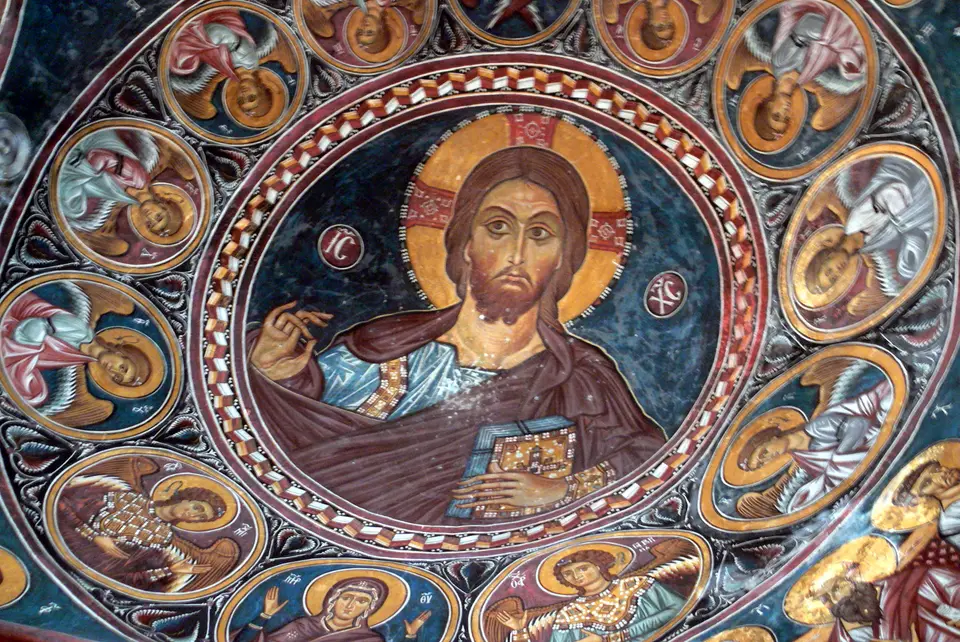
Situated in Kakopetria, the Church of Agios Nikolaos tis Stegis is an eleventh-century monastery church and the oldest surviving Byzantine katholikon in Cyprus. Originally built with a masonry dome, it later received the steep timber-and-tile second roof that gave "St. Nicholas of the Roof" its name, protecting both its eleventh-century frescoes and its subsequent twelfth-century Comnenian wall paintings. In Nikitari, the twelfth-century Church of Panagia Phorbiotissa at Asinou preserves eleventh- and twelfth-century mural decoration (including the celebrated fresco of Christ Pantocrator in the narthex) alongside later fourteenth-century painting phases.
Together with St. Nicholas of the Roof in Kakopetria, the twelfth-century church of Panagia tou Arakou in Lagoudera (Lagoudhera) preserves exceptional wall paintings from the twelfth-century Comnenian era. The unified Comnenian fresco cycle inside Panagia tou Arakou in Lagoudera is recognized for its extraordinary artistic quality and is attributed directly to masters from Constantinople, demonstrating how metropolitan court painting reached the remote mountain villages of Cyprus.
Stepping inside these three eleventh- and twelfth-century churches reveals the transition from the hieratic, monumental figures of the eleventh century to the refined linear elegance and heightened emotional expression of the late twelfth-century Comnenian style. Every arch alongside each pendentive and apse conch is integrated into a theological programme leading the viewer's eye toward the dome and sanctuary.
Thirteenth-Century Latin Rule and Italo-Byzantine Fusion
During the thirteenth century, which corresponds to the early period of Western Latin rule in Cyprus, local wall painting continued the Orthodox Byzantine tradition while incorporating new external artistic influences. This thirteenth-century phase is represented in the wall paintings of the thirteenth-century Monastery of St. John Lampadistis (Agios Ioannis Lampadistis) at Kalopanagiotis and in the thirteenth-century chapel of Panagia (The Virgin) at Moutoullas (Moutoulla), a mountain sanctuary that also represents the earliest surviving example of the Troodos region's steep-pitched wooden roofs.
In the fourteenth century, wall paintings at Panagia Phorbiotissa in Nikitari alongside the Pelendri church of Timios Stavros (dedicated to the Holy Cross), the Platanistasa church of Stavros Agiasmati (also dedicated to the Holy Cross), and the Kalopanagiotis monastery of St. John Lampadistis display both local island traditions and Western artistic influences alongside the revived Paleologan art of Constantinople. Continuing the mountain tradition into the late fifteenth century is the church of Archangelos Michael in Pedoulas, whose timber roof shelters complete late fifteenth-century mural cycles.
When Venetian rule began in Cyprus in 1489, local workshops developed the sophisticated Italo-Byzantine school, successfully fusing Italian Renaissance artistic techniques with Byzantine iconographic tradition. The most accomplished sixteenth-century examples of this Italo-Byzantine synthesis are found in the early sixteenth-century church of Panagia Podhithou (Podithou) in Galata, inside the north chapel of the Monastery of St. John Lampadistis at Kalopanagiotis, and inside the sixteenth-century church of Agia Sotira tou Soteros (dedicated to the Transfiguration of the Savior) in Palaichori Oreinis, which joined the World Heritage List in the 2001 extension.
Because the ten inscribed churches are spread across separate mountain valleys of the Troodos range (from Kakopetria and Galata in the north to Kalopanagiotis and Pedoulas in the western valleys, Nikitari and Lagoudera to the north-east, and Pelendri alongside Platanistasa and Palaichori Oreinis on the southern and eastern slopes), visiting the serial monument group forms a scenic mountain circuit through traditional stone villages where local custodians still safeguard keys to chapels painted between five and nine centuries ago.
Together, the ten churches illustrate how a single mountain range in the Eastern Mediterranean preserved every major phase of Byzantine and post-Byzantine mural art across half a millennium beneath indigenous wooden roofs. From the eleventh-century monastic katholikon of St. Nicholas of the Roof in Kakopetria and the twelfth-century Constantinopolitan frescoes of Lagoudera to the sixteenth-century Italo-Byzantine synthesis at Galata, Kalopanagiotis, and Palaichori Oreinis, the Troodos monuments trace the unbroken artistic heritage of medieval Cyprus.
Few ecclesiastical ensembles anywhere in the former Byzantine world offer such a complete, dated sequence of wall paintings preserved inside their original village and monastic settings. By combining indigenous timber-roofed architecture with five centuries of dated dedicatory inscriptions and mural cycles, the ten churches of Kakopetria alongside Nikitari, Lagoudera, Kalopanagiotis, Moutoullas, Pelendri, Platanistasa, Pedoulas, Galata, and Palaichori Oreinis preserve an irreplaceable record of Mediterranean sacred art between the eleventh and sixteenth centuries. Whether examining the eleventh-century monastery church in Kakopetria or the sixteenth-century murals in Palaichori Oreinis and Galata, visitors witness how mountain villagers and monastic workshops across Cyprus protected five hundred years of Christian painting beneath steep wooden roofs clad in flat hooked tiles.
- Comnenian Era Murals: Visit Agios Nikolaos tis Stegis in Kakopetria, Panagia Phorbiotissa (Asinou) in Nikitari, and Panagia tou Arakou in Lagoudera to see eleventh-century and twelfth-century Constantinopolitan wall paintings.
- Medieval Mountain Chapels: Explore Panagia in Moutoullas, Timios Stavros in Pelendri, Stavros Agiasmati in Platanistasa, and Archangelos Michael in Pedoulas under steep hooked-tile wooden roofs.
- Italo-Byzantine School: Examine the sixteenth-century fusion of Italian Renaissance and Byzantine painting at St. John Lampadistis in Kalopanagiotis, Panagia Podhithou in Galata, and Agia Sotira tou Soteros in Palaichori Oreinis.
